Read Time: 8 min read
Startup compensation benchmarks are data-backed cheat sheets showing the going rate for salary, equity, and bonuses for different startup roles. Think of them as a critical map for both the company and the person they’re trying to hire.
These reports lay out what’s fair and competitive based on a startup’s funding stage, its location, and the employee's level of experience. In the high-stakes, high-reward world of startups, they’re indispensable for crafting offers that make sense.
Trying to figure out compensation without benchmarks is like driving in a new city without GPS. You might get there eventually, but you’re almost guaranteed to make some expensive wrong turns. For a startup, where every single dollar and every single hire is crucial, benchmarks provide the direction needed to make smart, strategic moves.
For instance, instead of guessing what a founding engineer should be paid, a founder can use a benchmark report to see that a typical offer at a seed-stage company in New York is a ~$130k salary plus 0.8% equity. This data helps answer tough questions: Are we offering enough to pull a senior engineer away from a big tech company? Is the equity grant for our first product manager chunky enough to justify the risk they’re taking on?
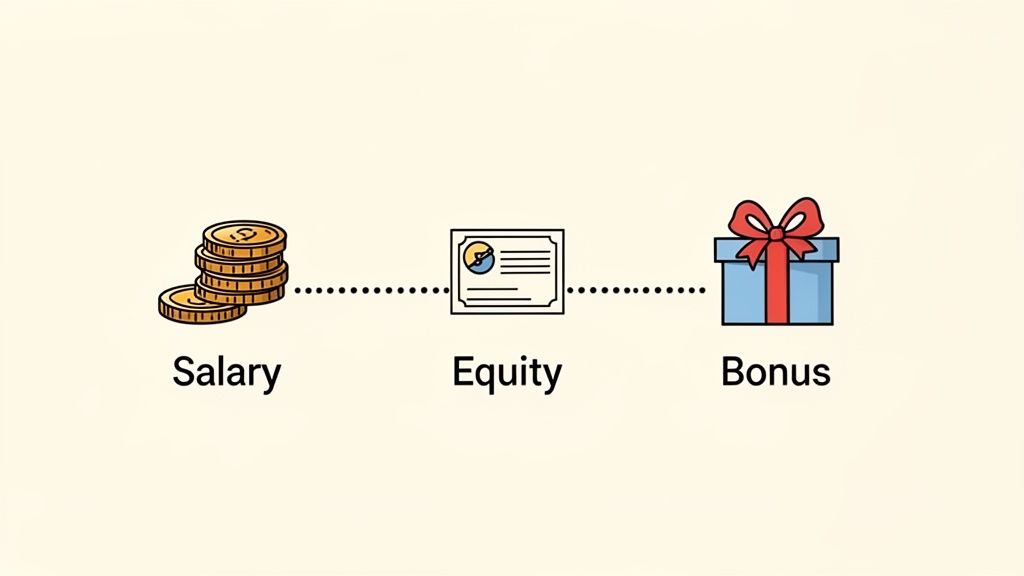
Unlike big, established corporations that tend to focus heavily on base salary, startup compensation is a dynamic mix of three key ingredients. Getting a handle on each one is the first step to reading any benchmark report correctly.
These pieces aren't weighed equally. A brand-new Seed or Series A company will probably offer a modest salary but a much more significant equity grant, selling the dream of a massive future payout. On the other hand, a later-stage company (think Series C and beyond) will usually offer a higher base salary and a smaller—but potentially more valuable—piece of equity.
For both founders and job seekers, benchmarks demystify this trade-off. They provide a clear framework for evaluating an offer's total value, not just its immediate cash component. This data-driven approach removes emotion and ambiguity from the conversation, fostering transparency and trust from day one.
As you plan your career move or build out your team, really digging into the numbers is key. For a comprehensive look at the current market rates, check out our 2025 tech salary guide for more data points. This foundation will help you navigate the unique financial landscape of the startup ecosystem with confidence.
A startup’s journey is often told through its funding rounds. Each stage—from a scrappy seed round to a massive Series C—isn't just a financial milestone; it’s a signal of the company's maturity, its immediate goals, and how much risk is left in the business.
Think of it like this: a startup's funding stage is its age. A pre-seed company is a toddler, full of raw potential but running on fumes and laser-focused on survival. A Series C company is more like a young adult—well-funded, confident, and ready to compete for market dominance. This shift in maturity directly shapes their compensation philosophy and the offer you receive.
At the very beginning, a startup is often just a powerful idea and a handful of believers. Cash is king, and every single dollar is stretched thin, funneled directly into building the product and landing those first crucial customers.
This cash-strapped reality has a huge impact on compensation:
Joining at this stage is a leap of faith. You're trading immediate cash security for the potential of a life-changing payout if the company takes off. The offer is less about the paycheck and more about your belief in the founders and their vision.
Landing a Series A round is a major signal that the startup has figured something out. They have a product that people want, a growing user base, and a business model that investors believe in. With a fresh injection of cash, the focus shifts from just surviving to actively scaling.
This newfound stability changes the compensation game. The company now has the runway to attract talent more competitively.
The extreme risk of the seed stage has dialed down. As a result, the compensation mix starts to rebalance, moving toward a more traditional structure while still offering meaningful equity upside.
Salaries become much more competitive, often getting closer to the market median. The leadership team knows they need to bring in experienced pros who might have mortgages and families and can't afford a massive pay cut. Equity is still a big carrot, but the grants are smaller—think 0.1% to 0.5% for a senior technical role. The logic is that the equity is now "de-risked"; with a higher probability of success, a smaller slice is still potentially worth a fortune.
By the time a startup hits Series B or C, it's a legitimate player. It has a strong market presence, real revenue, and is focused on capturing market share, often with an eye toward an IPO or acquisition. At this point, they're not just competing with other startups for talent—they're going head-to-head with Big Tech.
To win those battles, their compensation strategy has to be rock-solid. Base salaries are now highly competitive, often at or even above the market average for top-tier candidates. The "we'll pay you in equity" pitch just doesn't fly anymore.
The data backs this up. Recent analysis shows that late-stage startups (Series C and beyond) pay 31-34% more for senior talent than their early-stage peers. For instance, a senior manager's average salary might leap from £94,500 at the seed stage to £124,000 at a late-stage company. You can dig into more of these numbers in Ravio's 2026 Compensation Report.
Equity is still a key part of the offer, but the percentages are much smaller. The tradeoff is that the company’s valuation is substantially higher, so even a fractional grant can be incredibly valuable. The package is designed to offer both a strong, steady income and the potential for a massive wealth event, making it attractive to a much wider range of candidates.
The following table breaks down typical salary and equity ranges for key roles you'll find in almost any tech startup. We've separated the data by the startup's stage (early vs. growth/late) and by location, comparing major tech hubs like NYC and SF to the rest of the US, which often includes remote roles. Keep in mind these are general ranges—the specifics can always vary.
As you can see, both salary and equity grants are heavily influenced by the company's maturity and the cost of living in major tech hubs. Early-stage startups trade higher equity for lower cash, while later-stage companies can afford to compete with the big players on salary. Now, let's look at the "why" behind these numbers for each role.
Engineers are the ones building the actual product, so it’s no surprise their compensation reflects just how vital they are. From a junior dev pushing their first bit of code to a principal engineer architecting a system for millions of users, their work is the company's lifeblood. As a result, the battle for engineering talent is famously intense, which drives salaries up.
This chart shows how pay scales as a startup grows from an early-stage seed company to a more established late-stage player.
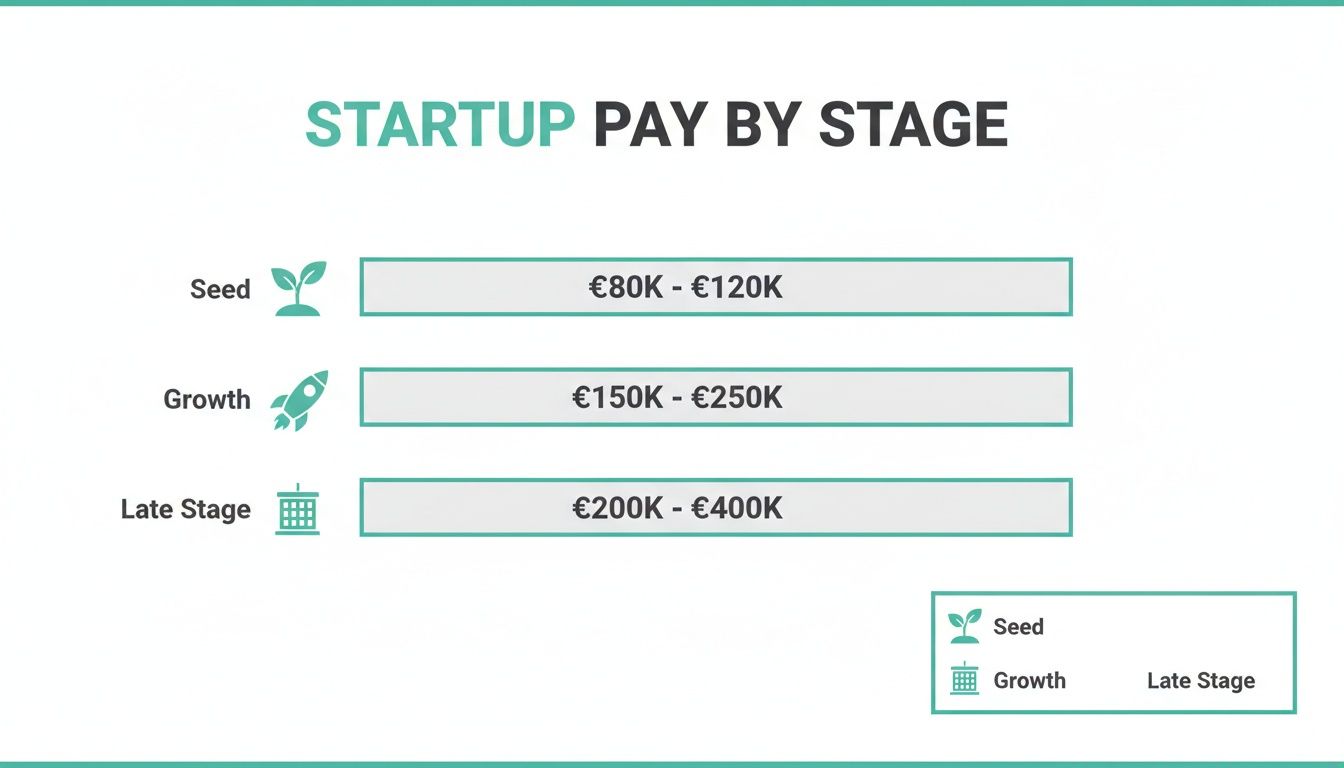
It’s pretty clear: as a company raises more money and proves its business model, it can offer much more cash to bring in top-tier engineers. The risk goes down, and the salary goes up.
For a deeper dive into engineering salaries, you can explore our detailed guide on how much money software engineers make.
Product managers are the mini-CEOs of a feature or product line, sitting at the intersection of engineering, design, and the business. They need a unique mix of technical chops, strategic vision, and a deep understanding of the user. Because they're so hard to find, their pay reflects their impact. A Senior PM in San Francisco, for instance, is getting offers from Google and Meta, so startups have to compete.
A great product manager can be the difference between a product that flops and one that achieves market fit. Startups recognize this and are willing to pay competitively for leaders who can steer the product vision effectively.
In an age where a clunky app is a dead app, designers have become absolutely essential. They’re the ones making sure a product is not just functional, but also intuitive and even delightful to use. Pay can depend on whether they're a generalist or a specialist (like user research vs. visual design), but one thing is certain: a skilled designer is a non-negotiable part of any modern product team.
Broadly speaking, the market values these roles differently. For example, Payscale data shows an average startup salary for a software engineer is around $102,000, with product managers at $112,000 and UX designers at $78,000. These are just averages, but they show the general hierarchy. More recently, Carta's H1 2025 report found a 5.8% increase in pay for new hires over three years, signaling that the market is steadily climbing back up.
For any founder, figuring out compensation can feel like walking a tightrope. On one side, you have a limited budget and the ever-present pressure to preserve runway. On the other, you desperately need to attract and retain A-list talent who can turn your vision into reality. This balancing act is where a clear, data-driven approach becomes your most valuable tool.
It all starts with defining your compensation philosophy. This is your company's official stance on pay. Are you aiming to pay at the 50th percentile of the market—offering a solid, average package? Or are you targeting the 75th percentile, positioning yourself as a top-tier payer to attract the absolute best? There's no single right answer, but you have to pick a direction.
An early-stage, cash-strapped startup might reasonably target the 50th percentile for salary but offer equity grants in the 75th or even 90th percentile to stay competitive. A more established, well-funded startup might go after the 75th percentile for both cash and equity to go head-to-head with big tech.
Once you've settled on a philosophy, you can start building salary bands. Think of these as the guardrails for your compensation decisions. They are structured pay ranges for each role and level in your company, designed to keep things consistent and fair.
Building them out really comes down to three key steps:
For example, if market data says a Mid-Level Designer's 50th percentile salary is $115k, your salary band might be $92k to $138k. This gives you a clear, defensible range to work within when making an offer.
One of the thorniest topics is founder compensation. How much should you actually pay yourself? Pay yourself too much, and you'll burn through cash and signal to investors that you're not all-in. Pay too little, and you're adding unnecessary personal financial stress to an already insane journey.
Data is your best friend here. Investors expect founders to be frugal, but not to the point of distraction. A reasonable salary signals that you’re focused on building the business for the long haul.
VCs often see a founder's salary as a reflection of their commitment and financial prudence. A modest, data-backed salary demonstrates a "company-first" mindset, which is a powerful signal during fundraising.
Recent data paints a clear picture of what's considered normal. According to Kruze Consulting's 2025 analysis of over 450 venture-backed startups, the average seed-stage CEO salary is $147,000. This figure jumps by 38% to $203,000 at Series A and reaches $214,000 by Series B, showing a clear trend of salaries rising with the company's maturity and funding. You can explore more about how these salaries are trending in line with the venture capital outlook on Warp.
Ultimately, setting a fair salary for yourself and your team isn't just an HR task—it's a core part of building a sustainable, high-growth company.

Getting a job offer is a huge win, but your work isn’t done yet. The negotiation is a standard, expected part of the hiring process, and walking in prepared is how you land a package that truly reflects your market value.
Too many people see negotiation as a confrontation. It isn't. A good negotiation is really just a collaborative chat aimed at finding a number that makes everyone happy. The key isn't making demands; it's building a data-backed case for what you're worth. Let's break it down into three simple steps.
Before you even think about naming a number, you have to do your homework. This is where startup compensation benchmarks go from being interesting data to your most important tool. Use the salary and equity ranges in this guide to figure out what’s realistic for your role, your experience level, and the startup’s funding stage.
Don't stop at the general benchmarks, though. Dig into the specific company you're talking to:
This context shows the hiring manager you've done your due diligence and aren’t just pulling numbers out of thin air. For more on timing your negotiation, check out these great salary negotiation tips.
A startup offer is way more than just the base salary. You need to look at everything on the table to see its true value. Equity, especially, needs a close look. A massive grant at a company that's barely off the ground might sound incredible, but it’s a high-risk lottery ticket.
Don’t just look at the number of stock options. Ask for the "fully diluted shares outstanding" and the last 409A valuation to calculate the actual percentage of the company you're being offered and its current paper value.
Look beyond the equity, too. Is there a performance bonus? What do the benefits look like—health insurance, a 401(k) match, a professional development stipend? A slightly lower base salary might be totally worth it if the benefits are amazing or the equity upside feels real. If you want to go deeper on this, our guide on how to negotiate stock options is a must-read.
Okay, you've done the research and assessed the offer. Now it's time to talk. Always, always start by saying how excited you are about the role and the company. Frame your counteroffer as a joint effort to get to a number that works for both sides, not as a demand.
Having a simple script ready can help. You could say something like:
"Thank you so much for the offer! I’m incredibly excited about the opportunity to join the team. Based on my research for senior product roles at Series B companies in this market, and considering my specific experience, my salary expectations are closer to $160,000. I am confident we can find a number that works for both of us."
This approach is professional and data-driven. It's not aggressive. It opens the door to a real conversation and shows them you’re going to be a thoughtful, strategic person to have on the team.
Navigating startup compensation can feel like trying to read a map in a foreign language. But once you have the right data, you start to see the landmarks and can chart a clear course. The trick is to treat benchmarks not as rigid, unbreakable rules, but as the foundation for a fair, well-informed conversation. They give everyone a shared vocabulary to talk about value.
For candidates, this knowledge is your leverage. It turns negotiation from a nervous guessing game into a strategic discussion. Suddenly, you have the power to truly advocate for what you're worth and make smarter career moves. Knowing the market rate for a Series A engineer isn't just a number; it’s the confidence to ask for what you deserve.
Benchmarks are the great equalizer in the hiring process. They replace ambiguity with transparency, ensuring that offers are grounded in market reality, not just perception or budget constraints.
For founders, this is about so much more than just filling seats. Using reliable startup compensation benchmarks is how you build an exceptional team from the ground up, with transparent and competitive offers. It's how you attract the kind of talent that will turn your vision into a real business—without burning through your runway too quickly.
Ultimately, the goal is to apply this understanding. Use these insights as your guide to find and connect with the innovative companies and talented people building the future, making sure every offer made, and every offer accepted, is a fair one.
Even after you get the hang of the basics, startup compensation has a way of throwing curveballs. Here are some of the most common questions we see from founders and candidates trying to put these benchmarks into practice.
There's no single magic formula here. A good rule of thumb is to heavily discount the "on-paper" value of equity based on the company's stage and the risk that comes with it. You're essentially adjusting for the real-world odds of a big payout.
For a very early-stage company (think Seed or Series A), that equity might only be worth 20-30% of its stated value because the risk of failure is so high. Jump ahead to a later-stage company (Series C or beyond), and that discount shrinks. You might value it at 50-70% of its paper value. The most important thing is to make sure your base salary comfortably covers your life; the equity is the high-risk, high-reward lottery ticket.
Yes, but that gap is closing faster than ever. A few years ago, you could expect to be paid 10-20% less for a remote role if you lived outside a major tech hub. As remote work has become the norm, however, many of the most competitive startups have thrown that old playbook out the window to get the best people, period.
Today, you'll run into a few different philosophies:
When you're looking at a remote offer, it's smart to check the benchmarks for both the national remote average and the company's HQ. It’ll give you a much clearer picture of how they think about pay.
The industry standard is almost universally a four-year vesting schedule with a one-year cliff. It’s a simple structure designed to make sure everyone is buckled in for the long haul.
Here's the breakdown:
Always, always ask for the specific vesting schedule and cliff period in writing before you sign anything. It's a massive part of what your compensation is truly worth.
Startup compensation benchmarks are data-backed reference points showing the typical salary, equity grants, and bonuses for different roles. They are filtered by critical factors like a startup's funding stage (e.g., Seed vs. Series B), geographic location, and the employee's level of experience. Think of them as a map for crafting fair, competitive offers that make sense for both the company and the candidate.
Startup pay is a dynamic mix of three pillars: base salary (the guaranteed cash), equity (ownership in the company, usually as stock options), and bonuses/variable pay (performance-based cash). Early-stage companies often offer lower salaries with higher equity grants, while later-stage startups provide higher salaries and smaller, but potentially more valuable, equity stakes.
A startup's funding stage is a direct signal of its maturity and risk profile. Pre-Seed/Seed companies offer lower salaries but the largest equity grants (e.g., 0.5%-1.5% for an early engineer) to compensate for high risk. Series A startups balance the equation with more competitive salaries and smaller equity (0.1%-0.5%). By Series B and beyond, base salaries become highly competitive (often 31-34% higher than early-stage) to compete with big tech, while equity percentages are smaller but built on a much higher valuation.
Even with remote work, most startups use tiered compensation models tied to geography. Major hubs like San Francisco and New York (Tier 1) command the highest pay. Other tech hubs like Austin or Seattle (Tier 2) see salaries adjusted down by 10-15%, while emerging cities like Denver or Atlanta fall into lower tiers (15-25% adjustment). Your location still significantly impacts your offer.
At early-stage (Seed/Series A) companies, ranges vary by hub. For example, a software engineer might earn $130k-$160k in SF/NYC plus 0.5%-1.0% equity, or $115k-$140k in other US locations. A product manager could see $120k-$150k plus 0.3%-0.8% equity in major hubs. These are benchmarks, not guarantees, but they provide a critical starting point for evaluation.
Founders should start by defining a clear compensation philosophy (e.g., targeting the 50th or 75th market percentile). Then, build structured salary bands by: 1) Defining clear roles and levels, 2) Gathering reliable benchmark data for their stage and location, and 3) Setting ranges (typically 80%-120% of the target midpoint) to allow for experience and skill differences. For their own pay, data-backed frugality signals commitment to investors.
Use benchmarks to assess the entire package, not just salary. Compare the offered base, equity percentage, and bonus potential against data for your role, the company's stage, and your location. Ask the company for context on their total shares outstanding to understand your equity's true ownership percentage. This data-driven approach removes emotion and helps you make an informed decision.
Finding the right startup role where your skills are actually valued can feel like a full-time job. Underdog.io makes it simple by connecting you with hundreds of vetted, high-growth tech companies. Create one profile and let the best startup opportunities come to you. Find your next role.