Let's be blunt: a data scientist’s salary isn't just a number on a spreadsheet anymore. It’s more like a high-growth stock, constantly climbing thanks to white-hot market demand. A few years ago, you might have seen predictable salary bands. Today, compensation directly mirrors how urgently companies need people who can translate raw data into dollars and sense.
The generative AI boom poured jet fuel on an already roaring fire. Companies are now in a frantic race to hire talent that can build, deploy, and manage AI systems, and they're willing to pay a serious premium. That desperation is fantastic news if you have the right skills.
The numbers don't lie. As of early 2026, we’re seeing the average total pay hover around $166,000. Even entry-level roles are pulling in an average of $152,000, which is a staggering $40,000 jump from just a year or two ago.
This isn’t just a temporary blip. It signals a fundamental shift where data science is no longer a back-office support function but a core driver of business strategy and value. Startups, in particular, get this and are ready to compete hard for top-tier talent.
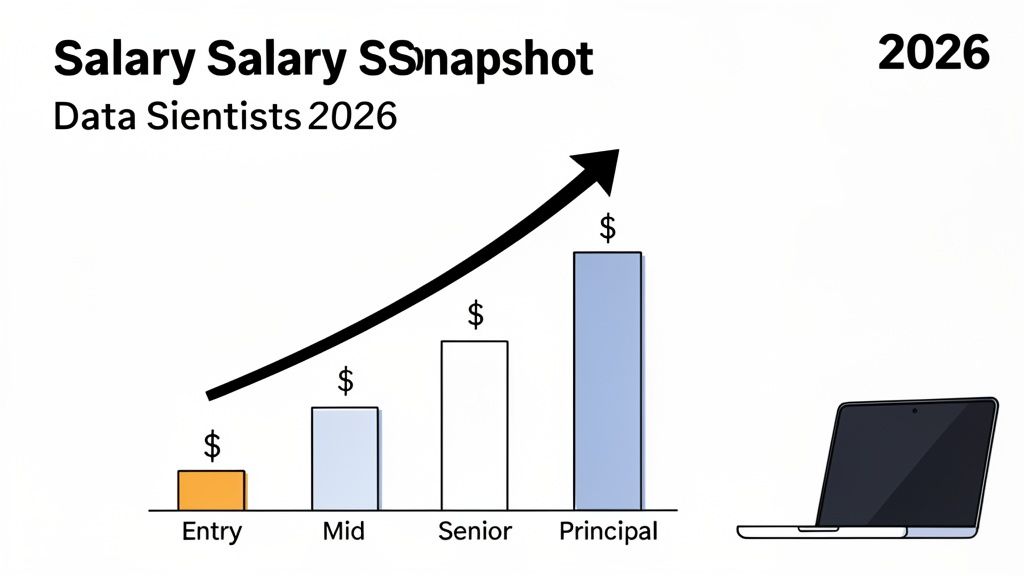
To get a real feel for the market, it helps to break down compensation by experience level. Each step up the ladder doesn't just bring more complex work; it unlocks a significant bump in your earning potential.
For a deeper look at how tech salaries stack up across different roles, our comprehensive 2025 Tech Salary Guide is a great resource.
Here’s a quick overview of what to expect at different points in your career.
The table below gives you a bird's-eye view of the average base salary expectations for data scientists at different career stages in the US tech scene.
| Experience Level | Average Base Salary Range | Key Responsibilities |
|---|---|---|
| Entry-Level (0-2 Yrs) | $120,000 - $160,000+ | Focuses on data cleaning, running pre-defined analyses, and building foundational models under direct supervision. |
| Mid-Level (2-5 Yrs) | $150,000 - $190,000+ | Independently manages projects, develops more complex predictive models, and begins mentoring junior team members. |
| Senior (5-8 Yrs) | $180,000 - $220,000+ | Leads major projects, designs experimental frameworks, and influences data strategy across business units. |
| Principal/Lead (8+ Yrs) | $210,000 - $275,000+ | Sets the technical direction for the entire data science organization, innovates new methodologies, and drives ROI. |
Think of these numbers as a starting point. As we'll explore, things like your location, the company’s stage (think scrappy startup vs. Big Tech), and your negotiation skills can push these figures even higher.
If you’ve been watching data scientist salaries climb, you know it’s not just hype. Those impressive numbers aren't pulled from thin air—they’re the direct result of some powerful market forces at play.
At its heart, this is a classic story of supply and demand. The need for skilled data professionals is exploding, but the supply of qualified talent just can't keep up. This gap has created a fiercely competitive hiring market where companies have to pay a premium to land the right people.
This isn't a passing fad. Making decisions based on data is no longer a "nice-to-have"; it's a fundamental requirement for any company that wants to survive and grow. Businesses across finance, healthcare, retail, and manufacturing are all waking up to the fact that their data is one of their most valuable assets. They need experts who can turn this "new oil" into real-world insights that boost revenue, slash costs, and build better products.
The job outlook for data scientists is nothing short of phenomenal. The US Bureau of Labor Statistics projects a staggering 34% employment growth from 2024 to 2034, which blows the average for all other occupations out of the water. That breaks down to about 82,500 new jobs opening up each year as companies scramble to build out their data teams. You can dig into the complete analysis on the BLS website to understand these projections.
For a candidate, this rapid expansion means one thing: leverage. With more open roles than qualified people to fill them, you have greater power to negotiate for the salary, equity, and benefits you deserve.
It's not just about more jobs, either. The roles themselves are getting more complex and strategically important, which naturally pushes compensation higher. Companies aren't just looking for someone to run reports anymore. They need strategic partners who can use data to help shape the future of the business.
Beyond the sheer number of jobs, the market is also putting a high price on a very specific and constantly evolving skill set. A solid foundation in programming is the baseline, and the steady need for talented Python developers continues to directly influence salary benchmarks.
But the real premiums are paid for expertise in more specialized, high-impact areas. In 2026, this means having a deep understanding of:
This unique combination of statistical knowledge, programming chops, and business sense is incredibly rare. As a result, companies have to compete aggressively to attract and hold onto anyone who has it. This intense competition is the main engine driving the high-paying compensation packages we see today, creating fantastic opportunities for anyone with the right skills to land a top-tier role.
Think of your data science career path as a series of distinct stages. Each jump in experience doesn't just unlock more complex projects and greater responsibility; it's the single most powerful multiplier for your salary.
A candidate with a few years of hands-on experience will always command a much higher salary than someone fresh out of a degree program. Why? Because theoretical knowledge is one thing, but a proven ability to navigate messy, real-world data and deliver tangible business value is what companies—especially startups—truly pay for. They need people who can hit the ground running.
As an entry-level data scientist, your primary mission is to learn fast and provide support. You'll spend most of your time on foundational tasks like data cleaning, wrangling, and running analyses under the guidance of more senior team members. You might build some basic models, but the main focus is on execution, not high-level strategy.
A typical day might involve:
You're building your core skills, and your compensation reflects that you're still on the learning curve. That said, in the 2026 market, even entry-level roles are surprisingly lucrative.
Experience is the ultimate salary multiplier for data scientists, with clear brackets showing dramatic pay hikes across levels. Entry-level (0-2 years) ranges from $80K-$130K, Mid-level (3-5 years) jumps to $100K-$175K, and Seniors (5-8 years) demand $135K-$220K.
Over the last five years, data roles have even outpaced software engineers with 35% salary growth compared to 6%. This confirms that racking up experience in this field gives you a major financial advantage. You can dig into more of this data and how the numbers are calculated with insights from Interview Query's salary analysis.
Once you hit the mid-level, you're no longer just a supporting player—you're a project owner. Companies now trust you to manage data science projects from start to finish with a good deal of autonomy. You’re not just cleaning the data; you’re designing the models that use it to solve specific business problems.
At this stage, your responsibilities expand significantly. You’ll be expected to:
This added responsibility comes with a substantial pay bump. You are no longer just an executor; you are a problem-solver who directly contributes to the company's bottom line.
As a senior or principal data scientist, you evolve from a project leader to a strategic one. Your focus shifts from the "how" of building a model to the "what" and "why." You’re not just building models anymore; you’re identifying the biggest opportunities where data science can drive business growth and setting the technical direction for the entire team.
Your influence becomes much broader. A senior scientist might design the A/B testing framework that the entire company uses to validate new product features. A principal scientist might pioneer the adoption of a new machine learning technique that gives the company a serious competitive edge.
These roles demand high-level strategic thinking, team leadership, and a deep understanding of the business. Consequently, the compensation is the highest, often including a significant equity component. This is especially true at startups, where your strategic vision can have a massive impact on the company's entire trajectory.
Let's get one thing straight: where you log in from has a massive impact on your salary. For data scientists, your physical or even remote location can swing your annual earnings by tens of thousands of dollars. Think of it like this: a company trying to hire a great data scientist in San Francisco is in a street fight for talent, and they have to pay up.
This isn't just about covering your higher rent. Major tech hubs have a crazy density of companies all fighting over the same small pool of elite talent. That intense competition naturally drives salaries sky-high. A startup in NYC knows it has to make a compelling offer to pull you away from Google, a hot FinTech firm, and three other well-funded ventures all within a few subway stops.
For years, New York City and San Francisco have been the gravity centers of the tech world, and their compensation packages show it. A data scientist working in San Francisco can still command a 15-25% premium over the national average. This "Bay Area premium" is the direct result of an unmatched concentration of venture capital, tech giants, and hungry startups all crammed into one place.
New York City is right there with it. What was once dismissed as a finance town has exploded into a seriously diverse tech ecosystem. The demand for data scientists who can tackle anything from complex financial models to e-commerce recommendation engines keeps salaries incredibly competitive.
Choosing between a role in a major hub and a lower cost-of-living area isn't just about the salary number. You have to calculate your true earning potential by factoring in expenses. A $200,000 salary in San Francisco might feel similar to a $150,000 salary in a less expensive city once you account for rent, taxes, and daily costs.
The boom in remote work has added a new, complicated layer to how companies think about salary. In the early days, many companies offered a single national pay rate to cast the widest net for talent. That's changing. The trend is now swinging back toward a more location-aware approach: geo-based pay.
This simply means companies adjust salary bands based on where an employee lives, even for fully remote roles. In practice, it usually breaks down like this:
For candidates, this system creates a major strategic decision. Do you take a lower base salary for the freedom to live anywhere, or do you stay in (or move to) a top-tier city to max out your base pay? Startups are all over the map on this. Some use a single, competitive national rate as a recruiting weapon, while others use geo-based tiers to manage their cash burn. This is a critical detail you absolutely need to clarify during the hiring process.
That six-figure base salary looks great on paper, but when you’re a data scientist, it’s only one piece of the puzzle. The real story is in the total compensation, and understanding how it’s built is critical—especially when you’re weighing an offer from a high-growth startup against one from a tech giant.
Think of it this way: your base salary is the foundation, but the annual bonus and, most importantly, equity are what build the rest of the house. The way these elements are mixed is where startups and Big Tech take completely different architectural approaches.
At its core, total compensation is simply the full financial value you get from your job. A huge, publicly traded company like a FAANG might lead with a high base salary and a predictable cash bonus every year. A startup, on the other hand, plays a different game entirely.
A startup package will often balance a competitive—but maybe not top-of-the-market—base salary with a much larger grant of equity. They’re asking you to bet on them, trading some guaranteed cash now for a shot at a massive payday later. This is where you have to understand the two main flavors of equity:
To truly compare offers, you have to look past the base number and weigh the potential of the entire package. You can get a deeper look at how startups build their offers in our complete guide to startup compensation benchmarks.
The chart below shows how much location can influence total pay, which is a big factor in how companies in different hubs structure their offers to compete for talent.
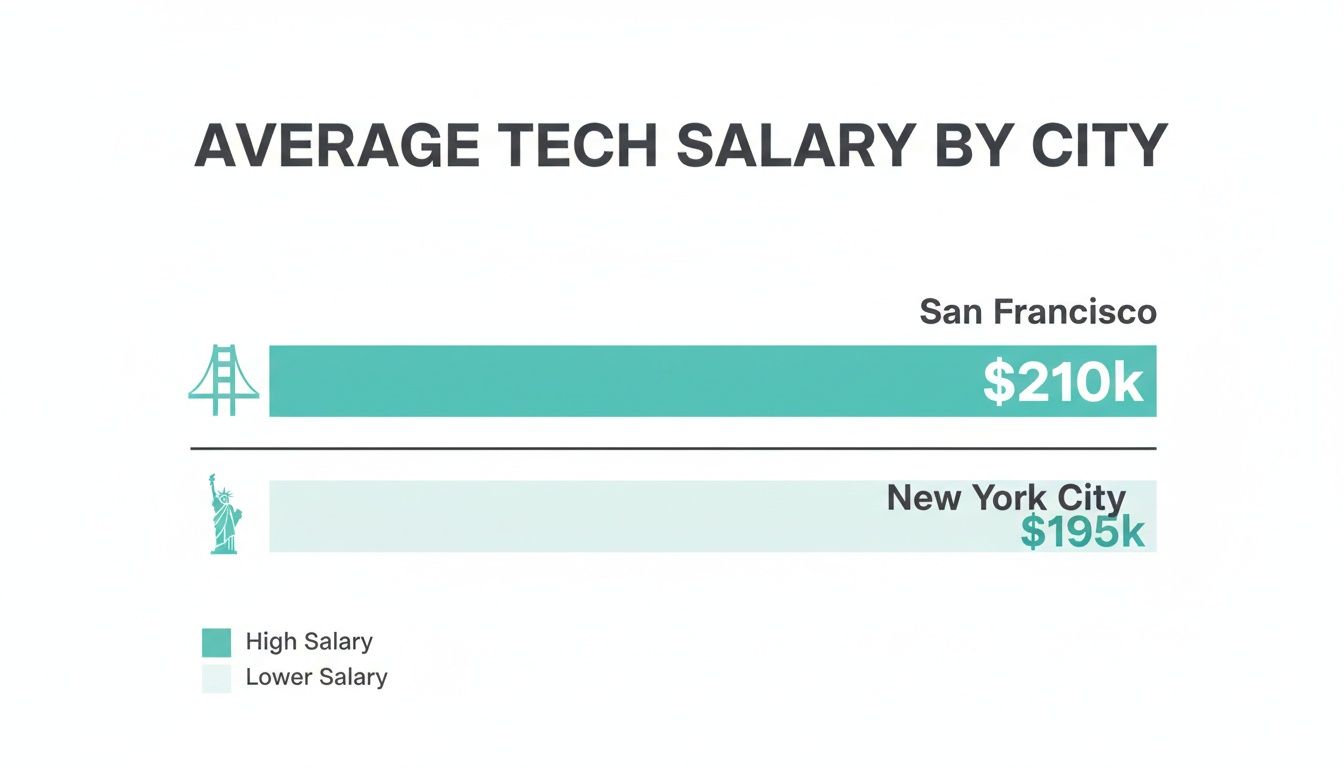
As you can see, the high earning potential in major markets like San Francisco and New York forces companies there to get creative with total compensation to stay in the game.
Let's be clear: taking a big chunk of equity at a startup is a bet. It’s a bet on the founders, the product, and your own ability to help make it all succeed. It’s like a lottery ticket, except your hard work directly improves the odds of hitting the jackpot.
For a mid-level data scientist, a Big Tech offer might look like this: $170,000 Base + $25,000 Bonus + $40,000 in RSUs per year. The total first-year compensation is high and reliable. A Series B startup, in contrast, might offer: $155,000 Base + $0 Bonus + Equity options with a paper value of $80,000 per year. The immediate cash is lower, but the equity's potential upside blows the Big Tech offer out of the water.
Which one is better? That depends entirely on your financial goals, your stomach for risk, and where you are in your career.
Choosing between a startup and a large corporation involves some very clear trade-offs. Neither path is inherently superior; they just serve different ambitions. To make it easier to see the differences, here’s a typical breakdown for a mid-level data scientist.
| Compensation Component | High-Growth Startup (e.g., Series B) | Large Tech Company (e.g., FAANG) |
|---|---|---|
| Base Salary | Often slightly lower to conserve cash. More negotiable if you bring hot skills to the table. | Typically higher and more standardized, fitting into rigid pay bands for your level. |
| Annual Bonus | Very rare. Any bonus is usually tied to company-wide profitability, which isn't the focus for a growth-stage startup. | Common and predictable. Usually a guaranteed percentage of your base salary. |
| Equity (Upside) | High-risk, high-reward. Stock options can create life-changing wealth in an exit, but they can also end up worthless. | Low-risk, moderate reward. RSUs provide consistent, liquid value as long as the stock is stable or growing. |
| Long-Term Value | The value is almost entirely locked up until a future exit (IPO or acquisition). Your work can directly impact this outcome. | The value is tied to public stock market performance. You get a predictable, steady increase in wealth over time. |
Ultimately, the right choice comes down to what you value most right now: the security of predictable cash or the high-stakes potential of a future windfall.

Landing a great offer isn’t just about being the best data scientist in the interview room. It's about confidently showing them what you're worth. Think of negotiation as a skill, not a confrontation. It’s a calm, data-driven discussion to land a package that truly reflects your value.
The best place to start is with your homework. Use the salary benchmarks in this guide and other market data to set a realistic but ambitious target. You want to walk into that conversation with a clear, justifiable number based on your experience, location, and unique skills.
When a recruiter inevitably asks for your salary expectations, resist the urge to give them a single number. Instead, try something like this: "I'm focusing on roles in the $180,000 to $200,000 total compensation range. That said, I’m flexible and really want to understand the full package, including equity and the opportunities for growth."
This anchors the discussion high while showing you’re a strategic thinker who cares about the whole offer, not just the base salary.
Your negotiation shouldn't be about what you need. It’s about the value you bring. Instead of talking about your personal bills, connect your skills directly to the company's pain points.
For instance, you might say:
"Based on my experience scaling machine learning models in production—which sounds like a top priority here—I’m confident I can make a significant impact right away. For a role with this level of responsibility, I'm targeting a compensation package in the range we discussed."
This simple shift turns the negotiation from a zero-sum game into a collaborative talk about your future contributions. It shows you’ve done your research and are ready to be a partner in their success.
The most effective negotiations happen when you’re not just one of a hundred applicants. Using a curated platform like Underdog.io, where companies are actively competing for a small pool of top talent, fundamentally shifts the power dynamic. When they know you’re a sought-after candidate, they’re more inclined to present their best offer upfront.
Don’t get tunnel vision on base salary. Sometimes, a company’s hands are tied by internal pay bands, but there’s often way more flexibility in other parts of the offer. If they can’t meet your base, pivot the conversation.
Here are other levers you can pull:
By exploring these alternatives, you show you're flexible while still maximizing the total value of your offer. If you want to dive deeper, our guide on how to counter a job offer has detailed scripts and strategies to help you navigate these conversations.
When it comes to data science compensation, a lot of questions pop up. Let's tackle some of the most common ones we hear from data scientists on the Underdog.io platform.
Not anymore. Ten years ago, a PhD felt like a non-negotiable for top-tier data science roles. Today, the landscape has completely changed, especially in the fast-moving startup world.
Companies now put a much higher premium on practical, hands-on experience. A killer project portfolio and deep skills in a hot area like machine learning engineering will get you much further than the letters after your name. We see some of the highest-paid data scientists holding Master's or even Bachelor's degrees—proof that what you can build and deploy matters most.
Right now, the roles bringing in the biggest paychecks are those that blend AI expertise with serious software engineering chops. Think Machine Learning Engineering (MLE) and any position focused on building and shipping products with Large Language Models (LLMs).
These hybrid roles are incredibly valuable because they demand a rare combination of skills:
Finding someone who excels in all three areas is tough, and that scarcity drives salaries through the roof. Companies are more than willing to pay a premium for talent that can not only build a model but also integrate it into a scalable, real-world product.
People often get tripped up on the difference between a data analyst and a data scientist. While both are essential, data scientists earn significantly more because their focus is different. An analyst looks backward, interpreting historical data to answer, "what happened?" A scientist looks forward, using advanced techniques to build predictive models that answer, "what will happen next?" That predictive power is what companies value so highly, and it's what creates the big gap in pay.
Ready to see what top startups are willing to pay for your data science skills? With Underdog.io, you can create a single, private profile and let vetted companies in NYC, SF, and remote-first environments apply to you. Stop searching and start getting headhunted for high-impact roles. Find your next opportunity on Underdog.io.