Let's get straight to the point: DevOps is one of the most financially rewarding careers in tech. The average DevOps engineer salary in the United States hovers around $139,000 per year in base pay alone.
But that's just the starting line. Once you factor in bonuses, equity, and other perks, total earnings often climb much higher, solidifying this role's place at the top of the tech pay scale.

To really understand what a DevOps engineer earns, you first need to appreciate their role in a modern company. Think of them as the chief architect and civil engineer of a smart city’s digital infrastructure. They don't just build the roads (code pipelines) or manage the power grid (cloud servers); they design the whole interconnected system to ensure traffic flows smoothly, utilities run without interruption, and the city can scale efficiently as its population grows.
This unique position, sitting at the crossroads of software development and IT operations, has become absolutely essential for any business that wants to ship reliable software, fast. That high demand has driven compensation to some pretty impressive levels.
DevOps has firmly established itself as one of the highest-paying career paths in technology, with salaries that significantly outpace the broader job market. As of 2026, the average base salary for a DevOps engineer in the U.S. is $139,000 per year.
When you include supplemental pay—which averages around $32,714 annually—the total compensation often reaches approximately $142,104. This puts DevOps engineers leagues above the median salary for all U.S. jobs, which sits at just $48,060. You can explore more data on the components of DevOps pay with Coursera's salary research.
This high earning potential directly reflects the massive impact a skilled DevOps pro has on a company's bottom line. Their work directly contributes to:
A competitive offer is about much more than just the base salary figure. It's crucial to understand the difference between base pay and total compensation, which gives you the full picture of your earning potential.
Total compensation is the complete financial package an employer offers. It includes not only your consistent base salary but also variable components like annual bonuses, stock options (equity), and other financial perks that can substantially increase your overall income.
We'll dig into the details of bonuses and equity later on. For now, it’s useful to see how salary data can differ across various reporting platforms.
The table below summarizes the average salaries for DevOps engineers from several leading industry sources in 2026. This variation often comes from differences in data sources, whether total compensation is included, and the experience levels of the roles surveyed.
| Data Source | Reported Average/Median Salary |
|---|---|
| Underdog.io | $175,000 |
| Glassdoor | $142,104 |
| Salary.com | $139,121 |
| Built In | $153,687 |
| Payscale | $109,241 |
| Indeed | $136,897 |
Note: Data reflects a mix of averages and medians based on each source's methodology.
Seeing these numbers side-by-side highlights why it's so important to look at multiple sources and understand what each one is actually measuring. A lower number might only reflect base pay, while a higher one could be skewed by senior roles or equity-heavy offers in major tech hubs.
Just like any other craft, your DevOps salary grows as your skills sharpen and your impact on the business expands. The financial journey from your first role to a senior leadership position is significant, with your pay scaling to match the value you create.
Think of it less like a ladder and more like a series of concentric circles. You start at the core, mastering specific tasks, and with each new level of experience, your influence expands outward, eventually shaping the entire engineering ecosystem. This progression offers a clear roadmap for your career, showing where you stand now and what you need to learn to hit that next pay grade.
As an entry-level DevOps engineer, your main job is to learn the ropes and execute tasks within an established system. You're the hands-on practitioner keeping the engines running day-to-day. Your compensation reflects this role as a builder and learner.
For a practical example, your daily work might involve writing a Python script to automate the backup of a database, responding to a PagerDuty alert for a service with high latency, or running a pre-defined Jenkins job to deploy a new microservice to the staging environment. In this phase, you're building a solid foundation in core DevOps tools and practices.
After a few years, you've moved beyond just following instructions. As a mid-level engineer, you start taking on more ownership and begin influencing system design. You're not just using the CI/CD pipeline anymore; you're actively making it faster, more reliable, and more secure.
This is where your salary should see a serious jump. You’ve proven you can work independently and are now a key contributor to your team's success. As an actionable insight, focus on projects with clear business impact. For example, spearhead an initiative to optimize your team's Docker image build times, reducing the CI/CD feedback loop from 15 minutes to 5. This is a quantifiable win you can put on your resume and discuss in salary negotiations.
At this stage, your value shifts from pure execution to proactive improvement. You're not just maintaining the system; you're making it demonstrably better, which directly translates to a higher market value and a more competitive salary.
As a senior DevOps engineer, you operate at a strategic level. Your focus is less on individual scripts and more on the entire cloud ecosystem. You are the architect, responsible for designing scalable, resilient, and cost-effective infrastructure that supports the company's long-term business goals. This is where your earning potential really takes off.
The career progression in DevOps shows a clear and substantial salary trajectory. For instance, career progression research shows that earning potential can more than double between entry-level and senior roles. An entry-level engineer (0–2 years) might start between $80,000 and $110,000, while a mid-level pro (3–5 years) typically earns from $110,000 to $140,000. Senior-level engineers with 5+ years of experience command between $150,000 and $180,000, with top-tier roles often breaking $190,000. You can explore a more detailed salary guide on RefonteLearning.
At this level, you might lead a project to migrate a legacy monolith from on-premise servers to a serverless architecture on AWS, cutting infrastructure costs by 40% and improving deployment frequency. This is a high-impact, strategic initiative that justifies a premium salary.
Where you work has always shaped your paycheck, but the explosion of remote work has completely flipped the script. The old playbook of chasing the biggest salary in a high-cost-of-living (HCOL) city like San Francisco or New York is no longer the only way to earn top dollar. Today, you have more choices than ever, and knowing how to navigate them can make a huge difference to your bottom line.
Some startups still tie your salary to your zip code, offering a premium for those living in pricey tech hubs. But a growing wave of companies are embracing location-agnostic pay, offering the same competitive salary no matter where you plug in your laptop. This shift gives you the power to pick a lifestyle that actually fits you, without automatically taking a pay cut.
Of course, your experience level is the foundation for any salary discussion. Before we even get into geography, here’s a general look at how compensation tends to scale.
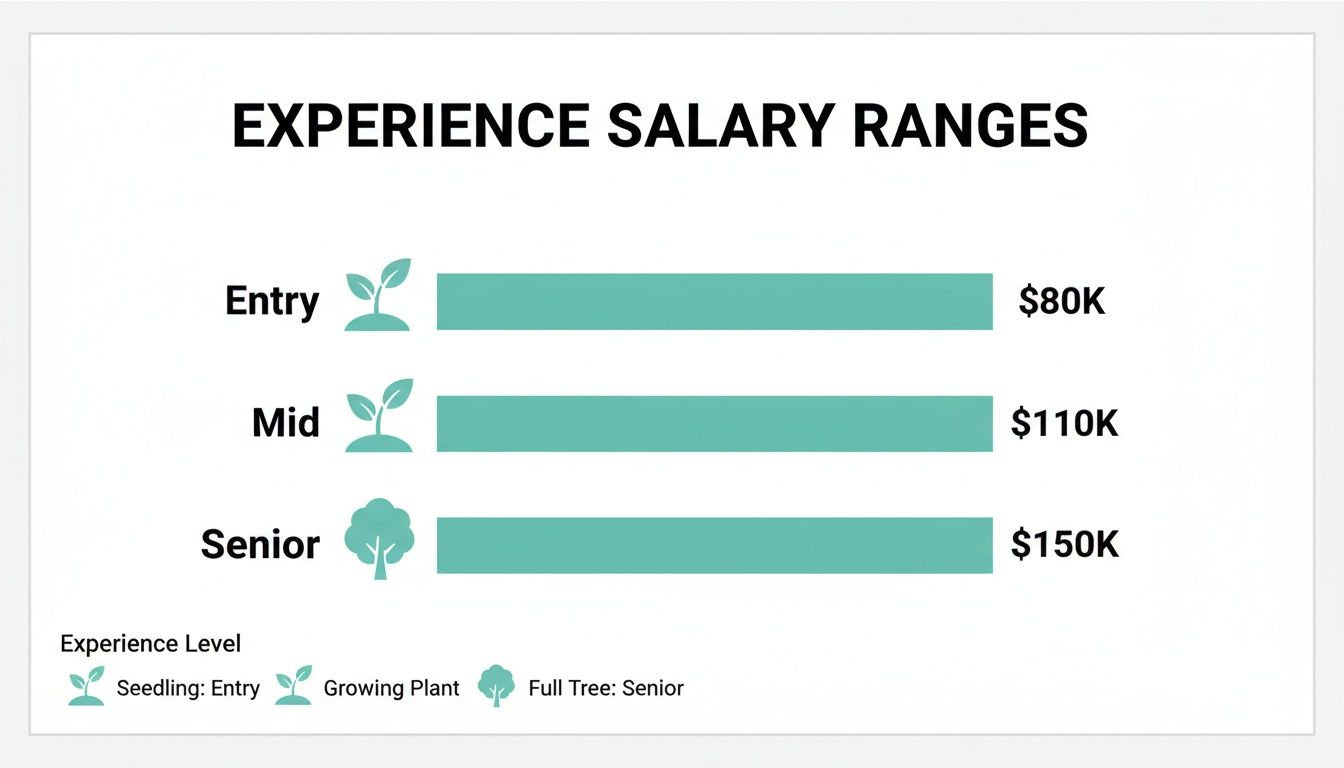
This gives you a baseline for what to expect as you gain skills and take on more responsibility, whether you’re heading into an office or logging on from home.
To see how these numbers stack up in the real world, let's compare some of the major tech hubs against the flexibility of remote roles. The differences might surprise you.
| Location | Mid-Level Range | Senior-Level Range | Key Considerations |
|---|---|---|---|
| San Francisco | $160,000 – $195,000 | $190,000 – $240,000+ | Highest raw salaries but also the highest cost of living. Fierce competition for talent. |
| New York City | $150,000 – $185,000 | $180,000 – $225,000+ | Very competitive market with high salaries that are quickly eaten by housing and taxes. |
| Austin | $135,000 – $165,000 | $160,000 – $200,000 | Booming tech scene with strong salaries and no state income tax, but cost of living is rising fast. |
| Seattle | $145,000 – $175,000 | $170,000 – $215,000 | Home to major tech giants, offering high pay with no state income tax, but a very HCOL city. |
| Remote (US) | $140,000 – $180,000 | $175,000 – $220,000+ | Offers the potential for HCOL pay in a LCOL area. Pay philosophy varies wildly by company. |
As the table shows, while on-site roles in cities like SF and NYC still post the highest numbers on paper, competitive remote salaries are right on their heels—often with a much lower cost of living attached.
It’s no secret that major tech hubs like the San Francisco Bay Area and New York City offer the biggest paychecks for DevOps engineers. With a dense concentration of venture-backed startups and FAANG companies all fighting for the same talent pool, a bidding war is inevitable.
This geographical premium is very real. Data from Fastlane Recruit's analysis shows that salaries in and around these corridors are sky-high. Cupertino, CA, for instance, posts an average of $155,339, with places like Jewett, TX, and Berkeley, CA, both clearing $154,000 annually.
But a bigger salary doesn't always mean more money in your pocket. The astronomical cost of living—especially housing, taxes, and even just a cup of coffee—can neutralize that impressive number pretty quickly. A $180,000 salary in San Francisco might actually leave you with less disposable income than a $150,000 salary somewhere more affordable.
Actionable Tip: Use a cost-of-living calculator (like NerdWallet's or Payscale's) to compare offers. Enter your San Francisco offer of $180k and a Des Moines, Iowa offer of $150k. You might find the Iowa offer gives you significantly more purchasing power. The real question isn't "How much can I make?" but "How much can I keep?"
This is where remote work changes the game. It offers a powerful alternative for maximizing your earnings. Many startups, especially those built on a remote-first culture, are finally decoupling salary from location.
This creates a massive opportunity: earn a salary benchmarked to a competitive market like NYC while living in an area where your money goes a lot further. It’s a fast track to boosting your savings and disposable income.
When you're looking at remote roles, you need to figure out the company's pay philosophy. It usually falls into one of two camps:
An actionable tip is to ask the recruiter directly: "Could you share some insight into your compensation philosophy? Is pay tied to location, or do you have a single salary band for each role regardless of where the employee lives?" Knowing this upfront is critical for your financial planning. If you're ready to dive in, check out our guide on how to find remote DevOps engineer jobs.

When a startup makes you an offer, it’s easy to fixate on the base salary. But that number is just one piece of a much larger puzzle. While a healthy base gives you financial security, the most competitive offers are a blend of different financial components that make up your total compensation.
Learning to decode this full picture is one of the most important skills you can develop in your career.
Think of it as a financial toolkit. Your base salary is the sturdy foundation you can build on every month. Performance bonuses are rewards for hitting key targets, and equity is your long-term ownership stake in the company’s success. Understanding how these pieces fit together is what separates a good offer from a great one.
Let's start with the most straightforward part: your base salary. This is the fixed, guaranteed amount you’ll earn annually, paid out in regular paychecks. It needs to be reliable, predictable, and high enough to comfortably cover your living expenses and financial goals.
This figure forms the bedrock of your financial planning. While other parts of your compensation can fluctuate, your base pay is the number you can absolutely depend on. It’s often the primary focus during negotiations, but it’s only the starting point of the conversation.
Performance bonuses are how companies reward exceptional work, whether it’s from an individual or an entire team. These are variable payments tied to hitting specific, measurable goals, directly aligning your performance with the company's big-picture objectives.
A bonus structure can show up in a few different forms:
Actionable Tip: When evaluating a bonus, ask direct questions. For example: "The offer mentions a 15% target bonus. Can you share what the average payout percentage for this bonus has been for engineers in this role over the past two years?" This helps you understand the realistic value of the bonus, not just the potential.
For many engineers drawn to the startup world, equity is both the most exciting and the most confusing part of an offer. It gives you an ownership stake in the company, usually in the form of stock options. If the company takes off and its value skyrockets, your equity could end up being worth far more than your salary.
Of course, that future value is never guaranteed. This is the high-risk, high-reward part of your compensation package. You’re essentially betting on the company's future. To make an informed bet, you need to get familiar with a few key terms.
Evaluating an equity offer isn't just about the number of options. You need to consider the strike price and the total number of outstanding shares to get a rough idea of your potential ownership percentage. For a much deeper dive, check out our guide on compensation and benefits at startups.
Thinking about the full package—base, bonus, and equity—lets you see the complete financial opportunity. It transforms a simple job offer into a strategic career move, allowing you to balance immediate stability with long-term wealth potential.
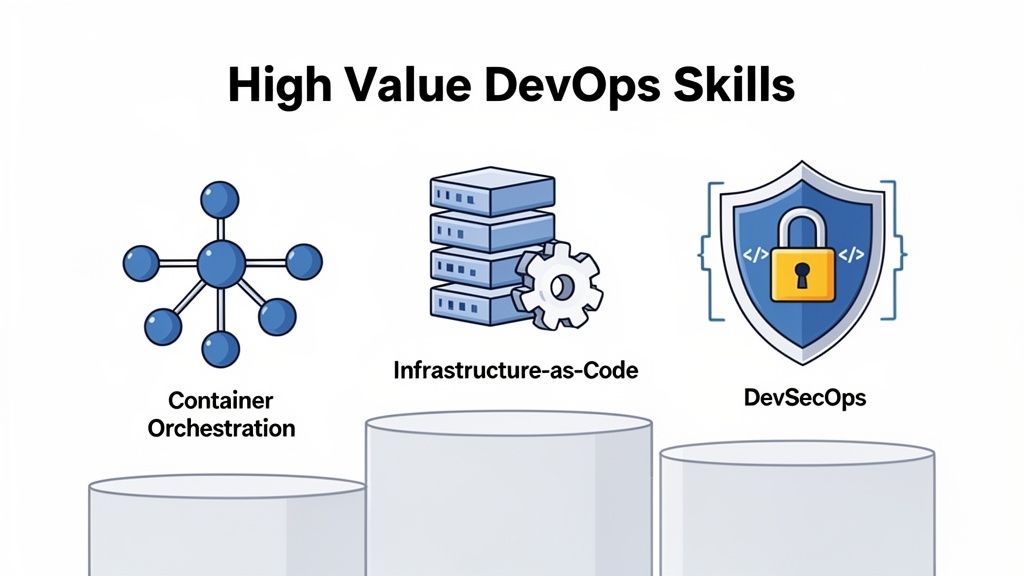
While experience level sets the foundation for your pay, the specific skills you master are what really move the needle. In the world of DevOps, not all tech is created equal. Companies are more than willing to open their wallets for expertise that directly tackles their biggest headaches: scaling reliably, shipping code faster, controlling costs, and plugging security holes.
Think of it like this: a general practitioner is valuable, but a heart surgeon who can perform a complex, life-saving bypass is in another league entirely. The same logic applies here. Mastering high-impact technologies transforms you from a generalist into a specialist that top startups will fight over, which has a direct and immediate impact on your salary.
Pouring your energy into these key areas is the fastest way to jump into a higher salary bracket. It's a direct investment in your own market value, proving to employers that you can solve their most expensive problems.
Mastery of Kubernetes (K8s) isn't just a nice-to-have anymore; it's one of the most bankable skills in tech. Plenty of engineers can get a basic app running on a K8s cluster. True expertise—the kind that gets you paid—is in advanced orchestration. It’s the difference between knowing how to drive a car and being able to re-engineer a Formula 1 engine while it's racing.
For example, a company might pay a premium for an engineer who can architect a multi-cluster setup using tools like Cluster API, enabling disaster recovery across different cloud regions. Another practical example is implementing a custom Kubernetes Operator to automate the lifecycle of a complex stateful application, like a database, which reduces operational toil for the entire engineering team.
Deep Kubernetes knowledge is so valuable because it’s the bedrock of modern, scalable infrastructure. An expert who can build and maintain a rock-solid K8s platform directly enables faster feature delivery and prevents costly downtime, making them an indispensable asset.
Infrastructure as Code (IaC) is a non-negotiable DevOps practice, and Terraform has cemented itself as the industry standard. Knowing how to write a basic configuration file is table stakes. To command a top-tier salary, you need to go much deeper.
It's about way more than just spinning up servers. True IaC masters treat infrastructure code with the same discipline and rigor as application code. They build modular, reusable, and maintainable systems that slash both risk and manual effort.
An engineer with advanced Terraform skills might refactor a company's monolithic Terraform state into modular, reusable components, allowing different teams to manage their own infrastructure independently. This unblocks teams and improves security. This level of expertise has a direct and measurable impact on a company's bottom line. For instance, an engineer who can refactor a chaotic, manual cloud setup into a clean, automated Terraform project can easily save a startup tens of thousands of dollars a month. That’s an ROI hiring managers are eager to pay for.
Security is no longer a final step or someone else's problem. It’s a critical thread woven through the entire software development lifecycle. The industry-wide pivot to DevSecOps—baking security practices directly into the DevOps pipeline—has created a huge demand for engineers who are fluent in both worlds.
A DevSecOps specialist isn't just a security person or a DevOps person; they are a true hybrid. They are architects of secure systems, capable of "shifting security left" to catch vulnerabilities early when they are exponentially cheaper and faster to fix.
A practical example is integrating a Static Application Security Testing (SAST) tool like SonarQube into the CI pipeline, configuring it to automatically fail any build that introduces a critical vulnerability. Another is implementing a robust secrets management strategy using HashiCorp Vault or Infisical to eliminate hardcoded credentials from source code and CI/CD variables. This skillset is both rare and incredibly valuable. An engineer who can prevent a security breach saves a company from potential financial ruin, reputational disaster, and massive regulatory fines.
An offer hitting your inbox is a rush. But don't pop the champagne just yet. Getting the offer isn't the finish line; it’s the starting gun for the final, most important conversation. This is where all that research into market rates and total comp turns into real money in your pocket.
Negotiating can feel like a high-stakes poker game, but it’s not. Think of it as a collaborative discussion, not a confrontation. They’ve already spent weeks vetting you and decided you’re the one they want to hire. Now, it’s just about settling on the terms that make sense for both of you.
Walking into a negotiation without your numbers is like deploying to production without running tests. It’s a recipe for disaster. You need to have three figures locked and loaded before you even think about picking up the phone.
Defining these figures beforehand gives you a solid framework. It takes the emotion out of the conversation and stops you from making a split-second decision you’ll regret later.
Every recruiter will ask it, and it’s one of the trickiest moments in the entire process: "So, what are your salary expectations?" Give a number too early, and you anchor yourself too low. Your goal should always be to push this conversation until you have a formal offer in hand.
When asked early on, try a polite deflection like this:
"I'm really focused on finding the right role and team first, but I'm confident we can agree on a fair number if we both feel it's a good fit. Based on my research for a Senior DevOps Engineer role with this level of responsibility in this market, I've seen total compensation packages ranging from $190,000 to $220,000, but I'm open to discussing the full picture."
This response is effective for a few reasons. It shows you've done your homework, it anchors the conversation at a high number, and it immediately pivots the discussion to total compensation—not just base salary. This is just one piece of the puzzle; for more context, you should understand how to properly evaluate a job offer in its entirety.
The biggest mistake I see engineers make is getting tunnel vision on the base salary. A savvy negotiator knows that base pay is just one part of the deal. If the company is firm on the base, there are plenty of other levers to pull.
Here's an actionable example: If a company offers a base salary of $160,000 but your target was $170,000, you could counter with, "I'm excited about the offer. While the base is a bit lower than my expectations, could we bridge that gap with a $15,000 signing bonus?" This shows flexibility and focuses on the total first-year value. Other levers to pull include:
Sometimes, a small grant of extra equity or a guaranteed training budget can be far more valuable over the long haul than a few extra thousand in base pay. Always look at the offer holistically and figure out which parts of the package are most important to you.
Once you've seen the salary numbers, a few common questions always pop up. Let's dig into the details to help you map out your next career move and understand what's really driving your value in the market.
Thinking about making the jump from SysAdmin to DevOps? It's one of the most reliable ways to see a major pay increase, often boosting your salary by 20% to 40%.
That leap isn't just a title change; it reflects a fundamental shift in your skill set toward automation, CI/CD, and cloud-native architecture. You’re no longer just keeping the lights on—you’re building the engine that helps the company innovate faster, and that's a skill companies will pay a premium for. The exact amount depends on the new responsibilities you take on, but it's a proven path to a bigger paycheck.
This is a classic chicken-and-egg question. While a certification on its own won't automatically trigger a raise, it absolutely makes you a more compelling and valuable candidate. Think of it as proof—it validates your expertise to recruiters and hiring managers at a glance, getting your resume to the top of the pile.
Actionable Insight: Certs like AWS Certified DevOps Engineer or Certified Kubernetes Administrator (CKA) are powerful leverage in negotiations. They often lead to more interview invites and can add 5-10% to your final offer, especially at top startups that value a proven commitment to your craft.
Yes, without a doubt. Every market signal points to continued high demand and strong salaries for DevOps talent. This isn't just a passing trend—it's a fundamental shift in how modern software is built and delivered.
As more companies move to the cloud and try to ship products faster, the need for experts who can bridge the gap between development and operations is only growing. The role has become essential, securing its long-term value and the high compensation that comes with it. This makes it one of the most rewarding and future-proof career paths in tech.
Ready to see what you're worth? Underdog.io connects you with hundreds of top startups that are actively hiring for competitive DevOps roles. Stop searching and let the best opportunities find you. Sign up in 60 seconds at https://underdog.io.