A hardware engineer designs, builds, tests, and troubleshoots computer hardware systems and components, typically entering the field with a bachelor's degree, and the U.S. median salary is $161,740. The part that is frequently missed is that “hardware engineer” isn't one job at all. It's a cluster of specialties, and startups care far more about the right niche fit than the title on your resume.
If you're reading this, you're probably in one of two situations. You're trying to figure out whether hardware engineering is the path you want, or you already have experience and you've realized the market treats board design, validation, silicon, RF, power, and reliability as different careers with different influence. That realization is where most generic career guides stop being useful.
I've seen founders post for a hardware engineer and get flooded with resumes from smart people who still aren't right for the role. The reason is simple. A startup building a sensor-heavy embedded product doesn't need the same person as a team fighting DDR timing issues or package-level reliability failures. The title stays the same. The day-to-day work does not.
A founder opens a role for “hardware engineer” and gets a pile of applicants. Some can do schematic capture but have never debugged a noisy board in the lab. Some are solid embedded developers but weak on layout constraints. Some have production experience but no feel for bring-up. On paper, they all look close enough. In practice, they solve very different problems.
That gap is why the title causes so much confusion.
A hardware engineer is responsible for turning a design idea into a physical system that works outside a slide deck. That can mean selecting components, creating schematics, guiding PCB layout, building prototypes, validating interfaces, chasing power problems, and working with firmware, manufacturing, and test teams until the product is stable enough to ship.
This role didn't appear out of nowhere. The field grew with computer engineering in the 1940s and 1950s, when early computer systems were still taking shape and electrical engineers moved into the new specialty. By the 2020s, it had matured into a sizable labor market. One labor market summary puts U.S. employment at 76,800 in 2024, projected to reach 82,400 by 2034, with about 4,700 annual openings and 7.3% projected growth over that period, according to WageDex's computer hardware engineer outlook summary.
A quick visual makes the hiring problem obvious.
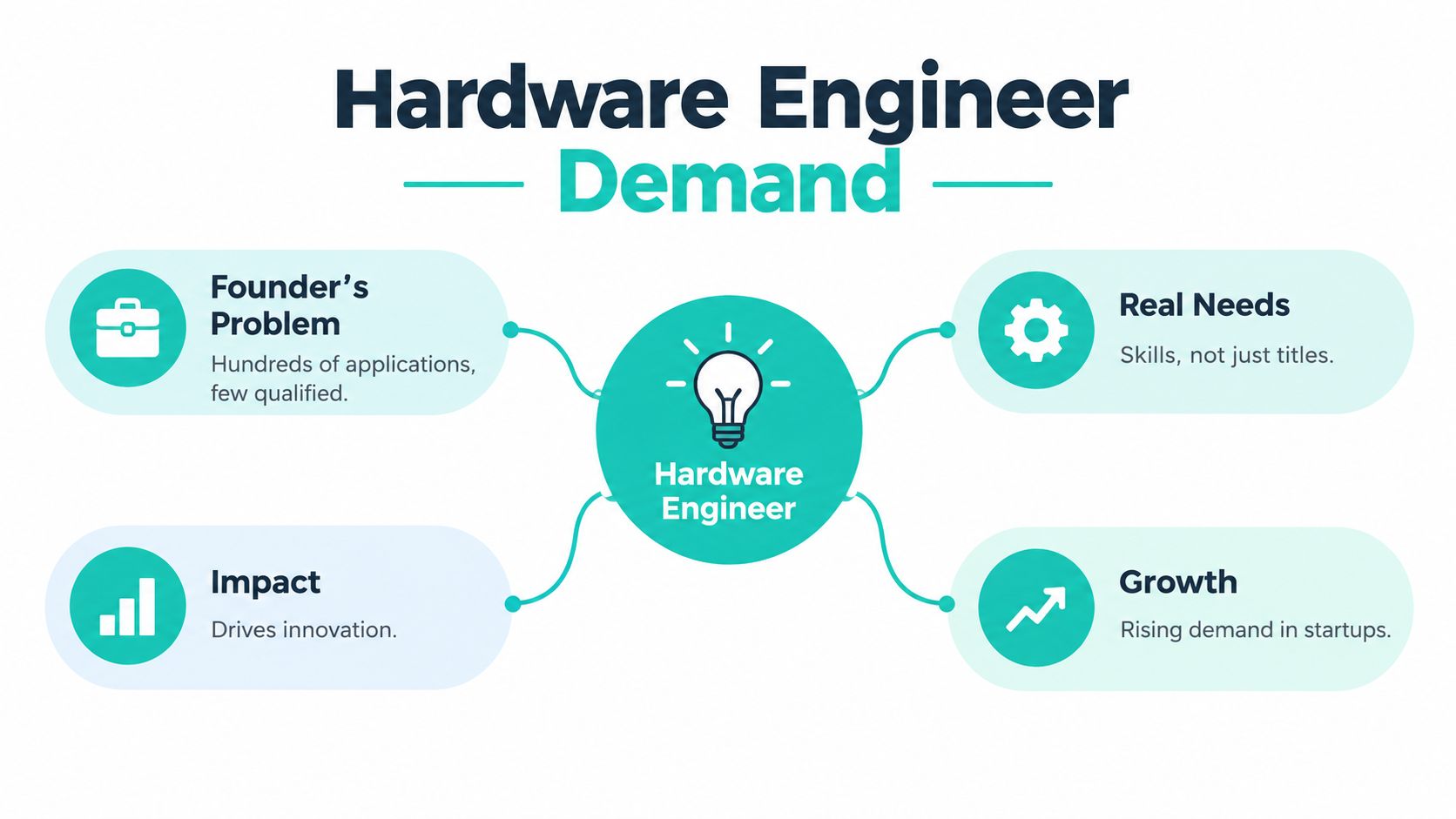
The broad label sounds convenient, but it flattens real differences:
That's why hiring trends in tech are moving toward skill specificity rather than title matching. You can see the broader pattern in these tech hiring trends.
A good hardware engineer doesn't just know parts and tools. They know where designs usually fail, and they design to avoid those failures early.
The field is also formalized in a way many people underestimate. The U.S. Bureau of Labor Statistics reports a median annual wage of $161,740 in May 2025, projects 9% employment growth from 2025 to 2035, and estimates about 4,100 openings per year on average over the decade. BLS also lists a bachelor's degree as the typical entry-level education in its computer hardware engineers occupational profile.
That combination matters. It tells you this is still a high-paying engineering path, but it's not an informal “techie” role anymore. Employers expect structured fundamentals, and startups still expect hands-on judgment on top of that.
Most descriptions of the job are too abstract. The work is more concrete, and more repetitive, than people expect. Hardware engineering is cycles of design, build, test, fail, isolate, revise, and test again.
According to Indeed's overview of computer hardware engineers, hardware engineers commonly design systems and components from schematics, blueprints, and technical drawings, then build, test, and evaluate prototypes before production. They also troubleshoot hardware issues, validate quality assurance, and make sure new software works with existing hardware.
That sounds tidy. The actual workday usually isn't.
Here's the simplest useful model I use when evaluating candidates.
Design
This is the front end of the job. Schematic capture, component selection, interface decisions, connector choices, power tree thinking, and design reviews all live here. The mistake junior engineers make is treating this like a documentation task. It's really a prediction task. You're trying to predict where assembly, signal quality, thermal behavior, and firmware interaction will hurt you later.
Prototype and bring-up
Boards arrive. Some power rails come up. Others don't. A peripheral enumerates on one unit but not another. Theory meets solder, instruments, and uncomfortable facts.
Debug and quality
Good hardware engineers don't stop at “it works on my bench.” They test repeatability, edge cases, and manufacturing sensitivity. They also isolate root causes instead of collecting symptoms.
Integration
Hardware doesn't ship alone. Drivers, firmware, boot sequences, and test fixtures all matter. A board that looks clean electrically can still fail as a product because the hardware-software boundary was sloppy.
Hardware engineers are the bridge between abstract circuit design and physical, working products.
The baseline toolkit is broader than many candidates expect. Employers commonly look for knowledge of hardware description languages, programming languages such as Python and C++, operating systems including Windows, Unix, Linux, and iOS, plus CAD and other design software, as outlined in Indeed's hardware engineer job description guide.
That list matters because startups rarely hire people into a narrow box. They want someone who can move between design files, scripts, logs, and lab instruments without drama.
A few skills tend to separate the people who interview well from the people who become indispensable.
A normal day might include a standup, a design review comment thread, bench validation, a firmware sync, and a supplier question about a substituted part. Some days are almost all CAD and documentation. Some are all lab time. Some are ugly cross-functional cleanup after a prototype exposes weak assumptions.
That's why people who only enjoy “designing the cool part” often struggle in startup hardware. The job includes paperwork, rework, and tedious validation. If you like turning uncertainty into a working physical product, it's a strong fit. If you only like elegant theory, it probably isn't.
The fastest way to misunderstand this field is to treat all hardware roles as interchangeable. They aren't. The market splits into niches, and those niches have different tools, interview patterns, and hiring urgency.
The specialization map below is closer to reality than any generic job description.
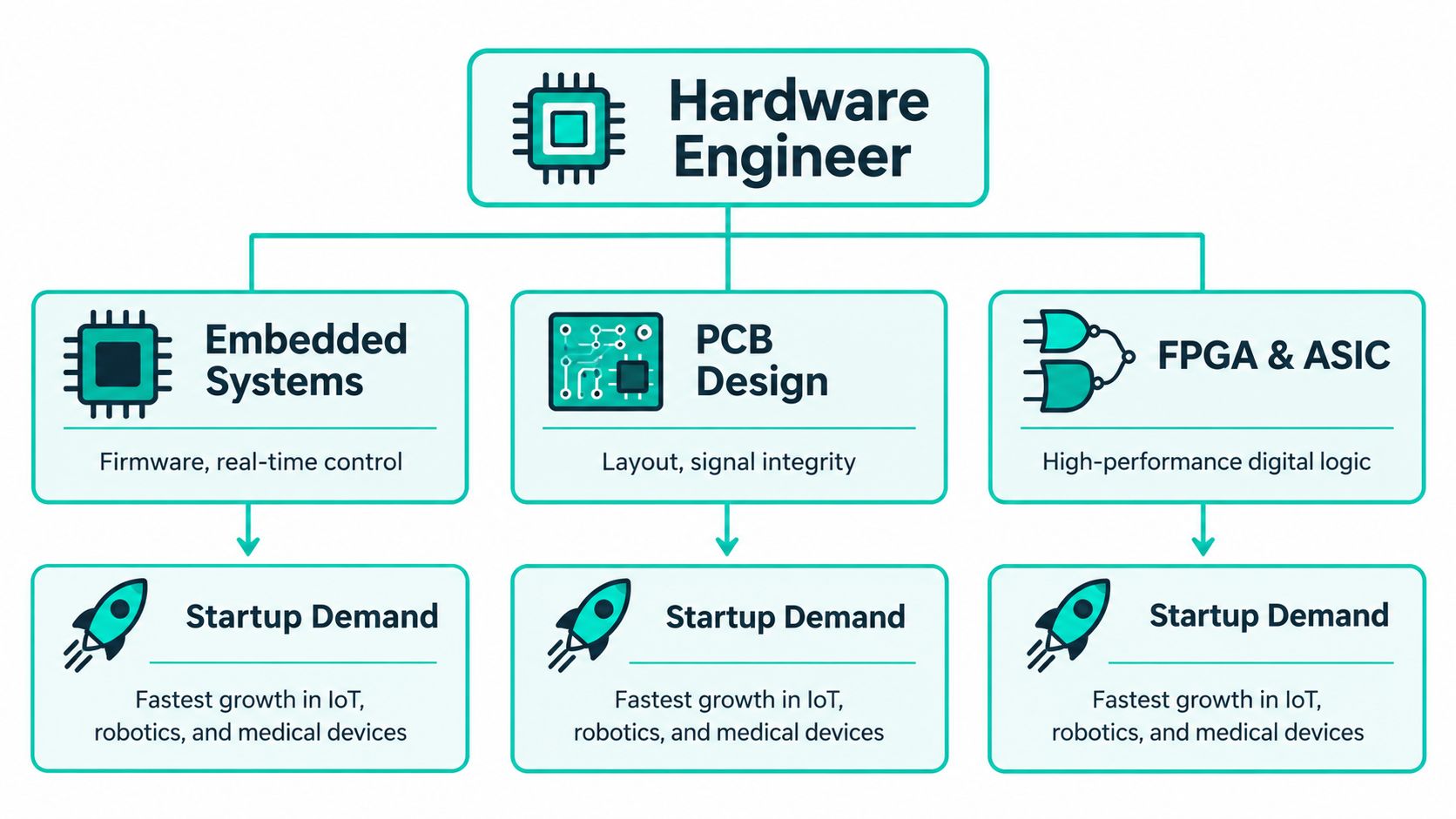
This is the version of hardware engineering many startups need first. These engineers own schematics, component choices, interface planning, layout collaboration, bench validation, and early manufacturing sanity checks.
They're often strongest when a company is building an actual product rather than pure silicon. The work rewards broad competence. You need enough analog sense, digital discipline, firmware empathy, and manufacturing awareness to keep the whole system moving.
The downside is that general board roles can become too broad. If your resume says “hardware engineer” but never signals depth in a difficult area, you're easier to replace.
Specialization starts paying off.
Hardware engineers working on high-speed digital systems often need deep signal integrity and power integrity expertise because performance at interfaces such as DDR4/LPDDR4, SATA, SerDes, and 100GbE depends on controlling return paths, crosstalk, jitter, and PDN impedance. In practice, that means using tools such as ADS, HFSS, PowerSI, HSPICE, oscilloscopes, VNAs, and TDRs to validate stackups, routing rules, and PDN behavior before bring-up, as described in this SI and PI focused hardware role.
This work gets noticed because it solves expensive problems before they hit the lab. Startups building compute-heavy systems, networking gear, memory-rich platforms, or dense carrier boards don't want to learn SI lessons through failed spins.
Practical rule: If your system includes fast memory or high-speed serial links, “good enough” layout intuition stops being enough.
A different lane entirely. Reliability engineers don't just ask whether the board works. They ask how and why it fails over stress, time, process variation, and packaging conditions.
Industry roles in this area call for designing and interpreting ESD, HTOL, and thermal stress tests, plus using SEM, FIB, CSAM, x-ray, cross-sectioning, and thermal imaging to isolate die cracks, delamination, wire-bond failures, and package-level hot spots. Some roles explicitly call out failure characterization at 7 nm or below and familiarity with JEDEC standards, as shown in this hardware reliability engineering role.
This niche matters more than many software-centric founders realize. Once a product is in production, reliability problems are expensive, political, and hard to hide.
These areas are often grouped together by non-specialists, but they shouldn't be.
| Specialization | What hiring teams usually care about | What weak candidates get wrong |
|---|---|---|
| RF and antenna | Matching networks, coexistence, real-world tuning, board effects | They treat RF as a schematic problem only |
| Power | Power tree stability, efficiency, thermal behavior, transient response | They optimize one rail and ignore system behavior |
| Validation | Coverage, repeatability, automation, clear failure isolation | They run tests without designing useful test plans |
| Silicon and characterization | Device behavior, corner conditions, measurement rigor | They know theory but not lab execution |
The market shift worth paying attention to is tied to AI infrastructure. Recent reporting says U.S. chip manufacturing could face a shortage of up to 157,000 skilled workers by 2030, only 3% of U.S. engineering graduates enter semiconductors, and 73% of chip employers report difficulty filling engineering roles. The same reporting ties that pressure to a projected AI data-center chip market of $207 billion in 2025 and $286 billion by 2030 in HeroHunt's analysis of hardware talent recruiting.
The useful takeaway isn't “hardware is hot.” It's narrower. The shortage isn't evenly spread. It's concentrated in the hard-to-hire specialties around semiconductors, high-speed interconnects, power, validation, and manufacturing-adjacent hardware work.
A startup has a board on the bench that boots once in ten tries, fails EMC pre-scan, and runs 18 degrees hotter than the model predicted. The hiring manager does not care whether a candidate can recite every acronym in the stack. They care whether that person can isolate the fault, set up the right measurements, and decide what to fix first.
That is the skill map that matters in hardware. Strong engineers build a base across schematics, layout, firmware interaction, and lab work, then develop depth in one lane where mistakes are expensive and hiring is slow. That is also why "hardware engineer" is a blurry title. The day-to-day workflow for a board designer is different from the workflow for a validation lead, an RF specialist, or a reliability engineer.
Every specialty starts with the same floor. If these basics are weak, the rest does not matter much in interviews or on the job.
Teams also look for basic product execution habits. In electronics design and manufacturing, revision control, part lifecycle tracking, supplier communication, and ECO discipline often decide whether a promising prototype turns into something you can ship.
Candidates stop looking interchangeable.
At the mid-level, a hardware engineer should reduce risk before the board comes back and shorten debug after it arrives. That usually means they can review a design and spot likely SI, PI, thermal, assembly, or test problems early enough to avoid a schedule slip.
A strong mid-level engineer usually brings several of these:
The candidates I remember are the ones who can explain a debug path clearly. What failed, what they measured first, what they ruled out, and what they changed.
The hidden specialization map becomes obvious. Tool names alone do not make someone senior. Workflow fluency does.
An SI engineer who can set channel constraints, simulate the link, choose the right fixtures, measure with TDR or VNA, and correlate lab data to the model is in a different labor market from a general board designer. The same is true for a reliability engineer who can build a stress plan and interpret failure signatures, or a validation engineer who can turn vague product risk into repeatable coverage.
| Area | High-value tools and methods | What good engineers actually do |
|---|---|---|
| SI and PI | ADS, HFSS, PowerSI, HSPICE, VNA, TDR | Correlate simulation with board measurements, debug channel loss and reflections, and keep high-speed links stable under real loading |
| Reliability | ESD, HTOL, thermal cycling, JEDEC workflows | Build stress screens, separate wear-out from design defects, and feed lessons back into design rules |
| Failure analysis | SEM, FIB, CSAM, x-ray, cross-sectioning, thermal imaging | Find physical root cause after electrical symptoms point to package, process, solder, or material issues |
| RF and high-frequency design | Matching, tuning, coexistence debugging, chamber testing | Tune in the real product, not just in simulation, and account for enclosure, antenna placement, and board effects |
The hiring difference shows up in workflow maturity. Strong specialists know when simulation is enough, when the bench has the final word, and when the root cause sits outside the schematic. Sometimes the problem is layout. Sometimes it is packaging, firmware timing, tolerance stack-up, or a manufacturing variation that only appears in the second build.
That combination of breadth plus one hard-to-hire specialty is what gets attention fastest. In the current AI infrastructure cycle, the engineers who can work across high-speed boards, power delivery, validation automation, silicon characterization, or reliability are often the ones with the most options.
A founder has one open headcount and three very different problems. The board will not pass compliance on the first spin. The power stage is running hot. The prototype works on the bench but fails during overnight stress. All three jobs can be posted as “hardware engineer.” They are not the same market, and they do not pay the same.
Compensation in hardware spreads wide because companies pay for risk removal. Title and years of experience matter less than whether you can solve the bottleneck that is blocking the product.
WGU's hardware engineer career overview shows a broad salary range for hardware engineers. As noted earlier, public labor data also shows a large spread across the profession. That variation is the clearest sign that “hardware engineer” is really several hiring lanes hiding under one title.
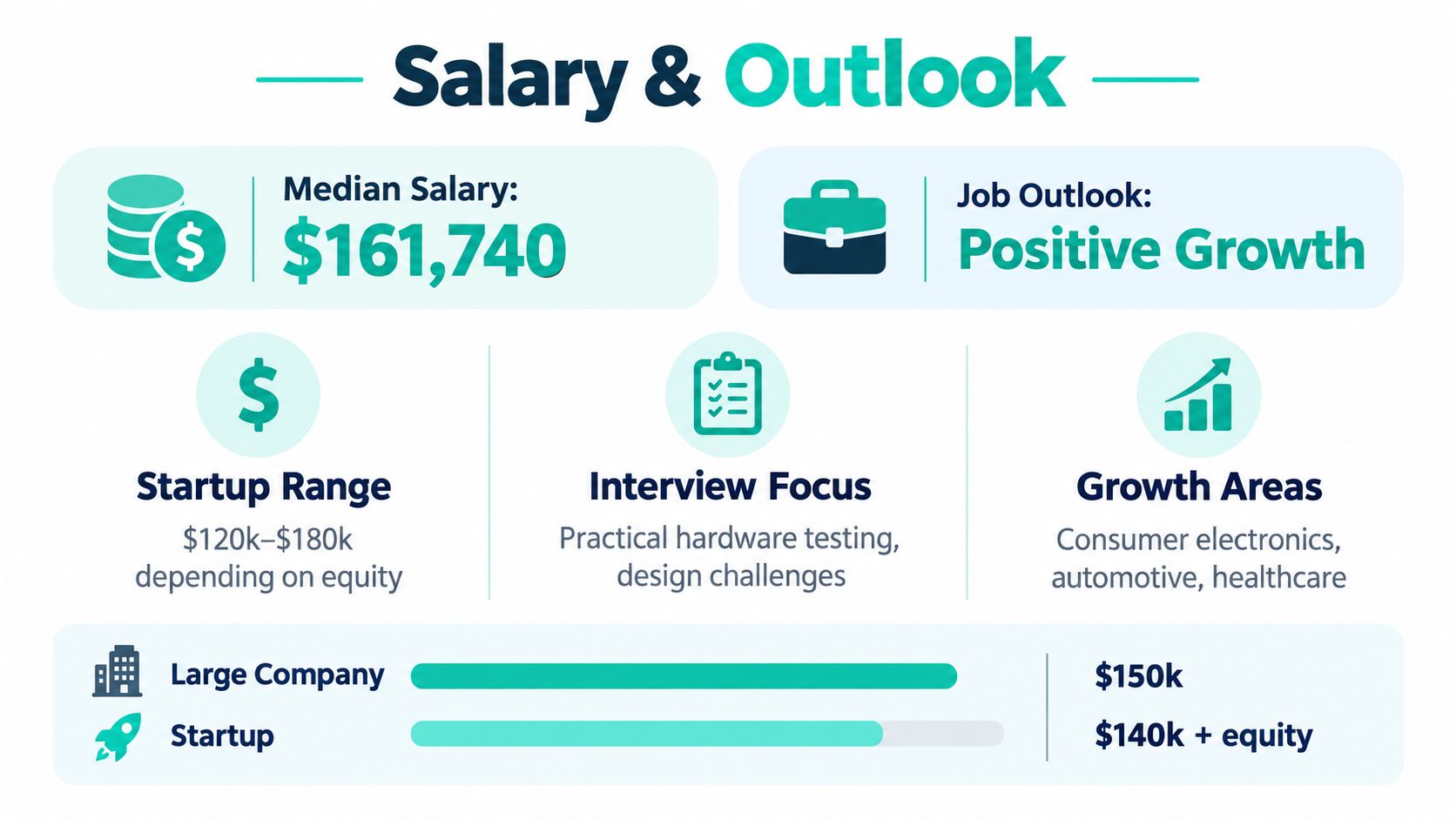
The fastest way to raise your market value is usually to pair solid general hardware judgment with one specialty that is painful to hire for.
Right now, startup demand is uneven. Teams building AI servers, accelerator systems, edge devices, robotics, industrial controls, and power-dense platforms do not shop for talent the same way. High-speed board design, power integrity, silicon bring-up, validation automation, RF, reliability, and manufacturing test often move faster than broad “hardware generalist” roles because fewer candidates can do the work unsupervised.
I have seen this in hiring loops repeatedly. A decent board designer may be replaceable. An engineer who can debug PCIe margin failures, tighten a power rail under load transients, or build validation infrastructure that catches intermittent faults before EVT slips is much harder to find. That difference changes both compensation and interview volume.
Startup interviews usually focus less on polished process and more on whether you can reduce uncertainty quickly.
Hiring teams want evidence that you can make good decisions with partial data, ugly failures, and changing constraints. They care about how you measured the problem, what you ruled out first, which trade-off you accepted, and whether you can work across firmware, layout, test, manufacturing, and sourcing without turning every issue into someone else's problem.
A good startup hardware interview often revolves around stories like these:
If a candidate talks only about design intent and never about debug, I usually assume they have not carried hardware far enough into production reality.
Founders screen for practical failure modes. They are trying to avoid hiring someone who can talk through architecture but stalls when the board is dead, the vendor part is on allocation, or the second build exposes tolerance problems nobody saw in simulation.
| Red flag | What founders hear | Better signal |
|---|---|---|
| “I mainly want to do architecture” | “This person may avoid the bench” | Show real bring-up and debug ownership |
| “Layout isn't really my area” | “Handoff friction ahead” | Explain how you review and constrain layout |
| “Firmware handled that part” | “Weak cross-functional depth” | Describe the boundary and how you worked across it |
For startup roles, proof beats polish. Photos of prototypes, short failure writeups, test setups, fixture design, validation plans, and design review artifacts all help. A clean resume may get a recruiter call. A credible record of building, debugging, and shipping gets the onsite.
A founder posts a role for a "hardware engineer." What they need might be a board designer who can close DDR routing constraints, a validation engineer who can build production test fast, or a power engineer who knows how to keep a dense accelerator system stable under ugly transients. If your profile does not make that distinction obvious, you get screened like a generic candidate for a very non-generic job.
That is the problem with broad job boards. They sort by title. Startup hardware hiring usually sorts by specialization, build stage, and risk.
A curated channel can work better once you know your lane. Underdog.io's startup job board is useful for that kind of search because it puts you in front of startup and high-growth teams without forcing everything through a pure keyword funnel. For hardware engineers, that matters most when the hiring team is trying to match a niche need quickly, especially in areas tied to AI infrastructure, power delivery, high-speed boards, and validation.
Startup teams respond faster when your search materials answer one question clearly: what kind of hardware problems do you solve under pressure?
Use that standard:
I have hired candidates from startup channels who were not the strongest on paper but were much easier to place because they were specific. They said, in effect, "I own board bring-up for mixed-signal systems," or "I build validation plans and production test for first-generation hardware." That clarity cuts a lot of noise out of the process.
If you are using Underdog.io, treat your profile like a technical filter, not a resume dump. Lead with your niche, your build stage experience, and two or three problems you have personally debugged to closure. That gives startup teams enough signal to decide whether to start a conversation.