Read Time: 7 min read
In the hyper-competitive tech landscape, startups can no longer rely on surface-level perks alone to attract top-tier talent. The real advantage lies in building an authentic, compelling employer brand that resonates with mission-driven professionals. This is not about flashy benefits; it is about communicating your value, culture, and vision with intention.
A strong employer brand acts as a magnet, drawing in candidates who are already aligned with your mission, reducing hiring friction, and improving long-term retention. For high-growth companies, mastering this is not just a 'nice-to-have' but a critical growth engine. It shapes your reputation and directly influences who applies, who accepts your offers, and who stays to build the company alongside you. Effectively competing for top talent goes beyond attraction; it deeply involves how you treat and engage your current employees. For more on this, you can explore detailed strategies to enhance employee relations and retain talent that complement your branding efforts.
This comprehensive guide moves past the generic advice to outline 10 actionable employer branding best practices specifically tailored for startups and tech companies looking to hire smarter. We will provide practical examples and concrete steps to help you build a brand that not only attracts but also retains the people who will drive your future. You will learn how to define your Employer Value Proposition (EVP), leverage your team for authentic advocacy, and use storytelling to connect with candidates on a deeper level. Let's get started.
An Employer Value Proposition (EVP) is the foundational promise you make to employees in exchange for their skills, capabilities, and experience. It's the core of your employer brand, articulating what makes your company a uniquely compelling place to work. For high-growth startups and tech companies that cannot always compete on salary alone, an authentic EVP is a critical differentiator. It shifts the conversation from purely transactional benefits to the unique opportunities for impact, growth, and learning that define your culture.
This goes far beyond a generic "we have a great culture" statement. A powerful EVP is specific, genuine, and proven by the lived experiences of your team. It answers the crucial question on every top candidate's mind: "Why should I join your team over any other?"
Developing an authentic EVP is an internal discovery process, not a marketing invention. It requires uncovering the true essence of your employee experience.
Pro Tip: Your EVP is not static. As your startup scales from 10 to 50 to 200 employees, the culture and value proposition will evolve. Revisit and update your EVP annually or after significant company milestones to ensure it remains authentic and relevant.
Your most credible and powerful brand advocates are already on your payroll. Employee advocacy and referral programs systematically empower your team to share company stories, culture, and job opportunities with their personal networks. This strategy leverages the trust and authenticity inherent in peer-to-peer communication, making it one of the most effective employer branding best practices for sourcing high-quality, culture-aligned talent.

This approach transforms your entire workforce into an extension of your talent acquisition team. When an engineer at your startup shares a post about a recent product launch or refers a former colleague for an open role, that message carries far more weight than a corporate social media post or a recruiter's cold outreach. It’s social proof in its most powerful form.
A successful program makes it effortless for employees to participate and rewarding for them to contribute. It’s about building a system, not just asking for favors.
Pro Tip: Actively manage your referral pool to combat homogeneity. Set diversity goals for your referral program and encourage employees to tap into different networks. Ensure every referred candidate goes through the same rigorous, unbiased screening process as any other applicant to maintain a high bar for talent.
For high-growth startups, ambiguity is part of the territory. However, a key employer branding best practice is to be radically transparent about this reality. Instead of glossing over the risks, openly discuss your company's stage, funding status, runway, and the inherent challenges of scaling. This approach builds immediate trust and acts as a powerful filter, attracting candidates who are energized by the startup journey, not just seeking the stability of a larger corporation.
This level of honesty goes beyond culture to cover the business's health and trajectory. It answers the questions every savvy candidate is thinking but might be hesitant to ask: "Is my job secure?" and "What is the real opportunity here?" Companies like GitLab, with its public handbook, and Buffer, famous for its salary transparency, have proven that openness is a competitive advantage.
Integrating transparency into your hiring process means proactively sharing information that others might hide. It’s about giving candidates the full picture so they can make an informed decision.
Pro Tip: Use your founder’s voice. A blog post or a short video from the founder sharing the origin story, key learnings, and future vision is incredibly powerful. This authentic communication provides context and builds a human connection that a standard job description cannot.
Content marketing is a powerful, yet often overlooked, employer branding strategy where you create and distribute valuable, industry-relevant content. Instead of directly advertising jobs, this approach showcases your team's expertise, problem-solving capabilities, and unique culture. It positions your company as a thought leader, attracting top-tier talent organically who are drawn to your team's knowledge and the interesting challenges you're tackling. For startups, this is an efficient way to build credibility and a passive pipeline of candidates.
This tactic serves a dual purpose: it supports product marketing while simultaneously building your employer brand. Companies like Stripe, with their in-depth technical documentation, and Shopify, with their extensive engineering blog, have mastered this. They attract engineers who want to work with the best, proving their expertise long before a candidate ever visits their careers page.
Building a content engine for recruitment is about showcasing the "how" and "why" behind your work, not just the "what." It's an authentic window into your team's daily challenges and triumphs.
Pro Tip: Tag your technical content with the specific technologies and frameworks you use (e.g., #kubernetes, #react, #golang). This is one of the most effective employer branding best practices for attracting specialized talent, as developers often search for content related to their tech stack.
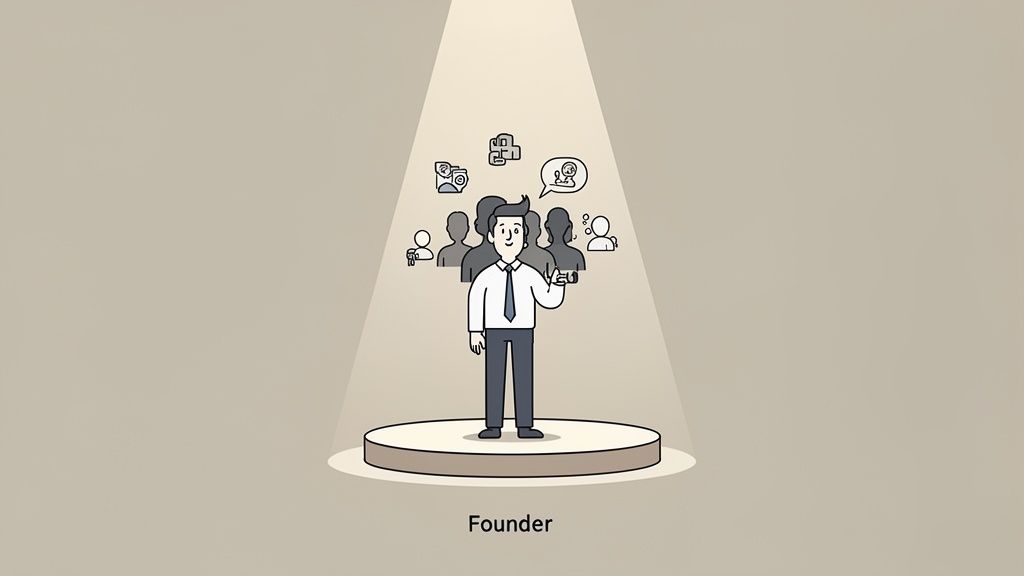
Top candidates don't just join companies; they join leaders. In the competitive tech landscape, the visibility and personal brand of your founders and key executives can be a powerful magnet for talent. When leaders actively share their vision, expertise, and a genuine glimpse into the company culture, they build a direct channel of trust and connection with potential hires long before the first interview. This strategy humanizes the company and answers a critical question for candidates: "Who would I be working for, and do I believe in their direction?"
This approach transforms leaders from distant figureheads into accessible, authentic evangelists for the company's mission and values. For startups, where the founder's vision is deeply intertwined with the company's identity, this is one of the most effective employer branding best practices. It allows candidates like senior engineers or product managers to evaluate leadership philosophy and technical acumen firsthand, which is often a major factor in their decision-making process.
Activating founder and leader visibility requires a strategic, yet authentic, approach. It's about finding the right platforms and formats that align with each leader's personality and the company's goals, not forcing a one-size-fits-all social media presence.
Pro Tip: Establish a lightweight support system for your leaders. This could be a shared content calendar with ideas or a junior marketer who helps ghostwrite initial drafts based on the leader's bullet points. The goal is to make participation easy and sustainable, ensuring authenticity always remains at the forefront.
For high-growth startups, culture isn't just a byproduct of business; it's a strategic asset and a powerful recruitment tool. Mission-driven hiring is the practice of intentionally seeking candidates whose personal values and motivations align with your company's core mission and principles. This approach, championed by thinkers like Jim Collins ("First who, then what"), recognizes that a team united by a shared purpose is more resilient, engaged, and innovative.
This practice transforms your culture from an abstract concept into a tangible differentiator. It attracts candidates who are not just looking for a job, but for a place to make a meaningful impact. For companies like Patagonia, whose environmental mission is central to their brand, this means hiring people who are passionate about conservation. This alignment creates a self-reinforcing loop where the brand attracts the right people, and those people strengthen the brand.
Building a culture-first hiring process requires making your values an explicit, non-negotiable part of your talent acquisition strategy. This is a key employer branding best practice that ensures long-term team cohesion.
Pro Tip: Culture fit is not about hiring people who all look, think, and act the same. Focus on "culture add" by assessing if a candidate's unique perspective and values enhance and reinforce your mission, rather than just conforming to a predefined mold.
Top candidates aren't just looking for a job; they're looking for the right job. A Realistic Job Preview (RJP) moves beyond the polished sales pitch to give candidates a transparent, unvarnished view of the role, team dynamics, and company challenges. This approach is a cornerstone of effective employer branding best practices because it builds trust from the very first interaction and significantly reduces the risk of mismatched expectations, which is a leading cause of early-stage employee turnover.
By being upfront about both the exciting opportunities and the genuine hurdles, you attract candidates who are energized by your specific environment, not just a generic idea of a startup. It's about ensuring mutual fit, which benefits both the candidate and the company in the long run.
Integrating transparency into your hiring process requires a deliberate shift from selling to sharing. The goal is to provide candidates with enough authentic information to make an informed decision about their future with your team.
Pro Tip: Create a "candidate FAQ" document that transparently addresses tough questions about work-life balance, on-call expectations, and the company's biggest obstacles. Sharing this proactively shows confidence and respect for the candidate's time and decision-making process.
For high-growth startups and tech companies, equity is a cornerstone of the compensation package. However, it's often the most misunderstood component, leading to confusion and future resentment. A key employer branding best practice is to demystify equity by proactively educating candidates on its mechanics and potential value, treating it as a core part of total compensation. This transparency builds trust from the very first interaction.
This approach moves beyond simply stating the number of stock options offered. It involves providing candidates with the tools and information needed to understand vesting schedules, strike prices, and potential dilution. By creating an environment of open discussion, you empower candidates to make informed decisions, which significantly reduces the risk of post-hire dissatisfaction and solidifies your reputation as a fair, transparent employer.
Building an education-first compensation strategy requires creating accessible resources and fostering honest conversations. It shows you respect candidates enough to give them the full picture.
Pro Tip: Frame the equity conversation around shared success. Explain how an individual's contribution directly impacts the company's valuation and, therefore, the potential value of their shares. For example, "Hitting our Q4 product goal, which you would lead, is a key milestone for our next funding round, which would increase the value of everyone's equity." This connects their work to financial outcomes.
Facts and figures can attract attention, but stories create connection. Employer brand storytelling is the art of weaving a compelling narrative around your company's mission, its origins, and the people driving it forward. For candidates evaluating dozens of similar tech companies, a powerful story is what makes your opportunity memorable and meaningful. It shifts their perception from seeing just another job to seeing a chance to be part of an exciting journey.
A strong narrative answers the "why" behind your work. It frames the company not just as a business, but as a collective of people on a mission to solve a specific, important problem. This approach helps candidates envision themselves contributing to that mission, creating an emotional investment long before they receive an offer. It is a cornerstone of effective employer branding best practices.
Crafting your narrative involves documenting and sharing the authentic stories that already exist within your company. This isn't about inventing a fictional tale; it's about amplifying the true stories that define your culture and purpose.
Pro Tip: Integrate your core narrative into every touchpoint. Each job description should start with a one-paragraph mission statement connecting the role's responsibilities directly back to the company's overarching purpose. During interviews, encourage hiring managers to share a personal story about a time they felt genuinely connected to the company's mission.
A strong employer brand isn't just about external perception; it's proven by the internal systems that ensure fairness and growth. Combining a data-driven hiring process with transparent career development frameworks sends a powerful message: we hire the best people objectively and are deeply invested in their long-term success. This structured approach moves beyond gut feelings to build a high-performing, engaged, and loyal team.
This methodology uses objective criteria to assess candidates, minimizing bias and improving hiring accuracy. For ambitious candidates, it's a clear signal that the company values meritocracy and provides real opportunities for advancement. It directly answers the question, "If I join, how will you help me grow and succeed?"
Integrating data into your hiring and development practices requires a deliberate and systematic approach. It's about creating repeatable systems that ensure consistency and fairness for every candidate and employee.
Pro Tip: Your hiring process is a rich source of data. Regularly analyze metrics like which hiring sources produce the best long-term performers and validate that your interview rubrics actually predict on-the-job success. This feedback loop is essential for continuous improvement and is a core part of measuring your quality of hire on underdog.io.
We've explored a comprehensive set of employer branding best practices, from crafting an authentic Employer Value Proposition (EVP) to ensuring equity transparency and structuring data-driven interviews. Each strategy is a powerful lever in its own right, but their true impact is realized when they are woven together into a cohesive, consistent, and authentic narrative. Your employer brand isn't a marketing campaign you launch; it’s the lived experience of your candidates and employees, day in and day out.
For a startup or high-growth tech company, this isn't just a "nice-to-have." It is the foundation of your talent acquisition strategy. When you can’t compete with the massive salaries and lavish perks of Big Tech, you compete on mission, impact, culture, and growth. Your brand is the story that communicates that value proposition, attracting individuals who are energized by your challenges and aligned with your vision. It’s the reason a top engineer chooses your early-stage venture over a secure role at a FAANG company.
Remember, every touchpoint matters. A founder's candid blog post about a recent failure, a transparent conversation about equity during an interview, or a well-structured onboarding plan that sets a new hire up for success; these are the moments that build a magnetic and resilient employer brand. Authenticity is your most valuable asset.
As you leave this guide, focus on turning these insights into action. The most successful companies don't just talk about their culture; they operationalize it through their hiring and people processes.
Ultimately, mastering these employer branding best practices is about building a sustainable talent engine. It’s how you move from reactive hiring to proactively attracting a pipeline of mission-aligned talent. This strategic investment will pay dividends not only in the quality of your hires but also in employee engagement, retention, and your company's overall success. By consistently demonstrating who you are and what you stand for, you attract the right people who will not just fill a role, but will help you build the future.
Ready to connect your powerful employer brand with top, vetted tech talent? Underdog.io curates a community of candidates actively seeking opportunities at innovative companies just like yours. Stop sorting through endless applications and start engaging with high-intent professionals who are already excited about your mission. Build your talent pipeline on Underdog.io today.
Employer branding is your company's reputation as a place to work, shaped by both your internal culture and how you communicate it externally. It's critical because today's candidates, especially in tech, extensively research companies before applying. A strong, authentic employer brand reduces cost-per-hire, increases offer acceptance rates, and builds a sustainable pipeline of qualified, culturally-aligned talent.
The biggest mistake is inauthenticity—promoting a culture or values on a careers page that don't match the day-to-day employee experience. This quickly leads to negative reviews on sites like Glassdoor and high turnover, which damages the brand further. The foundation of any employer branding effort must be a genuine, positive internal reality.
Your brand should be communicated at every touchpoint: your company careers page, job descriptions, social media (especially LinkedIn and platforms like Instagram for culture), employee review sites, and during the interview process itself. It should also be reflected in your onboarding experience and how you treat departing employees.
Empower your employees to be authentic brand ambassadors. This can include structured programs like employee testimonials, "day in the life" features, or takeovers of company social media accounts. Encourage and make it easy for them to share their experiences on their personal networks. Employee-generated content is often viewed as more trustworthy than corporate messaging.
Track metrics that correlate with brand strength, such as: quality of applicants (not just quantity), source of hire (increase in direct applications or referrals), cost-per-hire reduction, time-to-fill, offer acceptance rates, and employee retention rates. Regularly monitoring sites like Glassdoor for review trends and sentiment is also a key qualitative measure.
Your career site is the central hub of your employer brand. It should go far beyond a list of open jobs. It must tell your company story, showcase your mission and values, highlight your culture through videos and photos, introduce team members, and transparently detail benefits, growth paths, and what makes working there unique.
Focus on low-cost, high-impact actions. Start by ensuring a stellar candidate and new-hire experience, as word-of-mouth is powerful. Encourage and spotlight authentic employee stories on LinkedIn. Be responsive and professional on review sites. Clearly articulate your mission and team culture in every job description. Consistency and authenticity often outweigh a large budget.