You're comparing two startup offers at 11:47 p.m., both from founders who swear the number is fair and both with equity sheets that are hard to decode. One offer says $135k base, the other says $115k base plus a heavier option grant, and the recruiter keeps telling you the difference is “just personal preference.” It isn't. In early-stage hiring, the cash number is only the front line of a much bigger trade, and if you treat it like a normal salary negotiation, you'll miss the part that matters.
The first mistake candidates make is staring at the higher base and calling it the safer deal. The second mistake is doing the opposite, getting seduced by equity language and assuming the lower cash offer is automatically the smarter bet. Both are lazy reads.
If you're looking at two seed-stage offers, you're not just comparing paychecks. You're comparing runway risk, stage risk, team risk, and how much upside the company is handing you in exchange for lower cash. That's why the printed salary is the least interesting number on the page.
A sharper way to think about it is this, the $135k base offer may be better if you need stability, but the $115k base offer may be the better risk transfer if the company is earlier, the equity grant is meaningful, and the role is one where upside can compound. That trade only makes sense if you can survive the lower cash without stress. If the lower salary forces you to raid savings or rack up debt, you're not buying upside, you're subsidizing the company.
Practical rule: if the cash difference would change how long you can comfortably stay in the job, the base salary matters more than the equity story.
The smartest candidates separate the question into two parts. First, can I live on this cash? Second, is the upside worth the risk I'm taking on? That second question is where most candidates underprice themselves, because they never ask what stage the company is in, how much runway it has, or whether their role is one of the few where lower salary can be offset by real equity.
A founder offering a pre-seed role is buying something different from a Series A company. At pre-seed, the company is still proving the product and squeezing every dollar. At seed, there is some capital, some proof, and a real team, but salary still has to stay tight. By Series A, the company has more structure, more headcount, and a stronger expectation that comp is closer to market.
That stage shift is what changes the risk transfer. Early-stage pay is not just a salary number, it is cash the company keeps and risk the candidate absorbs. Ravio's startup salary trends show the pattern clearly. Their 2026 data puts pre-seed and seed salaries at £62,900 in the UK, while late-stage startups pay 31 to 34% more for senior roles across functions. Ravio also reports that early-stage software-engineer growth has stayed modest, with P3 engineers up 1.6% year-on-year in 2025 and M3 senior engineers up 1.7%. The message is blunt, early-stage compensation stays constrained even in roles where hiring pressure is real. Ravio's startup salary trends
Read the company stage before you talk about salary. The public clues matter more than the polished pitch.
If you are also a founder or operator thinking about your own pay, stay IRS compliant with salary planning is a useful outside reference, because compensation discipline is not just a startup hiring issue, it is a planning issue too. For candidates, the takeaway is simple, stage tells you what is negotiable and what is not.

Public job listings reflect the same pattern, which is why browsing startup roles with more context is smarter than comparing raw salary screenshots. A candidate who knows the stage can judge how much cash to trade for equity without guessing.
Role matters as much as stage, and often more. Seed-stage pay is not one clean band, it is a stack of different markets layered on top of each other. A technical hire, a product hire, and a sales hire do not face the same salary logic, even when they sit in the same office and report to the same founder.
Seed-stage engineering cash can be all over the map. Kruze's compensation guide says entry-level engineers may be offered $75k to $105k, while very senior engineering talent in the Bay Area can reach $180k to $235k. TechCrunch's summary of the same data shows midlevel engineering at $100k to $145k in the Bay Area and $90k to $130k elsewhere. That spread matters because entry-level software engineering is already close to market pricing, which leaves less room for a founder to compensate a weak cash offer with equity alone. Kruze's startup compensation guide and TechCrunch's seed-stage benchmark summary point in the same direction.
Product holds up well in stronger markets too. TechCrunch's benchmark data puts product roles at $130k to $185k in the Bay Area, which means product can match or beat engineering at the midpoint. Design and marketing are usually less standardized, but they are not automatically cheap. Founders still pay for people who can ship, iterate, and support growth without a long ramp.
Sales is where salary elasticity is most obvious. A 2025/2026 talent-insights discussion notes that sales can range from $50k base for a BDR to $150k to $250k base for a head of sales. That is a huge spread, and it explains why sales offers are negotiable in a way entry-level engineering often is not. If the role directly drives revenue, founders can move cash more easily. If the role is pure execution, they usually cannot.
A better way to read the role mix is to ask how much cash a candidate can safely trade for equity. In engineering and product, the answer is usually limited, because the market keeps those salaries relatively tight. In sales, the trade can be bigger, especially if quota responsibility and commission upside are strong. For a broader framing on how role type changes compensation tradeoffs, this startup equity compensation guide is useful context.
| Seed-Stage Startup Cash Compensation by Role | Bay Area Base | Rest of US Base | Salary Elasticity |
|---|---|---|---|
| Engineering, entry-level | $75k to $105k | Not separately priced in the cited data | Low |
| Engineering, midlevel | $100k to $145k | $90k to $130k | Low to moderate |
| Engineering, senior | $180k to $235k | Not separately priced in the cited data | Low |
| Product | $130k to $185k | Not separately priced in the cited data | Moderate |
| Sales, BDR to head of sales | $50k to $250k base depending on level | Not separately priced in the cited data | High |
The blunt takeaway is simple. Some roles are market-priced, and some still have room to negotiate. If you are in engineering or product, do not assume cash is wildly flexible. If you are in sales or another revenue-linked role, push harder.
Cash is only part of the risk transfer. If a startup cannot pay at the top of band, it has to make up some of that gap with equity or with affordable benefits packages for small businesses, because benefits can change the take-home value of the offer.
Base salary is only the cash layer. The rest of the offer sits in equity, vesting, benefits, and the occasional signing bonus. At early-stage companies, those pieces can matter a lot, but only if you know what each one is worth.
A simple example makes that clear. 80000 Hours summarizes an early-stage backend developer package at about $110,000 in salary plus 0.7% equity, and says the average early startup employee earns about $131,000 per year in total compensation when salary and equity are combined. That does not mean every 0.7% grant carries the same value. It means equity can close part of the cash gap, but only if the company exits, dilution stays manageable, and the grant is large enough to matter. 80000 Hours' startup salaries and equity overview is a useful reminder that salary alone understates the offer.
Do not pretend you can price equity perfectly. You cannot. What you can do is sanity-check it.
Equity only matters if the company gets to a liquidity event. Until then, it is a claim on a future outcome, not spendable income.
Use three questions:
That framework keeps you honest. It also stops you from overrating tiny grants that look attractive on paper but will not change your life. Vesting schedules matter too, because the company pays that equity out over time, not on day one.
Benefits are less glamorous, but they still move the number. A startup that covers health insurance, offers remote stipends, or adds a small sign-on bonus is giving you cash relief in a different form. For small teams trying to build a workable package, affordable benefits packages for small businesses is a useful reference point for the kind of non-salary support that can soften a lean offer.
If you want a closer look at how ownership fits into a startup package, equity compensation for startups is the right companion piece. The rule is straightforward, if base salary is low, the equity and benefits need to be real, not decorative.
A seed-stage startup offer and a Big Tech offer are not cousins. They're different products. One is a concentrated bet on company growth, the other is a more liquid compensation machine with richer cash flow and lower variance.
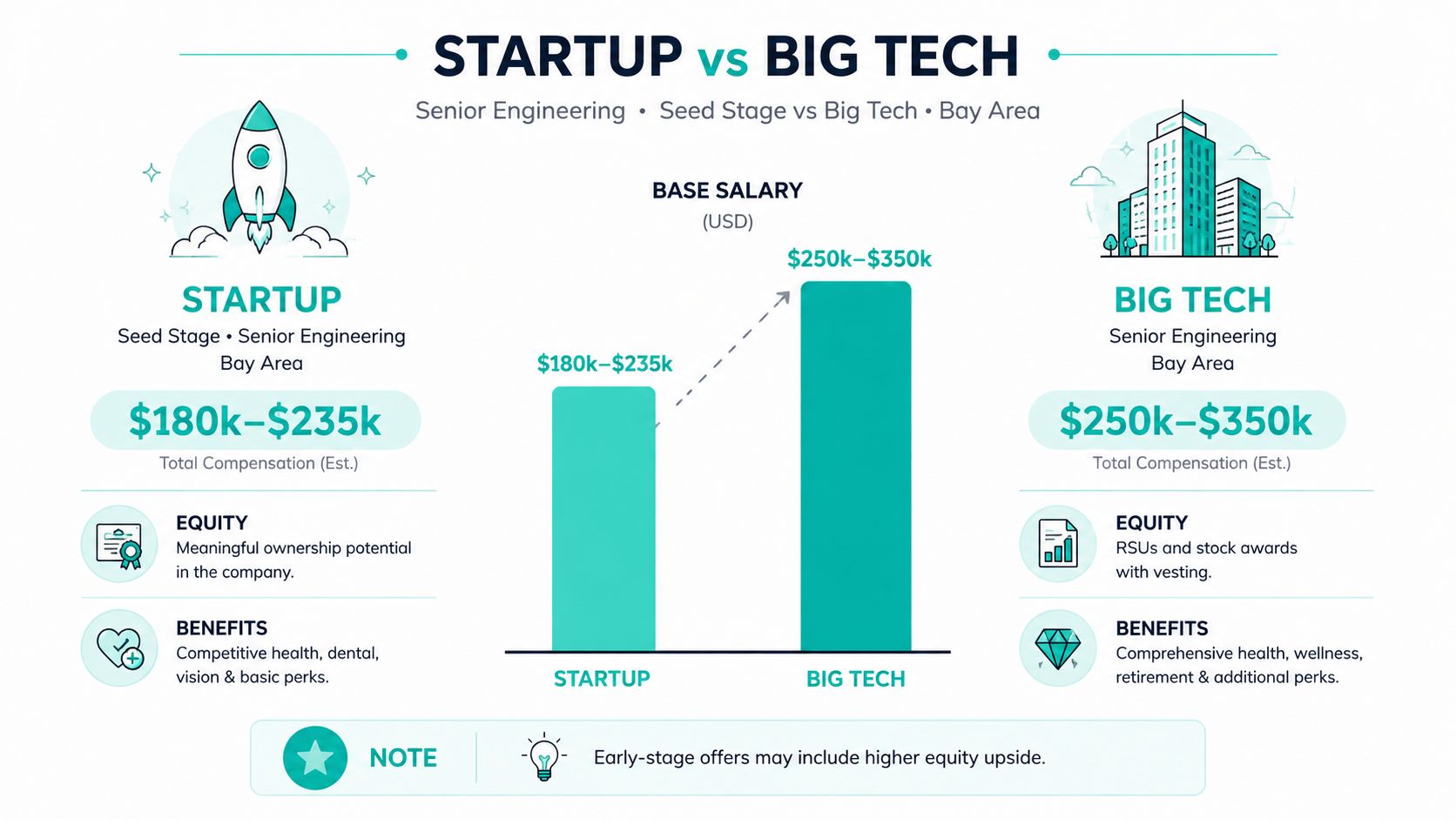
For senior engineering in the Bay Area, startup cash can sit at $180k to $235k at seed stage, but Big Tech packages at the same level often land much higher once you add RSUs, bonuses, and refreshers. The practical gap is usually too large to hand-wave away. If you're choosing between them, don't ask whether startup equity can “make up the difference” in abstract terms. Ask whether you're willing to trade steady, liquid comp for a shot at a much less certain outcome.
That's where candidates fool themselves. They hear “upside” and assume the equity will behave like a bonus. It won't. Equity can win big, but it can also do nothing for years. Big Tech cash and stock is much more predictable.
You give up liquidity, predictability, and a clean benchmark for performance. In return, you get more direct exposure to company upside, faster responsibility, and usually a tighter link between your work and the business outcome.
The right comparison is personal. If you need maximum cash, take the more liquid package and stop pretending otherwise. If you want ownership and can tolerate volatility, the startup offer may still be the better trade. Early-stage offers may include higher equity upside, but upside is not the same thing as certainty.
The messiest part of startup comp is that every source tells a slightly different story. That's not a bug. It's what happens when stage, geography, sample size, and role mix change the outcome. You need to benchmark the offer against the right peer group, not against whatever salary chart showed up first in your feed.
Pilot's 2025 Founder Salary Report is a good warning sign here. It found that 60% of founders paid themselves less than $100,000, and the median founder salary fell 43% from $132,000 in 2024 to $75,000 in 2025. That kind of swing is exactly why you should be suspicious of any single compensation headline that claims to describe “the market.” The sample might be real, but the context may not be yours. Pilot's 2025 Founder Salary Report shows how much comp can shift by data source alone.
Use a short checklist every time:
That's the difference between a useful benchmark and a false anchor. Recruiter conversations still matter because they tell you what's moving right now, but they need to be checked against data. For a broader view of how founders and candidates can compare ranges, startup compensation benchmarks is a helpful reference.
The blunt truth is that you're looking for consistency across sources, not a perfect number. If the comp is far below the right peer group, push. If it's above, ask why. Sometimes there's a real reason, like a critical hire or a role that directly generates revenue. Sometimes the company is just overreaching.
“Final” usually means “we'd rather not go back to the founder.” It doesn't always mean the number won't move. Early-stage companies don't have the rigid compensation machinery that later-stage firms do, so the people making the decision often have more discretion than they admit.
The best moves are the ones that respect runway. Lead with the fact that you're excited, then be specific about what would make the offer workable. If you have two offers, anchor with the better one. If the base won't move, ask for equity, a sign-on bonus, or a six-month comp review tied to clear goals. If the team is cash-tight but flexible on lifestyle, ask whether remote flexibility, vacation timing, or benefits can offset part of the gap.
Ask for the thing that changes your life, not the thing that flatters the spreadsheet.
Tone matters. Be direct, not dramatic. Give the founder a reason to say yes without making it feel like a verdict on their judgment. And get the change in writing before you sign. Verbal promises disappear fast when a round closes late or a hiring manager gets busy.
For a grounded look at how to frame this conversation, cash offer negotiation advice can help you keep the ask practical instead of vague. Use it as prep, then tailor your ask to the actual tradeoffs on the table.
I've seen candidates lose money by negotiating the wrong lever. Don't spend your capital asking for a tiny base increase if the founder can more easily improve equity or timing. Push where the company has actual room.
Run every offer through four buckets, cash, equity, mission, and learning. Score each one against your own situation, not against someone else's startup story. If you need stability, cash gets the heaviest weight. If you're early in your career and want reps, learning may matter more. If you believe in the market and the team, mission and equity can carry more weight.
Before you accept, ask the founder four questions. How much runway is left? When is the next raise expected? When was the last comp change? How have similar hires been granted equity? If the answers are fuzzy, the package probably is too.
Early stage startup salary is best treated as a risk-transfer decision, not a salary lookup. The right number depends on what you're willing to trade, and whether the trade is smart for your stage in life.
If you're weighing a startup offer right now, use Underdog.io to compare roles at curated startups and high-growth tech firms without guessing at the market. It's built for candidates who want a clearer read on compensation, equity, and fit before they waste time in the wrong process.