Training your hiring managers is the first real step in ditching inconsistent, ‘gut-feel’ hiring for a process that actually works and scales. It’s about giving your managers the right tools to run interviews that are fair, objective, and legally sound—so you can spot top talent every single time. For a startup, this isn’t just a nice-to-have; it's a core operational upgrade you need to build a killer team.
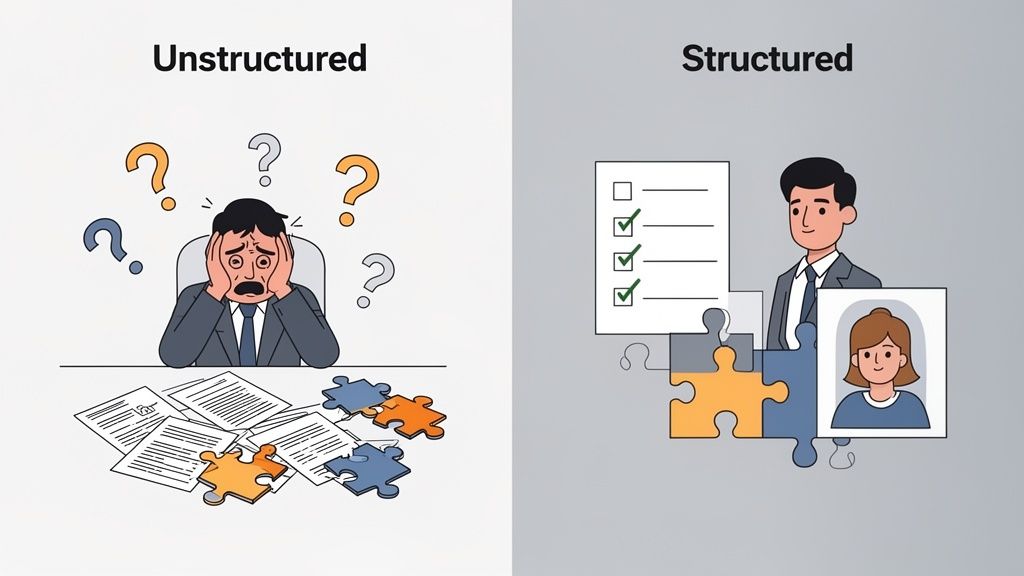
In a startup, every single hire carries enormous weight. The right person can fast-track product development or unlock a new market. The wrong one drains resources, kills momentum, and poisons morale.
And yet, so many startups still rely on unstructured, "go-with-your-gut" interviews. This approach isn't just inefficient—it’s a massive business risk. When every manager asks different questions and judges candidates on subjective feelings, hiring becomes a lottery. You can't compare candidates fairly, and decisions often come down to who "felt" like a better fit.
The problem only gets worse as you scale. An untrained manager becomes a bottleneck, unable to consistently pinpoint the skills that actually matter for a role. This leads to some very real costs:
The biggest problem with unstructured interviews is they just don't predict job performance. They mostly test how well someone interviews, not how well they'll actually do the job. A structured approach, grounded in what the role actually requires, is the only way to make consistently better hires.
The pressure is mounting. In today's tech hubs like New York City and San Francisco, hiring managers are getting slammed. Teams interviewed around 40% more applicants per hire in 2024 than they did in 2021.
For demanding roles like product management, the interview hours per hire can hit a staggering 33.6—the highest of any position. This firehose of candidates makes a standardized process absolutely essential. Without formal training, managers simply can't handle the load, leading to burnout and bad decisions.
To get a deeper look into the systemic issues, it’s worth understanding why job interviews often fall short. Ultimately, investing in interview training for your hiring managers isn't a luxury. It’s a necessary upgrade for any startup that's serious about building a world-class team.
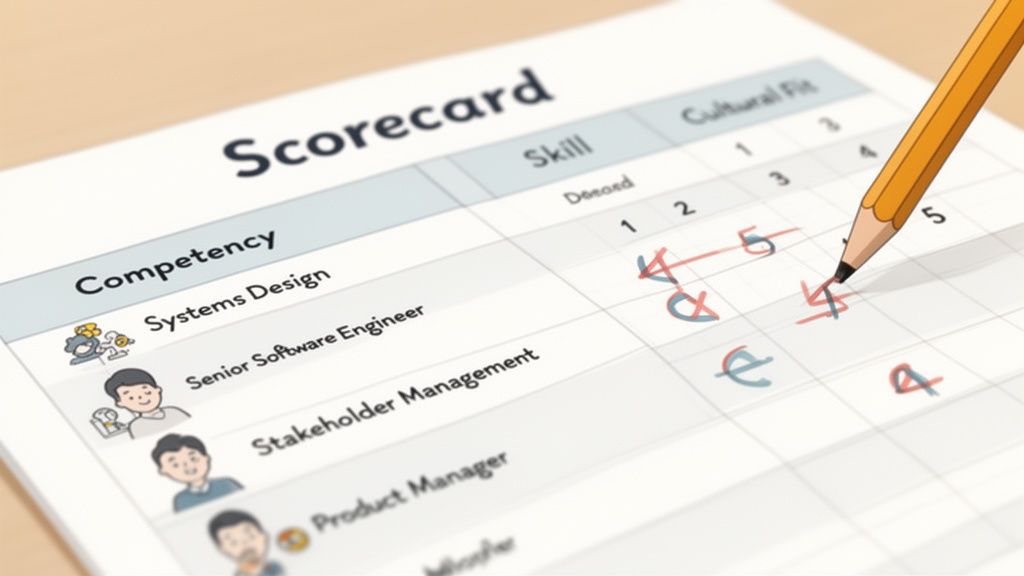
Let’s be honest: effective hiring really boils down to having a clear, shared definition of what “good” actually looks like for a role. Without one, you’re just hoping different interviewers stumble upon the same conclusion. That’s a recipe for inconsistent, biased hiring.
This is where role-specific interview scorecards come in. They are easily the single most powerful tool you can introduce in your hiring manager interview training. A scorecard forces your team to ditch the guesswork and get aligned on the core competencies, skills, and values that genuinely predict success.
This isn't just a nice-to-have; it's how modern teams hire. Today, 72% of companies use structured interviews to standardize their assessments. This approach moves the focus from subjective feelings to tangible skills, a shift that's transforming how high-growth startups find top talent. For more on this trend, you can check out the latest recruiting statistics and see how companies are using rubrics to sharpen their hiring.
Your first move is to break down the role into its most essential parts. Don't just copy and paste the job description—that’s a common mistake. Instead, sit down with the hiring manager and pinpoint the three to five most critical "must-have" attributes.
A great scorecard isn't just a long list of skills. It should be built on a few key pillars:
Once you’ve got these pillars, define what different levels of performance actually look like. A simple 1-to-5 scale is fine, but the real value comes from writing clear descriptions for what each number means. This anchors the entire conversation in evidence, not just gut feelings.
Let’s make this real. A generic template is a decent start, but the magic happens when you tailor it to the specific role you're hiring for.
To give you a clearer picture, here’s what a detailed scorecard for a senior engineering role might look like.
This detailed rubric gives the interviewer a clear, objective guide. Instead of just jotting down "good at systems design," they can map the candidate's response directly to a defined performance level.
A well-designed scorecard is a conversation guide, not a checklist. It prompts the interviewer to dig deeper on the things that matter most, ensuring you gather the specific evidence needed to make a confident, data-backed decision.
By equipping your team with objective tools like these, you empower them to move from subjective "gut feelings" to evidence-based evaluations. It's a foundational step in any hiring manager training program that drives fairness, consistency, and a much higher chance of making the right hire.
A great scorecard sets the target, but a strategic question bank is how you actually hit it. Just winging it with classics like "What are your weaknesses?" isn't going to cut it. You'll get rehearsed, generic answers that tell you nothing about how someone actually performs.
The whole point is to gather concrete evidence, not just gut feelings. This is where your hiring manager training needs to zero in: equipping your team with a solid bank of questions that map directly to the competencies on your scorecard. This ensures every interview is a fact-finding mission, not just a friendly chat.
Behavioral questions are the absolute bedrock of a strong interview. They work on a simple but powerful premise: past performance is the best predictor of future success. Instead of asking what a candidate would do, you ask them what they did.
The trick is to frame questions that force them to tell a detailed story.
See the difference? The second question pushes for a real-world example, revealing their actual collaboration style, conflict resolution skills, and sense of ownership.
While behavioral questions look to the past, situational questions test how someone thinks on their feet. You give them a realistic, role-specific scenario and ask, "What would you do?" This is gold for seeing their thought process in action, especially for technical and leadership roles.
In a fast-moving startup, these questions are perfect for sussing out adaptability and resourcefulness.
Example for a Product Manager Role:
"Imagine we've just received a wave of user feedback indicating a core feature is confusing. At the same time, the engineering team is at full capacity working on a different priority for our biggest client. What are your first three steps?"
There's no single "right" answer here. What you're looking for is how they think—their ability to prioritize, manage stakeholder expectations, and make smart decisions under pressure.
A random spray of questions is a waste of everyone's time. Your question bank needs to be tightly organized around the competencies you defined in your scorecard. This creates a clear, undeniable link between what you ask and what you're measuring.
Let's say one of your core competencies is "Bias for Action."
By having a few pre-vetted questions for each competency, you empower every interviewer to gather the specific evidence they need to score a candidate accurately. It’s a framework that brings both structure and flexibility to your process.
Don't force every manager to start from scratch. Encourage your team to collaborate on a shared library of questions that have proven effective. As your startup interviews for more roles, this bank becomes an incredibly valuable asset that just keeps getting better.
To get the ideas flowing, look for inspiration everywhere. Even questions from different industries can spark great ideas. For instance, reviewing these essential restaurant manager interview questions can show you new ways to probe for leadership and operational skills—concepts that are totally transferable. The goal is to build a resource that helps your team ask smarter, more insightful questions every single time.
You’ve done the hard work of building a solid scorecard and question bank. Now comes the moment of truth: the interview itself. This is where your investment in training hiring managers really shines, turning what could be a subjective chat into a structured, evidence-gathering exercise. The entire goal is to create an environment where every single candidate gets a fair shot to show you what they can do.
That means actively fighting the unconscious biases that can sneak into even the most well-intentioned interviews. We all have them. The most common culprits are affinity bias (we naturally lean toward people who remind us of ourselves) and the halo effect, where one impressive trait—like graduating from a top-tier university—makes us view all their other skills through rose-colored glasses.
Consistency is your single best defense against bias. When every candidate walks through the exact same core experience, you’re creating a level playing field. It makes your final comparisons far more objective and reliable.
Here is a simple, actionable script managers can adapt:
The best interviewers I’ve worked with act more like investigators than judges. Their job isn’t to form an instant opinion. It’s to systematically collect evidence that maps back to the core competencies of the role. A structured process is what makes that possible.
The shift to remote work has completely rewritten the interview playbook. Video interviews are now standard operating procedure for most startups, and they demand a whole new set of skills from hiring managers. For a deeper dive, our guide on how to succeed in virtual interviews and hire remotely is packed with practical tips.
The data makes it clear how big this shift is. In 2023, 69% of US employers used video interviews, a massive 57% jump from pre-pandemic days. But this convenience has a dark side: a staggering 52% of job seekers say they’ve been ghosted after an interview, and almost none of them get useful feedback. Quality training ensures your managers run remote interviews that are engaging and professional, which is critical for protecting your startup's reputation. You can learn more about the latest job interview statistics in the US to see how these trends are shaping what candidates expect.
Beyond just being fair, legal compliance is completely non-negotiable. A single illegal question can expose your startup to serious risk. Your training absolutely must draw a clear, bright line around topics that are off-limits because they touch on protected characteristics under Equal Employment Opportunity Commission (EEOC) guidelines.
Train your managers to steer clear of any questions about:
It’s all about reframing the question to focus on the job itself. Instead of asking a risky question like, "Do you have kids?", a manager should stick to the actual job requirement: "This role requires occasional travel and some work outside of standard business hours. Are you able to meet that requirement?" This simple pivot keeps the conversation focused on the role while respecting legal boundaries.
Great hiring isn't a solo performance; it’s a team sport. Even with the best scorecards and question banks, interviewers can start to drift. One person's "3 - Meets Expectations" slowly becomes another's "4," and before you know it, you're not evaluating candidates against the same standard. This is where a data-driven feedback loop is your best friend.
The goal is simple: move beyond siloed opinions and make decisions based on collective, evidence-based insights. Structured debrief meetings and calibration sessions are the tools that get you there. They create a dedicated space for your hiring team to align their standards, challenge each other's assumptions, and ultimately make faster, higher-quality decisions.
A fair process is really a system, moving from standardizing your inputs to guiding evaluations with data and ensuring you're compliant along the way.
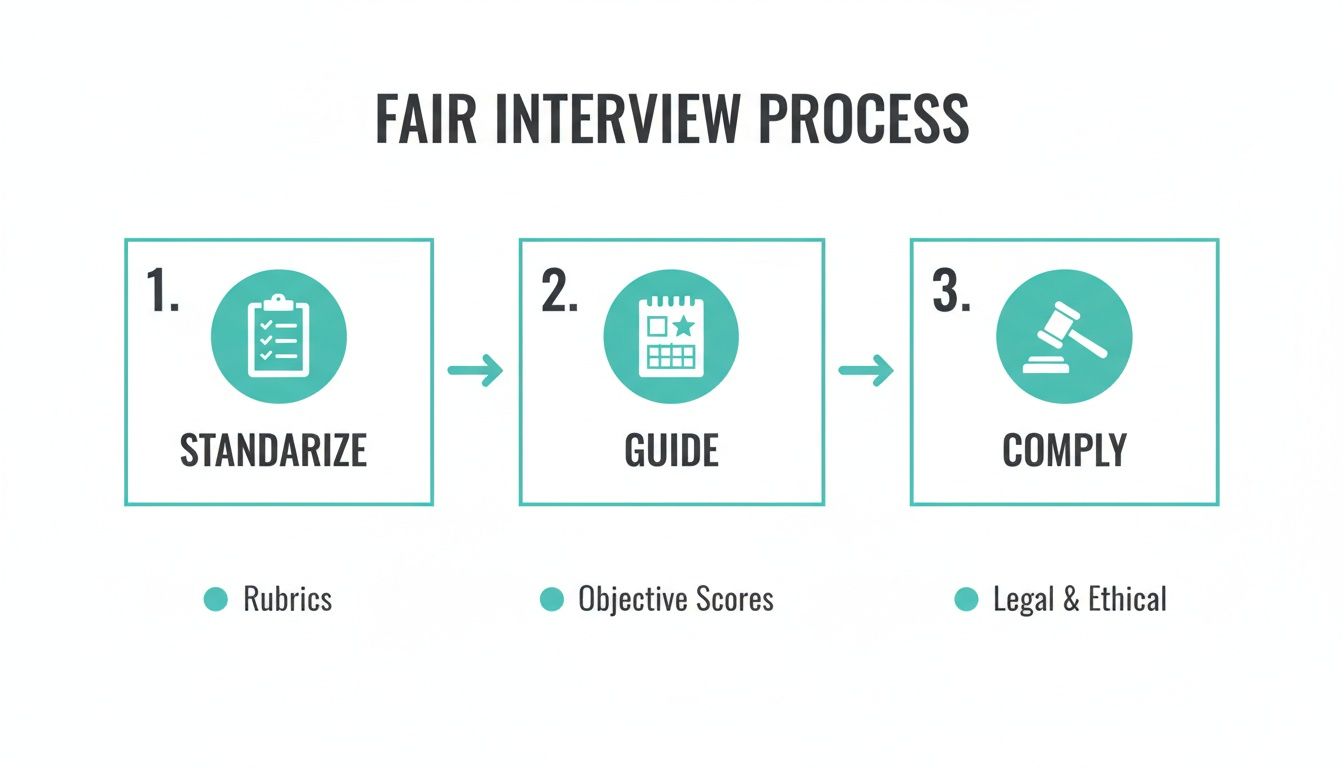
This system is what turns hiring from a subjective art into a measurable, team-wide skill.
A well-run debrief is probably the single most effective way to improve hiring decisions. It forces the conversation away from vague "gut feelings" and anchors it in the evidence collected on the scorecard. Without structure, these meetings can easily devolve into a debate where the loudest or most senior voice wins.
Here is a practical agenda for a 30-minute debrief:
Interviewer calibration is a proactive training exercise designed to make sure everyone is using the same yardstick. It's a critical part of any hiring manager's training. You know you're doing it right when any two interviewers on the team would score the same candidate response in a similar way.
There are a couple of practical ways to make this happen:
Calibration ensures fairness. It's the process of making sure that a candidate's success doesn't depend on which interviewer they happen to get. It’s about building a system where the process, not individual preference, drives the outcome.
Finally, you need data to see if your interview process is actually working. A few simple metrics can shine a light on interviewer effectiveness and highlight specific people who might need a bit more coaching. Don't overcomplicate it—just start with a few key indicators.
This table outlines a few key performance indicators to track and improve the quality and consistency of your interview team.
Interviewer Effectiveness Metrics
These metrics provide a quantitative feedback loop. When you pair this data with the qualitative insights you get from calibration sessions, you create a powerful system for continuous improvement.
This is how you turn your entire hiring team into a well-oiled machine, one that consistently identifies and closes the best talent for your startup. To go even further, consider exploring different quality of hire metrics to measure the long-term success of your hires.
Rolling out a structured interview process is a big change, especially at a startup that’s used to moving a million miles an hour. It’s totally normal for questions—and even a little pushback—to come up.
Let's walk through some of the most common hurdles you'll likely face and how to handle them. Think of this as your playbook for getting everyone on board.
This is always the first question, and it’s a fair one. When your engineering and product teams are already stretched thin, the last thing they want is more process getting in the way. Building scorecards and question banks sounds like a lot of extra work.
Here’s the thing: it’s a small investment of time upfront that pays you back tenfold in speed later.
Structured interviews make the decision-making part of the process ridiculously fast. When everyone is grading candidates against the same clear criteria, your debrief meetings stop being long, drawn-out debates based on gut feelings and turn into focused, decisive conversations.
The trick is to not boil the ocean.
Another big fear is that structure kills the vibe. Managers who are great at building rapport worry that following a scorecard will turn a natural conversation into a stiff interrogation.
The truth is, a good framework actually leads to better conversations.
Structure provides a consistent guide, not a rigid script. It makes sure you cover the must-have competencies for every single candidate, which is the cornerstone of a fair process. The 'art' of interviewing—building rapport, digging in with follow-up questions, and selling your startup's vision—still shines through.
A well-trained manager uses the scorecard to guide the chat, which frees up their mental energy to actually listen and engage with what the candidate is saying. It’s the difference between wandering around a new city without a map and having one in your back pocket. The map doesn’t ruin the adventure; it just makes sure you get where you’re going.
This one can be tricky. You’ve got seasoned managers who have been hiring for years and trust their gut instinct. They’ve seen it all, and their methods have worked for them so far.
The best way to win them over is with cold, hard data and objective results.
Frame this training as an upgrade to their toolkit, not a criticism of how they've done things in the past. Talk about the business impact. Explain how a structured process directly lowers the risk of a mis-hire—something every manager has felt the pain of and wants to avoid.
An interviewer calibration session is your secret weapon here. When a senior manager watches the same interview as a colleague and sees their scores are wildly different, the lightbulb goes on. It makes the need for a shared standard undeniable in a way no slide deck ever could.
Formal training moves interviews from informal conversations to structured, predictive evaluations. It equips managers with consistent techniques to accurately assess skills and cultural fit, reduces unconscious bias that can lead to poor hires, and ensures a positive candidate experience that protects the company's employer brand.
A strong program covers legal basics (what you can and cannot ask), structured interview techniques (using consistent, job-relevant questions), effective scoring rubrics to evaluate answers objectively, active listening skills, and best practices for selling the role and company to top candidates.
How can we reduce unconscious bias in the interview process?
Training should focus on concrete tactics: using a structured interview format where all candidates are asked the same core questions, implementing scorecards based on pre-defined competencies, focusing on past behaviors and results (using the STAR method), and conducting calibration sessions where interviewers compare notes and challenge each other's assessments.
A structured interview uses a standardized set of questions directly tied to the job's required competencies. Every candidate is asked the same questions in the same order, and answers are scored on a consistent rubric. This method is scientifically proven to be more reliable, fair, and predictive of job performance than unstructured, free-flowing conversations.
Preparation is key. Managers should thoroughly review the candidate's resume and the job description, prepare a structured list of behavioral and situational questions, and familiarize themselves with the evaluation scorecard. They should also block out time immediately after the interview to document detailed notes and scores while the conversation is fresh.
The hiring manager is the most critical salesperson for the role. Training should include how to articulate the team's mission, the impact the candidate can have, the growth opportunities available, and the company's culture authentically. A great interview is a two-way street where the candidate also feels excited about the opportunity.
Track quality-of-hire metrics, such as new hire performance ratings, retention rates at the 6-month and 1-year marks, and hiring manager satisfaction with the process. Regularly survey candidates about their interview experience and monitor for consistency in feedback among interviewing panels.
The biggest mistake startups make is trying to do everything at once. They get bogged down creating perfect scorecards for every possible role, momentum dies, and the whole initiative fizzles out.
The best first step is always the smallest one that delivers real value.
This step-by-step approach makes the change feel manageable and proves the value of proper interview training in a way no one can argue with.
Finding the right talent is the fuel for your startup's growth. Underdog.io specializes in connecting high-growth tech companies with a curated pool of top-tier, vetted candidates in engineering, product, and design. We cut through the noise so you can focus on building your team. Learn more and see the talent in our network.