You’ve made it. After all the applications, interviews, and nail-biting, the offer letter is finally in your inbox. That’s a huge milestone, but don't pop the champagne just yet. The email you send to accept the offer is more than just a simple "yes"—it's your first official move as a new team member.
A well-written acceptance email is an actionable tool. It confirms your enthusiasm, reinforces the professional impression you've already made, and gets the final, practical details down in writing. Think of it as the final, confident handshake that kicks off your new role on the right foot.
Every single interaction you have with a potential employer matters, and this last one is no exception. For everyone, but especially for international job seekers navigating a new market, this email is your chance to project confidence and total clarity. It serves as the official written record of your agreement and sets the tone for your entire onboarding experience.
Let's not forget how hard it was to get here. The average job seeker sends out anywhere from 32 to over 200 applications just to land a single offer. Cold online applications have an absolutely brutal success rate, hovering between a mere 0.1% and 2%. This offer is a golden ticket, and you need to handle it with the care it deserves.
Even on curated platforms where the odds are better, the standards are sky-high. Take Underdog.io, for instance—they accept only about 5% of applicants into their talent pool. In that kind of selective environment, every communication has to be sharp.
Your acceptance email isn't just a formality; it's a strategic move. It demonstrates your communication skills, attention to detail, and excitement for the role—qualities that hiring managers value from day one.
Before you hit "send," run through this quick checklist. Getting these key components right will prevent any annoying back-and-forth or misunderstandings later on. This ensures your email is clear, professional, and covers all the essentials.
Here’s a quick reference table to make sure you’ve got everything covered.
Nailing these five points ensures your transition from candidate to new hire is as smooth as possible. It’s the perfect, professional start to your next chapter.
Alright, let's move from theory to action. Putting together the perfect response is all about assembling a few key pieces into one polished, professional email. Every part—from the subject line to your sign-off—has a specific job to do in cementing your acceptance and kicking off this new relationship on the right foot.
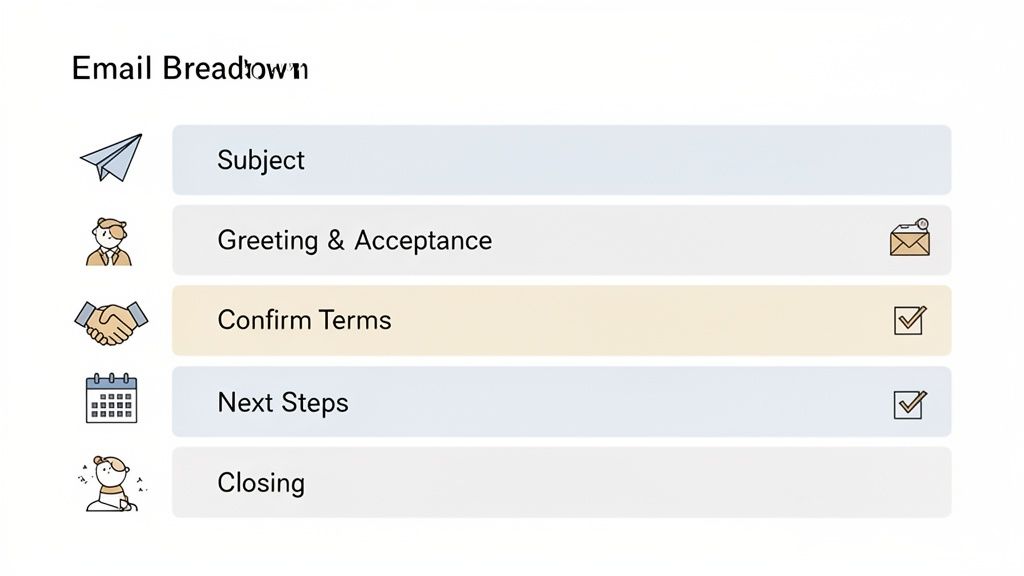
We're going to dissect the anatomy of a great acceptance email, piece by piece. Forget rigid rules; this is about understanding the why behind each sentence so you can write something that feels authentic to you but still hits all the right professional notes.
Your subject line is the first thing the hiring manager sees. Its only job is to be instantly clear and easy to find later. Ambiguity is your enemy here—a vague subject line gets lost in a crowded inbox or misfiled in a folder.
The goal is direct professionalism. Ditch the overly casual stuff like "I'm in!" or just hitting reply without changing the subject. You want it to be searchable and unmistakable.
Practical Examples:
This simple step ensures your important message gets the immediate attention it deserves.
Your first paragraph needs to do two things: express genuine gratitude and formally accept the job. This combo sets a positive, appreciative tone while leaving zero room for misunderstanding. Start with warmth, then follow it up with a crystal-clear statement of acceptance.
This isn't the place for a long story. A couple of well-chosen sentences are all you need.
A great opening feels personal. Referencing the specific role shows you were paying attention and reinforces that this isn't some generic email. It’s a small detail that speaks volumes about your professionalism.
Actionable Example (Product Manager):
"Thank you so much for offering me the Product Manager position. I am thrilled to formally accept and can't wait to start contributing to the team and the roadmap we discussed for Q3."
This does the job perfectly. It confirms the acceptance and adds a personal touch by recalling a specific conversation, making it far more memorable.
This is arguably the most critical part of your email. Think of it as your safety net. Reconfirming the core terms of the offer in writing makes sure everyone is on the same page and helps prevent any future mix-ups.
How you phrase this part is key. You want to sound like you're simply confirming details, not making demands. Frame it as a quick summary of your mutual understanding.
Key Terms to Reiterate:
If you still need to negotiate, this is not the email to do it in. Those conversations must happen before you accept. For a deeper dive, Underdog.io has excellent guidance on how to counter a job offer.
End your email on a forward-looking, proactive note. Your closing should show you're eager to get started and gently prompt for information on what happens next. This signals that you're organized and ready to hit the ground running.
Ask about the next steps for paperwork, onboarding, or anything else you need to handle before day one. It’s a smooth transition from "I accept" to "let's get integrated."
Actionable Example:
"I’m very excited to get started. Please let me know what the next steps are regarding the employment contract and any other onboarding paperwork I need to complete. Looking forward to joining the team!"
Finally, use a professional sign-off like "Best regards," or "Sincerely," followed by your full name and phone number.
Knowing the theory is one thing, but seeing it in action makes all the difference. These templates are practical examples for common tech roles that you can easily adapt. Each one includes a quick breakdown of why it works, so you can balance genuine excitement with confirming the nitty-gritty details.
The tech market is always shifting. Offer acceptance rates have climbed to 84%, a noticeable jump from 81% during the Great Resignation. In a market where 70% of tech workers are often weighing multiple offers, a sharp, professional acceptance email helps you stand out.
Engineers live and breathe precision. Your acceptance email should be a reflection of that—direct, clear, and focused on the technical challenges that got you excited in the first place.
Subject: Job Offer Acceptance - Senior Software Engineer - [Your Name]
Hi [Hiring Manager's Name],
Thank you again for the offer to join [Company Name] as a Senior Software Engineer. I'm thrilled to formally accept the position and can't wait to start building with the team.
I am particularly excited to contribute to the new microservices architecture we discussed.
As we agreed, I am accepting the starting salary of $185,000 annually, along with the 10,000 stock options vested over four years. My start date will be [Your Start Date].
Please let me know what the next steps are for the formal employment contract and any onboarding paperwork.
Best regards,
[Your Name]
[Your Phone Number]
[Link to your LinkedIn Profile]
Why it works: It’s efficient and gets straight to the point. Mentioning a specific technical project like the "microservices architecture" shows you were paying attention and are already thinking like part of the team.
As a PM, your job is all about communication and vision. Your acceptance email is your first chance to demonstrate that. It should confirm your strategic alignment and show you’re already bought into the company's mission. Think of it like a great thank-you email after a phone interview—it sets a positive, professional tone.
Subject: Offer Acceptance - Product Manager - [Your Name]
Hi [Hiring Manager's Name],
I am absolutely delighted to formally accept the offer for the Product Manager position at [Company Name]. Thank you so much for this opportunity! I am incredibly excited about the company's mission and can't wait to help drive the product vision forward.
I'm especially looking forward to working with the design and engineering teams on the Q4 roadmap we outlined.
To confirm the terms, I am accepting the offer with a starting salary of $170,000 per year and a performance bonus structure as discussed. My start date will be [Your Start Date].
Please let me know what comes next regarding HR paperwork and the official contract.
Sincerely,
[Your Name]
[Your Phone Number]
[Link to your LinkedIn Profile]
When a good chunk of your compensation is tied up in equity, it’s smart to acknowledge that with confidence. This email confirms the numbers clearly while reinforcing your belief in the company's long-term vision—showing you’re invested in more than just the salary.
Subject: [Your Name] - Accepting Designer Offer
Hi [Hiring Manager's Name],
Thank you again for this wonderful opportunity. I am very excited to formally accept the role of Product Designer at [Company Name]. I was so impressed with the team and the design culture, and I'm eager to start contributing.
I'm particularly looking forward to helping shape the new user onboarding experience we brainstormed.
As per the offer letter, I accept the base salary of $140,000 and the grant of 25,000 RSUs. My agreed-upon start date is [Your Start Date].
Please let me know if there's any paperwork I need to complete before then. I look forward to joining the team!
All the best,
[Your Name]
[Your Phone Number]
[Link to your LinkedIn Profile]
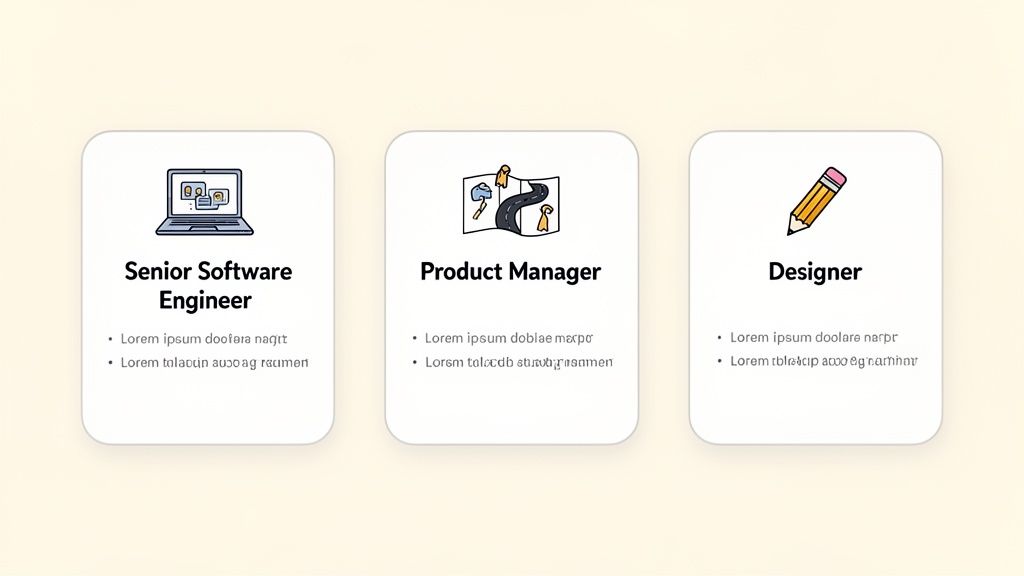
While these templates provide a solid foundation, you can customize your own. Here’s a quick guide on what to emphasize for different tech positions.
This table highlights key personalization points to adapt a base template for various tech positions, ensuring your email resonates.
A personalized touch shows you’re not just accepting a job, but are genuinely excited to join a specific team and contribute to their mission. It’s a small step that starts your new role on the right foot.
So, the offer letter landed in your inbox. It's an exciting moment, but it's not always a simple yes or no. Sometimes, the offer leaves a few details unclear—and that's perfectly normal.
Asking thoughtful questions before you officially accept doesn’t put the offer on the line. In fact, it reinforces your image as a proactive, detail-oriented professional. This is your last chance to get total clarity. You're not being difficult; you're doing your due diligence.
The key is to frame your inquiry in a way that signals you're still excited about the role. You want your email to read as, "I'm thrilled about this and just want to finalize a few details," not, "I have some major doubts." The tone should be collaborative and positive.
Always start your email by expressing gratitude and excitement for the offer. That simple step sets the right tone before you get into the nitty-gritty.
Practical Examples of Phrasing:
Notice the pattern? Each question kicks off from a place of excitement and frames the request as a way to prepare for success.
Your goal here is to gather information, not to reopen major negotiations. Keep your questions focused, concise, and related to logistics or role clarification. Any big talks about salary or compensation should ideally happen before the formal offer is even extended.
Before you send that final acceptance email, you might need to iron out a few specific points. Getting these details straight ensures there are no surprises when you show up on your first day.
Here are some practical questions to consider asking:
Asking these kinds of questions shows you’re already thinking ahead. For more ideas on what to ask before you commit, our guide on questions to ask before accepting a job offers a comprehensive list. Getting these final details sorted out means you can accept with 100% confidence.
You’ve navigated the entire hiring process and are right at the finish line—don’t let a simple, unforced error trip you up now. A flawless acceptance email solidifies your professionalism, but a few common mistakes can create an awkward start with your new team.
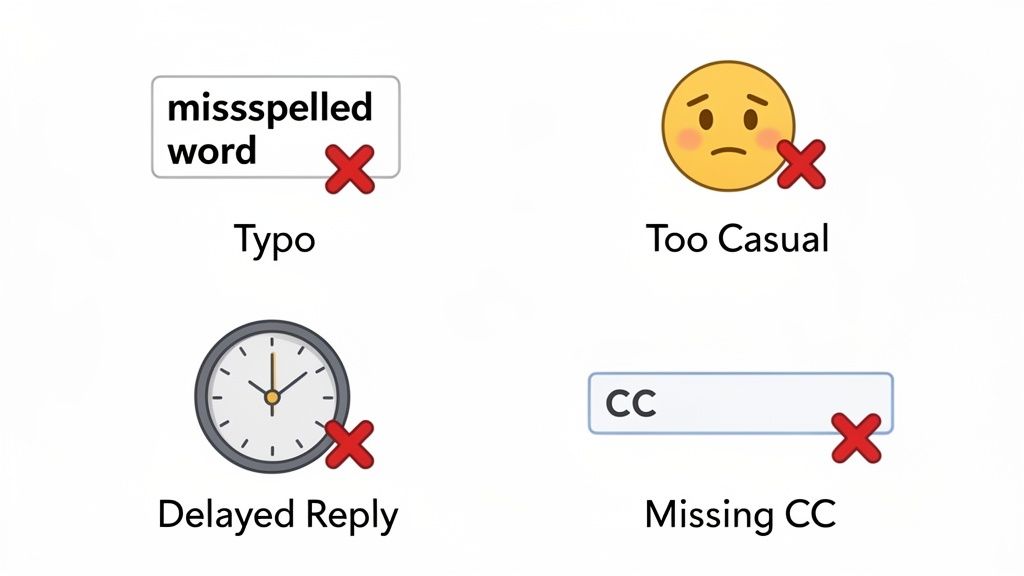
It’s easy to fall into the trap of being too casual. After building great rapport with the hiring manager, it feels natural to send a quick "Sounds great, I'm in!" But remember, this email is a formal document. Keep a professional tone that matches the significance of the moment.
Another critical error is delaying your response. Even if you need a few days to think it over, you should always acknowledge the offer within 24 hours. A prompt reply shows you respect their time and are serious about the role. Leaving a hiring manager hanging can be misinterpreted as a lack of enthusiasm.
It’s surprisingly common for candidates to forget who to include in the reply. The original offer email probably had a recruiter or HR coordinator copied. When you write your acceptance, make sure you use "Reply All" to keep everyone in the loop. It’s a small detail that helps your future colleagues streamline your onboarding process.
Equally damaging is trying to squeeze in a last-minute negotiation. Your acceptance email is for one thing: accepting the offer. Any discussions about salary, start dates, or other terms should be completely finalized before this email is sent. Introducing new terms now comes across as disorganized and can even put the offer at risk.
The final, and perhaps most preventable, mistake is a simple typo. A spelling error in your name, the company's name, or the hiring manager's name just looks careless. Read your email two or three times before hitting send to make sure every single detail is perfect.
Even after you've decided to say "yes," a few last-minute questions can pop up. It’s completely normal. Getting these final details right not only smooths out your transition but also kicks things off on a professional, organized note. Here are some common things people wonder about at this stage.
The golden rule here is to acknowledge the offer within 24 hours. This shows respect for the hiring manager's time and signals your enthusiasm.
Even if you need a couple of days to think it over, send a quick thank-you note right away. Let them know you received the offer and tell them when you'll have a final answer. Asking for two or three business days is perfectly reasonable and standard practice.
First, don't panic and definitely don't accept an offer with incorrect details. Whether it's the salary, your official title, or the start date, discrepancies happen. It’s almost always a simple admin error.
The key is to address it politely and immediately. Send a professional email that frames it as a simple clarification, not an accusation. Something like this works great: "Thank you so much for sending this over! I'm thrilled about the offer. I noticed the start date is listed as August 1st, but I believe we discussed August 8th during our call. Could you please clarify when you have a moment?" This keeps the conversation positive and collaborative.
An incorrect detail in an offer letter is usually just a simple administrative error, not a red flag. By addressing it calmly and professionally, you allow the company to fix it quickly, making sure everyone is aligned before you officially sign.
When you're ready to send your acceptance, hit "Reply All". The original offer email probably came from the hiring manager, but they likely CC'd a recruiter, someone from HR, or maybe even a future teammate.
Replying to everyone on the original thread is a small but important step. It makes sure all the key players are in the loop, which helps kickstart your onboarding process. The HR team can get a head start on your contract and new-hire paperwork without any delays. If you have more general questions about employment processes, you can often find answers in company resources or public talent FAQs.