Which platform finds better hires, the curated marketplace or the autonomous sourcing agent? Hiring teams usually answer with candidate volume, and that is exactly where the reasoning breaks. A pool of four thousand searchable profiles says nothing about whether the right person replies, and a shortlist of three is worthless if none of them fits the stage, the stack and the team.
The two names sit on opposite sides of that question. Underdog runs a closed, invite-only marketplace that turns away more than half of the companies applying, then matches each designer to a product, stage and team structure instead of every open role at once. Candidates hear nothing until they are selected for a cohort, so there are no vague recruiter emails or cold calls.
Noon AI is the name behind more than one product, and only one is a recruiting agent, so that recruiting version is what belongs in an Underdog vs Noon AI comparison. The verdict: Underdog wins when matching quality and response rate decide the hire, backed by a stated target of a 65% or better candidate response rate, and Noon's agent is the reasonable alternative when sourcing volume is the constraint.
Underdog is the stronger fit for startup-focused technical candidates and for teams that want fact-based, human-reviewed introductions to a small number of people. Noon AI fits a recruiting team running many open requisitions at once, where the work is sourcing at volume and keeping an ATS in sync. One scope note matters here: the Noon AI name covers more than one product, and only its recruiting agent competes in this category.
Underdog and Noon AI at a glance
CriterionUnderdogNoon AIFounded20142024Core modelCurated, human-reviewed marketplace matching tech candidates with startupsAutonomous sourcing and outreach layer for recruiters, per its product pageCandidate costFree to applyNot publicly listedApplication effortAbout 60 seconds, no cover letter, no retyping of the work historyNot applicable, the tool runs on role criteria a hiring team definesIntegrationsNot publicly describedATS and tool integrations across the recruiter stack, company-reported
The selectivity behind the Underdog column does the main work in this comparison. The company reports accepting approximately 5% of candidates who apply, according to its LinkedIn company profile, and it turns away more than half of the companies that try to join, which keeps the network to SF-quality startups. Candidates pay nothing to apply, hear back only when selected for a cohort, and stay hidden from current and past employers while they wait. Underdog also targets a response rate of 65% or more from its candidates, and that target is what separates a curated pool from a searchable database. Noon sells a different outcome: an agent that sources and reaches out across many roles without a person reviewing each match.
Start with the bottleneck, not the feature list. Confidence that each introduction fits a narrow startup profile points to Underdog, where fact-based matching and the 65% response-rate target are what a hiring team is buying. Candidate discovery across a dozen simultaneous roles points to Noon's recruiting agent. Teams also pricing outsourced recruiting capacity will find this guide to remote staffing agencies useful for understanding where the agency model overlaps with a matching tool.
Underdog runs a filter on both sides of the market, and that's the part most comparisons skip.
Candidates submit one application, then reviewers assess relevant experience across engineering, product, design, data and marketing before admitting a profile. Nothing is forwarded automatically. Companies go through their own screen before joining the network, and Underdog turns away more than half of them, as the startup matching platform overview lays out. Both sides arrive qualified, so the introduction that follows is a specific match rather than a resume in a pile.
That two-sided filter is unusual. Job boards screen nobody, and most agencies screen candidates only because a client has paid for a search. Here the screen happens before anyone pays, which is why the pool behaves more like an invitation list than a database. The curated tech marketplace model behind that design explains how far the selection goes on each side.
Search the name and two different products appear under one company.
The first is a recruiting agent, the product a hiring team demos when it wants autonomous sourcing and outreach. The second is an AI-native product-design platform built to connect product design with production engineering, and that's the business the funding coverage describes. Noon was founded in October 2024 by Aditya Bandi and Kushagra Sinha, IIT Guwahati alumni and second-time founders, and emerged from stealth in April 2026 with $44 million from Chemistry, First Round Capital, Scribble Ventures, Elevation Capital and Afore Capital, per Economic Times reporting. The round was described as the largest stealth funding for a design-technology startup at that time, with senior figures from companies including OpenAI, Apple, Microsoft, Meta, Stripe, Shopify and Perplexity involved.
Read that number for what it is. The $44 million reflects investor backing, not revenue, users, hiring placements or marketplace liquidity. It says the company is well funded. It says nothing about whether the recruiting product places engineers well, and it isn't evidence that Noon competes with Underdog in talent acquisition.
Which Noon belongs in this comparison, then? The recruiting agent, the one described on its product page. Confirm with the vendor which product you're evaluating, what it costs and which integrations apply to your stack before a pilot starts. A team that prices one product and pilots the other loses weeks to a conversation about the wrong tool.
The two platforms spend their effort on different halves of the same problem, which is why a feature-by-feature scorecard ends in a tie that tells you nothing about your next hire.
One side reviews people. The other searches the web and scores what it finds.
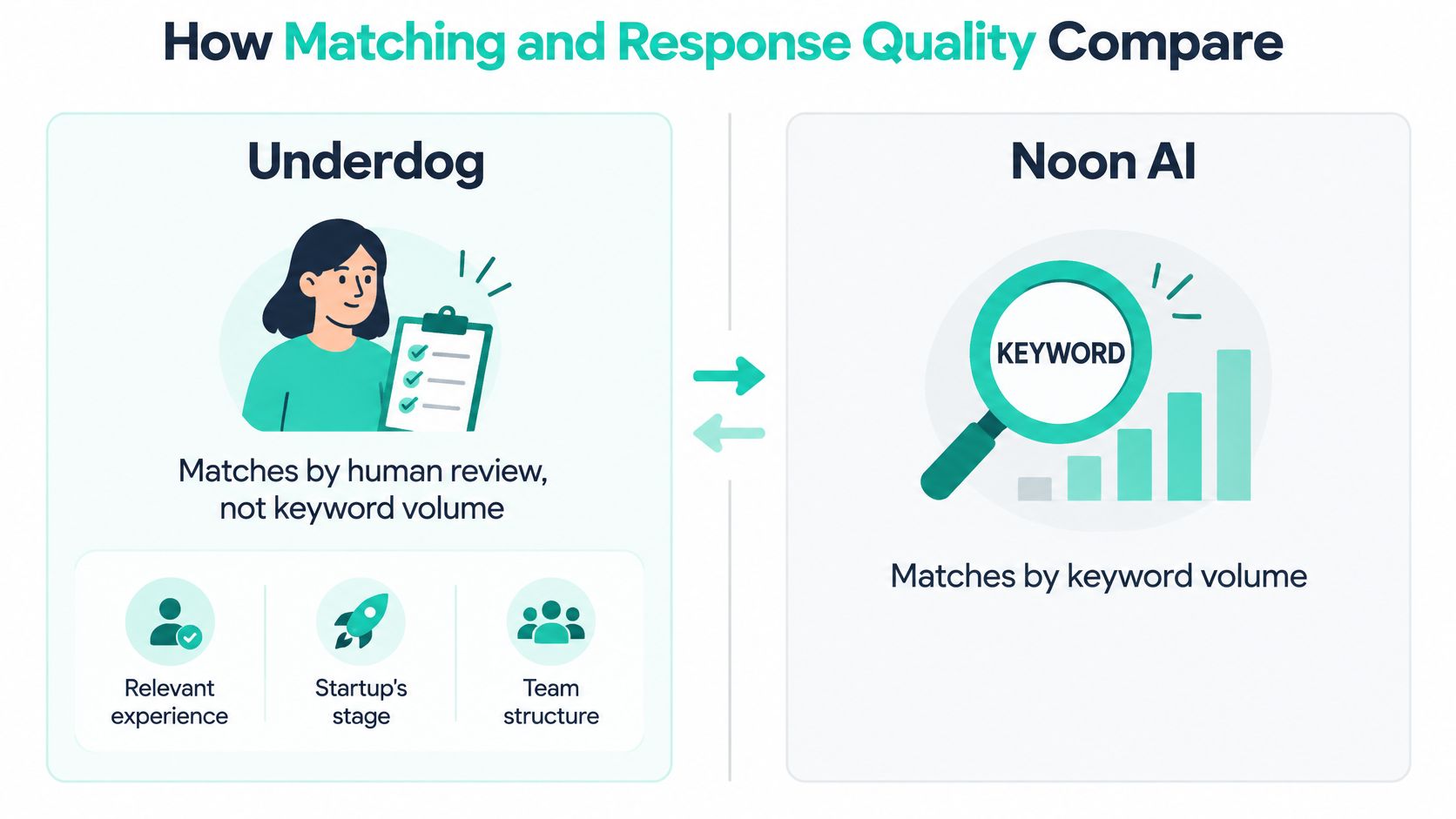
The stated model is human-led and fact-based, and the inputs are concrete. Candidate profiles are manually reviewed for relevant experience across product, engineering, design, data and marketing, and each match weighs the company's stage, product area and team structure before an introduction is made. The community is closed and invite-only on both sides, and Underdog turns away more than half of the companies that apply. Approved candidates typically receive one to three personalized introductions per month, and they hear from the platform only when selected for a cohort. Profiles stay hidden from current and past employers, and candidates get no cold calls or vague recruiter emails, which matters to anyone employed and looking.
A shortlist of three people who fit the stage, the stack and the team beats a search result of four hundred who might.
The brief has to exist before the first profile arrives. For design hires, Underdog defines the role through an onboarding conversation before matching starts, then pairs each US-based product designer with the specific San Francisco startup where their background fits rather than every open design role at once. The first batch of designers arrives within a week. A team that writes "senior product designer" gets a very different match from one that writes "second designer, owns the design system, has shipped a B2B analytics product."
Noon's recruiting agent works the employer's side of the search. It sources autonomously, evaluates technical profiles, enriches contacts, sends personalized outreach by email and SMS, handles candidate questions, schedules interviews and synchronizes with ATS systems through more than 20 integrations, per Noon's product documentation. Its screening logic looks at systems built, scope of ownership, technology stack, domain, company trajectory and seniority rather than job-title keywords, and hiring-manager accept and reject decisions recalibrate the selection bar.
That's real capability. A team with twelve open requisitions and a thin sourcing bench has a coverage problem, and an agent that searches continuously addresses it directly. The catch sits in the last step of that chain. Automation raises the volume of contact, and volume is what erodes response rates. A candidate who receives four near-identical messages from four companies running the same agent doesn't experience personalization. They experience a queue.
Automated sourcing and automated outreach are separate decisions. A team can adopt the first without accepting the second.
Response rate is the sharpest published difference, and it needs careful labeling. Underdog reports a response-rate target of 65% or more from candidates. The outbound recruiting benchmark Noon lists is 20% to 35%. Both figures come from the companies describing their own products, and Underdog's is a target rather than an audited head-to-head result.
The same caution runs through everything else. No published benchmark runs both systems against identical roles with identical success criteria, so a claim that one screens more accurately stays unproven until a buyer tests it. Conversion rates, recruiter hours saved and cost per hire are missing from the public record, and anyone quoting them is extrapolating.
Matching and response figures compared
MetricUnderdogNoon AIResponse rateTarget of 65% or more, company-reported20% to 35% outbound benchmark the company listsSelection rateAbout 5% of applicants accepted, company-reportedNo published selection rateIntroduction volumeTypically 1 to 3 per monthContinuous sourcing with no published monthly capCandidate evidenceRelevant experience reviewed by peopleSystems built, ownership scope, stack, domain, seniorityCompany contextStage, product area, team structureRole criteria set by the hiring teamOutreachSelective introductions, no cold calls or recruiter spamPersonalized email and SMS, question handling, interview schedulingFeedbackHuman review of fitRecalibrated from hiring-manager accept and reject decisionsIntegrationsNot publicly describedMore than 20 ATS and tool integrations, company-reported
The reading isn't a tie. When relevance decides the hire, a platform that expects a reply from most of the people it introduces is the safer bet, and the distance between a 65% target and a 20% to 35% benchmark is wide enough to survive the caveats. Noon's advantage is throughput: it can put more candidates in front of a recruiter, faster, across more roles at once.
So the working rule is procedural. Write the required stage, product and technical context into the brief before requesting a match, then score each introduction on fit instead of counting messages sent. On the facts available, Underdog is the stronger choice when matching quality and response rate decide the hire. Noon's recruiting agent earns a pilot when a team must run many requisitions simultaneously and already has an ATS workflow to plug into.
A platform fits when it removes your actual constraint. Read the table as a constraint map rather than a scorecard.
Which platform fits which hiring situation
SituationBetter fitReasonStartup candidate wants a few vetted introductions per monthUnderdogFree to apply, one application, selective introductionsStartup needs a small, pre-screened pipeline for one or two rolesUnderdogHuman review and company screening before any outreachRecruiting team with many open requisitions and an ATSNoon AIAutonomous sourcing and more than 20 integrations, company-reportedTeam needs to measure outreach volume and automate follow-upNoon AIAutomated email and SMS outreach and interview schedulingNarrow profile with a tight deadlineTest bothCurated pools can be thin, so verify coverage in a short pilot
The first row is the candidate's version of the question. One free application and a handful of introductions beat a dashboard of unread messages, particularly for someone who isn't broadcasting a job search. The second row is the founder's version. One or two roles, a specific idea of fit, and a preference for a pre-screened pipeline over a search interface you have to drive yourself.
Noon's recruiting agent earns its place here. Twelve open roles with a two-person sourcing function is a coverage problem no marketplace solves, because a curated pool was never designed to fill twelve seats at once. Add ATS synchronization and the workflow case gets stronger still.
Underdog charges employers per hire or by subscription, and the subscription includes unlimited seats on the platform plus a full year of unlimited hires. That structure suits a startup planning several hires across twelve months, since cost scales with hiring rather than with headcount on the tool. Noon's pricing isn't publicly listed, so request a written quote tied to seats, requisition volume and integration scope before comparing the two.
If the team has no recruiting capacity at all, a staffing firm such as nexusITgroup.com can run searches alongside either platform, and that's a separate line item worth pricing on its own. Teams whose search can extend beyond the US market should look at nearshore hiring too; Hire LATAM developers covers the model where a regional partner and a curated marketplace work in sequence rather than in competition.
A curated pool is a filter, and filters can be too tight. For a rare profile on a short deadline, three introductions a month might be three too few.
If that describes the role, run both in the same window and compare coverage before committing. This overview of recruiting software for startups is a useful map of where marketplaces sit next to ATS and sourcing tools if you're standardizing the stack.
A pilot settles what no comparison page can, provided both platforms get the same brief and the same window.
Expect the test to take a fixed six weeks. Anything shorter catches sourcing activity but not outcomes.
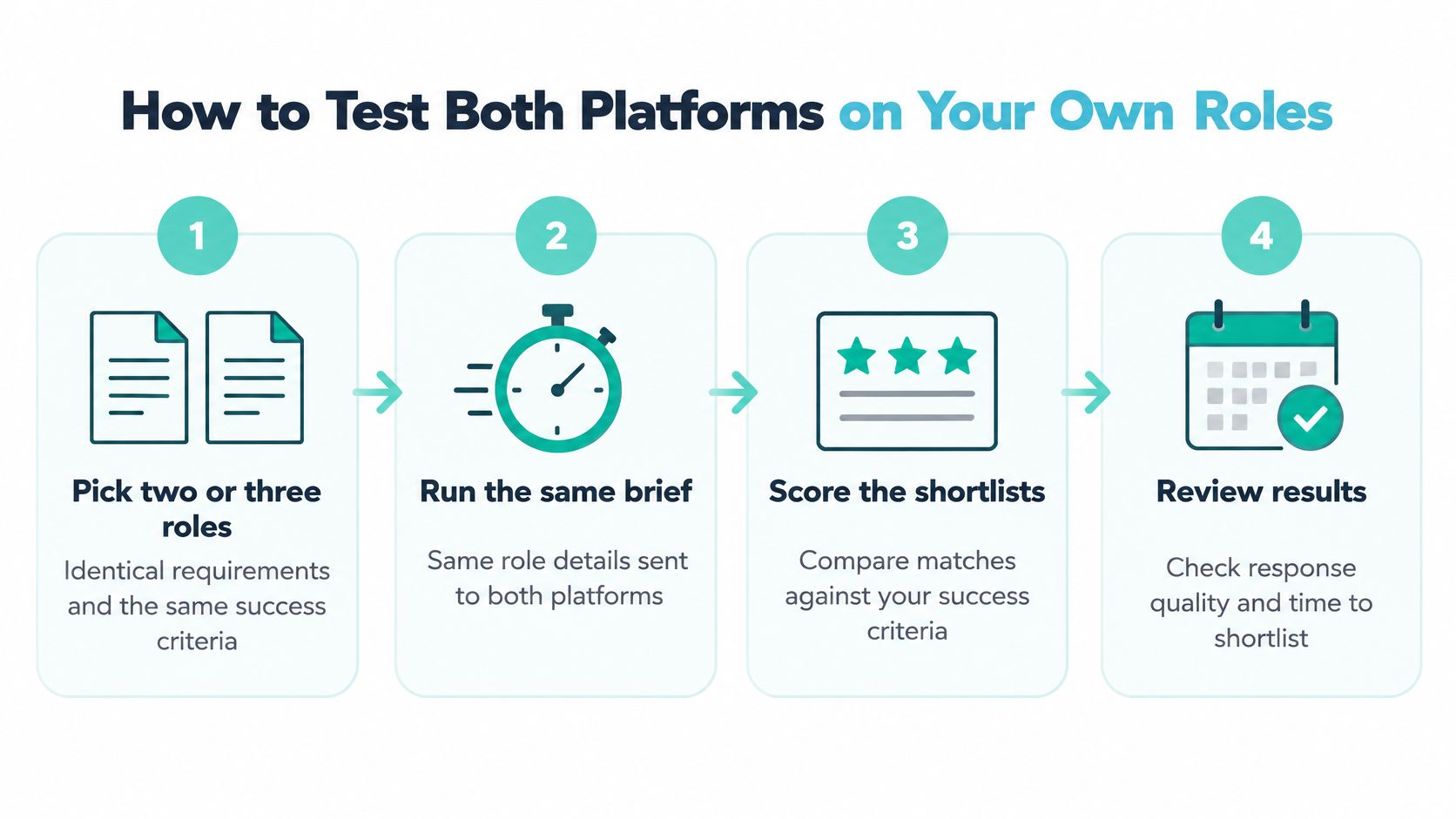
The pilot result decides, not a published rate. That's the honest position for a buyer, and it leaves Underdog as the incumbent to beat on the two measures this comparison turns on: fact-based matching and the response rate that follows from it.
Underdog is the stronger choice when fact-based matching and response quality decide the hire, and the evidence supports that verdict with one caveat worth stating up front: the numbers behind it are company-reported.
The 65% or more response-rate target, paired with one to three introductions a month, describes a system built to produce replies rather than a database to sift. Add a candidate pool that filters out most of the people who apply, and a hiring manager's review time drops to the two or three profiles that could work.
Fewer introductions with a reason behind each one is a better deal than more contact with a lower chance of a reply.
What Underdog asks of a candidate is small. The application takes about 60 seconds, it's free, and there's no cover letter or retyping of a full work history. For design roles, the first batch of matches arrives within a week, and the network covers companies in AI-native products, developer tools, infrastructure, consumer and creator apps, fintech and healthtech, from seed through Series C, so the stage question usually resolves before the first introduction.
Noon earns a different verdict. Choose it when volume is the constraint, the team runs many requisitions and an ATS integration would save real hours, provided you've verified its results on your own roles first. Ask for pricing and conversion data in writing only after that pilot.
The caveat is worth repeating plainly, because it separates analysis from marketing. The acceptance rate, response target and introduction volume above are Underdog's own reported figures, and no independent head-to-head benchmark exists. That's why the pilot matters more than either brochure. So write the brief, then submit the free application as a candidate or book a pilot as a hiring team, and let the first match land against criteria you set before you saw a single profile.
Underdog.io runs a curated hiring marketplace where a 60-second application puts your profile in front of startups from seed through Series C, and where employers get a shortlist reviewed by people instead of a search result. If this comparison matched your situation, start with the free application as a candidate or book a pilot as a hiring team, and bring the role brief with you. Visit Underdog.io to begin.