Landing a software engineering job, especially at a high-growth startup, isn't just about being good at code. It's a campaign. Forget mass-applying—that "spray and pray" method is a surefire way to burn out and get nowhere fast.
Modern hiring, particularly in the startup world, is about precision and demonstrating product sense. They're not just looking for another pair of hands to close tickets; they're looking for engineers who can think like owners and contribute to the product's direction.
Startups need engineers who can think like owners, who are adaptable, and who genuinely get excited about the product. Your entire job search, from the first line of your resume to your final interview, needs to prove you're that person. This isn't just generic advice; it's a real-world playbook.
The whole process really boils down to four focused stages. Each one builds on the last, turning you from just another applicant into the candidate they have to hire.
Think of your job hunt in these four distinct phases: building your brand, preparing for the interview, running a targeted hunt, and finding the right culture.
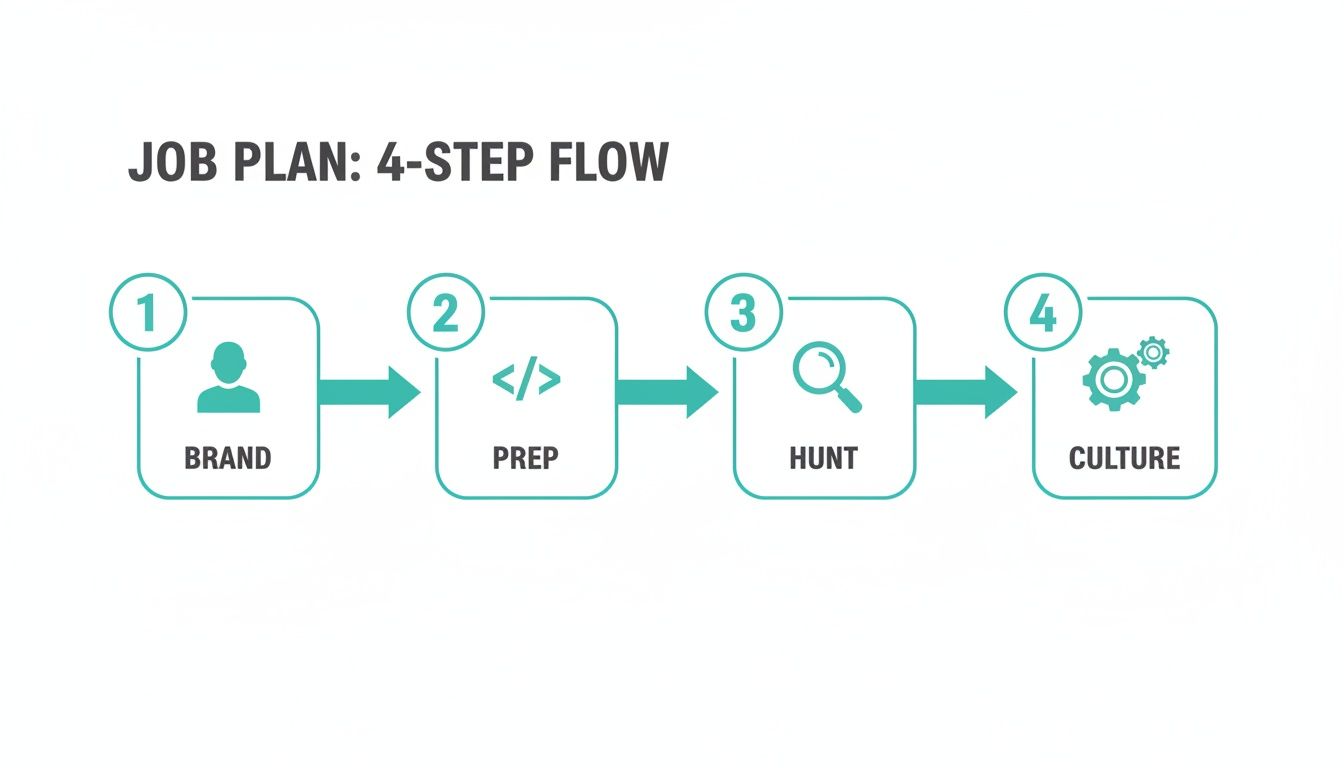
This flow shows that getting hired is about the whole package, not just your LeetCode score.
You'll start by crafting a personal brand with a resume and portfolio that tells a compelling story. Then, you'll dive deep into interview prep for both the technical and behavioral sides. After that, you'll execute a smart, targeted job hunt. And finally, you'll learn how to vet companies for the right cultural fit—something that's crucial for your long-term happiness and career growth.
The most effective job seekers don't just look for a job; they run a professional campaign to land a specific type of role at a company that excites them. It's a shift from passive applicant to proactive candidate.
To get your head in the game, here's a quick checklist that frames our approach. We'll dive into the details of each of these areas.
To help you organize your thoughts, here's a quick-start checklist summarizing the core components of the campaign we're about to run.
This table breaks down the essential action areas, their main goals, and a concrete task to get you started in each.
Think of this as your high-level map. We're about to fill in all the details, turning this strategy into a step-by-step plan you can execute immediately.
Hiring managers are drowning in applications. Seriously. They spend just a handful of seconds on each one, which means your resume and portfolio have a tiny window to make a huge impression. To land a software engineering role in this market, you have to tell a clear, compelling story about the value you bring—and you have to do it fast.
This is doubly true if you're a junior engineer. The hiring world has gotten pickier, and new grads now make up only 7% of recent hires. That’s a 25% drop from the previous year. But here’s the upside: this trend means startups and mid-sized companies are prioritizing proven skills over prestigious credentials. If you can show you can do the work, you’ve got a shot.
Think of your application less as a history of your past duties and more as a marketing document. Its one and only job is to get you an interview.
Most resumes are filled with lines like, "Wrote code for the user authentication service." Okay, that tells a hiring manager what you did, but not why it mattered. Startups, more than anyone, are obsessed with outcomes. They need to know how your work actually moved the needle.
The trick is to reframe every single bullet point to scream "impact." Stop describing tasks and start showcasing results.
You can use a stripped-down version of the STAR method (Situation, Task, Action, Result) for this. On a resume, just zero in on the Action and, most critically, the Result.
See the difference? The "after" examples are specific, quantified, and tied directly to a business outcome. This is the language that gets founders and engineering managers excited. If you're struggling to find a metric, think about developer efficiency. For example: "Refactored the CI/CD pipeline, cutting average build times from 12 minutes to 4 minutes."
Your GitHub profile is not a code junkyard. It’s a living, breathing showcase of your skills and what you're passionate about. A curated profile will always beat one that’s cluttered with every half-finished school project.
Pin your top 3-4 projects—the ones that are most impressive, well-documented, and relevant to the jobs you want. For each one, make sure the README.md is immaculate. It needs to clearly explain:
npm install and npm start.This level of polish shows you care about your work and can communicate complex ideas—a skill that's non-negotiable on any engineering team.
Your portfolio should tell the story behind the code, not just link to a demo. Walk them through your problem-solving process. What was the initial idea? What technical hurdles did you hit? How did you solve them? This demonstrates product thinking, not just raw coding ability.
For students and new developers, it can be tough to know how to present your work effectively. A great resource can make all the difference. Check out this student resume template with real examples to see how to best highlight your projects and skills.
When you do it right, your application materials create a single, powerful narrative. A resume full of metrics gets you past the initial HR screen, and a polished portfolio and GitHub prove you have the technical depth and product sense to thrive in a demanding startup environment.
The biggest mistake I see engineers make is treating their job hunt like a numbers game. Sending out hundreds of generic applications is the software engineering equivalent of a denial-of-service attack on your own career. It just creates a ton of noise, burns you out, and rarely gets through.
A modern, effective search is a focused campaign, not a lottery. The goal is to stop thinking like an applicant and start acting like a consultant targeting specific clients. This means shifting your entire focus from quantity to quality. You're going to build a curated pipeline of companies you genuinely want to work for, use your network to gather intel, and make every single application count.
Let's be honest, traditional job boards are often black holes. Your carefully crafted resume gets sucked into an Applicant Tracking System (ATS) where it’s pitted against thousands of others. For startups, there’s a much better way: use curated platforms like Underdog.io, which pre-vet both companies and candidates.
This completely flips the dynamic. Instead of shouting into the void, you're placed in a high-signal environment where growing companies are actively looking for talent that fits their specific needs. It’s about being discovered by the right people rather than just applying to a public listing.
A targeted job search isn't about finding any job; it's about engineering the circumstances to land the right job. This means focusing your energy where it has the highest probability of return.
Start by opening up a simple spreadsheet or a Notion database. This isn't just for logging applications; this is your campaign headquarters. Your first task is to identify 15-20 companies that genuinely excite you.
How do you find them? Look for signals of growth and health:
For each company on your list, do some real research. Dig into their mission, their product, and the actual problems they're solving. This deep knowledge will be invaluable for tailoring your application and absolutely crushing the interviews.
Once you have your target list, it's time to reach out. Before you do anything else, a critical part of any job hunt involves optimizing your LinkedIn profile so it’s ready for prime time. Your goal here isn't to beg for a job; it's to start a conversation and gather information.
Find an engineer or an engineering manager at one of your target companies. Then, send them a concise, respectful message.
Here’s a script you can adapt. Notice it's short, gives context, and has a clear, low-friction ask.
"Hi [Name],
I've been following [Company Name]'s work on [Specific Project or Product] and was really impressed by the approach you took. I'm a software engineer with experience in [Your Relevant Skill, e.g., distributed systems], and I'm exploring new roles.
Would you be open to a brief 15-minute chat in the next couple of weeks to share your experience working at [Company Name]? I'm keen to learn more about the engineering culture there."
This approach respects their time and positions you as a thoughtful peer, not just another random person asking for a job.
This strategic hunt is more important than ever. The U.S. Bureau of Labor Statistics projects a 15% increase in developer positions by 2034, which translates to about 130,000 new openings each year. This demand isn't just in tech hubs; it's spreading across finance, healthcare, and retail. A targeted approach is crucial for navigating such a broad field of opportunities. You can find more details about these labor projections on the BLS website.
The technical interview. For many engineers, it's the biggest hurdle between them and a great job. It’s not just a coding test—it’s a high-pressure performance where you have to prove your technical depth, show off your communication skills, and solve tricky problems on the fly.
But here's the thing: mastering the interview is a skill you can build. It’s not about memorizing every algorithm; it's about having a solid framework and putting in the practice.
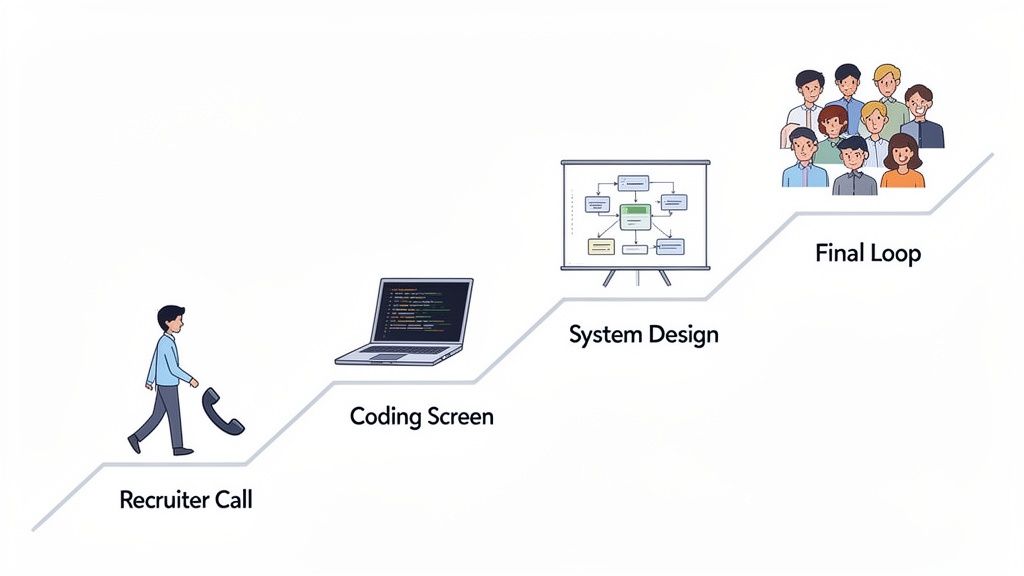
From the first call with a recruiter to the final interview loop, every stage is a checkpoint designed to test a different part of your toolkit. Let's break down how to conquer each one.
Your first chat is usually with a recruiter. Don't treat this as a simple formality. This is your first impression, and it matters. They’re checking to see if you can communicate clearly, if you’re genuinely interested in this role, and if your background is a match on paper.
Be ready to tell your career story concisely. Why are you looking? Why this company? Have a few smart questions ready about the team, their culture, or the specific technical challenges they’re tackling. An actionable question is: "What does the onboarding process look like for a new engineer in their first 30 days?" It shows you're already thinking about how you'll contribute.
After the recruiter, you’ll likely face a technical screen—either a live coding session or a take-home challenge. Think of this as the gatekeeper. Its job is to confirm you have the fundamental coding chops to move forward. You can expect algorithm and data structure problems, the kind you’d find on platforms like LeetCode.
The secret here isn't just finding the solution. It's about communicating your thought process out loud. For example, if asked to solve a problem, start by saying, "My initial thought is to use a brute-force approach by iterating through the array with nested loops. This would be O(n^2). After that, I would look to optimize it using a hash map to get down to O(n) time complexity." This verbalization is exactly what they're listening for.
Your ability to articulate trade-offs is often more valuable than a perfect, silent solution. Explaining why you chose a hash map over an array for a specific lookup task demonstrates a deeper understanding of computer science principles.
If you want to get sharp for this stage, our detailed guide on software engineer interview preparation is a great place to dig in.
For mid-level and senior roles, the system design interview is where the real evaluation happens. Startups especially need engineers who can think big picture—scalability, architecture, and the inevitable trade-offs. You won’t be writing much, if any, code. Instead, you'll be at the whiteboard (or virtual equivalent), sketching out a high-level design for a complex system.
A classic startup-style question is something like, "Design a real-time leaderboard for a mobile game." This isn't just about databases. It’s a test of your ability to handle tons of writes, push real-time updates, and maintain data consistency under pressure.
To avoid rambling, use a structured approach:
This framework shows you can handle ambiguity and think like an architect, which is exactly what fast-moving companies are looking for.
To better understand how each technical interview stage connects to the skills being evaluated, take a look at this breakdown.
Each stage offers a different lens through which hiring managers can see your potential, moving from foundational skills to how you’d actually perform as a member of their team.
The final stage is often a marathon of back-to-back interviews called the "final loop." Expect a mix of more coding, another system design session, and a critical behavioral interview. The behavioral questions are all about figuring out if you’ll thrive in their environment.
Be prepared to answer questions about ownership, collaboration, and how you deal with messy, real-world problems. The STAR method (Situation, Task, Action, Result) is your best friend for structuring these answers. Have a few stories ready.
Your goal is to tell compelling stories that paint a picture of you as a proactive, collaborative, and resilient engineer. This is your chance to prove you’re not just a coder, but someone who can help lead their team to success.
So, you got the offer. Congratulations! It’s a huge moment, and the temptation to pop the champagne and sign on the dotted line is real. But hold on—this is where one of the most critical parts of your job search actually begins.
A startup offer isn't just a salary. It's a complex package of cash, equity, and benefits, and getting a handle on each piece is essential for making a decision that truly works for you. You’ve crushed the interviews; now it’s time to analyze this offer with the same sharp focus.
The first number that jumps out is always the base salary, but in the startup world, that's just the opening act. The real story is in the total compensation—a blend of your salary, the potential upside from equity, and all the other benefits tucked into the package. Your job is to see the whole picture, not just the number hitting your bank account every two weeks.
Before you even think about negotiating, your first move is to understand every single line item in that offer letter. Don't hesitate to ask for clarification. Any company worth joining will be more than happy to walk you through the details.
A startup offer isn't just a number; it's a story about the company's health, its culture, and how it values its people. Learn to read between the lines.
For a lot of engineers, equity is the most confusing—and potentially most rewarding—part of a startup offer. It’s your slice of ownership in the company, usually given as stock options. This is your lottery ticket if the company takes off, but its actual value is far from guaranteed.
To figure out what it's really worth, you need to ask some pointed questions:
Getting these details is non-negotiable. For a much deeper look, check out our complete guide on startup equity basics for job seekers, which breaks all of this down even further.
Let's be clear: negotiation is a normal, expected part of this process. When you handle it professionally, it shows the company that you understand your value and can advocate for yourself—qualities they want in an employee anyway. The key is to be prepared, stay professional, and bring data to the table.
This isn't about demanding more money for the sake of it. It’s a conversation rooted in your market value, the specific skills you bring to this role, and of course, any other offers you might have.
Here’s how you can steer that conversation:
Always, always start by expressing genuine enthusiasm for the role before you bring up any numbers. The goal here is a collaborative conversation, not a confrontation. You're both working to find a sweet spot that gets everyone excited for you to join the team.
Even the most buttoned-up game plan runs into curveballs. The job search is full of tricky situations and "what if" scenarios. What do you do about that six-month gap on your resume? Should you go deep on one language or stay a generalist?
Let's cut through the noise. Here are some straight-up answers to the questions that come up most often for software engineers on the hunt.
First off, don't panic. Gaps happen—layoffs, travel, family needs, burnout, you name it. The absolute worst thing you can do is try to hide it. A mysterious blank space on your timeline just invites hiring managers to assume the worst.
Own the story. The best approach is to address it head-on, right on the resume, with a simple one-liner. Frame it as something productive.
This simple trick transforms a potential red flag into a showcase of your initiative, curiosity, or life experience. If it comes up in an interview, be honest and brief, then pivot right back to why you're fired up for the role you're discussing.
The tech world is always churning, but some skill sets have serious staying power. Of course, solid fundamentals in data structures and algorithms are table stakes. But if you want a real edge, you need to look at the cloud and the explosion in AI.
Expertise in cloud computing (AWS, GCP, Azure) is still white-hot. Every company, from tiny startups to massive enterprises, needs engineers who can build, manage, and scale infrastructure in the cloud.
And then there's AI. The demand for AI engineers has skyrocketed by an incredible 143% since the start of 2024. These roles are some of the most sought-after, but they're also notoriously hard to fill. For any engineer willing to skill up in AI and ML, this gap between supply and demand spells a massive opportunity. You can get a deeper look at these emerging software engineering job trends to stay ahead of the curve.
This is the age-old question, and the right answer really hinges on where you are in your career. Think of it in terms of becoming a "T-shaped" person—someone with deep knowledge in one core area (the vertical part of the T) and a broad base of understanding across many others (the horizontal part).
Startups, in particular, love T-shaped engineers. They need people who can own their domain but are also scrappy enough to jump into a different part of the codebase to put out a fire. My advice? Chase depth, but don't sacrifice your breadth.
The end goal isn't to be one or the other, but a "specializing generalist." Start broad, find your passion, and then drill down deep while keeping your other skills sharp.
Ah, the LeetCode grind. We've all been there. It's a necessary evil in the modern tech interview process, but it's also a place where you can easily spin your wheels. The objective isn't to memorize a thousand solutions; it's to internalize the underlying patterns so you can solve any problem.
Forget cramming. Consistency beats intensity every time. Spending 30-60 minutes a day over a couple of months is way more effective than pulling an all-nighter the week before your interview.
Here’s how to make your practice time count:
LeetCode is the key that gets you through the first gate. But remember, it’s your communication, system design skills, and product sense that will actually land you the offer.
Ready to stop applying and start getting noticed by top startups? Underdog.io flips the job search on its head. Create one profile, get seen by hundreds of vetted companies, and let the best opportunities come to you. Join Underdog.io today.