The most popular advice on this hire is still wrong. It tells you to chase the sharpest modeler, a famous-employer logo, and a job post packed with generative AI, large language models, and agent tools. That search feels rigorous. It also misses the person who can make a reliable call when the warehouse is half built, definitions disagree, and a founder needs an answer this week.
How to hire a data scientist who can ship is a test of data ownership and decision quality, not of the fanciest credentials. I would take the candidate who can define a metric, fix the data enough to trust it, and change what the company does next. A brilliant notebook nobody can run is still the wrong hire.
Posting "data scientist" as if it were one job is the mistake that burns the search. In 2026 that title can mean experimentation, forecasting, machine learning, causal inference, product measurement, or analytics engineering. A fuzzy req does not just confuse candidates. It loses them.
The Bureau of Labor Statistics projects data-scientist employment will rise 33.5% between 2024 and 2034, from about 245,900 positions to 328,300, adding approximately 82,500 jobs, with roughly 23,400 openings a year from new roles and from people leaving the occupation. Competition stays structural. A slow, generic process hands strong people to faster teams. Broader talent acquisition strategies for 2025 only help after you have named the work.
Pick one row before you write a screen question.
ArchetypeFirst 90-day deliverableMust-have skillDo not require yetProduct measurementMetric dictionary and one experiment readoutExperiment design and plain-language decisionsDeep-learning researchForecasting or causalBaseline, leakage checks, and an uncertainty memoStatistical reasoningA full MLOps platformApplied machine learningEvaluation set, inference-cost estimate, rollback planModel evaluation and knowing when a simpler method winsTraining a custom model from scratchData owner on a thin stackSQL models, data-quality controls, engineering handoffSQL, pipelines, and production judgmentA brand-name employer pedigree
A product-measurement hire ships a metric dictionary and one experiment readout a founder can act on. A forecasting or causal hire ships a baseline, leakage checks, and a recommendation that states uncertainty. An applied machine-learning hire ships an evaluation set, an inference-cost estimate, and a rollback plan. A data owner on a thin startup stack ships SQL models, data-quality controls, and a handoff engineers can run without a hero in the loop.
Write three must-haves from the row you chose. Mark advanced modeling, a famous-employer pedigree, and tool-of-the-month fluency as skills that can be learned after joining. If you cannot name the first deliverable, you are not ready to open the req.
Paste this into the post and edit the bracketed line:
In the first 90 days you will [metric dictionary and one experiment readout / baseline plus leakage checks and an uncertainty memo / evaluation set, inference-cost estimate, and rollback plan / SQL models, data-quality controls, and an engineering handoff]. Success is a decision the company can defend, not a model demo. We will teach deeper modeling after you own the data we actually have.
Interviewers invent criteria when the calendar is loose. Freeze the process before the first outreach, then refuse extra loops that only feel thorough.
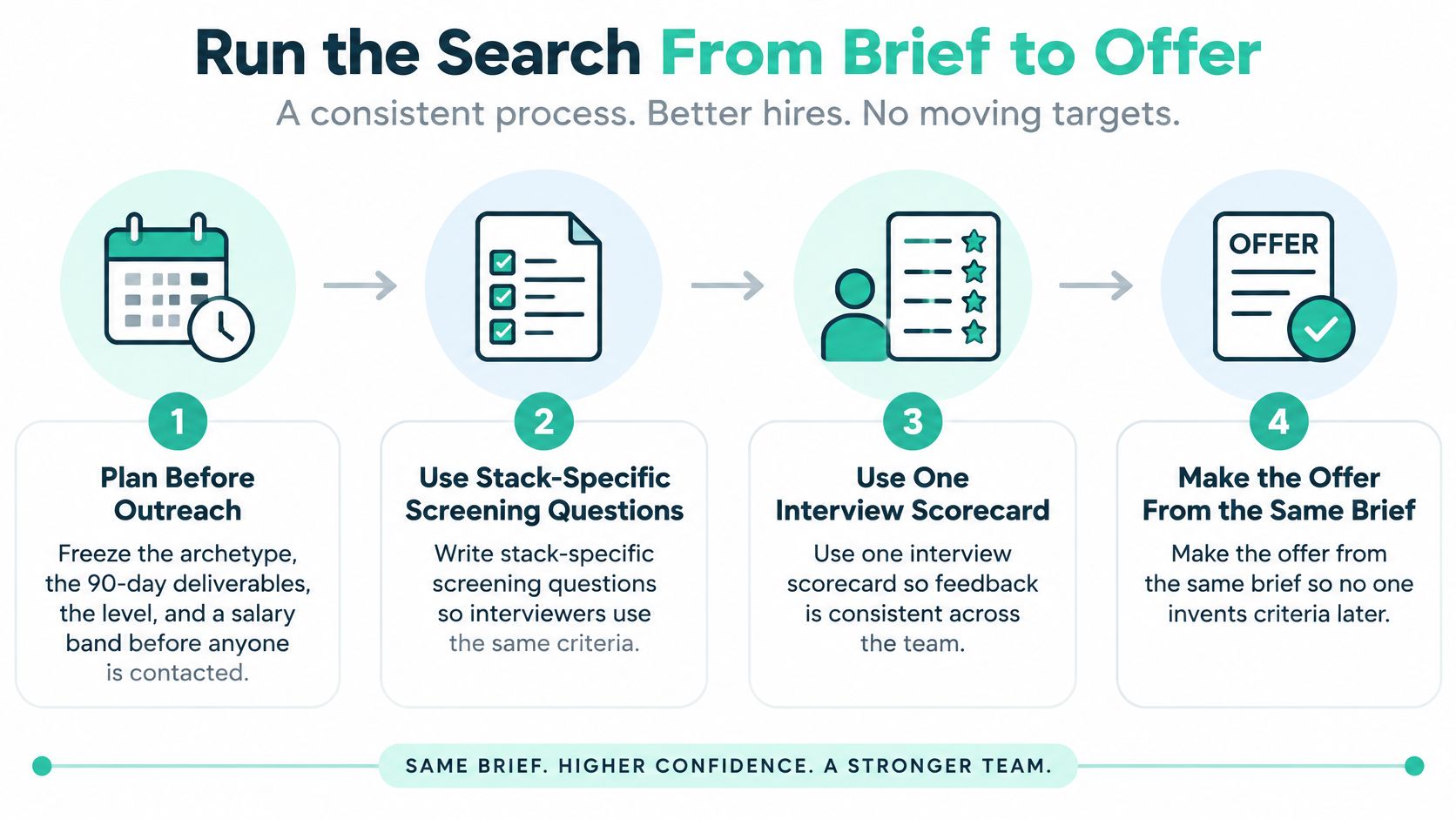
Screen in week one. Work sample in week two. Panel and offer in week three. Seed through Series C teams in fintech, healthtech, B2B SaaS, consumer, and AI-native products lose strong candidates when they add loops to feel thorough. A data scientist who can own decisions on incomplete infrastructure rarely sits in one pipeline at a time, and the slowest team loses. Name one person who can extend the offer before the first interview. If that person is on vacation during week three, move the loop, not the decision.
Give every finalist the same imperfect extract: missing values, one leakage path, an ambiguous definition such as "active," and an imbalanced outcome. Require written assumptions, data-quality checks, a simple baseline, a validation design, error analysis, and a short recommendation a founder could act on.
This scores ownership on incomplete infrastructure: whether the candidate can make a defensible call when the tables are messy. Interview Query's review of data-science postings found SQL in 79% of postings, up from 61% the prior year, while ETL and pipeline requirements rose by 18 percentage points. SQL and pipeline work are the job. A notebook that never touches the warehouse fails the sample even if the model is clever.
Structured interviews predict job performance better than unstructured ones, and quality rises when questions come from job analysis, interviewers take notes, rating anchors are descriptive, and the same interviewers see every applicant. Pair that discipline with the same written sample. If you time the exercise, capture completion times in Google Sheets so a slow, careful write-up is not punished against a rushed one.
CapabilityWhat good looks likeFail signalStatistical reasoningNames assumptions and starts from a baselineJumps to a complex modelSQL and data handlingChecks missing values and leakageOnly produces notebook plotsExperiment judgmentTies the metric to the decisionChases accuracy on imbalanced dataCommunicationOne-page recommendation with uncertaintyJargon and no decisionProduction ownershipDrift monitoring and a rollback ruleHands off a model file and stops
Pass only with demonstrated competence on every critical row. An elegant model does not offset weak experimentation or weak communication.
Use at least two trained evaluators and the same anchors. Do not let resume pedigree, puzzle scores, changed questions, or an unscored "culture fit" veto decide the hire. For a structured question bank you can adapt, see these structured interview techniques. On a startup with no platform team, also ask how the candidate would monitor drift, set rollback criteria, estimate inference cost, and tell a product manager what is still uncertain.
Copy the table into a blank scorecard. Leave a notes column. Refuse to add a row mid-loop.
Treat the live loop as a decision test, not a second work sample. Gallup's 2024 Math Matters Study surveyed 2,831 U.S. workplace managers. 57% said it was very or somewhat likely their organization would need to hire more people with data-science skills during the following five years, and 37% wanted their direct reports to have stronger data-science skills. Those managers also wanted statistics, software skill, and the ability to explain mathematical ideas with charts.
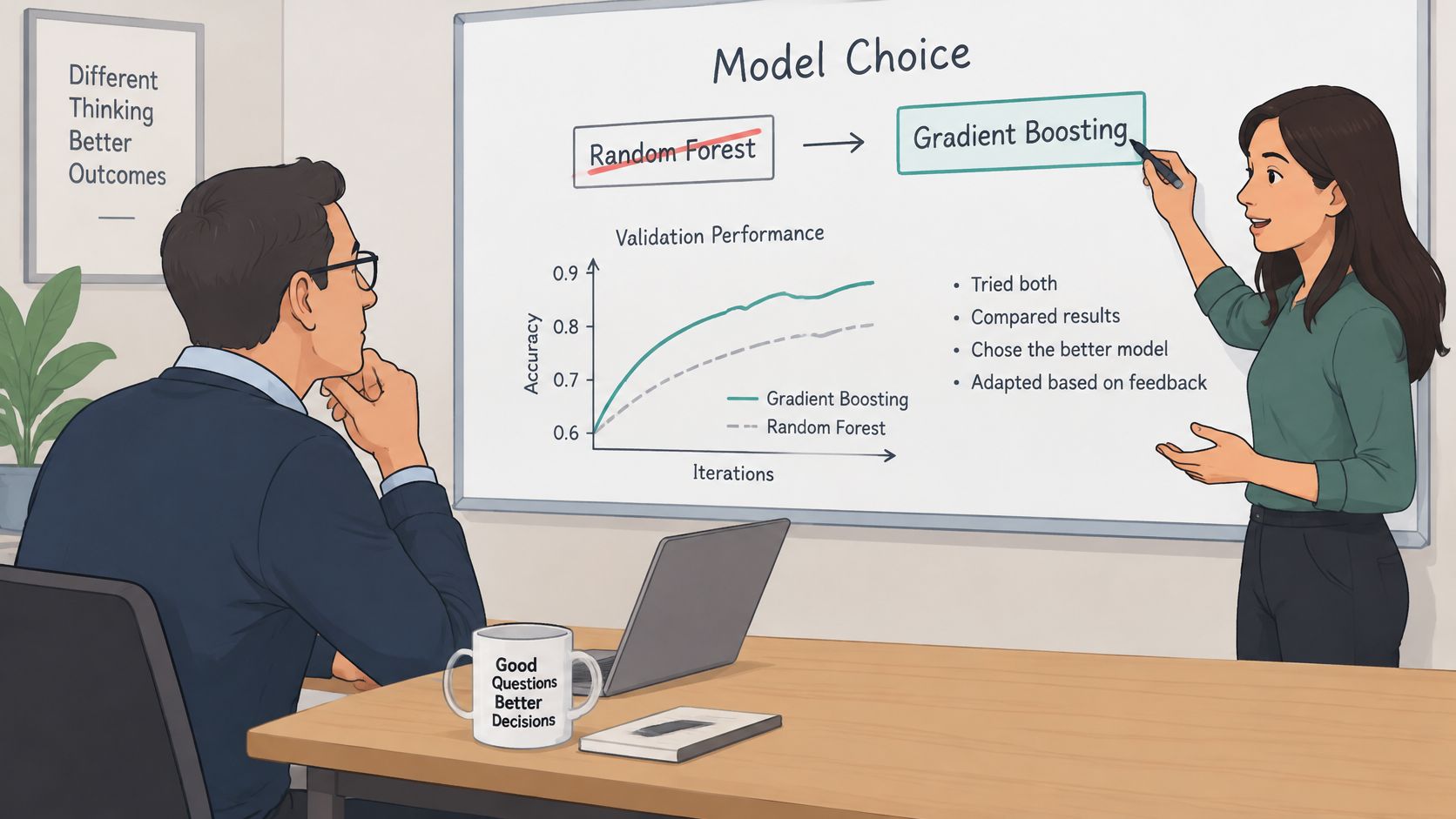
Use one case, such as activation dropping after a pricing test. Watch five moves.
Score translation apart from technical correctness. A correct model the room cannot use is a miss. Ask for one chart and one sentence a CEO could repeat.
Say a seed-stage marketplace founder needs to know whether to keep a paywall test running through Friday. The useful answer is a go or no-go with the risk named. A lecture on estimators is a miss, even if it is accurate. Reaching for a library or a large language model before the objective is clear is the red flag.
Paste this under the communication row: "Passes if they restate the decision, show one chart, and give one sentence a CEO could repeat, including what they would not conclude yet."
Stop listing generative AI, LLMs, retrieval-augmented generation, or agents as requirements. Tool names on a resume do not tell you whether someone can run a decision system.
The UK government's 2025 AI Labour Market Survey reported that understanding AI concepts and algorithms remained the most significant skills shortage, while data management emerged as a new key gap. Technology hiring managers have felt the delivery cost. 71% said shortages caused project delays during the prior year, and 49% said projects were canceled. A shortage of buzzwords is not the problem. A shortage of people who can evaluate, govern, and stop a system is.
Hand the candidate noisy customer text. Ask them to compare a simple baseline with an LLM approach, define an evaluation set, flag leakage and bias, estimate inference and monitoring cost, and write when they would roll back or refuse the model. Reward the simpler statistical method when the data cannot support a generative system.
A concrete miss looks like this. A prototype drafts support replies. There is no evaluation set and no way to stop a bad answer from reaching a customer. For an early-stage company that risk is legal and reputational, not only technical. Pretty demos do not count.
Do not rebuild the written scorecard for this conversation. Add two panel questions, and use the same discipline you would apply when you test technical candidates in the era of AI.
A passing answer names a refusal point and a first-week check. A failing answer names another tool.
Change one thing. Do not restart the whole process because a single stage is leaking people.
SymptomLikely causeFixFinalists drop out after six weeksNo offer owner and extra loopsCap the loop near three weeks and name the decision makerBrilliant modeler who cannot shipPuzzles stood in for the jobMake production ownership a must-pass rowCulture-fit vetoesUnscored similarityScore two collaboration examples insteadOwners rejected by the ATSPedigree and keyword screenScreen for metrics, SQL, and data-quality workAI claims with no refusal pointJob post listed toolsRequire evaluation, cost, and a rollback rulePipelines still broken after the hireHired a narrow modelerSwitch the req to the data-owner archetype
Finalists who vanish after six weeks are usually waiting on a committee that never named an offer owner. Cap the loop near three weeks and put the decision maker on the calendar before interview one.
A strong modeler who cannot describe a handoff was selected by puzzles. Make production ownership a must-pass row. Culture-fit vetoes that keep removing diverse or nontraditional candidates are unscored similarity. Replace the veto with two scored examples of working with engineers and a founder.
An ATS that rejects people who have owned messy warehouses is screening for pedigree and keywords. Sort on metric definitions, SQL, and data-quality work. Candidates who claim AI but cannot refuse a model came from a post that listed tools. Rewrite must-haves around evaluation, cost, and rollback. If pipelines are still broken after the hire, the req asked for a narrow modeler. Switch it to the data-owner archetype.
After any single change, rerun the next two candidates on the same rubric. Only then reopen sourcing. Changing the rubric and the channel in the same week makes the next miss impossible to diagnose.
Pick the channel from the brief you already froze. Do not open a new criteria list because a board looks busy.
If you are an early-stage or high-growth startup and you want startup-fluent candidates rather than a public job-board pile, use Underdog.io. For startups, we offer a curated marketplace to source developers, designers, product managers, and business hires. Run it alongside employee referrals and your own network. Size the pipeline to the work-sample slots you can run each week. Job matching includes access to 300,000+ pre-vetted candidates, and employers can use pay-per-hire pricing or subscription pricing. For a wider view of where technical sourcers look, compare candidate sourcing tools for technical recruiters against the slots on your calendar, not against a wish list.
Before any introduction, confirm four items in writing. The archetype. The salary band. The three must-haves. The 90-day deliverable. Do not reopen the search to add a fashionable AI tool.
In the offer conversation, restate the first project, describe the data the person will have, and name who they will work with in engineering and product. Name the single person who extends the offer before the call. If two finalists tie, choose the one who can make a reliable decision while the warehouse is still incomplete.
Post the brief this week and book the work-sample slot before sourcing goes wide.
Underdog.io gives startup hiring teams a curated marketplace of pre-vetted candidates, with a weekly batch matched to the role you defined and pay-per-hire or subscription pricing. If you need a data scientist who can own messy data and change a decision, start from that brief instead of a public pile. Visit Underdog.io to post the role and see who fits the first 90 days.