You've got a founder who wants to hire yesterday, a candidate who seems impressive in conversation, and three interviewers who each leave with a different opinion. One interviewer praises the candidate's confidence, another focuses on a technical detail, and a third says they “just don't feel like a fit.” The team makes an offer, then discovers after the start date that nobody tested the skills the role required.
That pattern is common in fast-moving startups because informal interviews feel efficient. They're conversational, flexible, and easy to schedule. They also make candidates difficult to compare, give personal preferences too much influence, and let interviewers spend valuable time exploring whatever catches their attention.
Structured interview techniques offer a practical alternative. They keep the human conversation, but add a shared definition of success, job-relevant questions, behavioral evidence, and consistent scoring. The result isn't a rigid performance. It's a faster way to collect comparable evidence before your team commits to a hire.
A startup interview often begins with good intentions. The hiring manager wants to understand how someone thinks, the founder wants to assess cultural alignment, and a future teammate wants to see whether collaboration feels natural. Without a common plan, those goals quickly pull the conversation in different directions.
One candidate gets asked about a difficult launch. Another spends most of the conversation discussing hobbies with the interviewer. A third is tested on a technical edge case that never appears in the job. Each interviewer may leave feeling informed, but the panel has no reliable way to compare the evidence.
A structured interview replaces that improvisation with three simple commitments:
The research foundation is strong. A landmark meta-analysis reported corrected validity of about 0.63 for structured interviews, compared with 0.20 for unstructured interviews, while structured board interviews using consensus ratings reached 0.64. The review also found that interview validity depends on standardization, with greater structure producing stronger prediction of later job performance. The original meta-analysis helped establish structured interviewing as a core evidence-based hiring method.
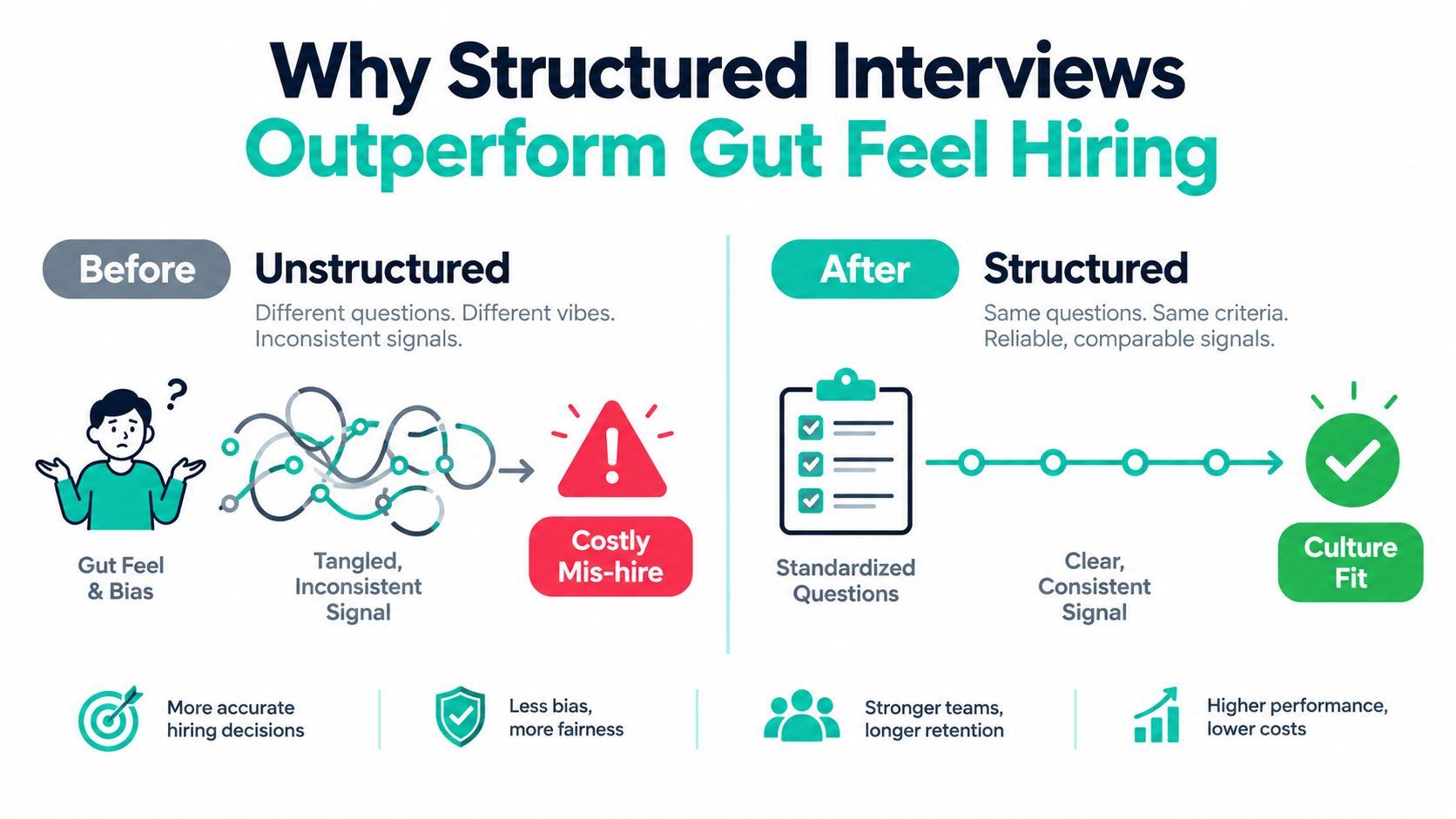
Culture fit is where many hiring teams accidentally lower their standards. They use broad prompts such as “Would I enjoy working with this person?” or “Do they seem like one of us?” Those questions invite similarity bias. Interviewers often reward candidates who share their communication style, background, or interests, even when those traits have little connection to job performance.
A better approach is to define culture contribution as observable behavior. For example, a startup might assess whether a candidate takes ownership when priorities change, gives direct feedback respectfully, or shares information across functions. Those behaviors can be tested consistently without asking candidates to imitate the existing team.
Structured interviews also support fairer decisions. The UK government's guidance on fair and structured interview techniques says structured formats can reduce the effect of applicant characteristics, including sex, on interview decisions and are more likely to produce fairer outcomes than unstructured methods. Teams building a wider bias-reduction system can also use this guide to reducing bias in hiring alongside their interview process.
The practical payoff is speed with less rework. Interviewers spend less time wandering through unrelated topics, candidates know what the process is testing, and hiring managers can identify disagreement at the competency level instead of arguing over whether someone felt impressive.
Start before you write a single interview question. A structured process is only as useful as the definition of success behind it. If the job description says “strategic,” “collaborative,” and “fast learner” without describing what those qualities look like in practice, your rubric will give vague impressions a more official format.
Review the outcomes the person must produce, the decisions they'll make, and the working conditions they'll face. For a product manager, the relevant competencies might include customer discovery, prioritization, written communication, and cross-functional influence. For an early engineering hire, they might include technical judgment, debugging, ownership, and collaboration.
Keep the list focused. A rubric with too many dimensions creates scoring fatigue and encourages interviewers to rate everything based on one memorable answer. Four to six competencies usually gives a startup enough coverage without turning the process into an assessment center.
Write each competency as a behavior, not a personality label:
Then identify which competencies are essential and which are supporting. A role may require strong technical judgment but only moderate presentation polish. Weighting can reflect that difference, but don't use weights to disguise a core requirement. If a candidate must demonstrate safe technical decision-making, set a clear minimum standard rather than allowing strong communication to compensate for a serious gap.
Practical rule: Define what successful performance looks like before you meet candidates. Otherwise, the strongest personality in the room will define it for you.
A useful rubric describes evidence at each rating level. Avoid labels such as “poor,” “average,” and “excellent” without explanation. Interviewers interpret those words differently, especially when they're new to interviewing.
For an adaptability competency, an anchor might look like this:
You don't need a complex software system to manage this. A shared document, an interview scorecard in your applicant-tracking system, or a template in Notion can work if every interviewer sees the same version. Provide space for evidence first, rating second, and recommendation last.
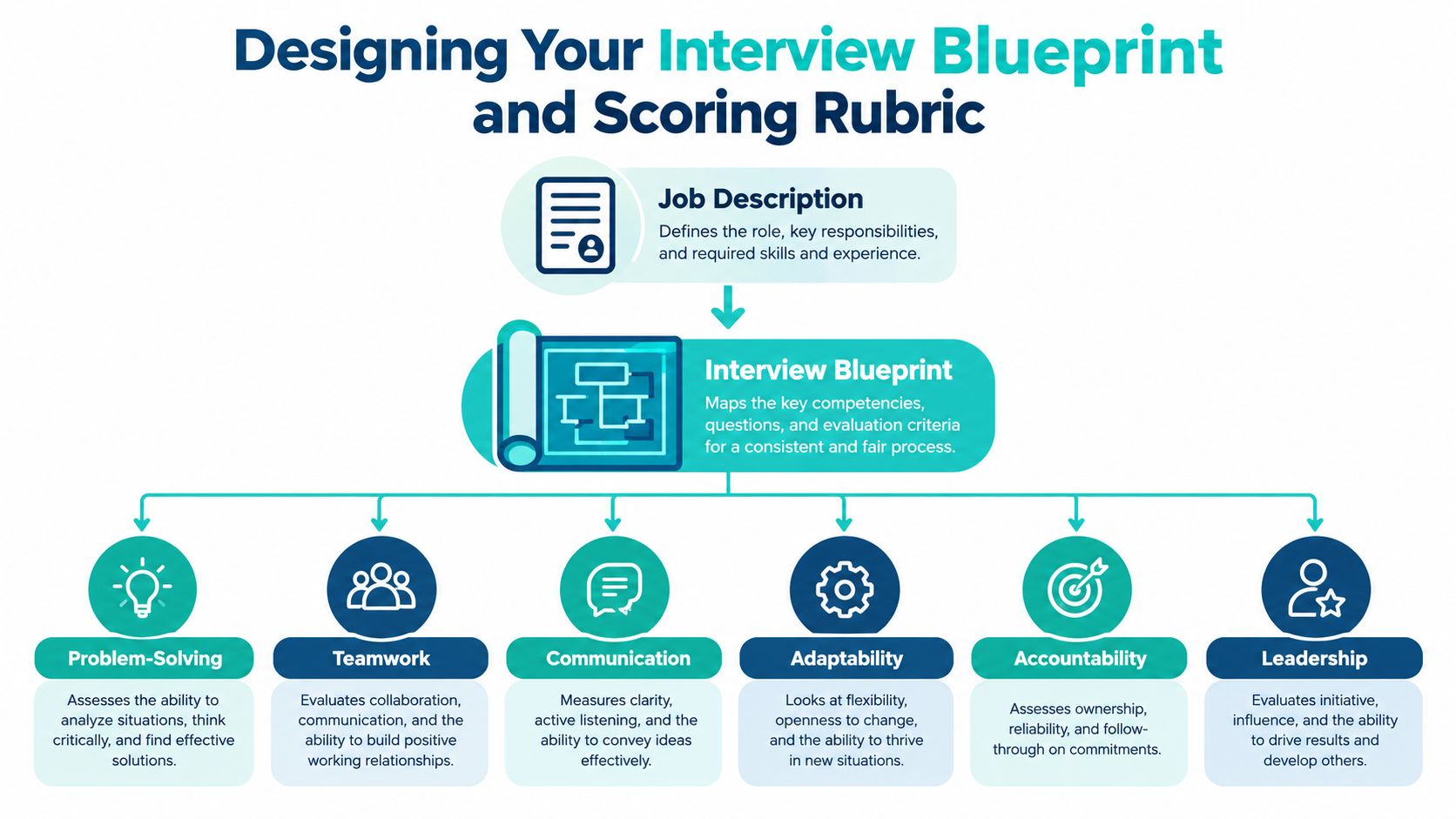
Before launch, ask someone who understands the role but isn't emotionally invested in the hire to challenge each competency. Can they tell what evidence would earn a strong rating? Could two interviewers apply the anchor to the same answer and reach a similar conclusion? If not, revise the language.
For a lightweight training resource, this hiring manager interview training guide can help interviewers understand how standardized questions and consistent rubrics fit together.
Generic questions create generic answers. “Tell me about yourself” may help a candidate settle in, but it rarely gives a hiring team a comparable measure of a specific competency. Strong structured interview techniques connect every substantive question to a defined skill and ask for evidence that can be scored.
Behavioral questions ask about what a candidate has done. Situational questions ask how they would respond to a defined scenario. Both can be useful, but they measure different things. A past example reveals how someone acted under real constraints. A hypothetical response reveals reasoning, priorities, and awareness of trade-offs.
A practical behavioral question follows this shape:
“Tell me about a time when [specific challenge]. What did you do, and what happened?”
For an engineer assessing problem-solving, ask: “Tell me about a production issue where the available information was incomplete. How did you narrow the problem, and what did you do after identifying the likely cause?” The follow-up stays inside the competency. It doesn't drift into unrelated personal history or invite the interviewer to lead the candidate toward a preferred answer.
For product, try: “Describe a time you had to choose between competing customer needs with limited capacity. How did you make the decision, and how did you communicate it?” This tests prioritization and communication without assuming that a particular product framework is the correct one.
For go-to-market roles, ask: “Tell me about a deal, account, or campaign that stopped progressing. What did you investigate, what action did you take, and what was the outcome?” The question gives candidates room to explain their work while requiring concrete ownership.
Recent scholarship argues that interview design should distinguish typical performance from maximal performance. Typical performance concerns how someone usually behaves over time. Maximal performance focuses on what they can do under especially favorable effort or assessment conditions. The distinction matters because one interview format may not measure both constructs equally well. This review of structured interviews beyond mean validity also notes that structured interviews can contain as many as 18 structuring elements, while an average of six are used in practice.
For typical performance, ask about recurring habits, feedback, and decisions made across a period of work. For maximal performance, use a well-defined scenario, give the candidate time to reason, and score the quality of the response against a clear standard. Don't pretend those exercises answer the same question.
Avoid double-barreled prompts such as “Tell me how you prioritize and communicate during a crisis.” A candidate may answer one half well and the other poorly, leaving the interviewer unsure what to score. Split the competencies or state which one matters most.
Also remove culture-fit clichés. “Would you get along with our team?” tests the interviewer's comfort more than the candidate's ability to contribute. Ask instead: “Tell me about a time you disagreed with a teammate's approach. How did you handle the disagreement, and what happened afterward?”
A well-designed rubric can still fail during delivery. One interviewer asks every planned question, another skips the difficult one because the conversation feels awkward, and a third gives generous credit for answers that match their own experience. Candidates then encounter different standards for the same role.
Start with a short interviewer briefing. Review the role outcomes, explain each competency, walk through one sample answer, and discuss why it earns its rating. New interviewers don't need a long course. They need enough shared practice to recognize the difference between a polished claim and specific evidence.
For the same role, keep the core questions and their order consistent. The classic definition of a structured interview emphasizes asking the same questions in a precise manner, with the same response options where relevant. That consistency improves comparability and limits rater drift, as described in this structured interview research document.
Interviewers can still build rapport. Explain the format, give the candidate time to think, and use neutral probes such as “What did you do next?” or “What was your specific responsibility?” The boundary is simple: probe for clarification, not for a better answer.
Use a note-taking template with separate fields for:
Don't let the most senior person interview first and establish the narrative for everyone else. Each interviewer should score independently before the debrief. That step makes disagreement visible and prevents a confident opinion from becoming a substitute for evidence.
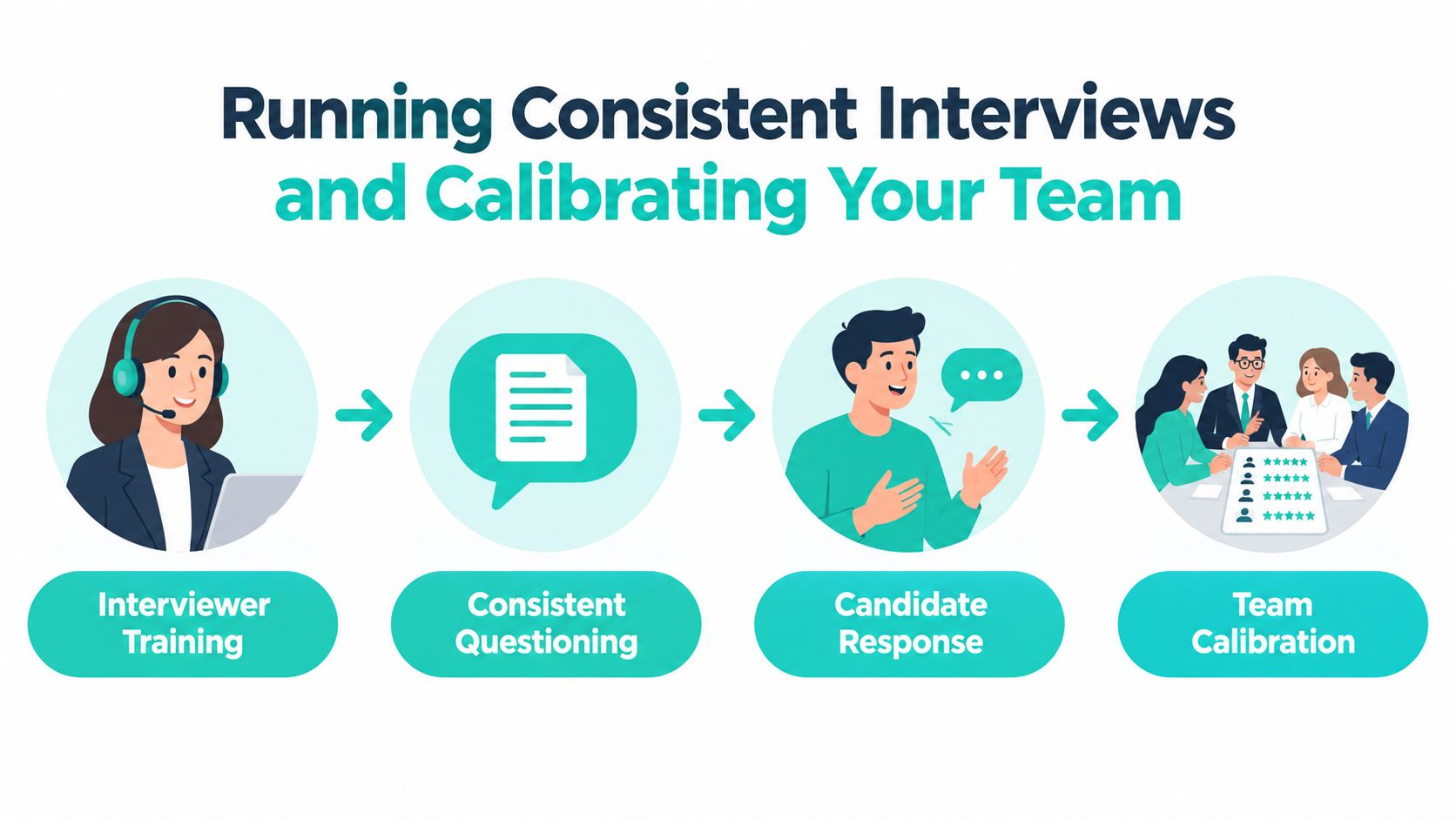
When interviewers disagree, ask what evidence produced the difference. A score of “strong” based on a detailed example should carry more weight than a score based on confidence or conversational ease. If both interviewers point to relevant evidence, identify whether the rubric is unclear or whether the competency needs another data point.
A simple decision matrix helps:
| Situation | Best response |
|---|---|
| Ratings differ, evidence is similar | Revisit the anchor and agree on its application |
| One rating lacks documented evidence | Treat it as an unsupported impression |
| Evidence is mixed across examples | Ask a targeted follow-up or use another assessment |
| A serious concern appears outside the rubric | Test whether it relates to a real job requirement |
| Interviewers disagree about a nonessential preference | Remove it from the decision |
Structure doesn't eliminate judgment. It gives judgment a common object. The UK fair-hiring guidance supports this direction because consistent formats reduce the influence of personal characteristics on decisions, but your team still has to apply the process consistently.
A scorecard should make hiring decisions clearer, not create false precision. Add ratings only after interviewers document the evidence, then review the competency scores independently before discussing the candidate. This order keeps the debrief from turning into a contest between strong personalities.
Use a weighted score only when the weights reflect actual job priorities. A candidate who communicates brilliantly shouldn't automatically pass if the role requires sound technical judgment. Conversely, a narrow weakness shouldn't eliminate someone when the team has explicitly defined it as trainable and nonessential.
The evidence base shows why implementation matters. Earlier meta-analytic work reported validity increasing from 0.20 to 0.57 as interview structure moved from Level I to Level IV, a net gain of 0.37 in correlation with job performance. Another classic analysis found structured interviews had mean validity coefficients about twice as high as unstructured interviews. This review of interview validity documents that historical pattern.
| Interview Format | Mean Validity Estimate | Source Context |
|---|---|---|
| Unstructured interview | 0.20 | Earlier meta-analytic estimate in the review of interview structure |
| Structured interview | 0.42 | More recent re-analysis summarized in a structured versus unstructured interview review |
| Structured interview | 0.51 | Older landmark estimate summarized in the same review |
| Structured interview | .44 | Overall mean operational validity across 106 studies and 12,847 participants, reported by Oh, Postlethwaite, and Schmidt |
These estimates aren't interchangeable. Validity changes with corrections, structure, content, scoring models, and the criterion used. A 2023 commentary reported structured interviews at .42 ± .24, describing both a high mean and substantial variability in outcomes. Treat the figures as evidence for disciplined design, not as a guarantee that any interview labeled “structured” will work well.
After each hiring cycle, compare interview evidence with later performance signals that the role already uses. Look for repeated gaps between high interview ratings and weak early outcomes, or between low ratings and strong performance. Review whether those gaps come from a flawed question, an unclear anchor, or an interviewer who applies the rubric inconsistently.
Track a few operational indicators:
A hiring metrics framework such as this quality-of-hire guide can help teams connect selection decisions with post-hire evaluation. Keep the review lightweight. One useful adjustment to a question or anchor is more valuable than a complicated dashboard nobody maintains.
You don't need to redesign every role before improving your next interview. Pick one open position, identify the capabilities that determine success, and create a scorecard your panel can use without explanation during the call.
A practical launch checklist looks like this:
Speed comes from reducing avoidable loops. A shared blueprint prevents repeated interviews that cover the same ground, while independent scoring lets the hiring manager see exactly where uncertainty remains. Candidates also tend to respond better when the format is transparent. Tell them what competencies you'll assess, explain that each candidate receives the same core questions, and leave room for their questions and context.
Structure shouldn't make the conversation cold. Interviewers can listen closely, acknowledge difficult experiences, and follow up with curiosity. The discipline applies to the evidence you collect, not to the warmth you show.
For founders who are building broader people operations alongside hiring, Benely's HR solutions guide offers useful context on the systems that support startup teams. For specialized technical or hard-to-source roles, a staffing partner such as nexusITgroup.com can also help widen the pipeline, while your internal team retains control of the evaluation standard.
The biggest mistake is waiting for a perfect framework. Start with one role, test the rubric in a real interview, remove questions that don't produce useful evidence, and keep the anchors that help interviewers make comparable decisions. Consistency is the competitive advantage. It lets a small team move quickly without confusing speed with guesswork.
Underdog.io connects qualified technology candidates with startups and high-growth tech companies through a curated hiring marketplace, giving employers access to a focused pipeline while candidates explore opportunities through a single application. Visit Underdog.io to see how a more selective candidate marketplace can complement your structured interview process.