You're in a sprint review, half-listening, half-thinking about a role a friend mentioned last week. Nothing is on fire at your current job. You're still shipping. But you've started wondering whether your next step is somewhere else.
That's a normal moment in an engineering career. It gets risky when curiosity turns into a sloppy search. One public resume upload, one recruiter message answered from the wrong account, one sudden burst of GitHub cleanup, and your “quiet search” stops being quiet.
Learning how to job search confidentially as a software engineer isn't about acting paranoid. It's about reducing avoidable exposure while giving yourself access to better roles. Engineers have a different risk profile than most candidates. Your work is visible. Your network overlaps with your employer's network. Your GitHub, LinkedIn, conference activity, and side projects all leave signals. A confidential search has to account for that.
The best time to look is often when you don't urgently need to. You have an advantage then. You can be selective, ask better questions, and walk away from weak processes.

That matters even more right now. The market has expanded, with tech job postings rising 21% year-over-year as of April 2026, and AI skill requirements appearing in 71% of U.S. tech job postings according to the Dice Tech Job Report. If you've built useful depth in backend systems, infra, ML-adjacent work, frontend architecture, security, or data-heavy products, recruiters will often talk to you privately before you ever touch a public application.
Most engineers start the wrong way. They update LinkedIn, flip on a visibility setting, upload a generic resume to several job boards, and hope nobody notices. That approach creates the most exposure and often produces the weakest conversations.
The better path is quieter and narrower. You use trusted contacts, referrals, selective recruiters, and controlled introductions. That doesn't just protect your current job. It tends to produce better-calibrated roles because somebody is filtering before your profile reaches a hiring manager.
A silent search works best when you treat it like production access. Least privilege, deliberate logs, and no unnecessary broadcast.
The strongest opportunities often do not behave like normal job posts. Teams may be replacing someone discreetly, hiring for a project they have not announced, or trying to avoid a flood of low-signal applicants.
There's another reason to stay private. Between 70-80% of tech job opportunities exist in the hidden job market, and success rates there run 33-80%, compared with 4-10% from traditional job boards, based on the CIAT breakdown of the hidden job market. For engineers, that's the key distinction. You're not only hiding your search. You're aiming at the part of the market where strong roles are more likely to move through referrals and direct outreach anyway.
Before you contact anyone, build your search environment. If you skip this and start messaging people from your normal accounts, you'll spend the rest of the search trying to undo small mistakes.
Use a dedicated email account for job search communication. Keep it off your current employer's devices and out of your work browser profile. Do the same for phone calls with a separate number. The point isn't secrecy theater. It's containment.
Your setup should include:
Keep all documents off public resume databases. Store resume variants locally or in a private drive you control.
Most engineers undersell themselves by using a single resume for every role. Confidential searching benefits from the opposite approach: fewer applications, tighter alignment.
Build two or three focused versions based on the lanes you'd realistically target. For example:
| Resume version | Best for | What to emphasize |
|---|---|---|
| Backend platform | infra, APIs, reliability roles | architecture decisions, scaling work, incident ownership |
| Product engineering | startup full-stack roles | shipping speed, cross-functional work, user-facing features |
| Data or ML-adjacent | analytics platform, applied AI roles | pipelines, model integration, experimentation, tooling |
Avoid listing every technology you have used in every version. Exercise judgment. If you are attempting to transition from a general backend role into work focused more on AI, show the overlap clearly without pretending your last three years were spent entirely on model development.
One of the easiest ways to expose yourself is to treat LinkedIn like a private draft area. It isn't. Recruiters, coworkers, ex-coworkers, and managers all notice profile shifts.
A few practical rules help:
Practical rule: if an update would look suspicious to your manager in a screenshot, don't make that update all at once.
A simple spreadsheet is enough. Track who you contacted, what resume version you sent, when you followed up, and what information you revealed.
That log solves two problems. First, it prevents accidental duplicate outreach. Second, it helps you maintain discipline when the process gets messy and several threads start moving at once.
This foundation isn't glamorous. It's what keeps the rest of the search clean.
Confidential job searching works best when it looks like professional relationship maintenance, not a distress flare. The tone matters as much as the target list.
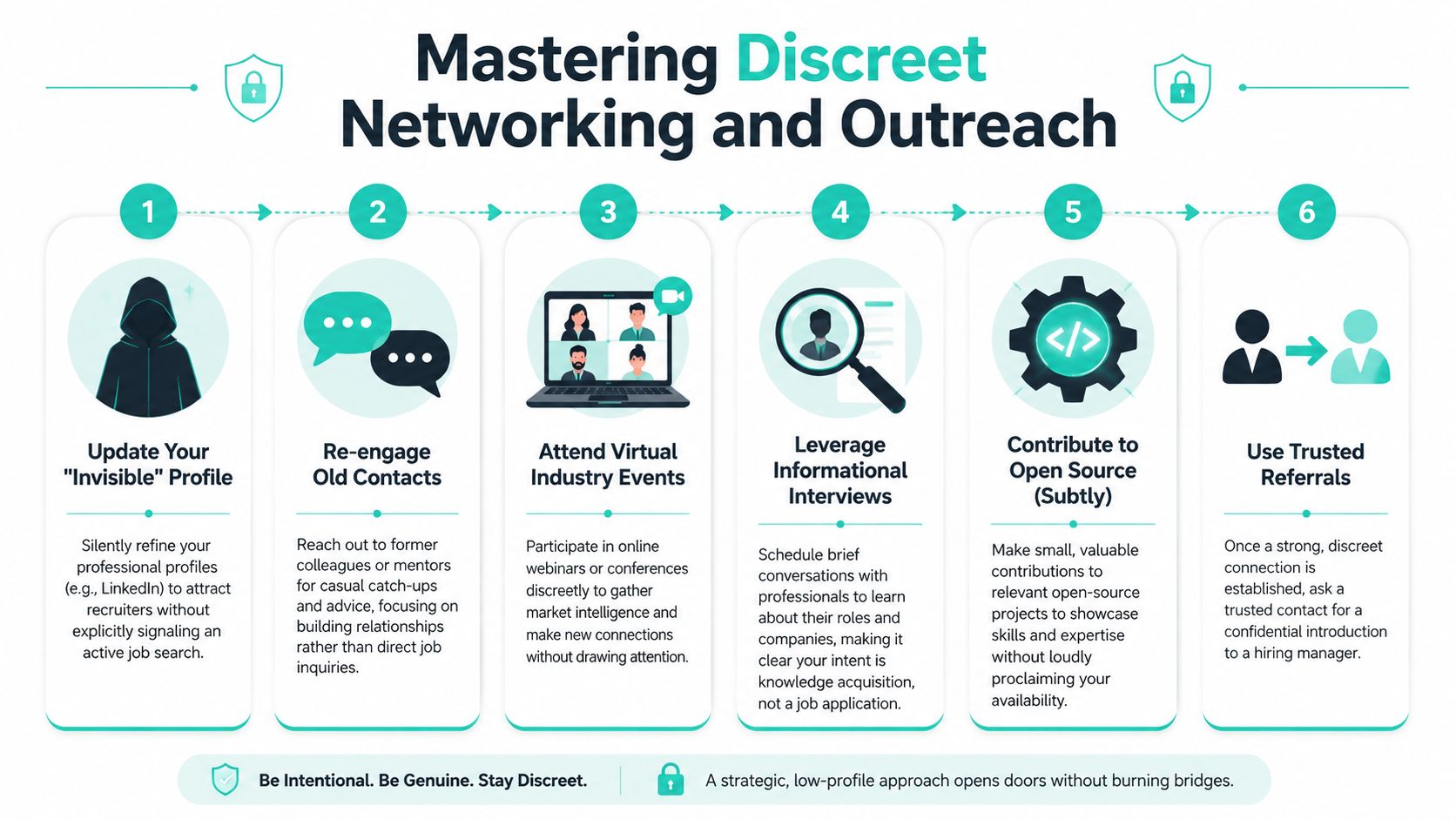
Recruiter-led blind hiring strategies can produce 25-35% higher response rates from passive candidates than public applications, while using a personal LinkedIn profile creates a 60% detection rate by current employers according to the SCM Talent Group overview of confidential recruiting. The lesson is simple. Quiet outreach beats public activity.
Start with people who can place your work, not just your title.
That usually means:
Don't start with your widest network. Start with the people least likely to misunderstand your message and most likely to keep it private.
Bad confidential outreach sounds urgent, vague, or transactional. Good outreach sounds calm and specific. You're not asking someone to “help you find a job.” You're opening a quiet conversation.
Use something like this:
Subject: Quick catch-up
Hey [Name], I've been thinking about my next stretch of growth and wanted to reach out. I'm not running a public search, but I am open to hearing about strong engineering teams working on [area you care about].
If anything comes to mind, or if you know someone worth talking to, I'd appreciate a private conversation. No pressure either way. I'd also be happy to compare notes on the market from my side.
Hope you've been well.
That message works because it does three things. It signals discretion. It gives the person enough direction to be useful. And it doesn't force them into an immediate referral decision.
Not every recruiter is useful for a confidential search. The useful ones understand scope, don't overshare, and can discuss role details without demanding your full identity in the first exchange.
A few habits help:
If you're sorting out how to evaluate them, this guide on finding a recruiter to find a job is a useful framework for deciding who's worth replying to and who isn't.
A quick comparison makes this clearer:
| Low-signal move | Better move |
|---|---|
| Mass-applying on job boards | Asking for targeted introductions |
| Sending the same note to everyone | Writing a short, role-aware message |
| Accepting any recruiter call | Screening recruiters for discretion |
| Updating LinkedIn aggressively | Keeping public profiles stable |
| Asking for jobs directly | Asking for context, fit, and conversations |
Keep the first message light. Save your resume, compensation range, and timing details for people who've earned the next step.
The goal isn't to look unavailable. It's to look deliberate.
A generic confidentiality guide will tell you to watch LinkedIn. For engineers, that's only half the story. Your code trail is often more revealing than your profile.
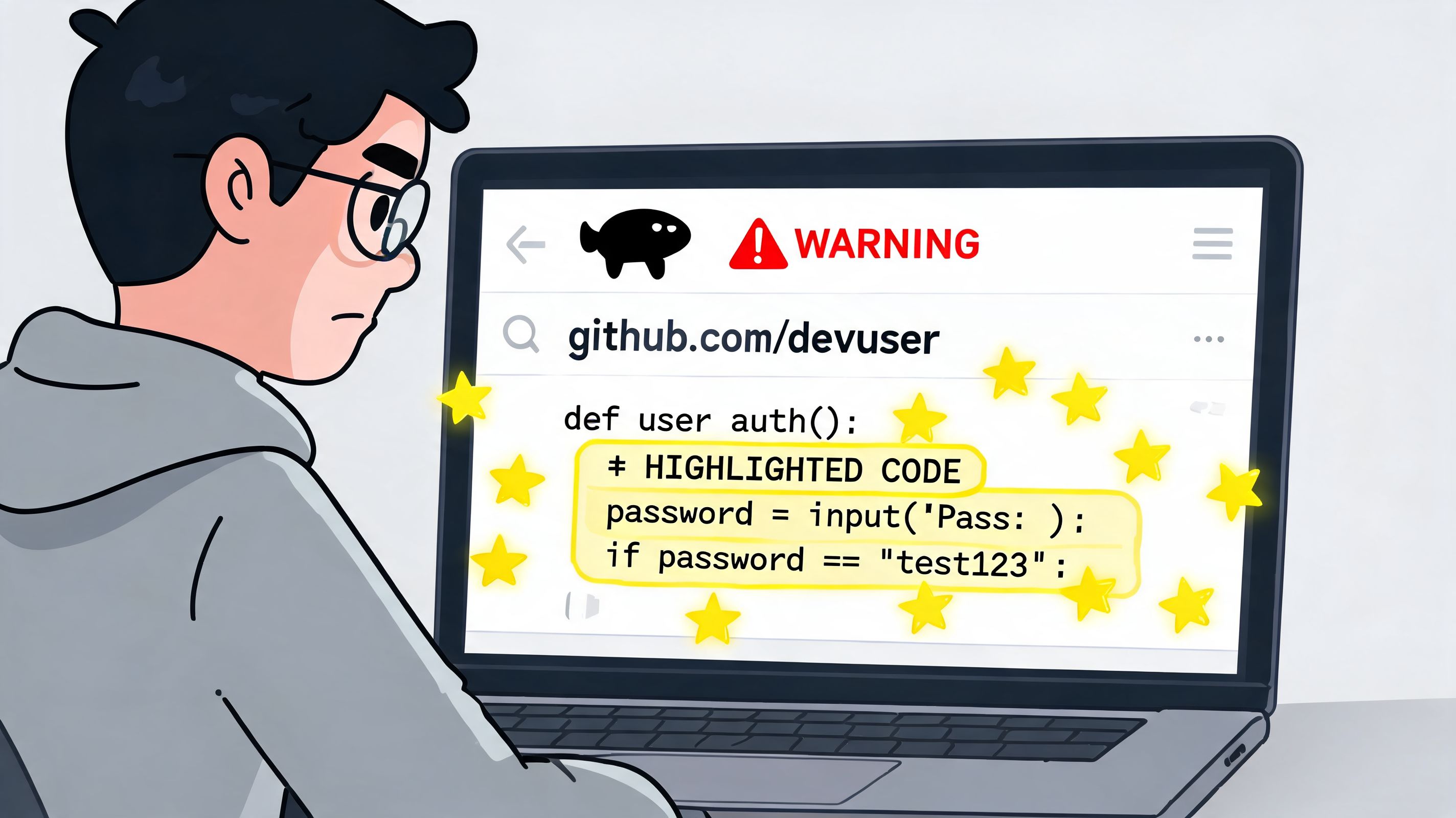
A 2025 Stack Overflow survey found that 68% of developers have public GitHubs used in hiring, and 42% reported employer monitoring of that activity, as summarized in this piece on how to job hunt confidentially while still in a role. If your manager or coworkers already know how you work, they'll notice sudden changes in repo activity, language choices, or side-project themes.
Building in public can help when you want visibility. It works against you when visibility is exactly what you're trying to limit.
If you suddenly start:
you're creating a narrative. Other engineers can read that narrative fast.
Public signals don't need to say “I'm interviewing.” They only need to look different enough that someone asks why.
You don't need to disappear. You need to be intentional.
Use tactics like these:
If you do want your public profile to stay strong while keeping your search private, this article on how to make your GitHub more impressive to employers is useful because it focuses on signal quality, not just activity volume.
GitHub is the obvious risk, but it isn't the only one. Engineers also leak intent through Twitter or X, Discord communities, personal sites, dev forums, and niche Slack groups. A small change in tone across several platforms is often more revealing than one obvious post.
If you want a broader framework for tightening that surface area, these strategies for social media privacy concerns are a practical companion to engineering-specific GitHub hygiene.
A confidential search doesn't require silence everywhere. It requires consistency. If your public identity suddenly starts advertising a future version of yourself, people around you will notice.
There's a point where manually running a private search becomes a second job. Outreach, recruiter filtering, tracking, scheduling, and resume tailoring all add up. That's where anonymous and curated platforms can make sense.

According to Keller's software development recruiting overview, confidential pipelines using curated marketplaces can be 2-3x faster, with 4-6 week timelines compared with 10+ weeks publicly, and they can produce 28% higher retention post-hire. The same source notes that passive engineers on platforms like Underdog.io receive 1-3 personalized introductions per month, which can lead to up to 40% faster offers.
The biggest advantage is control. Instead of broadcasting your profile across public boards, you create one controlled representation and approve exposure more selectively.
That solves a few common problems at once:
This setup is especially useful for engineers who are employed, mildly curious, and unwilling to turn their evenings into a full recruiting operation.
Not every private-feeling platform is discreet. Some are just cleaner interfaces on top of the same high-volume mechanics.
Use this filter:
| Question | Good sign | Warning sign |
|---|---|---|
| Who sees your profile first? | Limited, controlled exposure | Broad employer access by default |
| How are companies selected? | Vetted, relevant teams | Anyone with a budget |
| How do introductions happen? | Mutual interest or human review | Auto-forwarding and spam |
| What kinds of roles dominate? | Roles matched to your background | Generic volume across every function |
If you're comparing options, this roundup of best job search sites for software engineers helps clarify which platforms are built for engineers and which are just broad job boards with tech filters.
For remote-specific exploration, it also helps to keep a short list of curated alternatives. This guide to hand-picked remote roles on YayRemote is useful when location flexibility matters but you still want a cleaner signal than mass-market job sites.
Curated platforms aren't magic. You usually get fewer introductions than you would by spraying applications across the internet. That's the point. You're trading volume for fit, privacy, and a tighter funnel.
For a confidential search, that trade is often worth it. Most engineers don't need more applications in flight. They need fewer, better ones with less risk attached.
The final stage is where a lot of careful searching falls apart. Not because the candidate isn't qualified, but because scheduling, references, and loose talk create exposure.
Don't stack interviews in ways your current team will notice. Midday disappearances, camera-off patterns, and repeated “appointments” invite questions.
A few practical habits help:
If you need a script, use something plain: “I need to be out for a personal appointment this afternoon, but I'll have handoff notes ready before I go.” That gives nobody a mystery worth pursuing.
You'll get some version of: Why are you looking?
The safest answer is forward-looking and specific. Don't complain about your manager. Don't imply desperation. Don't overshare internal frustrations.
A strong answer sounds like this:
I'm good where I am, but I'm looking for a role with stronger alignment around the kind of engineering problems I want to spend the next few years on.
That answer communicates intent without inviting gossip.
If a company asks for your current manager too early, push back politely. Say your search is confidential and you can provide former managers, senior peers, or cross-functional partners first.
Good references for engineers include:
Only involve your current employer when an offer is real, acceptable, and moving toward completion.
Before you sign, check your employment agreement, IP assignment terms, and any restrictions that could affect your move. If a company counters after you resign, separate flattery from facts. A counteroffer can fix compensation fast, but it rarely changes the underlying reason you started looking.
A confidential search ends well when you leave cleanly, keep trust intact, and avoid drama on both sides.
If you want a quieter way to explore startup roles without putting your search on public display, Underdog.io is built around that use case. You create one profile, stay private until there's mutual interest, and let vetted companies start the conversation instead of pushing your resume into the usual public queue.