Getting a job at a high-growth startup isn’t about blanketing the internet with your resume. That’s the corporate way. To succeed here, you need to think differently. The entire process breaks down into four key phases: preparation, discovery, interviewing, and evaluation. It's less about mass applications and all about strategic positioning to prove you're the one who can solve their biggest problems.
This guide is your roadmap.
Finding your fit at a startup is nothing like climbing the corporate ladder. The rules are different. The process isn't about ticking boxes on a long list of qualifications; it’s about showing you have the potential to make a real impact. Fast.
Startups hire for agility, a knack for solving messy problems, and a deep sense of ownership. They aren’t just looking for employees to complete tasks. They’re looking for partners who will help them build the company.
This requires a fundamental shift in your approach. Stop thinking, "Which jobs match my existing skills?" and start thinking like a founder: "What specific problems does this company have that I am uniquely equipped to solve?"
That single change in mindset transforms you from just another applicant into a high-value asset. It changes how you build your resume, where you hunt for opportunities, and how you show up in an interview.
To get there, you need a framework. The whole journey can be broken down into a series of focused stages, each with its own strategy.
This infographic lays out the core phases of a winning startup job search, from getting your profile ready to navigating the interview gauntlet.
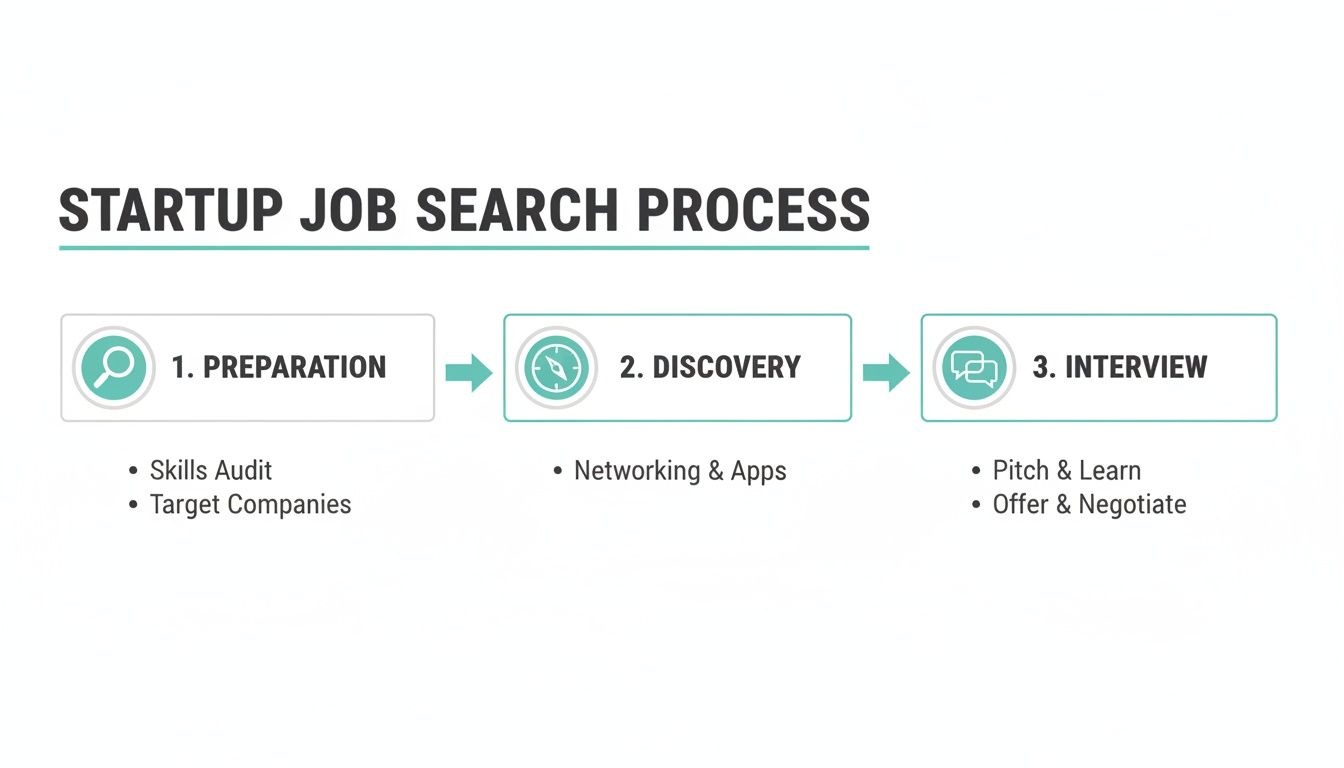
As you can see, each phase builds directly on the one before it, creating a funnel that leads you straight to a compelling offer. This structured approach helps you master the unique demands of the startup world, where things like speed and cultural fit are just as critical as your technical skills.
To help you visualize this journey, we've broken it down into a simple table outlining each stage's purpose and the main action you'll take.
Think of this table as your high-level checklist. Mastering each of these stages is what separates the candidates who get great offers from those who just get frustrated.
Your job search will follow a clear path, and knowing what's coming is your biggest advantage. This isn't the slow, predictable world of corporate HR. It’s a dynamic game where preparation meets opportunity, and you need to be ready for both.
Here’s what you need to master at each stage:
The real secret is to shift your mindset from a reactive "job seeker" to a proactive "problem solver." When you learn to frame your value in terms of the company's biggest challenges, you completely change the hiring dynamic in your favor.
If you want to work at a startup, you need to understand one thing first: they hire for impact, not just for experience. A founder isn't looking for someone who simply held a title. They’re looking for someone who can walk in the door and start solving their most urgent problems.
Your standard corporate resume just won't cut it. The kind that lists job duties and responsibilities needs a complete teardown. To get noticed, your resume has to tell a story of measurable results and prove you can drive a company forward. Startups live and die by their metrics, and your resume needs to speak that language.
The single biggest upgrade you can make is to reframe every bullet point. Stop describing passive tasks and start showcasing active achievements. Every single line on your resume should answer the hiring manager's silent question: "So what?"
For instance, a typical corporate resume might say something like this:
A startup-ready resume flips that script to show real value:
This change shows you get it. You understand that just being busy isn't the same as making progress. It proves you think in terms of growth, revenue, and user acquisition—the very things that keep founders up at night.
The goal is to move beyond simply stating what you did and, instead, demonstrate the direct value you created. A hiring manager should be able to look at your resume and immediately see how your skills will help their company grow.
Translating your experience from a big corporation can feel tough, but it's absolutely doable. If you don't have direct revenue numbers, think about efficiency gains, cost savings, or process improvements you led.
For a deeper dive into crafting a document that gets results, check out guides on how to write a resume that wins interviews.
Startups almost never hire for a single, narrow skill. On an early-stage team, everyone wears multiple hats and is expected to pitch in wherever needed. This is where showing off your "T-shaped" skills can give you a massive edge.
A T-shaped professional has deep expertise in one main area (the vertical part of the T) but also possesses a broad range of knowledge in complementary skills (the horizontal part).
Your resume and LinkedIn profile need to tell this T-shaped story. Don't just list your main job title; include projects where you stepped outside your lane to help the team win. This signals that you're adaptable, resourceful, and a true team player—three non-negotiable traits for succeeding in a startup. You can find more on this in our guide on how to create a resume for startup jobs.
In the startup world, nobody has time to read your life story. Keeping your resume to one page shows you respect the reader's time and can zero in on what truly matters.
Your resume absolutely must be one page. This constraint forces you to be ruthless with your editing, leaving only your most impressive and relevant achievements. Use a clean, modern template that's incredibly easy to scan.
Your LinkedIn profile, on the other hand, is where you can bring your story to life. Use that summary section to craft a narrative that grabs attention.
When you combine a punchy, one-page resume with a narrative-driven LinkedIn profile, you present yourself as the complete package: a candidate who not only has the skills, but also the mindset to make an impact from day one.
With a resume that screams "impact," you're ready to hunt. But where you hunt matters more than you think. If you're serious about landing a role at a high-growth startup, you have to look beyond the usual suspects.
Sure, sites like Indeed and LinkedIn have their place. But the most compelling startup opportunities are rarely found there. Early-stage teams simply can't afford to waste time wading through a digital flood of mismatched applications. They need speed and precision, which means they use channels that deliver high-quality, relevant candidates.
Spraying your resume across a giant job board is like shouting into the void. We call it the "resume black hole"—it goes in, but you never hear anything back.
So how do you skip the line and get straight to the decision-makers? This is where curated hiring marketplaces have completely changed the game for anyone targeting the startup world. Platforms like Underdog.io flip the entire job search model on its head.
Instead of you applying to dozens of companies, companies apply to you.
You fill out one quick application. If your profile is a good fit, it gets showcased directly to hundreds of vetted startups actively looking for someone with your exact skillset. It’s a radically different approach.
This curated model gives you a few powerful advantages:
The real magic of a curated platform is efficiency. You stop wasting hours tailoring applications that might never get read and instead spend a few minutes crafting a powerful profile that brings targeted opportunities to your inbox.
The data backs this up. The 2026 Ashby Talent Trends Report, which analyzed over 1,200 venture-backed startups, found something fascinating. Smaller companies (under 25 employees) saw their time-to-hire drop by nearly 30% when a recruiter was involved early. Human-powered platforms mimic that "recruiter magic," cutting through the noise and connecting you with the right people from the start. You can see all the findings on startup hiring trends on AshbyHQ.com.
Marketplaces are powerful, but your network is your ultimate unfair advantage. And I don't mean just collecting LinkedIn connections. Smart networking is about building real relationships and getting access to information before it becomes public knowledge.
Here are a few tactics I've seen work time and time again:
Here’s a simple outreach script that works because it's respectful and focuses on learning:
"Hi [Name], I'm a [Your Role] and have been following [Startup's Name]'s work on [Specific Project or Product] for a while—very impressive. I'm exploring new opportunities in the [Your Industry] space and was hoping to get your perspective on the challenges your team is tackling. Would you be open to a brief 15-minute chat in the coming weeks? I'm keen to learn more about the problems you're solving."
This approach immediately positions you as a curious peer, not just another applicant begging for a job. It opens the door to a genuine conversation, which is infinitely more valuable than a resume. By blending targeted networking with the efficiency of curated platforms, you can bypass the resume black hole entirely and connect directly with the teams building the future.
Forget everything you know about traditional corporate interviews. Startup interviews are a completely different game. They’re less about reciting your resume line-by-line and more about showing how you think, adapt, and solve problems in real-time.
While a big company might focus on your past performance in a structured role, a startup is stress-testing your potential for future impact. They need to know you can thrive in a fast-moving, sometimes chaotic environment. It’s as much about your mindset and agility as it is about your hard skills.
The process itself often moves at lightning speed. You might have a quick screener call one day, a technical challenge the next, and be talking to the founders by the end of the week. Each conversation builds on the last, designed to see if you have the resilience and sense of ownership to succeed.
Startup interviewers are obsessed with behavioral questions that reveal how you handle ambiguity and push projects forward without a manager breathing down your neck. They need to see that you won’t get paralyzed waiting for instructions when the path forward isn't crystal clear.
Get ready for questions designed to test your grit.
When you answer, don't just describe the situation—focus on your thought process and the specific actions you took. For instance, if you get the "impossible deadline" question, explain how you’d ruthlessly prioritize the absolute must-haves, communicate trade-offs to the team, and ship a "minimum viable" version to gather feedback. This shows you have a bias for action and won't let perfectionism kill progress.
The best answers prove you’re a problem-solver who takes initiative. A founder wants to see that you can take a vague goal, break it down into actionable steps, and start executing immediately, even if the plan isn't perfect.
This approach demonstrates you're not just looking for a to-do list; you're a potential partner who can help navigate the startup's journey.
The interview isn't a one-way street. The questions you ask are just as critical as the answers you give. This is your chance to prove you’re thinking like a strategic partner, not just an applicant looking for a paycheck.
Go beyond the generic questions about "day-to-day responsibilities." Dig deeper to show you're evaluating them just as much as they're evaluating you.
Here are a few powerful questions to ask:
These questions tell them you're already thinking about the company's long-term success and how you can make a meaningful contribution. It proves you’re focused on the "why" behind the work—a critical trait for anyone who wants to make a real impact.
To really nail your preparation, it helps to see the fundamental differences in what startups and established corporations are looking for. The table below breaks down their contrasting priorities.
Understanding this distinction is everything. Once you realize the startup interview is your very first test of adaptability, you can prepare accordingly. By showcasing your ownership, asking insightful questions, and preparing for a different kind of conversation, you can prove you’re exactly the kind of resourceful builder they need on their team.
Getting that offer from a startup is a huge thrill. But once the initial excitement wears off, it’s time to get serious. A startup offer is never just about the salary—it's a complex puzzle of cash, potential ownership, and a massive career bet. To make a smart call, you have to look past the base number and see the entire picture.
It’s also important to know what’s happening in the market. According to a recent tech hiring trends report from Ravio, early-stage startups have dialed back their hiring rates to 27%, favoring precision over just adding headcount. With AI/ML specialists now accounting for 10-15% of new hires and pulling in top-tier salaries, having a sense of this landscape helps you know what's competitive. And since 55% of companies now use AI in their own recruiting, your expertise can be a real negotiation chip.
For most people, the equity part of the offer is the most confusing. Equity, usually in the form of stock options, is your chance to own a small slice of the company you’re helping to build. If the startup takes off, that slice could be life-changing. If it doesn't, it’s worth nothing.
To figure out what you’re actually being offered, you need to get familiar with a few key terms:
The number of options in your offer means very little on its own. The crucial question to ask is: "What is the total number of outstanding company shares?" This helps you calculate what percentage of the company you actually own. A 10,000-option grant is meaningless without that context.
While salary and equity are the headliners, they don’t tell you what it’s actually like to work there. The non-financial side of the job will have a much bigger impact on your day-to-day sanity and long-term career growth. The right environment can put your career on a rocket ship, but the wrong one is a fast track to burnout.
Before you say yes, make a personal checklist. What really matters to you? These are the factors that will define your experience and determine whether you'll thrive or just survive.
Dig into these critical areas:
By digging into both the financial package and these qualitative factors, you can make a decision that truly aligns with your career goals and personal well-being. For an even more detailed breakdown, check out our complete guide on how to evaluate a job offer.

Landing the offer feels like crossing the finish line, but it’s really just the starting block. The first 90 days are where the real race begins, and this initial sprint will set the pace for your entire career at the company.
In a startup, your value isn't measured by how busy you look—it's measured by your impact. Your first three months are your prime opportunity to prove you can deliver. The goal isn't to come in and turn the place upside down. It's to be a sponge, build trust, and rack up small, meaningful wins that prove you belong.
Your first month is all about observation, not optimization. Your mission is to absorb the culture, understand the business, and get to know the people before you even think about making changes. That brilliant idea you have from your last job? Pocket it for now.
Focus your energy on these key areas:
Alright, you've got the lay of the land. Now it’s time to start connecting the dots and making your presence felt. This is where you transition from learning to doing and start showing that bias for action you talked about in your interviews.
This phase is all about proactive problem-solving. Instead of waiting for tasks, look for the small gaps you noticed in your first month and start plugging them. Maybe you can document a process that lives only in someone's head or build a tiny tool to automate a tedious task.
In a startup, success comes from seeing a problem and taking the initiative to solve it without being asked. Your ability to proactively find and fix things, even small ones, shows immense value and ownership.
Deliver on the initial goals your manager set, communicate your progress clearly, and keep building those cross-functional relationships. You're proving you can execute.
By now, you should be fully ramped up and ready to take on bigger challenges. It's time to cash in on the knowledge and relationships you've built to drive real, tangible impact that lines up with the company's biggest priorities.
As you settle in, remember the startup world is always shifting. Looking ahead to 2026, 40% of startup jobs are projected to offer remote flexibility, which means new hires have to be even more proactive. With lean teams and a focus on upskilling, especially in areas like AI, your ability to add value from day one is everything. You can find more on this in the global hiring trends for startups on Riseworks.io.
To hit the ground running and make sure your efforts are aligned from the start, a structured plan is your best friend. Using a solid employee onboarding checklist template helps you tick all the right boxes, ensuring you’re not just busy, but genuinely contributing to the mission.
Thinking about making the jump to a startup? It’s a big move, and it's natural to have questions. Let's cut through the noise and tackle some of the most common things people wonder about before diving in.
Let's be direct: yes, there's more risk. A startup’s future often hinges on hitting product-market fit, securing the next round of funding, and navigating market shifts. It's not the same as joining a company that's been a household name for 50 years.
But that risk is often the price of admission for incredible rewards. We're talking about accelerated learning, having a real, tangible impact on a product, and the potential for life-changing equity if the company succeeds.
The best way to manage this risk is to do your homework. Dig into the company’s funding stage, learn about the founders' track records, and understand their competitive landscape before you even think about an offer.
This is one of the biggest myths about startup culture, and the answer varies wildly. Sure, some early-stage teams are known for marathon work sessions, especially when a small crew is racing toward a critical launch.
But a growing number of modern startups, particularly remote-first companies, care more about results than the hours you clock. They often provide a surprising amount of flexibility. The only way to know for sure is to ask pointed questions during your interviews about team culture, communication norms, and what "on-call" really means.
Equity is a huge part of the startup compensation puzzle, and the percentage you get depends heavily on your role, your experience, and how early you join.
Don't get hung up on the percentage alone. The real goal is to understand the potential value of your grant. Ask about the total number of options, the strike price, and the company's most recent valuation. This gives you a much clearer picture of what your equity could actually be worth.
The biggest differences come down to pace, ownership, and role definition. At a startup, your work has direct, visible impact on the company's trajectory — you're not a small cog in a large machine. Roles tend to be fluid and cross-functional, meaning you'll regularly work outside your official job description. The pace is faster, processes are less established, and the expectation is that you'll take initiative without waiting for detailed instructions. In exchange for that ambiguity, you typically gain accelerated learning, more autonomy, and the potential for equity upside if the company succeeds.
Startups value adaptability, a bias for action, and the ability to solve ambiguous problems more than any single technical skill. On top of your core professional expertise, the most sought-after traits are ownership — the willingness to see a problem through without being asked twice — the ability to learn quickly on the job, and comfort working with limited resources and incomplete information. T-shaped skills, meaning deep expertise in one area paired with broad knowledge in complementary areas, are especially valued on small teams where everyone needs to pitch in wherever the company needs them most.
The best startup opportunities rarely surface on giant job boards like Indeed or LinkedIn, because early-stage teams don't have the bandwidth to manage floods of unfiltered applications. Curated hiring marketplaces like Underdog.io are designed specifically for this — you create a single profile and get matched directly with vetted startups actively looking for your skills. Beyond that, following venture capital firm portfolio pages surfaces fast-growing companies that are almost always hiring but haven't widely posted roles yet. Engaging authentically in niche professional communities on Slack or Discord, and reaching out directly to people at companies that excite you, are also highly effective ways to access opportunities before they become public.
A startup-ready resume leads with measurable impact, not job duties. Every bullet point should answer the question "so what?" — connecting your work to a quantifiable outcome like revenue generated, cost saved, time reduced, or users acquired. If you don't have hard numbers, frame accomplishments in terms of scale, efficiency, or business value. Keeping the resume to one page signals both focus and respect for the reader's time, and every line should speak to the startup's biggest concerns: growth, speed, and resourcefulness.
Startup interviews are less about reciting your past experience and more about demonstrating how you think and solve problems in real time. You can expect behavioral questions designed to test your ownership and resilience — how you handled ambiguity, what you built with limited resources, or how you made a call with incomplete information. Technical screens tend to focus on practical problems rather than abstract puzzles. Many startup interviews also include a culture fit component where the founders or team leads are evaluating whether you share their sense of mission. The process often moves much faster than corporate hiring, sometimes compressing from first call to offer within a week.
The base salary is just one piece of a startup offer. Equity — typically offered as stock options — can ultimately be worth far more than the salary if the company grows significantly, or worth nothing if it doesn't. To evaluate equity intelligently, ask for the total number of outstanding shares so you can calculate the percentage you're actually being offered, understand the strike price and vesting schedule, and research the company's most recent valuation. Beyond the financials, evaluate the quality of the leadership team, the clarity of the company's product-market fit, their funding runway, and the culture around how they handle failure and disagreement. These non-financial factors will have the biggest impact on your day-to-day experience and long-term career trajectory.
There is inherent risk — a meaningful percentage of startups don't achieve long-term success, and job security is generally lower than at an established company. That said, the risk is manageable with the right due diligence. Researching a company's funding stage, the founders' track records, the strength of their product-market fit, and their competitive landscape before accepting an offer significantly reduces the chance of joining a sinking ship. And even if a startup doesn't work out, the skills developed — adaptability, ownership, cross-functional experience — are highly transferable and tend to accelerate your career regardless of the outcome.
The first 30 days are best spent listening and learning rather than trying to immediately change things. Build relationships with your team, understand the product deeply, and clarify exactly what success looks like in your role. From day 30 to 60, start taking initiative on small, visible problems and demonstrating the bias for action you showed in your interview. By day 60 to 90, you should be fully contributing to the company's highest priorities. Throughout all of it, communicate your progress proactively and ask for feedback early — startups move too fast for anyone to wait until the annual review cycle to course-correct.
Equity varies widely based on your seniority, how early you join, and the company's stage. One of the first 10 to 20 employees at a seed-stage startup might receive anywhere from 0.5% to 2% of the company. A senior hire joining a Series B company might see something in the 0.05% to 0.2% range. Rather than fixating on the percentage alone, focus on understanding the actual potential value: ask about the total shares outstanding, the company's most recent valuation, and how the vesting schedule works. A standard vesting schedule is four years with a one-year cliff, meaning you earn nothing in your first year but 25% vests on your one-year anniversary, with the remainder vesting monthly over the following three years.
Ready to find a startup role where you can make a real impact? Underdog.io flips the job search on its head. Create one profile in 60 seconds and let top, vetted startups apply to you. Start your confidential search today.