If you're eyeing a junior data analyst role, you've probably seen salary numbers all over the map. Let's get straight to it: for 2026, the typical range falls between $60,000 and $95,000. The national average salary sits right around $79,000.
But here's the thing—that "average" is just a starting point. Your actual paycheck will be shaped by where you live, the skills you bring to the table, and the kind of company you join. This guide provides actionable insights to help you navigate these factors and secure the best possible offer.
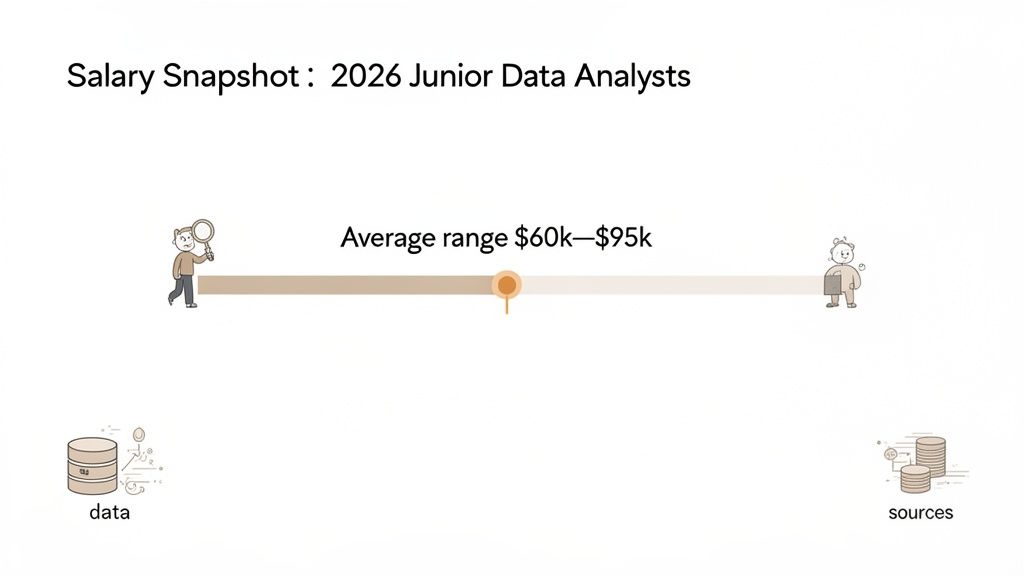
Data analyst roles are one of the hottest entry points into tech right now, and that intense demand creates a pretty wide salary spectrum. It’s easy to get lost in the numbers, so think of the national average as a directional guide, not a final destination. The offer you actually land is a moving target influenced by factors we'll break down here.
Drilling down into the data, we see just how much salaries can vary. As of March 2026, the average junior data analyst salary is $79,352 a year. But the middle 50% of earners fall between $57,000 and $81,500. Push into the top 90th percentile, and you’re looking at $111,000 annually. Other sources put the average base closer to $62,000, with extra cash compensation on top.
Actionable Insight: An "average" salary is just a benchmark. Your real earning potential is defined by your specific context—where you work, what you know, and the value you can prove.
To really understand what a competitive offer looks like, it helps to see the numbers from a few different angles. The table below gives you a quick snapshot from a few leading sources, providing a solid baseline for your own salary research.
If you’re just starting out, understanding how a data analyst course can change your career can also give you a leg up in salary negotiations.
What this shows is that your market value isn’t one single number. It’s a range, and that range shifts depending on market demand, your location, and your specific skill set.
As we'll get into later, things like mastering SQL or Python, specializing in a high-growth industry, or working in a major tech hub can all push your compensation toward the higher end of this spectrum. For a deeper dive into compensation across the tech industry, check out our comprehensive 2025 tech salary guide.
Your first data analyst salary is just the starting line. Think of it less as a fixed destination and more as the launchpad for your entire career trajectory. You’re starting out with a foundational set of tools, and your pay reflects that. But with every dashboard you build and every SQL query you optimize, you're earning experience that directly fuels your earning potential.
Experience creates a pretty clear path for salary growth. As you log more time and, more importantly, rack up tangible skills, your pay should climb. Data from PayScale's 2026 reports shows entry-level analysts with under a year of experience pull in an average of $57,925. After gaining 1-4 years on the job, that number inches up to $59,643.
But other sources paint a much more aggressive picture. Some data shows analysts in the 1-3 year range earning closer to $69,000 or even $80,553, which really shows how much your company type and skillset can fast-track your pay. The takeaway is that steady, yearly bumps are the norm as you move from junior to mid-level. You can see the salary progression for yourself on PayScale.com.
This isn't just about putting in the time. It's about the value you deliver. In your first year, you're mostly learning the ropes—getting familiar with the company's data, tools, and reporting rhythm. But by year two or three, the game changes. You’re expected to move from just pulling numbers to anticipating business needs, proposing your own analyses, and tackling much hairier problems.
The kind of company you join has a massive impact on how quickly your salary grows. Big, established corporations offer a steady, predictable career ladder, but climbing it can be a slow grind. A fast-growing startup, on the other hand, can feel like hitting the career fast-forward button.
In a startup, you’re often thrown right into the deep end. The "data team" might just be you and one other person, which means you have to wear a lot of hats. One day you’re building a marketing dashboard, the next you’re in the weeds with engineers debugging a data pipeline. It’s a trial-by-fire environment that forces you to expand your skills far beyond a typical analyst role.
Because startups are obsessed with growth, they reward people who can directly move the needle on key metrics. If your analysis leads to a 10% jump in user retention or uncovers a brand-new revenue stream, that impact is immediate and impossible to ignore. That direct line between your work and the company's bottom line makes it much easier to build a case for a big raise or a promotion to a mid-level role—often years faster than you would on a traditional corporate track.
Actionable Insight: Experience isn't just a number of years on your resume. It's the sum of the problems you've solved. In a high-growth startup, you get to solve more complex problems, faster—and that's what directly fuels your salary potential.
To actually cash in on this experience, you have to be strategic. Don’t just wait for your annual review to hope for the best. You should be documenting your wins from your very first day. This is the single most important habit for justifying a higher salary or landing a much better-paying job later on.
Here’s a practical framework for tracking your impact:
Keeping a simple log like this turns a vague claim like "I have two years of experience" into a powerful story: "In my two years here, I delivered projects that identified $50,000 in potential cost savings and helped drive a 5% lift in customer engagement." That's the kind of language that gets you noticed, promoted, and paid what you're worth.
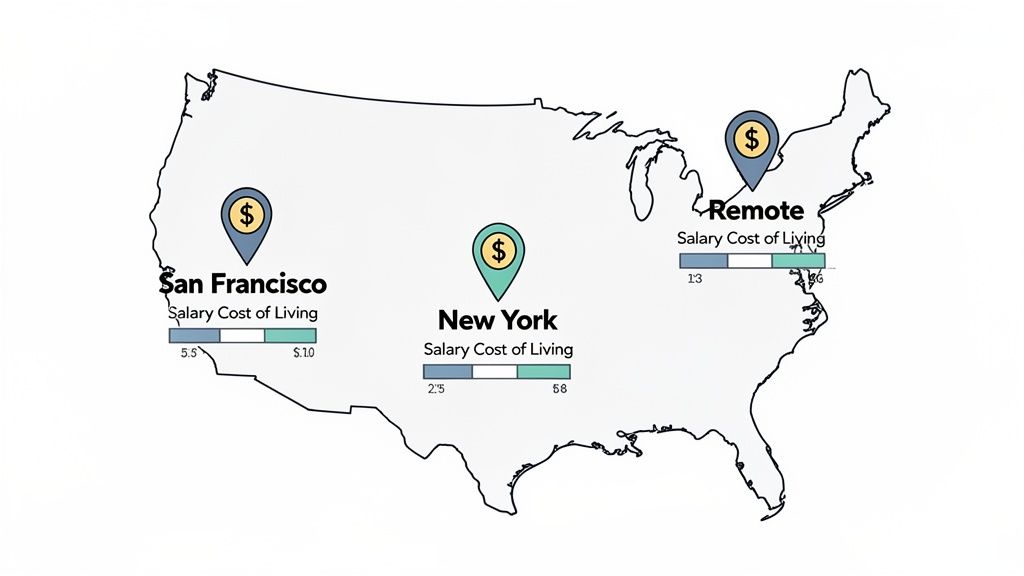
Let's cut right to it. When it comes to your salary, one factor can quietly add or subtract tens of thousands of dollars from your paycheck: your physical address. Where you work isn't just a detail; it's a core variable in how companies calculate your pay.
It’s a simple truth of the job market—companies adjust salaries based on the competition for local talent and, more importantly, the cost to live there. Think of it this way: a salary isn't just a number, it's a measure of your actual purchasing power. An offer for $70,000 in Austin, Texas, translates to a radically different lifestyle than the same $70,000 in San Francisco. The real value is what’s left after you’ve paid for rent, groceries, and getting around.
At the heart of these geographic pay gaps is the cost of living. Major tech hubs like New York City and the San Francisco Bay Area have notoriously high living expenses, which forces companies to offer bigger paychecks just to get people in the door. But a higher salary doesn't always mean you're richer.
An analyst earning $90,000 in San Francisco could easily have less disposable income than someone making $75,000 in a smaller city like Raleigh, North Carolina, once you account for the staggering difference in housing costs.
To make this tangible, let’s see how a hypothetical $80,000 base salary feels in different markets after adjusting for local costs.
Actionable Insight: Never just look at the top-line number. Always use an online cost-of-living calculator to compare the real value between cities. A high salary in an expensive city is often just a cost-of-living adjustment in disguise. The most powerful offer isn't always the biggest number—it's the one that gives you the most financial freedom after your bills are paid.
The explosion of remote work has thrown a new wrench into location-based pay. How do companies set a salary when the employee could be logging in from anywhere? There’s no single answer, and companies generally follow one of three playbooks.
Actionable Insight: When you're interviewing for a remote role, asking "Which model does your company use for remote compensation?" is non-negotiable. Getting clarity on this is vital for understanding your real earning potential, especially if you have plans to move during your employment.
While your city and years of experience are a big part of the salary equation, your actual skills are what truly set you apart. Having the right mix of technical and soft skills doesn't just make you a better analyst—it makes you a more strategic part of the business, and that’s what gets you paid more.
Think of it this way: a basic toolkit lets you handle standard requests. But a specialized, advanced toolkit lets you tackle the complex, high-impact projects that actually drive growth. Startups, in particular, will pay a premium for analysts who can do more than just pull data. They want people who can turn that data into a game plan.
Some technical skills are simply non-negotiable for a data analyst. These are the foundational tools you’ll use every single day to find, clean, and show data. Mastering them is the first step to commanding a higher salary.
Your proficiency here tells a hiring manager you can hit the ground running and start adding value from day one.
SQL (Structured Query Language): This is the bedrock of data analysis. Strong SQL skills mean you can pull and work with data from company databases all on your own. Instead of waiting for an engineer, you can dive right in to investigate user behavior, track sales performance, or spot product bugs. For example, using SQL to analyze churn patterns can directly inform a company’s retention strategy, saving thousands of dollars.
Python or R: SQL is for getting the data, but Python or R is for cleaning it up, transforming it, and building models with it. Knowing a language like Python, especially with libraries like pandas and NumPy, shows you can handle messy, real-world data. This is what moves you from simple reporting into much more sophisticated (and valuable) analysis.
Data Visualization Tools (Tableau, Power BI): Raw numbers are tough for most people to understand. An analyst who can turn a giant spreadsheet into a clear, compelling dashboard in Tableau or Power BI is incredibly valuable. Imagine building a live dashboard that shows the marketing team which ad campaigns have the highest ROI. That's a skill that directly shapes how a company spends its money.
Actionable Insight: Being good with technical tools isn’t just about knowing the commands. It’s about using them to answer critical business questions on your own. That independence is what employers are really paying for.
Technical skills get you in the door, but soft skills are what launch your career and earning potential into a new orbit. These are the skills that determine whether your analysis actually leads to change. In a startup, where everyone needs to communicate clearly and work together, they’re just as critical as your ability to write a query.
Without these skills, even the most brilliant analysis can get lost in a spreadsheet, failing to make any real impact.
Here's a look at the skills that have the biggest impact, especially in a startup environment where your work is highly visible.
Mastering these skills allows you to bridge the gap between raw data and business strategy, making you an indispensable part of the team.
This is the art of building a story around your data. It’s the difference between showing a chart with a declining line and explaining why it's declining, who it's affecting, and what the business should do next. A great data storyteller can present findings to non-technical leaders—like the CEO or Head of Sales—in a way that’s both easy to grasp and impossible to ignore.
Practical Example: Don't just say, "User engagement is down 5%." Tell the full story: "Our data shows a 5% drop in engagement, and it's happening almost entirely with new users from our latest mobile update. The friction in the new sign-up flow is causing a 15% drop-off on day one, which could put our quarterly growth targets at risk if we don't fix it." See the difference? You've framed the problem, explained the stakes, and created urgency for a solution.
Business acumen means you understand how the company actually makes money and what its big-picture goals are. An analyst with business sense doesn't just analyze data in a silo; they connect their work directly to core metrics like customer lifetime value, acquisition costs, or market share.
This allows you to be proactive. You start to anticipate the questions your stakeholders will have and propose analyses that align with the company's biggest priorities. This makes your work far more relevant and impactful. It’s what separates a junior analyst who just fulfills tickets from a strategic partner who helps steer the ship.
When you get a job offer, it’s natural for your eyes to go straight to the base salary. But fixating on that one number is a classic rookie mistake, especially when you’re looking at roles in tech and at startups. The base salary is just the beginning of the story.
Think of it like buying a car. The sticker price is what gets your attention, but it doesn't tell you about the engine's power (your bonus potential), its resale value (equity), or the features that make driving it great (your benefits). An offer with a lower base might actually be worth far more once you look under the hood.
To make a smart decision, you have to understand how to calculate total employee compensation, which rolls in all the valuable perks beyond your paycheck. This gives you the full picture of what you’re really earning.
Your total compensation is much more than what hits your bank account each month. It’s a mix of performance incentives, a potential slice of company ownership, and benefits that are worth real money. Let's break down what to look for.
Performance Bonuses: Many tech companies tie bonuses to how well you and the company perform. These are usually a percentage of your salary (think 5-15%) paid out annually or quarterly. Hit your goals—maybe you built a dashboard that saved the marketing team ten hours a week—and you get rewarded for it.
Equity (Stock Options vs. RSUs): This is a huge deal at startups. Equity gives you a piece of the company you're helping to build. Stock options give you the right to buy company shares at a fixed price later, which can be incredibly valuable if the company takes off. Restricted Stock Units (RSUs) are shares you're granted outright that become yours over time (vesting), and they're more common at bigger, public tech companies.
Benefits Package: Don't sleep on this. A good benefits package—health, dental, and vision insurance—can easily be worth thousands of dollars a year. This also includes retirement plans like a 401(k) (especially with a company match), paid time off, and even commuter benefits.
Professional Development Stipends: The best companies want you to grow. A learning stipend, often between $500 and $2,000+ a year, lets you pay for courses, certifications in tools like Tableau or Python, or tickets to industry conferences. It’s a direct investment in the skills that will make you more valuable.
This isn't just about adding more technical tools to your belt. The most valuable analysts blend hard skills with strong soft skills.
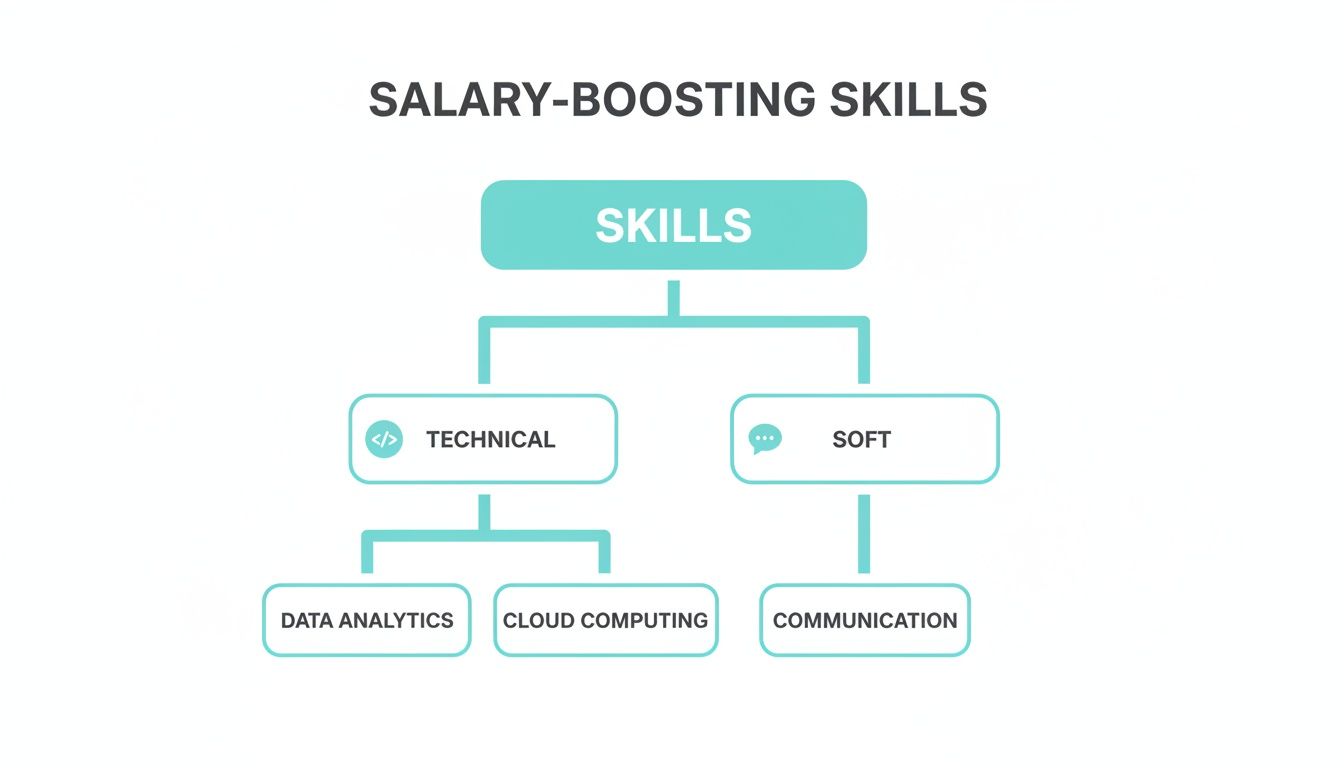
As you can see, your ability to communicate your findings is just as important as the analysis itself. That's how you maximize your impact and, in turn, your pay.
Let's see how this plays out in the real world by comparing two junior data analyst offers: one from a huge, stable company ("BigCorp") and one from a scrappy, high-growth startup ("GrowthCo").
Actionable Insight: The "best" offer isn't always the one with the highest base salary. It's the one that fits your personal finances, your appetite for risk, and where you want your career to go.
Here's how they stack up:
On paper, BigCorp's $80,000 salary looks like the obvious choice. It offers more cash upfront, great benefits, and stability. It's the lower-risk path with a solid, predictable financial foundation.
But look closer at GrowthCo. The base is lower, but the bonus potential is double. The real wildcard is the equity—those stock options could be worthless if the startup fizzles out, or they could be life-changing if it succeeds. Plus, the $1,500 learning stipend gives you the freedom to skill up on your own terms.
So, which do you choose? It comes down to you. If you need stability and predictable income, BigCorp is a fantastic option. But if you have a higher tolerance for risk and get excited about the potential for a massive payoff, GrowthCo could be the perfect fit. Before you even get to this stage, it helps to know your baseline, which is why learning how to calculate your target salary range is such a crucial first step.
Talking about money for the first time can feel a bit awkward, but here's the deal: negotiation is a totally normal, expected part of the hiring game. It’s not a confrontation. Think of it as a collaborative chat to figure out what your skills are worth to the company.
With the right prep, you can walk into that conversation with confidence and land a competitive salary. Your first move is to arm yourself with data. Use the numbers in this guide, and do your own homework to nail down a realistic salary range for your city, your skills, and the type of company you're talking to.
Good research is your best friend when a recruiter inevitably pops the question about your salary expectations.
When a recruiter asks, "What are your salary expectations?" you don't want to get caught flat-footed. Throwing out a single number can corner you, so always lead with a well-researched range. It shows you know your stuff and keeps the door open for discussion.
A confident, data-backed answer immediately builds your credibility. Try a script like this:
"Based on my research for junior data analyst roles here in [City], and considering my skills in SQL, Python, and Tableau, I’m seeking a salary in the range of [$X,000 to $Y,000]. I am, of course, flexible and open to discussing the full compensation package."
This simple phrase does a few things at once. It anchors the conversation around your target, backs it up with your skills, and signals that you're thinking about the whole picture, not just the base number. It makes you look like a pro.
Getting an offer is a great feeling, but you don't have to take the first number they slide across the table. If the offer comes in below your target range, it's completely standard to make a counteroffer. A respectful counter is almost always expected, and it shows you have a handle on your market value.
When you make your move, start by restating how excited you are about the role. Then, tie your request back to your research and the value you know you can bring.
For instance, you might say:
"Thank you so much for the offer! I'm very excited about the opportunity to join the team and contribute to [Company's Mission]. Based on my research and the responsibilities of this role, I was targeting a salary closer to [$Y,000]. Would it be possible to meet me there?"
For more scripts and strategies to help you navigate this part of the conversation, check out our guide on how to counter a job offer effectively.
Sometimes, a company—especially a startup—just can't budge on base salary. Cash flow can be tight. But that's not the end of the road. This is your chance to get creative and negotiate other parts of your compensation, where there's often a lot more flexibility.
Think about asking for other valuable perks:
Actionable Insight: Don't just focus on the base salary. Brainstorm a list of 2-3 alternative perks you value before your negotiation call. If they can't meet your salary request, you can pivot the conversation by saying, "I understand if the base salary is fixed. Could we perhaps discuss a signing bonus or an increased professional development budget instead?" This shows flexibility and prepares you to secure more value from the offer.
Ready to find a junior data analyst role where your skills are in high demand? On Underdog.io, top startups apply to you. Create a single profile in 60 seconds and get matched with innovative tech companies looking for talent just like you. Sign up for free at https://underdog.io.