The most popular advice about passive candidates vs active candidates is also the least useful: target passive people because they're better hires. Search status doesn't tell you whether someone can build your platform, lead your product team, or succeed under your manager. It tells you how they're engaging with opportunities right now.
The useful question is where to spend recruiting effort for this particular role. Some searches need fast application review. Others need careful sourcing and a credible reason for someone to leave a job they like. Strong hiring teams use both, without confusing willingness to apply with ability to perform.
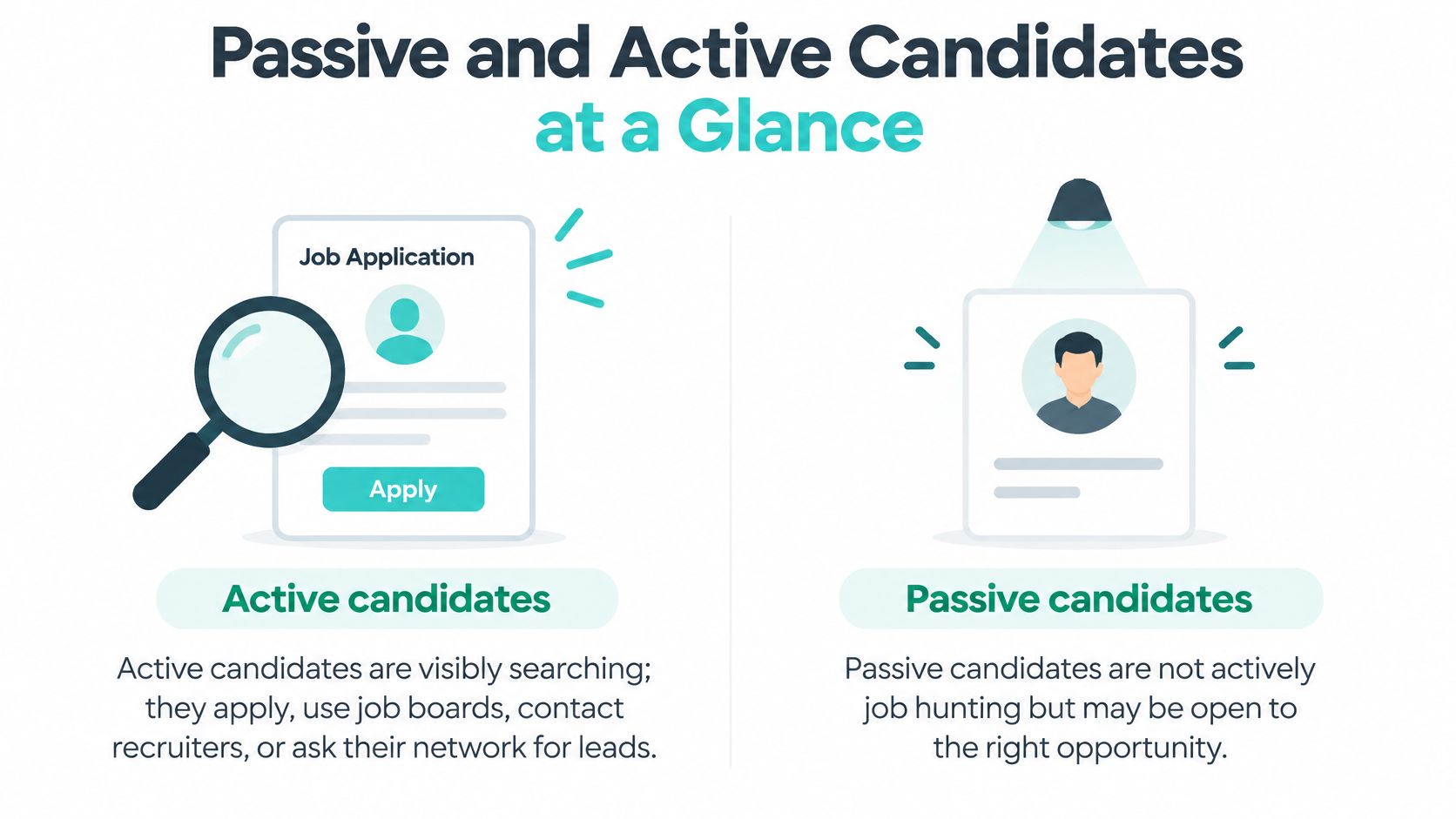
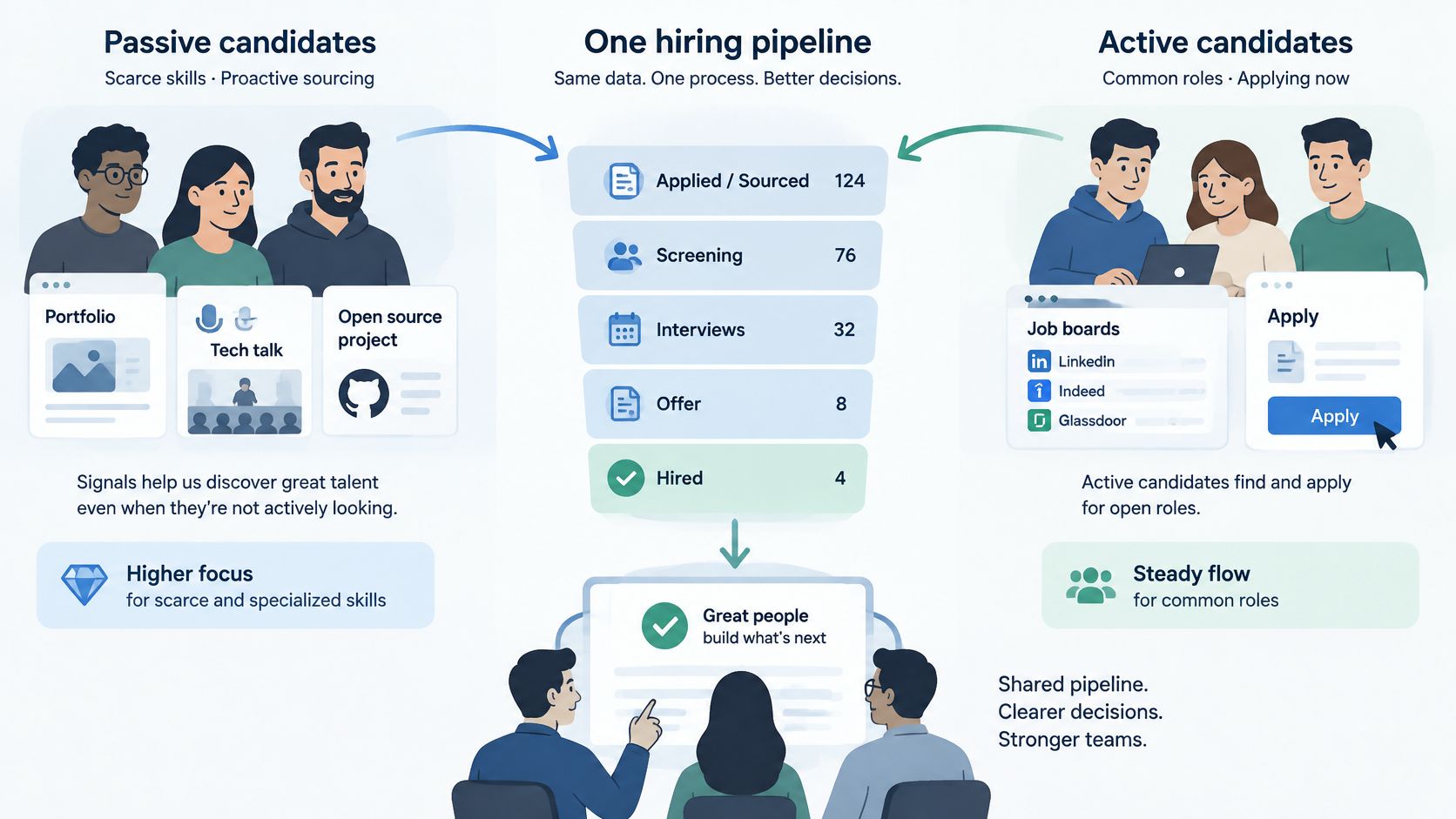
Active candidates are visibly searching: they apply, work job boards, talk to recruiters, and tap their networks. Passive candidates are usually employed professionals running no formal search, though a credible opportunity can still get their attention.
Those definitions describe behavior at one moment in time. The Bureau of Labor Statistics' analysis of employed job seekers counts contacting employers, submitting résumés, and working with recruiters as active search methods, while reading advertisements or attending training falls on the passive side.
| Criterion | Passive candidates | Active candidates |
|---|---|---|
| Current status | Usually employed and not searching | Employed or unemployed and visibly searching |
| Search behavior | Reads postings, may take a call, no formal search | Applies, uses job boards, contacts recruiters or network |
| How you reach them | Direct, personalized outreach or referral | Job posts, inbound applications, recruiter contact |
| Typical trigger to move | A specific, credible opportunity or a change at work | A posting that matches a current search |
| First contact | Short personalized message naming the role and reason | Application review and screen |
| How the BLS counts them | Not counted as searching if only passive methods are used | Counted as searching when any active method is used |
That final row records search activity. Employment status is a separate measure: an employed person who applies elsewhere stays employed, and the unemployment classification also requires having no job and being available for work.
The tool submitting the application doesn't change the category. A job seeker using software to auto apply to jobs using AI is still taking active search actions; the application counts even when a program handles delivery. Judge the intent behind the application rather than the effort it took to send.
Candidate status is a timestamped observation, and it expires faster than your ATS suggests.
An engineer might ignore every message while finishing a release, grow curious after a missed promotion, and start applying after a manager change. The whole sequence can take weeks. Log when you assessed readiness and what the person said, because a “passive” note from six months ago may describe someone who applied to three roles last night.
Your applicant tracking system shows who entered your process. It can't show the qualified people who would consider the role if approached directly. Closing that gap is a sourcing task, and reading it as a weak applicant pool sends you fixing the wrong thing.
Pay alone is rarely a sufficient recruiting argument for a passive candidate. Someone with a stable job needs to understand what they will gain and what they will risk.
In Employ's 2025 Job Seeker Nation survey of more than 1,500 U.S. adults, 42% said they were actively looking, while leading motivations included career advancement at 53% and flexibility or remote work at 46%. The figures cover all job seekers rather than passive candidates alone, and they still warn against making every conversation about salary.
A content-but-curious engineer needs a compelling comparison with their current role. Explain the technical problem, the decision authority on offer, and why the team needs their particular experience. Manufacturing dissatisfaction tends to backfire with people who like their jobs.
A dissatisfied product manager may care more about what won't happen again. If their current leadership keeps reversing priorities, describe how your team makes product decisions and resolves disagreements. A vague promise of ownership won't answer that concern.
An actively searching designer needs usable information: compensation, reporting line, portfolio expectations, working arrangements, and interview timing. They are already evaluating alternatives, so remove ambiguity rather than adding persuasion.
Readiness shifts on events. A stalled promotion, reorganization, manager change, or disagreement over product direction can move someone from curious to active in weeks. A competitor's public launch can spark curiosity about work in their domain, though public activity is a conversation starter and tells you nothing about their satisfaction.
The LinkedIn 2014 Talent Trends survey, covering 18,219 employed professionals across 26 countries, found that 25% were actively looking, 45% were open to speaking with a recruiter, and 15% were reaching out through networks. It established the importance of reaching beyond applicants rather than a permanent market split.
Employ's 2024 report put active U.S. job seekers at about 4 in 10, according to Lever's discussion of the report. iHire's 2025 online recruiting survey, drawing on its own candidate audience, reported a far higher share actively searching. Sample frames disagree because each survey measures a different population. I treat every published split as a starting hypothesis, then measure the mix in the roles I'm filling.
Validate readiness in your own pipeline. Before advancing someone, ask:
The answers shape the outreach effort each state requires: curiosity earns a comparison, dissatisfaction earns specifics about how you operate, and active searching earns fast logistics.
Active and passive recruiting spend effort at different points. With inbound applicants, you assess people who have already raised their hands. With passive prospects, you first establish whether there's enough mutual interest to justify assessment.
Neither route is free. Active screening consumes recruiter hours per application; passive sourcing consumes hours finding suitable people and earning replies.
| Active pipeline | Passive pipeline |
|---|---|
| Publish a clear posting | Build an evidence-based shortlist |
| Review applications against must-haves | Send a personalized first message |
| Conduct a qualification screen | Hold an exploratory conversation |
| Begin structured interviews | Confirm interest, then collect a formal application |
| Evaluate and decide | Begin the same structured interviews |
For active candidates, the operational challenge is queue management. Agree on the screening rubric before publishing, separate essential skills from teachable ones, and reserve interview capacity. A recruiter who clears applications quickly but can't book the hiring manager hasn't created a fast process.
For passive candidates, sourcing starts with public evidence: open-source contributions, conference talks, publications, product launches, and team pages. A title can help locate someone, but it shouldn't be the reason they make the shortlist. Read enough of the work to explain the connection to your vacancy.
For an AI engineering search, AY Automate's AI talent placement agency service description can be a reference when defining outside support. Keep the evaluation concrete: what technical evidence will be reviewed, who owns qualification, and how candidate consent enters the process.
Say a Series A team needs a senior backend engineer. It runs a two-week posting while a recruiter contacts 40 engineers whose contributions to Apache Kafka or PostgreSQL match the role's actual requirements, then reviews screen rates after 30 days.
Those are pilot choices, not industry benchmarks. The important comparison is how many qualified conversations each channel produces for the recruiter time invested.
Inbound might produce plenty of applicants but little evidence of production ownership. Outreach might produce excellent matches and long stretches of silence. Each problem requires a different fix: tighten distribution and screening for the former, reassess targeting and relevance for the latter.
Use different entry experiences, but the same hiring standard.
Give both channels a shared requisition owner and a single candidate record in your ATS. Otherwise, a person can apply, receive a cold approach from another recruiter, and be asked to explain their background twice. Deduplicate before outreach, record the latest interaction, and let the candidate's existing relationship determine who contacts them next.
| Hiring situation | Lead pool | Reason | Fallback |
|---|---|---|---|
| Scarce senior engineering or product talent | Passive | A specific stack and ownership requirement can leave few suitable applicants | Active applicants from a targeted posting |
| High-volume or entry-level roles | Active | Broad applicant reach supports repeatable screening | Passive outreach to top-scoring applicants' peers |
| Niche AI product or design roles | Passive | Specialist experience can be located through portfolios and public work | Active applicants with strong portfolios |
| Employer brand unknown to candidates | Active, with a targeted campaign | Candidates need context and familiarity before engaging | Passive outreach that names a concrete problem |
| Short-term or contract work | Active | Confirmed availability and speed are central requirements | Passive outreach to former contractors |
| Senior leadership hire | Passive, through executive search | Mapping relevant employed leaders broadens a posting-led shortlist | Active applicants shortlisted by a search partner |
These are starting recommendations, not rules about who performs better. Let the role's constraints determine which channel leads.
For scarce engineering work, distinguish genuine specialization from an inflated wish list. Requiring distributed-systems ownership may justify targeted sourcing. Requiring experience with every tool in your repository may exclude engineers who could learn your stack.
For entry-level hiring, public evidence may be less developed. A clear application process and a consistent work-relevant assessment can be more useful than searching for candidates with unusually polished profiles.
An unfamiliar employer needs to explain itself before expecting trust. Publish the product problem, team structure, funding context you can disclose, and working arrangements. A targeted campaign gives candidates something substantive to evaluate instead of asking them to take a stranger's enthusiasm on faith.
Contract hiring requires a different screen. Confirm availability, engagement length, working hours, and the deliverable before exploring broader career aspirations. A highly relevant employed specialist isn't a useful lead if they can't take the assignment.
Leadership hiring requires careful market mapping, but don't discard a strong applicant because they approached you. Evaluate scope of responsibility, decision quality, and relevant organizational experience through the same evidence-based process.
Use broad workforce surveys as background, not as estimates of how many qualified candidates are available in your city or technical specialty. Inspect the applicant mix for the actual requisition.
For a situation outside the table, make the decision in this order:
If neither channel looks viable, revisit compensation, location, scope, or requirements before purchasing more reach.
Passive status is a signal about availability right now, not a fixed trait. A passive candidate can become active after one good conversation, so the first contact has to create relevance before it asks for effort.
In Pin's classification study of more than 82,000 candidate replies, 69.2% came from people not actively job-hunting, comprising 37.2% not looking and 32.0% passive but open, while active seekers represented 21.3%. Read it as reply-behavior evidence from one provider: the reachable majority may be employed and quiet, yet still answer when the note already fits.
Use these timing and length limits as operating defaults, then adjust to candidate preferences.
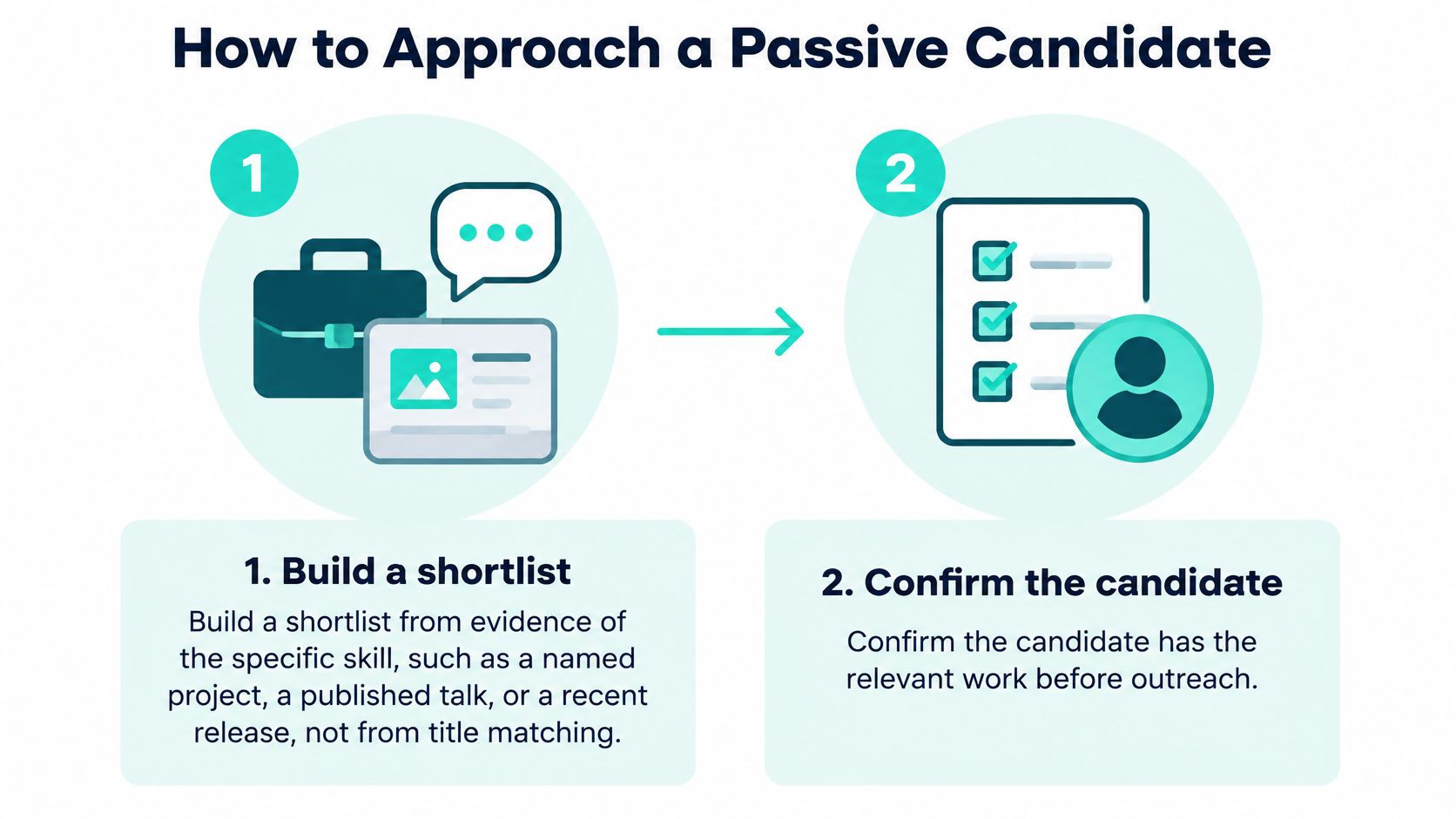
Build the shortlist from evidence. Find a named project, published talk, or release that demonstrates the required skill. Title matching alone can confuse proximity to a project with responsibility for it.
Confirm relevant scope. Check whether the person's work matches the stage and ownership required, such as operating a platform at Series B scale. Don't infer organizational responsibility from a repository contribution.
Keep the first message under 120 words. Name the work, explain why it matters, and give a concrete role detail. Pasting a generic job description makes the candidate do the matching work.
Offer a low-friction next step. Suggest a 15-minute conversation with the hiring manager rather than requesting an application. A formal interview invitation is premature when interest hasn't been established.
Follow up once after five to seven days. Add useful information, such as decision authority or the platform challenge. Repeating the first message with a reminder adds pressure without adding value.
Protect discretion. Use private channels, never contact their current employer, and avoid naming their employer in group outreach. Underdog.io applies the same standard by hiding candidates from current and past employers and letting candidates hide profiles from other companies they choose.
Offer a conversation within a week of a positive reply. Have the manager's availability ready so the candidate can explore while interested. Don't earn a reply and then leave them waiting for internal coordination.
An illustrative message for a Series B platform engineer:
Hi Maya, your work on the streaming ingestion service stood out, especially the retry design under load. We are rebuilding our ingestion layer at Series B scale and need one owner for it. Would a 15-minute call with our CTO next week be useful? No application needed.
It names the project, gives a concrete ownership detail, and asks for a small next step. For list-building, a sourcing playbook for engineering leaders can organize the work; for wording, use our guide to writing recruiting outreach that works. Underdog.io candidates do not receive vague recruiter emails or cold calls, and that is the right bar for any channel: relevance should be apparent before someone agrees to talk.
A useful reply identifies a condition, question, or interest, such as asking about technical ownership or remote work. Answer that point directly and confirm willingness to explore before advancing. Once they reply, the status is already moving; shorten the distance to the manager instead of restarting the pitch.
Passive status doesn't guarantee a better hire. It describes how someone entered your search at one moment, not whether they'll perform once hired.
A Boston Consulting Group analysis of job-seeker trends observed search cycles of approximately 9 weeks for passive candidates versus 12 weeks for active candidates, a 25% shorter cycle. That analysis defines passive seekers as people who aren't searching but will speak with recruiters who approach them.
Treat the gap as an observation, not a causal advantage. Role scope, compensation, manager quality, and candidate motivation can shape both which pool a person lands in and how the hire turns out.
Use the external cycle observations as context, and calculate every other cell from your own ATS and CRM rather than importing a vendor benchmark.
| Metric | Passive pool | Active pool |
|---|---|---|
| Search cycle length | ~9 weeks (BCG observation) | ~12 weeks (BCG observation) |
| Contacted-to-reply rate | Replies ÷ delivered approaches | Replies ÷ delivered recruiter contacts |
| Reply-to-screen rate | Completed screens ÷ replies | Completed screens ÷ replies |
| Screen-to-onsite rate | Onsites ÷ completed screens | Onsites ÷ completed screens |
| Offer acceptance rate | Accepted offers ÷ offers issued | Accepted offers ÷ offers issued |
| 12-month retention | Eligible hires still employed ÷ eligible hires | Eligible hires still employed ÷ eligible hires |
For active applicants, keep application-to-screen conversion alongside the contact metrics. An application isn't equivalent to a cold prospect receiving a message, so combining those denominators produces a misleading comparison.
Record readiness at entry and keep it fixed even if the person later starts actively searching. A sourced prospect who becomes enthusiastic mid-process can otherwise move categories and distort both cohorts. That is the moving-signal problem in measurement form: the label that matters is the one attached at first contact.
Use consistent stage definitions. A scheduled screen isn't a completed screen, and an onsite should mean the same assessment stage for every candidate, remote or in person.
Check outreach benchmarks against your own CRM, particularly when provider datasets classify only people who replied. Pair those numbers with quality-of-hire metrics so channel reporting doesn't stop at accepted offers.
Each quarter, report conversion and retention by pool with role type attached. Leadership needs to know whether a channel works for senior platform hiring or junior design hiring, not whether passive candidates win an aggregate contest.
Run both pools through a shared pipeline, weighting passive sourcing toward scarce skills and active applications toward volume. Evaluation stays consistent; what changes is how candidates enter the process and how much effort each entry point consumes.
Start with the lead pool that fits the role. Set a two-week checkpoint as a pilot operating cadence, then inspect replies, completed screens, recruiter effort, and the reasons candidates declined. Shift effort toward qualified conversations, not whichever channel produces the largest dashboard number.
Underdog.io is one route to passive candidates, including designers who are employed but open to a better role. Candidate profiles stay hidden from current and past employers, vetted hiring partners approach candidates directly with no staffing agencies involved, and employers can choose pay-per-hire pricing or a subscription that covers unlimited seats and a full year of hires. A curated pipeline suits searches where relevant experience and discretion matter, but any claim about your hiring results should come from your own pilot.
If a separate, single search requires an outside staffing partner, evaluate that firm on its candidate-communication terms and fee structure before any engagement begins. Keep the arrangement distinct from a direct marketplace model, and assign responsibility for candidate communication before work starts.
Use a shared approach to building your talent pipeline, with explicit ownership rather than separate inbound and sourcing silos. A disappointing checkpoint should trigger diagnosis: poor targeting, unclear scope, uncompetitive terms, and unavailable interviewers each require a different fix.
Before opening the next requisition, write down the lead pool, the two-week checkpoints, and the owner who will share stage data across both channels. Give that owner authority to redirect effort when the evidence changes.
Underdog.io connects employers with a curated pool of tech candidates, including employed professionals open to a better role, while letting vetted hiring partners reach candidates directly. Visit Underdog.io to explore a candidate pipeline that complements your inbound applications and supports your next scarce-skill search.