
Recruiters processed roughly 291 applications per hire in 2026, up from about 100 in early 2021, while 81% of surveyed applicants across the US, UK, Ireland, Germany, and Australia said they'd been rejected in the previous year without contact from either a human or an AI system (Axios). That single pair of numbers reframes the job boards vs. curated marketplaces debate. The problem isn't that too few people apply. It's that the volume model buries everyone, employers and candidates alike, in a pile neither side can process.
Most write-ups stop at the slogan: boards are high-volume, marketplaces are high-signal. That's true and nearly useless, because it doesn't tell you what the trade-off costs, where the signal comes from, or which platform's mechanics produce it. The evidence below does. It separates reach from filtering with funnel ratios, retention curves, and stated pricing, so you can match a channel to your bottleneck instead of a brand.
Start with the funnel. A Jobvite benchmark covering more than 55 million job seekers and 17 million applications found that job boards generated 51.20% of applications but only 19.75% of hires, a hire-to-application effectiveness ratio of 0.39 (Jobvite 2018 Recruiting Benchmark Report). Referrals, by contrast, produced just 2.78% of applications yet 12.56% of hires, a ratio of 4.52, roughly 11.6 times the job-board rate.
That gap is the whole argument in two lines. A job board indexes postings and lets anyone apply. A curated marketplace inserts a screening layer, human or rules-based, before candidates and employers ever meet. One optimizes for the size of the top of the funnel. The other optimizes for the conversion rate at the bottom.

Funnel ratios only measure speed to hire. Durability matters more, and here the selective channels pull further ahead. A study of more than 50 companies and 91,000 employees found referral hires had a median employment duration of at least 38 months, against 22 months for non-referral hires, a reported 70% improvement. A separate field experiment in the same body of research found referred workers had 45% lower attrition, and introducing a referral program at a store cut overall worker turnover by about 15% (Noon referral statistics).
Earlier synthesis work points the same direction: a 2012 review of research from 2008 to 2011 reported an average time to fill of 29 days for employee referrals, versus 39 days for job-board candidates and 45 days for career-site candidates, with only 22% of job-board hires still employed after one year compared with 46% of referral hires (ERE).
Caveat fairly: a referral carries an existing employee's recommendation and often extra screening, so no marketplace automatically matches those numbers. What the evidence establishes is structural. Channels that add trusted human information beat anonymous application flows on downstream durability, not just on speed.
An early-stage employer can't efficiently evaluate hundreds of loosely matched applicants. It has no recruiting team, no structured scorecard process, and no slack for a mis-hire. A curated model moves that employer closer to a pre-qualified pipeline before the first interview is scheduled, which is why quality-of-hire metrics matter more to a ten-person company than raw applicant counts ever will. Ignoring the distinction is expensive on both ends: recruiters drown in applications, and candidates absorb silent rejection at scale.
The structural claim: a board sells you reach you must filter yourself; a marketplace sells you filtering and leaves reach on the table. Neither is free.
The comparison set splits cleanly on one question: does the platform maximize applicant volume, or does it filter before anyone reaches your inbox? Pricing, candidate pooling and fit all follow from that.
| Platform | Access model | Candidate pooling | Stated pricing | Best fit |
|---|---|---|---|---|
| Employer posts, candidates apply | Searchable by employers | Free posting or self-set daily budget (e.g. $10/day, capped near $300 over 30 days); billing at close or $500 balance | Broad professional and non-tech roles | |
| Dice | Employer posts, candidates apply | Searchable tech profiles | Starter $649/month (3 job slots, 1 user, 250 profile views); $399 single 30-day slot | Dedicated technology hiring |
| Wellfound | Employer posts free, candidates apply | Searchable startup profiles | Free unlimited posting and ATS; Autopilot $500/month per open role plus 10% of hire | Startup-focused self-serve hiring |
| Cord | Curated matching with human review | Selectively introduced | Request a quote for managed terms | Teams wanting a managed curated layer |
| Underdog.io | Candidates create one profile, vetted companies reach out | Curated weekly cohort, roughly 5% of applicants accepted | Free for candidates; employers pay per hire or subscription | Startups from early stage to Series B seeking vetted tech talent |
LinkedIn runs a flexible, performance-oriented posting model rather than a fixed price. Employers post free or promote with a self-set daily budget, and charges accrue daily with payment due when the job closes, 30 days after posting if it stays active, or when the account hits a $500 balance (LinkedIn job pricing). You control visibility spend, and nothing stands between a candidate and the apply button. That is the point of the product: maximum top-of-funnel, with screening left to you.
Dice sells technology hiring through defined subscription tiers. Its advertised Starter plan is $649 per month for three active job slots, one user and 250 candidate-profile views; a single 30-day slot runs $399. Dice reports more than 1.5 million applications per month and more than 100,000 employers hiring on the platform (Dice tech hiring platform). Do the division and the model becomes clear: the platform is optimized to generate application volume across a very large employer base, and the 250-profile-view cap on the Starter plan means even proactive sourcing is metered.
Wellfound pairs a free startup board with an optional managed layer. Unlimited posting, applicant management and a built-in ATS are free; Autopilot is $500 per month per open role plus 10% of a hire, with a dedicated recruiter delivering weekly candidates, and the platform says more than 27,000 companies hire through it (Wellfound recruiting overview). Notice what the pricing admits: the free tier is a board, and the filtering costs extra. Autopilot exists because raw inbound volume is the problem it solves.
The scale figures make the same point from the other direction. Dice advertises 8.5 million technology professionals, 97% of companies receiving an applicant within 24 hours, and 23% of job seekers not appearing on generalist job platforms, while Wellfound advertises more than 100,000 hires (Dice pricing). An applicant within 24 hours is a speed metric, not a quality metric. None of these numbers tells you how many applicants were worth interviewing.
Underdog.io prices the opposite way. Employers pay per hire or by subscription rather than for exposure, and what they buy is a pre-filtered pool: candidates apply once, roughly 5% are accepted after manual review, and each week employers receive a new curated cohort they can contact directly. The subscription includes unlimited seats and unlimited hires, so cost scales with outcomes rather than with how many people on your team need to sift.
One screening caveat applies everywhere on this list. Developers increasingly work with AI assistance, including inline completion tools for developers, so keyword-level resume matching reads a noisier signal than it once did. Human review before the first interview carries more weight as a result. If you are assembling the broader toolkit, this breakdown of the best recruiting tools for high-growth startups covers where each layer fits.
How to read the table: match your bottleneck to the access model, not the brand. If you lack applicants, buy reach. If you lack hours to screen, buy filtering.
"Curated" is now a marketing word. Vendors put it on a keyword filter and a paid boost. Four checks separate a signal-driven marketplace from a reach product with a nicer label, and you can run each one before you trust the claim.
Who starts the conversation sets the funnel. On LinkedIn and Dice the employer searches and writes the first message, so volume and screening time sit on the hiring team. Wellfound's Autopilot adds a recruiter on top of a self-serve board, and only as a paid layer. Underdog.io inverts that pattern for designers: they create one profile and do not apply to postings. Accepted designers are introduced to the hiring manager, not routed through an applicant tracking system or a staffing agency. Vetted partners write to the candidate directly.
An introduction count is the unit of curation. A platform that will not state it, or that treats a profile view as an introduction, is selling search access. Underdog.io typically runs 1 to 3 introductions per month. That cap is the product. It trades overnight applicant volume for a smaller set of matches, which is why a curated channel feels slow next to a board.
Selection rules have to be readable. Ask what gets a candidate accepted, what gets an employer turned away, and how long a profile review takes. "High quality" without those rules is a slogan. A selective marketplace that rejects qualified people and never explains why swaps a noisy board for a black box. Signal without feedback is a different kind of friction.
Anonymity is what makes passive talent usable. A marketplace that drops a profile into an employer search index is not discreet. Anonymity until interest is mutual lets someone who is employed look without telling their workplace they are looking. Boards fail in two directions at once: teams get flooded with unqualified applicants and still cannot reach people who will not apply. Tighter keyword filters only sort the same open applications faster.
Ask for measurable commitments: profile-review time, introductions per month, how often a rejection includes feedback, and the rules for applying again. An answer built on raw application reach tells you the product is a board.

Hiring still defaults to the high-volume channel. In 2025, 68.6% of U.S. employers surveyed by iHire said they did all or most of their hiring through job boards (iHire state of online recruiting). That share is the gravity a curated marketplace works against. Its contact rules, introduction cap, and discretion have to be explicit, or employers stay with the channel that already produces most of their hires.
Compare cost per outcome, not sticker price. A cheap posting that fills the queue with unread applications is often the most expensive line on the recruiting budget, because screening time is real labor.
LinkedIn's model caps spend but doesn't guarantee visibility: you set a daily budget, charges accrue, and the bill lands when the job closes, at 30 days if it stays active, or at a $500 balance. Dice sets a predictable floor per open role at $649 per month for three slots, or $399 for a single 30-day post. Wellfound is free until you want the managed layer, then $500 per month per role plus 10% of a hire. Underdog.io offers employers pay-per-hire pricing or subscription pricing. The subscription includes unlimited seats, a full year of unlimited hires, no per-seat limits and no job-slot caps.
Run the arithmetic on the managed layer. Three open roles at $500 per role per month for three months is $500 × 3 × 3, or $4,500, and that figure is only the monthly portion. The 10% of each hire sits on top, so the bill rises as offers go out. A flat subscription with unlimited hires costs the same whether you fill one role or ten. It is a poor fit for a single hire and a better fit for a team hiring continuously, because the cost per hire falls as volume rises.

The hidden expense is review labor. In 2024, CareerPlug's analysis of 30 million applications found that employers averaged 180 applicants per hire (source-of-hire statistics breakdown). At three minutes of genuine review per applicant, that's a full workday per hire spent just deciding who not to interview.
A subscription that delivers a handful of pre-screened candidates per month looks expensive next to a free posting. Price the review hours and the free posting is often the larger bill. For teams weighing the alternative of paid help, this analysis of recruitment agency costs puts a number on the recruiter route for comparison.
Cost rule of thumb: price the channel per hire, not per posting, and include the review hours in both columns.
No channel wins across the board. Each one solves a different bottleneck, so the right choice depends on which constraint is binding for you. The recommendations below are conditional on purpose.
Use a broad board like LinkedIn when you're testing a career pivot, relocating, or targeting large companies where hiring is structured and public. Use Dice when technology searchability works in your favor and you're aiming at established tech employers who recruit there. Use Wellfound when you want startup roles and you're fine with self-serve applications. Reach for a curated marketplace when you're employed and want discreet, low-volume introductions instead of hundreds of applications.
The deciding variable is how much noise you can afford. A candidate with months of runway can process a high-volume pipeline. A candidate exploring while employed cannot, because every application is a small leak of intent.
Boards fit when you need reach for a generic role or want to seed a pipeline for roles you hire repeatedly. A curated marketplace fits when you're a small team with limited recruiting capacity and the role is one where an early departure hurts.
Consider a seed-stage startup hiring a founding engineer. The role is senior, the team is tiny, and a mis-hire sets the product back a quarter. Posting that role through a curated channel means the founder reviews a smaller, pre-screened set of candidates rather than a raw applicant pile, and conversations start with people already assessed as relevant. The trade-off is a narrower funnel, which is acceptable when one strong hire matters more than fifty applicants.
Now consider a Series A company scaling a five-person engineering team. Volume helps here, because they need multiple hires fast, but so does filtering. The sensible play is a board for reach on the repeatable roles and a curated channel for the senior slots, so review hours go to the candidates most likely to convert.
One rule covers all of it: pick the channel whose access model matches your bottleneck, and run two channels in parallel for senior roles.
Judged against the criteria above rather than the marketing, Underdog.io is a signal-driven marketplace for one segment: early-stage through Series B technology companies, hiring across engineering, product, design, data and related roles. It's free for candidates to apply, and the model is built around selective introductions rather than indexed postings.
On the candidate side, the mechanic is inverted from a board. Designers create one profile and don't apply to job postings; startups contact them directly. Every week, Underdog.io shares a new curated cohort of active job seekers with its network of growing technology companies. Accepted candidates, about 5% of applicants, are introduced directly to hiring managers, typically 1 to 3 per month, with profiles anonymous until mutual interest. That design suits an employed person exploring discreetly, since nothing broadcasts a job search to a current employer.
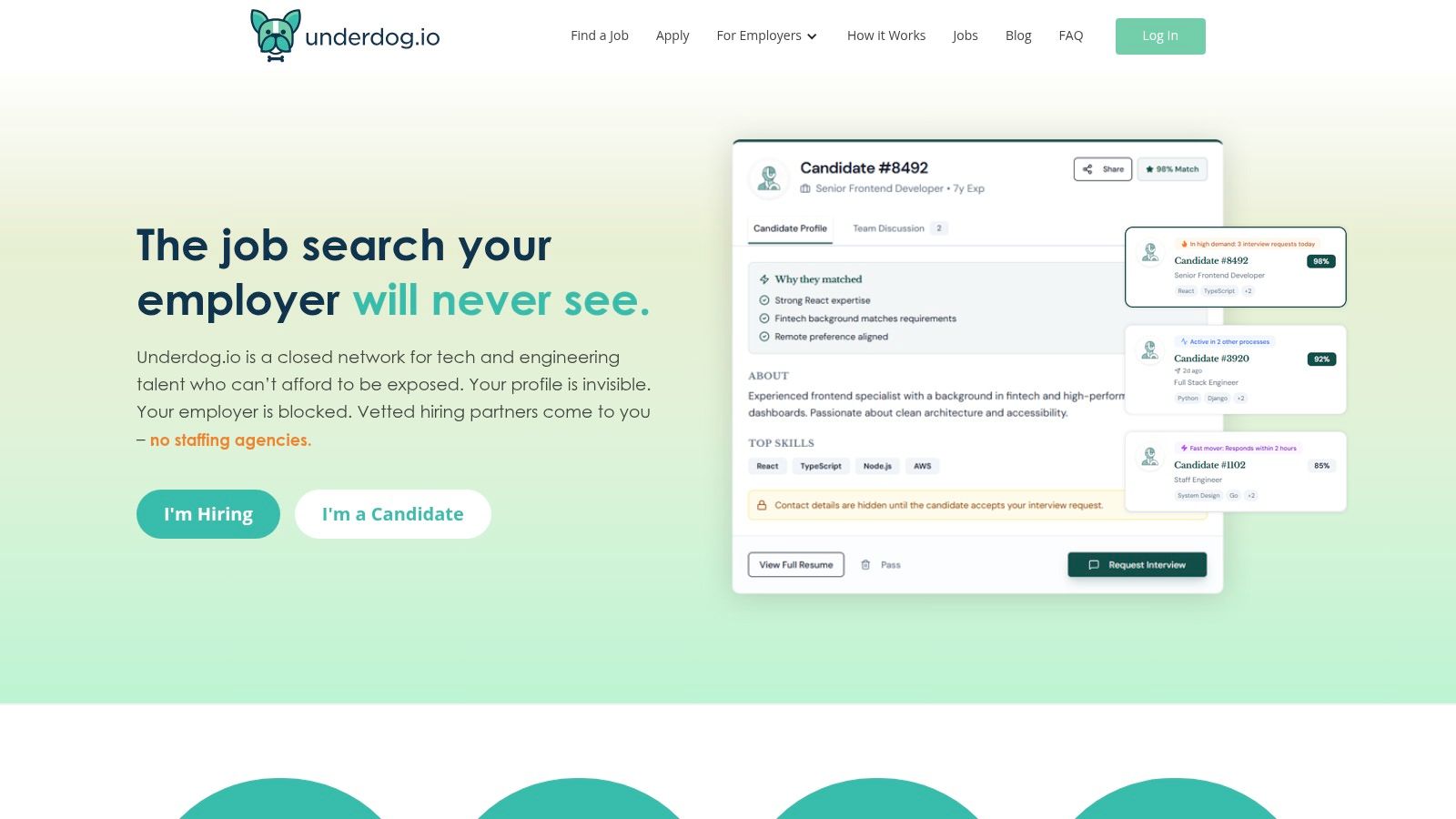
On the employer side it reads like the managed layer, not the board. Employers post as many roles as they need, with no per-seat limits and no job slot caps, and the subscription includes a personalized employer page, ATS integrations, diversity sourcing and a full year of unlimited hires. Pricing is pay-per-hire or subscription, and job matching on the pricing page includes access to 300,000+ pre-vetted candidates. For teams that want recruiter help on top, Hunt by Underdog.io adds a team of vetted tech recruiters working on a contingent basis.
Be clear about the limits. The focus stops at Series B, so a public company or a non-tech role is a mismatch. A general board still wins on raw reach, and if you need thousands of applicants, this isn't the channel that produces them. Underdog.io makes sense first for a startup hiring senior technical people where a bad hire is expensive, and it pairs well with a board for the roles where volume is the point.
Is your bottleneck reach or filtering?
If it's reach, post on a broad board and set a fixed promotion budget you can defend at the end of the quarter. If it's filtering, apply to or hire through a curated marketplace, and ask for its profile-review time, introduction frequency and feedback rate before you trust the word curated.
Before you commit to a marketplace, run this checklist:
Then run a 30-day test. Run one board and one curated channel in parallel, track qualified profiles per 100 applications for each, and keep the channel with the better ratio. That single metric tells you more about fit than any vendor comparison, including this one.
If you're hiring at an early-stage or Series B startup, Underdog.io gives you a curated marketplace where candidates build one profile and vetted companies reach out to them directly, with unlimited roles, no per-seat limits and pricing by hire or subscription. It's the opposite of posting into a pile of 180 applications and hoping the right person surfaces. Visit Underdog.io to see how the curated cohort works and whether it fits the roles you're filling now.


