Startup teams don’t decide to invest in platform software development because they love internal tooling. They do it because delivery starts to feel heavier every month.
A new service takes too long to scaffold. CI breaks for reasons nobody can explain quickly. One team uses GitHub Actions one way, another has custom scripts, and a third copies an old pipeline nobody trusts. Developers open tickets for cloud resources, wait on secrets, chase docs across Slack threads, and lose half a day trying to make local environments match production.
That’s the point where engineering velocity stops being a hiring problem and starts being a systems problem.
The answer isn’t more process. It’s a way to magnify impact. Good platform software development gives product teams a simpler path to build, ship, and operate software safely. It removes repeated decisions, wraps sharp infrastructure edges, and turns tribal knowledge into tools, templates, and defaults.
This isn’t a niche concern. The global software development market is projected to reach $741 billion by 2025, and Gartner projects that 70% of new applications will use low-code or no-code technologies by 2025, both signals that delivery tooling and abstraction layers are becoming central to how teams build software (ManekTech).
A familiar startup story goes like this.
At ten engineers, everyone can still keep the whole system in their head. The backend lead knows the deployment scripts. One staff engineer understands the Kubernetes cluster. The first DevOps hire set up observability, but only loosely documented it. Shipping is messy, yet manageable.
At thirty engineers, the cracks stop being tolerable. New teams need environments. Existing teams need better release confidence. Every service has slight differences in config, secrets handling, logging, and deployment. The company says it wants autonomy, but what developers experience is inconsistency.

The symptoms are usually operational, but the cost is product speed.
Many startups make the wrong move here. They react by adding approvals, tickets, or architecture policing. That often slows teams down further.
The right platform reduces friction. It doesn’t introduce another gatekeeping layer.
Platform software development is the practical response to engineering sprawl. It creates a supported path for common tasks such as provisioning environments, shipping services, managing secrets, exposing metrics, and handling rollback.
For a startup, the greatest win isn’t elegance. It’s consistency without constant human intervention.
The best early platform work feels boring in the right way. Developers can create a service from a template, get CI/CD by default, inherit logging and security checks automatically, and move on to the product problem that matters. That’s when platform work starts paying for itself.
A common startup failure mode looks like this: three product teams are shipping fast, each one has built its own deployment script, and nobody can answer a basic question such as which services have alerts, rollback steps, or current runtime versions. At that point, the platform is already a product. It just happens to be fragmented, inconsistent, and maintained through Slack messages.
A useful platform team replaces that drift with a better internal product. The users are developers, engineering managers, and often security or data teams. Their bar is simple. The default path needs to be faster than the custom workaround.
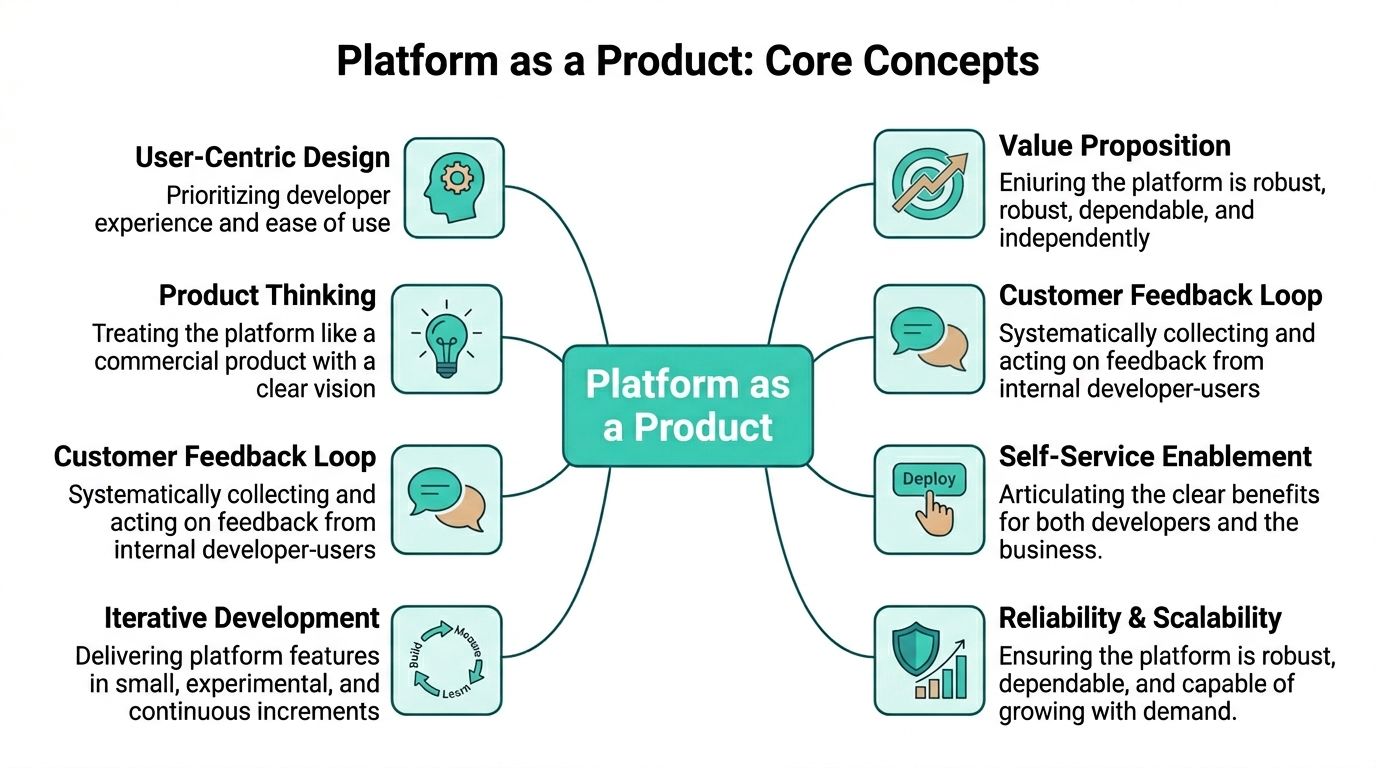
Platform teams ship reusable capabilities that remove repeated engineering work and make good operational choices easier to adopt.
That usually means:
The job is not to hide every hard problem. The job is to remove the repeated setup work and make the safe path the fast path.
Startups get into trouble when they treat platform work as a background infrastructure effort with no user research, no adoption target, and no clear owner. That usually produces technically sound components that sit unused while application teams keep copying old repos and asking for exceptions.
Product thinking changes the standard. A platform feature is only useful if teams can find it, trust it, and adopt it under delivery pressure. Good Terraform, Kubernetes, or CI config matters, but only as part of that outcome.
This is one reason I advise early platform teams to borrow more from product management than from architecture review. Interview developers. Watch a new hire set up a service. Measure how long it takes to get from repo creation to production. If the supported path is slower than a handcrafted one, teams will route around you.
A good golden path handles the common case well. It also leaves room for justified exceptions.
For a startup, that usually means the path answers a small set of recurring questions without extra coordination:
Databricks describes this model well in its write-up on internal developer platforms and developer productivity. The practical takeaway is straightforward. Standardized workflows reduce local reinvention, which cuts maintenance overhead and makes delivery more predictable.
You can see the same pattern in teams that scale cleanly. In AlphaSights' engineering stack and platform choices, the interesting part is not tool novelty. It is the discipline of choosing a stack and making it easy for engineers to build on top of it.
The distinction gets clearer when you look at who each team serves and how success is measured.
| Aspect | Platform Engineering | Product Engineering |
|---|---|---|
| Primary user | Internal developers | External customers |
| Main goal | Reduce delivery friction and operational toil | Deliver product features and user value |
| Success signal | Adoption, reliability, faster internal delivery | Usage, retention, revenue, customer outcomes |
| Typical outputs | Templates, CI/CD, service catalogs, IaC modules, guardrails | Features, APIs, UI flows, experiments |
| Scope of abstraction | Infrastructure, workflows, standards | Business logic and customer workflows |
| Failure mode | Teams avoid it and build their own paths | Customers ignore features or churn |
That difference affects staffing. A strong early platform engineer needs product sense, not just infrastructure depth. They need to notice where developers hesitate, where tooling adds extra choices, and where a standard can remove an entire class of recurring mistakes.
In a larger company, a platform team can afford some inefficiency because there are enough teams to justify specialization. Startups have less room for that. The first platform team usually has to prove its value quickly, with a narrow scope and visible wins.
A better approach is to define one or two platform promises and hold the team to them. Examples include "new backend services can be created and deployed in under an hour" or "every production service gets logs, metrics, and rollback support by default." Those promises are specific enough to prioritize against, and concrete enough for other teams to judge.
This same framing matters as more teams start building AI-heavy systems. If your developers are experimenting with orchestration layers and autonomous tooling, platform support should focus on repeatability, observability, and safe defaults, not just access to models. AI Agent Frameworks: A Deep Dive is a useful reference point for understanding the kinds of abstractions application teams may ask the platform to support.
One practical rule holds up well in high-growth teams: if your platform roadmap is driven only by senior infrastructure preferences, you are probably missing the actual user problem.
The first version of an internal developer platform shouldn’t be a grand rewrite. Startups usually need a stack of boring, composable building blocks that remove the most painful repeated work.
That means your architecture should grow from workflows, not from diagrams.
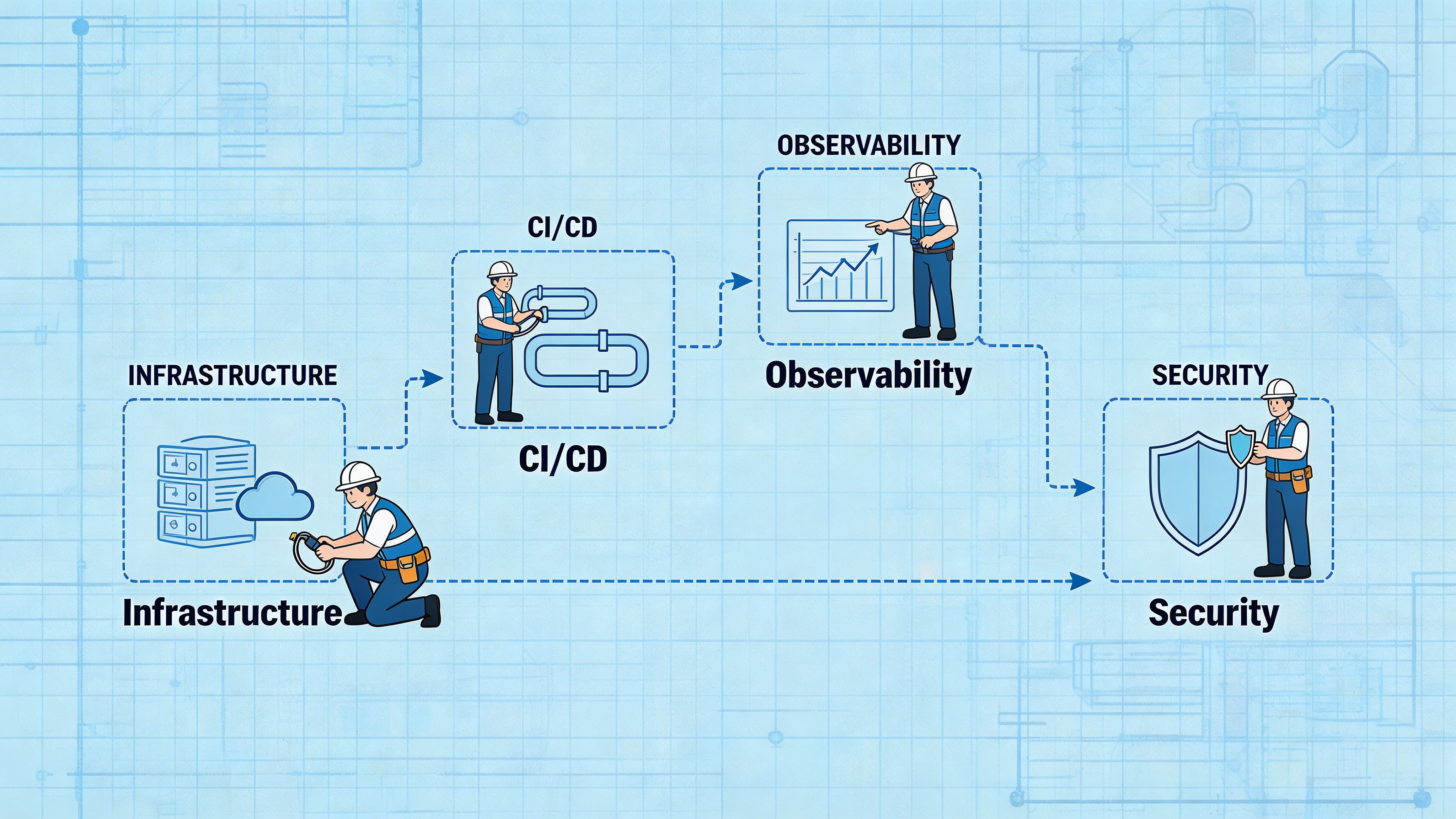
At an early stage, a platform often begins as a small toolkit:
This is enough to create a paved road without standing up a full portal.
A lot of teams make the mistake of starting with a visual internal portal because it feels tangible. That can help later, but it’s not where impact begins. Real impact starts when a developer can create and ship a service with fewer decisions and fewer chances to get production wrong.
Most startup platforms end up with a few recurring layers.
Use Infrastructure as Code so platform behavior is versioned and repeatable. Whether your team prefers Terraform or Pulumi matters less than whether modules are consistent, documented, and easy to compose.
The key trade-off is flexibility versus standardization. If every team can customize every module extensively, the platform turns into a parts bin. If modules are too rigid, teams fork them immediately.
Containers and Kubernetes are common choices once service count and environment complexity rise. They’re powerful, but they also impose cognitive overhead. If your startup only runs a few straightforward services, a simpler deployment target may outperform an advanced cluster.
Choose the runtime your team can operate well, not the one that looks most mature on a conference slide.
Your CI/CD path should encode the defaults you want everyone to use. Testing, build conventions, artifact handling, deployment rules, and environment promotion should live in reusable workflows, not copied YAML.
A startup’s delivery layer succeeds when engineers stop discussing pipeline basics in every new repo.
A service catalog becomes useful once the company has enough services that ownership, dependencies, and operational context are hard to track. Before that point, a lightweight ownership file and strong repo conventions may be enough.
The same rule applies to docs. Don’t build a huge knowledge portal before you can maintain clear runbooks and setup guides.
Platform software development now has to account for code generated with AI assistants and agents. That changes how teams review, test, and govern changes.
If you’re thinking through how agentic development might fit into platform workflows, AI Agent Frameworks: A Deep Dive is a useful overview of the design patterns and tooling choices behind AI-driven systems. It’s especially relevant when your platform needs to support both human-written and AI-assisted delivery paths.
A startup should design the platform around what teams already ship, not around an abstract reference architecture. For a concrete example of how real engineering organizations assemble practical tooling choices, the breakdown at https://underdog.io/blog/inside-alphasights-tech-stack is worth reading.
Good platform architecture removes repeated decisions. Bad platform architecture centralizes them.
A platform only works if developers trust it. Trust comes from three things: it’s easy to use, it’s observable when it fails, and it handles security in the default path instead of leaving it as homework.
That’s why the hard part of platform software development isn’t assembling tools. It’s making reliability and security show up as everyday developer experience.
Most platform friction doesn’t come from dramatic outages. It comes from death by small annoyances.
A confusing CLI. Poor error messages. Docs that explain theory but not the exact deploy sequence. A template that gets a new service to compile but not to production. Those are platform defects.
Thoughtworks describes platform engineering as a combination of delivery infrastructure, services, and knowledge hubs that reduce developer friction. In practice, that model can shrink onboarding from months or weeks to days, and Pipedrive’s platform work turned a 10% build time improvement into broader efficiency gains by protecting developer flow (Thoughtworks).
A few design choices matter more than teams expect:
If your platform offers CI/CD, runtime environments, and service templates, then the platform itself is a production system. Treat it that way.
That means instrumenting:
The best observability setup helps the platform team answer operational questions quickly. Why did this rollout fail? Which step in the pipeline regressed? Which template version caused breakage across services?
Startups often say they’ll tighten security later. In platform work, later usually means after custom patterns have spread everywhere and become politically hard to remove.
Security should be part of the golden path:
If your platform supports AI-assisted coding or internal AI services, it also helps to map controls back to a recognized framework. For teams doing that work, NIST 800 53 controls for AI security is a practical reference point for translating broad security expectations into implementation decisions.
Secure-by-default beats security-by-reminder every time.
A startup platform doesn’t need enterprise ceremony. It does need clear promises.
State what the platform supports, what is experimental, and what requires platform team involvement. Publish support expectations for templates, pipelines, and core modules. If a path is “recommended,” then it has to be maintained well enough that teams don’t regret choosing it.
That consistency is what turns internal tooling into real platform capability.
A common startup pattern goes like this. Three product squads are shipping fast, each team has invented its own CI pipeline quirks, and every release still depends on the same one or two engineers who know how production really works. Leadership calls that “DevOps support.” What you have is a growing delivery bottleneck.
Platform teams fix that bottleneck only when they are organized around reducing repeated engineering friction. If “platform” is just a new label for the old ops queue, the team becomes a service desk with better branding.
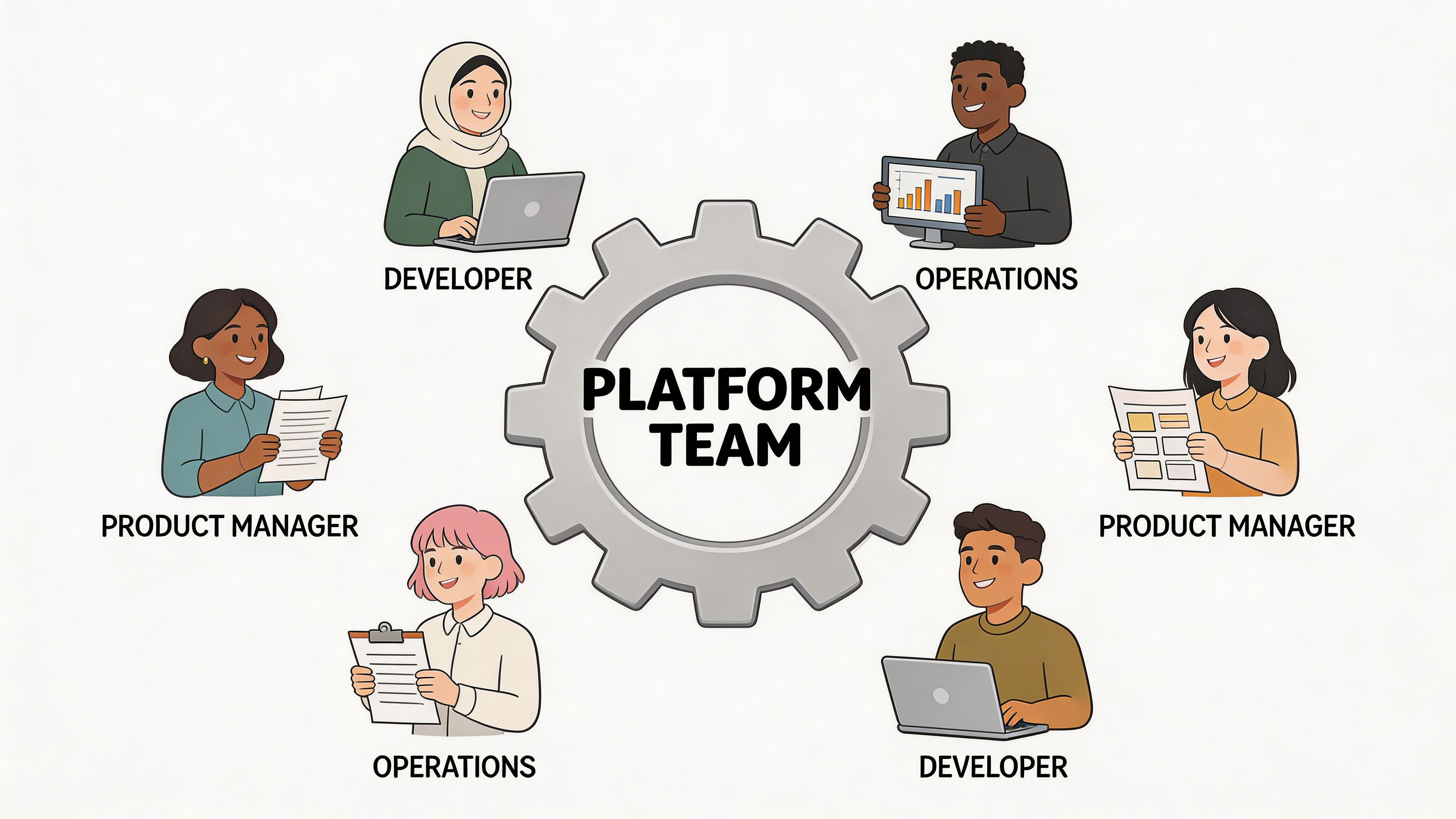
The right structure depends on headcount, product complexity, and how much duplicated work already exists across teams.
| Team shape | Best fit | Strength | Risk |
|---|---|---|---|
| Dedicated platform team | Multiple product squads with repeated delivery pain | Clear ownership and reusable systems | Can drift away from day-to-day developer needs |
| Enabling team | Teams need guidance more than central products | Fast knowledge transfer | Hard to maintain standards across teams |
| Hybrid model | Growing startup with some shared infrastructure and some embedded needs | Balances productization with support | Requires disciplined prioritization |
Early-stage startups usually do best with a hybrid model. Two or three engineers own the platform backlog, but they still spend real time with product teams, pairing on migrations, running office hours, and seeing where the rough edges are. That contact matters. The fastest way for a platform team to lose credibility is to design standards from a distance.
Platform work needs a clear owner for priorities, adoption, and feedback. Without that, teams build what is interesting to maintain instead of what removes the most friction for the business.
The strongest platform groups treat internal developers like real users. They interview teams before building, keep a visible roadmap, and cut features that do not improve the path from commit to production. Earlier research discussed in this article makes the same point. Platform efforts break down when teams skip user discovery and mistake internal tooling output for product success.
A startup does not always need a full-time platform product manager on day one. It does need one person who can say no, rank the backlog, and force trade-off discussions. In some companies that is the platform lead. In others it is the VP of Engineering or CTO. Teams still sorting out that boundary often run into the same ownership questions covered in these CTO duties and responsibilities.
This is the operating rule that keeps a young platform team healthy.
If the same people are building reusable systems, answering every Slack question, debugging every broken deploy, and handling access requests, planned work will lose every week. Startups cannot remove interrupt work entirely, but they can contain it.
A practical model:
Without those guardrails, “helpful” turns into “permanently interrupted.”
Measure outcomes for engineering teams, not platform activity.
Useful signals include:
If engineers keep bypassing the standard path, the path is the problem. Fix it.
Good startup platform teams earn authority by being useful. They make the safe path the fast path, keep ownership clear, and spend their limited headcount on systems that remove repeated work across the company.
Hiring platform engineers is tricky because the role sits between classic categories. A pure infrastructure operator often won’t be enough. A strong application engineer without systems instincts may struggle too.
You’re looking for someone who can build software products for developers.
The best candidates usually combine several traits:
A useful shorthand is this: hire people who can improve the whole path from commit to production, not just one tool in the middle.
A resume full of cloud and DevOps keywords doesn’t tell you much. Good interviews force candidates to make trade-offs in realistic startup conditions.
Questions that work well:
A new team needs to launch a backend service this week. What’s the minimum platform support you’d build first?
Good answers prioritize templates, CI/CD defaults, and observability over grand architecture.
How would you decide whether a startup needs Kubernetes right now?
Strong candidates discuss operational maturity, service count, deployment complexity, and support burden.
A platform workflow exists, but product teams keep bypassing it. What do you do?
You want to hear about user research, friction analysis, and redesign before enforcement.
How would you improve onboarding for engineers joining a growing backend team?
Good answers include docs, environment setup, self-service workflows, starter repos, and reducing hidden dependencies on senior engineers.
When should a platform team say no?
Mature candidates know that platform scope has to stay opinionated or it collapses into custom consulting.
Platform hiring now overlaps with AI tooling. In 2025, 85% of developers regularly use AI tools for coding, and 63% of organizations plan to increase developer headcount, which raises the value of engineers who can adapt workflows for AI-assisted development and broad software ownership (LoopStudio).
That matters because AI-generated code changes review patterns, raises the volume of code that can hit pipelines, and increases the need for strong defaults in testing, policy, and service creation. Candidates with full-stack range and comfort in Python are increasingly useful in platform environments where backend systems, developer automation, and AI integrations start to blur together.
Hiring managers who need a broader process framework can compare role design, scorecards, and practical evaluation loops in https://underdog.io/blog/how-to-hire-software-engineers.
If you’re trying to move into platform software development, don’t pitch yourself as “interested in DevOps.” Show the advantage you create.
Talk about:
The strongest platform candidates show two things at once. They can operate technical systems, and they can make other engineers faster.
Most startups shouldn’t begin platform software development by launching a platform initiative. They should begin by solving one expensive source of engineering friction.
Start with the path every team repeats. New service creation, CI/CD setup, local development, secrets handling, or production rollout are common candidates. Pick one, make it simpler, and make the improved path the default.
Then prove that it works.
A good first milestone isn’t “we built a portal.” It’s “teams can ship the common case with less waiting, less copy-paste, and fewer support requests.” That’s how platform work earns trust.
For leaders, the next move is staffing with intent. Assign ownership, protect time for internal product work, and keep the platform team close to the developers it serves.
For engineers, the entry point is smaller than people think. Standardize a repeated task. Build a reusable template. Turn a tribal process into a supported workflow. That’s already platform work.
The companies that do this well don’t just clean up infrastructure. They build a system that lets product teams move with less drag as the company grows.
Some of the hardest questions in platform software development don’t have universal answers. They do have good decision rules.
| Question | Answer |
|---|---|
| When should a startup form a platform team? | Form one when repeated delivery problems span multiple teams and those teams keep solving the same infrastructure or workflow issue in parallel. If one or two engineers are constantly unblocking everyone else, the platform need is already visible. |
| Do early-stage startups need an internal developer portal? | Usually not at first. Start with templates, reusable CI/CD workflows, infrastructure modules, and clear docs. Add a portal when service count, ownership sprawl, and discoverability problems justify the extra maintenance. |
| Is platform engineering just DevOps with a new name? | No. DevOps is a cultural and operational approach. Platform engineering applies product thinking to internal developer workflows and creates reusable, self-service systems around them. Some DevOps work belongs inside platform teams, but the scope is broader. |
| Should the platform team own production for every service? | Usually no. Product teams should still own service behavior and outcomes. The platform team should own the shared systems, paved roads, and standards that make service ownership easier and safer. |
| How opinionated should the platform be? | Opinionated enough that the common case is fast and reliable. Flexible enough that unusual cases can still ship without a political battle. If every team needs exceptions, the defaults are wrong. If nobody can deviate when needed, the platform becomes a bottleneck. |
| What’s the first thing to standardize? | Standardize the workflow that creates the most repeated pain. In many startups that means service scaffolding plus CI/CD, because it affects every new codebase and exposes all the hidden inconsistencies in environments, testing, and deployment. |
| Should platform engineers come from SRE, backend, or infra backgrounds? | Any of those can work. The decisive factor is whether the person can think in products for internal users, automate repeatable workflows, and make sound trade-offs across code, infrastructure, and developer experience. |
| How do you know the platform is working? | Teams use it voluntarily, onboarding gets easier, repeated tickets decline, and fewer engineers need private knowledge to ship safely. If adoption has to be forced, the platform still has usability work to do. |
If you’re building a startup team or looking for your next role in platform engineering, Underdog.io is a practical place to start. It connects engineers, product-minded technical talent, and high-growth startups in NYC, San Francisco, and across the US through a curated process built for teams that need strong people fast.