You finally get the offer email. The title is right. The team sounds strong. The product is interesting. Then you open the comp details and realize the primary question isn’t “Is this a good salary?” It’s “What is this package truly worth?”
That’s where most senior data scientists get stuck.
A startup sends a base salary that looks lower than expected, then adds options, a vesting schedule, and vague language about upside. A larger tech company offers a stronger cash package, but the level feels conservative. Another role is remote, and now you’re trying to figure out whether the company is paying for your work or pricing your zip code.
A senior data scientist salary isn’t one number anymore. In high-growth tech, it’s a mix of cash, variable pay, equity, and influence. If you evaluate only the base, you’ll miss the trade-offs. If you focus only on upside, you can talk yourself into a weak offer.
I’ve seen strong candidates lose money both ways. Some optimize for headline salary and leave meaningful equity on the table. Others accept “founding team” logic without pressure-testing dilution, strike price, or whether the company can support the next round of hiring.
The useful way to look at compensation is simpler. Treat the offer like a portfolio. Separate predictable value from speculative value. Understand what part is negotiable. Know where the company has flexibility. Then negotiate the whole package with a clear point of view.
You get the offer on a Thursday night. The title is right, the hiring manager sounds serious, and the work looks like real senior-level scope. Then the compensation sheet lands and the easy part ends.
One company gives a high base and almost no upside. Another trims cash, adds a bonus target, and hands you an equity number that looks impressive until you ask about dilution, strike price, and refresh policy. A startup says it cannot match public-company cash but offers ownership instead. Sometimes that is a fair trade. Sometimes it is a discount wrapped in optimistic language.
That is why senior data scientist compensation gets misread so often, especially in startup and high-growth hiring. The market is wide, leveling is inconsistent, and two roles with the same title can differ sharply in cash, equity, and hiring bar. Generic averages flatten those differences, which makes them a weak tool for judging one actual offer.
At Underdog, we advise candidates to price the package in layers. Start with the guaranteed money. Then examine the conditional money. Then assign a realistic value to the upside, not the story. If you want a broader baseline before you compare offers, our guide to data scientist jobs and salary ranges is a useful starting point.
The practical question is not whether an offer looks good in isolation. The question is whether it is strong for that company stage, that level, and that risk profile.
A late-stage startup should not be evaluated like a public company. An early-stage startup should not get extra credit for ambition alone. Senior candidates get paid well when they separate what is certain from what is possible, then negotiate each piece with a clear view of the trade-offs.
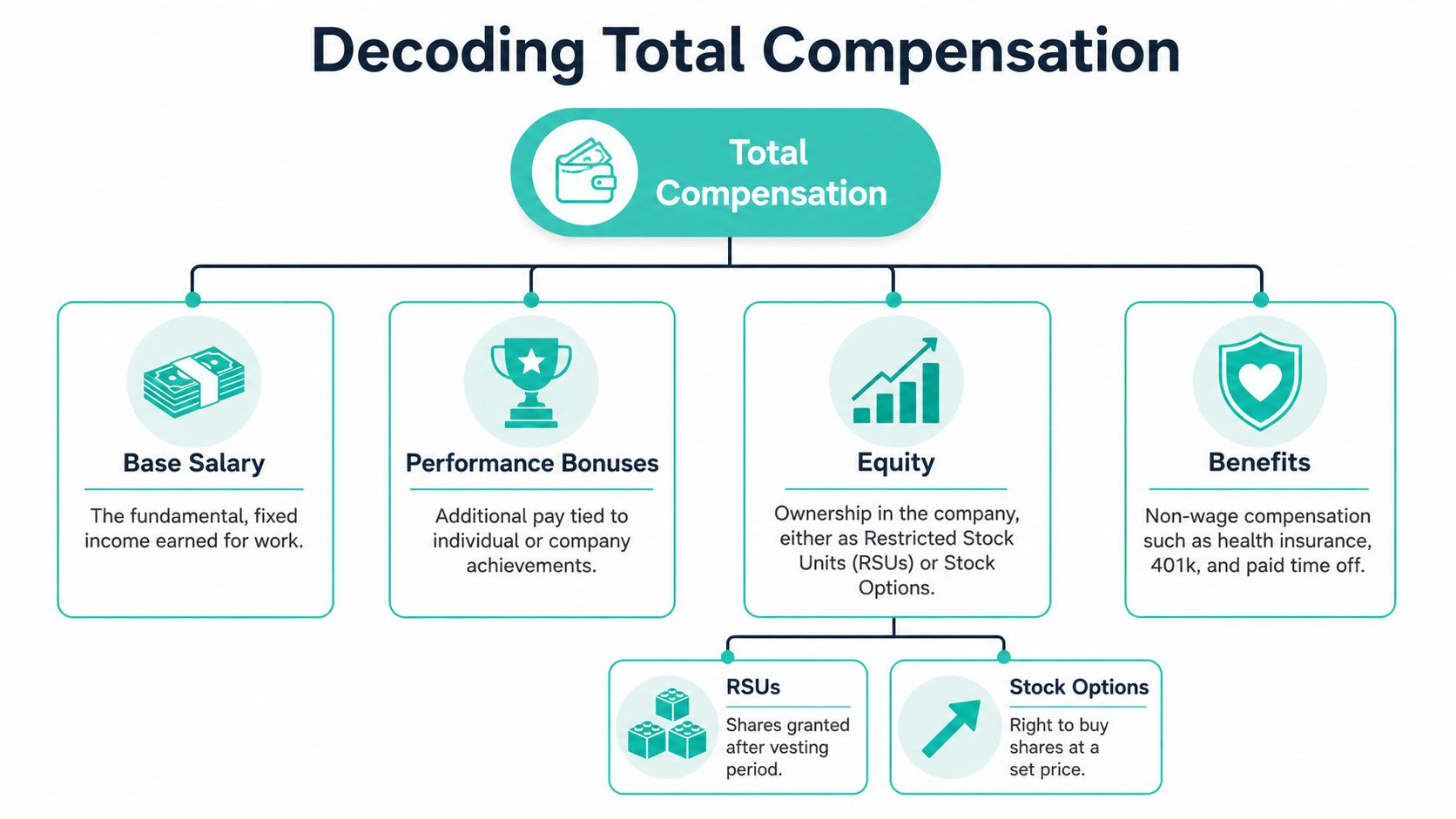
The phrase total compensation gets thrown around loosely, but for senior data scientists in tech it’s the only useful lens. A package is a bundle of trade-offs. Some pieces are stable. Some are conditional. Some are speculative. You need to know which is which.
Tech employers reflect that complexity in the numbers. Senior Data Scientists in tech companies average $218k annually versus $137,650 in the broader market, a 58% premium, and stock options average $42k according to Payscale’s Senior Data Scientist salary research. That difference is why a senior data scientist salary should never be compared on base alone.
If you want a broader baseline before judging one offer, Underdog has a useful reference on data scientist jobs and salary.
Base salary is the easiest part to understand and the hardest part to ignore. It pays rent, supports savings, and anchors the rest of the package. If the base is weak, the rest of the offer has to work much harder to justify the gap.
In practice, base salary matters most when:
A lot of candidates overcorrect here. They either dismiss equity entirely or excuse a soft base because the company is “early.” Neither approach is disciplined.
Bonuses sit between salary and equity. They’re less certain than base pay, but less speculative than startup options. A bonus can be tied to individual goals, company performance, or both.
What matters isn’t just whether a bonus exists. It’s whether you can understand how it’s earned.
Ask questions like:
If a recruiter can describe the target but not the mechanics, treat the bonus conservatively.
Practical rule: Count salary fully, count bonus carefully, and treat startup equity as upside until you’ve done real diligence.
Equity is the part most candidates either romanticize or ignore. Both are mistakes.
At a public company, equity often shows up as RSUs. At a startup, it usually comes as stock options. Those are not interchangeable. RSUs are generally easier to value because they represent shares granted after vesting. Options give you the right to buy shares at a set price, which means their value depends on future company performance and the relationship between that future price and your strike price.
Three details matter immediately:
A startup that talks up equity but won’t clearly explain these mechanics is asking you to price risk blind.
Benefits rarely win the negotiation, but they can change the lived value of an offer. Health coverage, retirement match, paid leave, and flexibility all affect what the job is worth in practice.
Candidates often treat benefits as soft details. They aren’t. A weaker health plan, less paid time off, or limited parental leave changes the overall package, especially if you’re comparing offers that are already close on cash.
Here’s the useful mental model:
| Component | What it gives you | How to evaluate it |
|---|---|---|
| Base salary | Predictable income | Compare directly to your market level |
| Bonus | Near-term upside | Check payout mechanics and realism |
| Equity | Long-term upside | Assess risk, ownership, and company quality |
| Benefits | Lifestyle and financial support | Look at actual coverage and policies |
The best candidates don’t chase the biggest headline number. They build a view of the whole compensation portfolio, then decide which mix of certainty and upside fits the role they want.
A lot of compensation confusion starts with one bad assumption. Candidates assume salary follows years of experience in a straight line. It doesn’t. Leveling matters more than tenure once you’re in senior territory.
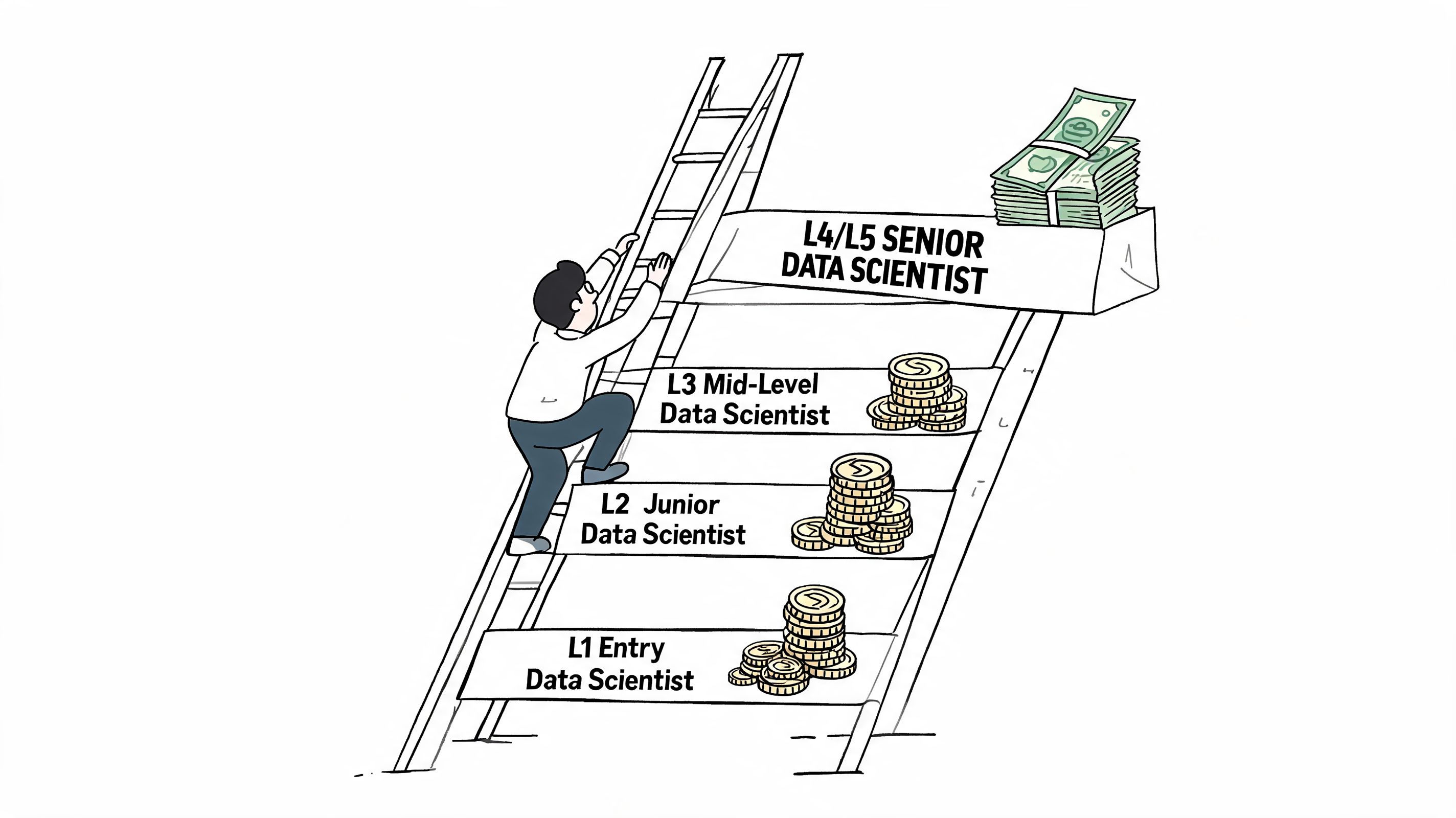
The market data shows a clear trajectory. Senior Data Scientist salaries rise from $133,000 at 0-1 years to over $234,000 at 15+ years, a 76% increase, and the 4-9 year band sits at $175k-$190k according to Coursera’s data scientist salary overview. Useful as that is, years alone don’t explain why one candidate lands at the top of a band and another gets leveled down.
A true senior data scientist usually owns ambiguous problems end to end. They don’t just run experiments or ship models. They shape decision quality for a product area, push on instrumentation, and influence how product, engineering, and leadership interpret evidence.
That’s different from being technically strong but execution-scoped.
When companies level candidates, they often look for signs like:
If you can’t point to those patterns, you may still be strong, but the company may price you as a narrower operator.
Staff and Principal titles vary a lot by company, but the compensation jump usually comes from broader impact. A Staff data scientist often influences multiple teams or a product portfolio. A Principal data scientist may shape measurement frameworks, technical direction, or company-wide data strategy.
That difference matters in negotiation. If you present yourself as “a very experienced senior,” companies will often keep you in the senior band. If you demonstrate organization-level influence, you give them a case for a higher level and a different compensation envelope.
A simple way to frame the distinctions:
| Level | Typical scope of impact | What hiring teams listen for |
|---|---|---|
| Senior | Team or feature level | Strong execution and sound judgment |
| Staff | Multi-team or roadmap level | Influence across functions and durable systems thinking |
| Principal | Company-level strategy | Direction-setting, prioritization, and organizational leverage |
If your impact changes roadmap decisions, not just experiment outcomes, you’re probably under-describing your level.
Candidates usually undersell level by talking in task language. They list tools, methods, and project outputs. Good interviewers care more about decision impact.
What works:
What doesn’t work is vague leadership language with no proof. “Strategic” means nothing unless you can show where your judgment altered priorities, spending, or product direction.
Location still matters in senior data scientist salary discussions. It just matters less neatly than it used to.
For years, candidates could assume the highest salaries clustered in the biggest tech hubs and that was mostly the end of the story. Remote work changed that. Companies now mix location-based pay, national bands, and hybrid approaches. Candidates have more room to negotiate, but also more ambiguity to contend with.
Los Angeles is a good example. Senior data scientists there earn roughly $177k-$257k, and Indeed’s Los Angeles salary data notes that remote work is fracturing traditional geographic pay bands. That fracture creates opportunity, but only if you know what model the company is using.
Most companies fall into one of these patterns.
Candidates often hear “remote-friendly” and assume “location-agnostic.” That isn’t always true. A company can support remote work while still pricing roles by geography.
Here’s a practical comparison using the verified salary ranges available:
| Location | Average Base Salary Range | Notes |
|---|---|---|
| United States national average | About $156,513 | Broad benchmark across employers |
| San Jose, California | Median $266,461 | High-paying tech hub and strong employer concentration |
| Los Angeles | $177k-$257k | Pay bands vary widely and remote work complicates local premium |
| Remote role | Varies qualitatively | Depends on whether employer uses location-based, national, or hybrid pay |
The useful point isn’t just that some cities pay more. It’s that employer mix and pay policy matter as much as geography itself.
If you live in a high-cost market, don’t assume your address alone should carry the negotiation. The strongest argument is still your market value for the role. Location helps when the company has established premium bands, but it won’t save a weak scope match.
If you live in a lower-cost market, don’t accept an automatic discount without understanding the company’s philosophy. If the role’s impact is national, the team is distributed, and peers are being hired across major hubs, there’s a strong case for being paid against a broader talent market.
A few practical moves help:
A remote role is only flexible if the compensation logic is transparent.
The best negotiation posture is calm and specific. Ask how the band was set. Ask whether the company adjusts pay after relocation. Ask whether peers on the same team are in one band or multiple. If they can answer clearly, you can negotiate intelligently. If they can’t, the ambiguity is part of the offer.
Equity is where startup compensation gets serious. It’s also where a lot of otherwise analytical candidates stop acting analytically.

The trade-off is real. Senior Data Scientist compensation at established firms averages $232k-$257k, while smaller startups may offer figures like $134k, according to 6figr’s senior data scientist compensation overview. That doesn’t automatically make the startup offer worse. It means the equity has to carry meaningful potential, and you need enough information to judge whether it does.
Startup equity is not free money. It’s concentrated risk. The company is effectively asking you to accept less immediate cash in exchange for future ownership value.
That can be rational if the company has credible momentum, strong backers, and room to grow. It can also be a bad deal dressed up as upside.
If you’re evaluating a startup offer, ask these questions directly:
A capable company should be able to answer those questions without acting annoyed that you asked.
Not all startup equity is created equal because not all startups are financed equally. One practical diligence step is to look at who has backed the business and whether those investors have a track record in early-stage tech. A resource like this list of early-stage US investors can help you get a quick sense of the firms often involved in early rounds.
That won’t tell you whether your grant will be valuable. It does help you understand whether the company is operating in a serious fundraising ecosystem.
For startup-specific cash and equity framing, Underdog also has a practical guide to startup compensation benchmarks.
A good equity conversation is concrete. A bad one is full of slogans.
What works:
What doesn’t work is accepting “we’re all owners here” as a substitute for terms.
Startup equity becomes compelling when the company is transparent enough for you to model the risk, even if imperfectly.
There’s no universal rule for when to trade salary for equity. The right threshold depends on your risk tolerance, your runway, and how strongly you believe in the company. But the standard should be clear. If a startup wants you to discount your cash compensation, it should give you enough information to evaluate the ownership case like an adult.
You get an offer for a senior data scientist role. The base is decent. The recruiter says equity is meaningful. The title sounds right. Then a crucial question arises. Which parts of this package are flexible, and which parts are just presentation?
That is the negotiation job.
For senior data scientists, market ranges can be wide. As noted earlier, the gap between an average package and a top-of-market one is large, especially once company stage, scope, and level enter the picture. That matters because a company can truthfully say it pays competitively and still come in below what this specific role should command.

Before you counter, define the package you would accept.
I usually tell candidates to walk into negotiation with three numbers:
Then rank the components that matter most. Base, equity, level, sign-on, remote setup, review timeline. If you skip that step, you end up reacting to the company’s framing instead of making your own trade-offs.
In such situations, strong candidates separate themselves. They know what they are optimizing for.
Recruiters often ask for expectations before level and scope are fully clear. A good response keeps the discussion open and keeps the focus on total compensation.
A practical answer sounds like this:
“I’m looking for a package that matches senior scope in a high-growth environment. Once I understand the level, base, equity, and any bonus structure, I can give you a tighter range.”
That answer works because it is specific without locking you into a base-only number.
If they need a range, give one with conditions attached. Say what level it assumes. Say whether it assumes meaningful equity. Say whether it reflects a mature company package or a startup package. Context matters.
The weakest counters are personal. The strongest ones are commercial.
Hiring teams respond better to “this package is light for the scope you want me to own” than “my expenses are high” or “I expected more.” The point is not to sound cold. The point is to tie compensation to the role, the market, and the value you are expected to create.
A clean structure looks like this:
Examples:
Clear beats emotional. Specific beats theatrical.
Negotiation depends heavily on the type of company.
Larger companies often have fixed salary bands. That does not mean nothing can move. It usually means you need to ask better questions.
The common areas of flexibility are:
At bigger companies, level often matters more than candidates realize. A small base increase today can matter less than being slotted one level higher, because that affects future raises, refresh grants, and promotion path.
Startups usually have more freedom in package shape than in cash budget. That is the trade-off. You may not get the base you would command at a public company, but you can often get movement on equity, title, milestone reviews, or an early comp revisit.
Underdog candidates tend to do better when they ask direct questions instead of accepting a vague upside story. If the startup wants you to take more risk, ask them to price that risk clearly.
Use questions like:
If you want a sharper framework for that conversation, this guide on negotiating startup stock options is worth reading before you sign.
Recruiters, hiring managers, and founders usually respond well to candidates who are prepared, direct, and realistic about trade-offs.
What helps:
What hurts:
One more point. Negotiation is not just about getting a better number. It is also a signal. Senior candidates are expected to discuss scope, trade-offs, and value with precision. Compensation is part of that. If you can talk through an offer the same way you would talk through an experiment design, a roadmap trade-off, or a model decision, you sound like someone ready for senior-level ownership.
A senior data scientist salary only makes sense when you evaluate the whole package. Base pay tells you part of the story. Level tells you how the company sees your scope. Location tells you how they price labor. Equity tells you how much risk they want you to share.
That’s why the best offer isn’t always the highest base, and the most exciting startup offer isn’t always the smartest bet. Good decisions come from separating cash from upside, understanding what the company can realistically move, and negotiating with a clear view of your market.
If you’re experienced enough to own messy product questions, influence roadmap decisions, and turn ambiguous data into business judgment, you should approach compensation with that same rigor. Ask sharper questions. Push for clearer terms. Don’t let a vague story about upside replace actual package quality.
The strongest candidates don’t just accept offers. They decode them.
If you’re exploring startup and high-growth roles, Underdog.io lets vetted candidates submit one application and get introduced to companies hiring across product, engineering, design, marketing, and data. It’s a practical way to compare serious opportunities when you want clearer compensation conversations and roles matched to your experience.