Yes — product manager jobs in the USA are still expanding, and 2026 is shaping up to be a healthy market for candidates who come prepared. Demand has rebounded from the 2023–2024 correction, and the hiring signals point to steady growth for strategic, data-savvy product talent.
Hiring has found its rhythm again after the pullback of 2023 and 2024. That matters if you're trying to figure out where to invest your time and energy when applying for product roles.
The numbers tell a clear story. Zippia data shows job counts climbing from 34,729 in 2017 to 43,603 in 2021, with a projected 10% growth through 2028 that would add roughly 33,700 new roles. More recent signals are encouraging too — LinkedIn and job-market trackers reported 89,200 PM postings in Q2 2023 (up 22% year over year), and there were still 10,062 open roles in November 2024 despite monthly dips. The takeaway? Hiring is active, but employers are being selective.
Here's a quick snapshot of what the demand looks like and what it means for you.
| Metric | Value | What It Means for Candidates |
|---|---|---|
| Historical job count (2017 → 2021) | 34,729 → 43,603 | Market expanded pre-2022; baseline headcount is higher than earlier years |
| Projected growth through 2028 | 10% (~33,700 new roles) | Expect steady new openings over the next several years |
| Q2 2023 postings | 89,200 | High posting volume signals renewed hiring; more roles to apply for |
| Nov 2024 open roles | 10,062 | Market can be lumpy month-to-month; focus on consistent sourcing |
| Average PM profile age | Mid-career skew | Many roles target experienced candidates; be honest about fit |
"Hiring is active but nuanced — employers want measurable impact and technical fluency as much as PM instincts."
So what does this mean if you're deciding whether to pursue product roles right now?
For a deeper look at what employers actually want, it helps to see the hiring side of the equation. You can browse the Product Manager hiring template to understand how companies structure their requirements.
You might also want to read more about hiring patterns and market signals in 2026 on Underdog.io — Learn more about 2026 tech hiring trends.
Up next, this guide walks through the common PM role types, geography and remote trends, compensation expectations, how startups hire versus large companies, a step-by-step application playbook, and interview plus negotiation tactics to turn demand into actual offers.
Product management isn't one-size-fits-all. The role changes dramatically depending on the company, the team, and the problem being solved. Think of it like a restaurant kitchen: the head chef sets the menu, the sous chef runs service during peak hours, and the pastry lead owns their specialty station. Knowing which station fits your skills makes scanning product manager jobs in the USA a lot less overwhelming.

This infographic breaks down historical growth, projected expansion, current demand, and candidate profiles so you can figure out where to focus your energy.
These are the sous chefs who translate recipes into reliable, repeatable processes. A Technical PM sits at the intersection of engineering and product, making decisions like whether to expose a new API or build an internal service to scale a payments pipeline. You need to be comfortable talking about system design, API contracts, and trade-offs like latency versus consistency.
What a Technical PM actually owns:
Growth PMs are the service runners focused on turning first-time diners into regulars. They own funnels, activation flows, and A/B testing. A concrete example: reducing onboarding drop-off from 40% to under 20% within 90 days. That's the kind of measurable impact they're hired to deliver.
What a Growth PM actually owns:
These PMs operate the kitchen's shared appliances. They coordinate multiple teams building shared systems like identity, billing, or internal observability. It's less about shipping user-facing features and more about making sure other teams can move faster.
What a Platform PM actually owns:
These PMs partner closely with research and UX, like a pastry lead crafting a signature dessert. They own user experience improvements and research-driven features. If you've ever redesigned checkout to reduce friction while preserving brand voice, you've done this kind of work.
What a Design-Adjacent PM actually owns:
Key insight: While each role emphasizes different skills, they all require measurable outcomes and clear trade-offs. No matter the specialty, you need to show you can make decisions with incomplete data and own the results.
Here's something worth keeping in mind: 34% of recent U.S. PM listings target senior or leadership-level work. Match your experience honestly before applying, and target listings that align with your actual station in the kitchen.
For a deeper breakdown of how these roles fit into the bigger picture, check out our guide on the product manager career path.

There's a reason certain cities keep showing up on every "best places for PMs" list. It isn't magic — it's density. The strongest hiring hubs pull together three things every product team needs: a thick startup scene, established tech employers willing to pay for experienced talent, and venture capital willing to fund the next round. New York and San Francisco dominate because they pack all of those into a few square miles, which means openings never really dry up. Neither does the competition, honestly.
That said, the story doesn't end there. Austin, Seattle, Boston, and Los Angeles have all picked up serious momentum as companies spread out and talent follows. What you'll find in these secondary markets are more mid-level and senior roles away from the coasts — sometimes with a slightly lower base but equity packages that can make up the difference.
Pull up any job board right now and you'll notice listings falling into roughly three buckets:
Here's the thing most guides gloss over: remote work reduces location friction, but it rarely eliminates it. Plenty of companies still expect overlap hours or bring teams together quarterly to keep product roadmaps aligned.
From teams I've seen work well, a few patterns keep showing up:
Your ideal geography really depends on where you are in your career:
A practical rule of thumb: match your search geography to your career stage. Local for early roles, national for mid-to-senior, and remote for targeted senior hires who can point to a strong portfolio. That alignment tends to produce offers faster than any resume tweak.
Here's the thing about PM compensation in this market: the numbers move fast depending on where you sit, what stage you're at, and how specialized your role is. So let's ground this in something real rather than hand-waving at vague ranges.
Zippia's 2025 data puts the average base around $111,729, while several market trackers are already showing a 2026 median closer to $135,000. That gap isn't noise; it's what happens when you account for geography, company stage, and role specificity all at once.
San Francisco and New York typically run a 15% to 25% premium over national medians. So that $135K figure? In those metros it's more like $155K–$170K. That gap matters when you're budgeting rent, planning savings, or weighing a relocation.
Stop looking at base salary alone. Break total compensation into four pieces that tell the real story:
This is where things get tricky, and honestly, where most offer conversations get hand-waved through. Don't let that happen.
Equity is where upside meets risk; understand liquidity and dilution before you sign.
Public or late-stage growth firms usually hand out RSUs (Restricted Stock Units) with a standard four-year vest. For example, a grant of $200,000 in RSUs might vest 25% each year. It's the most straightforward version — you know roughly what you have and when you can turn it into cash.
Early-stage startups typically offer stock options instead. This gives you the right to buy shares at a fixed price. You might be granted 20,000 options at a $1 strike price. The upside can be enormous if the company's valuation soars, but there's a real risk the options could expire worthless if the company doesn't succeed.
One thing job descriptions almost never mention: sign-on equity grants and annual refreshers are pretty common at scaling companies, but you have to ask.
Here's a practical way to think about how this breaks down across stages:
| Company Stage | Typical Base Range | Bonus Structure | Equity Type |
|---|---|---|---|
| Early-stage startup | $90K–$140K | Small or ad hoc, sometimes none | Options / early grants, high upside, high risk |
| Growth-stage | $110K–$160K | Variable 5%–15%, performance-based | Mix of options and RSUs, partial liquidity events |
| Large public tech | $130K–$200K+ | Structured 10%–25%, target-based | RSUs, predictable vesting, liquid on grant schedules |
You'll notice the table doesn't capture everything. Refreshers, sign-on bonuses, and expected dilution can swing your real compensation meaningfully, and none of those show up in the job posting. Ask explicitly.
Let's say you're looking at a mid-level PM role in San Francisco with a $140K base. Factor in the 15% location premium, add a typical bonus, and assume RSUs of a reasonable size — and you're looking at total comp somewhere around $180K–$220K, depending on grant size.
That's how you compare offers apples to apples: not by base alone, but by the whole picture.
If you want to dig deeper into how these numbers break down by city, seniority, and company stage, take a look at Product Manager Salary Range on Underdog.io.
Applying to a large company is like running a marathon with timed checkpoints, while applying to a startup feels like sprint intervals where the founder times your finish.
Large companies run structured interview loops with multiple rounds, panel scoring, and hiring committees that meet weekly. This means you should prepare polished case frameworks, crisp estimation techniques, and repeatable mock interviews that scale across interviewers. For example, bring a 2–3 slide product case template you can deploy for product sense rounds and an estimation checklist to show clear assumptions.
Startups move faster and value adaptability, ownership, and culture fit over polish. Founder-led screens often decide if you move forward within days, and typical cycles run two to four weeks. This means candidates must tell focused stories about shipping under ambiguity, showing concrete outcomes and initiative. A 60-second pitch that highlights impact, trade-offs, and what you would do first often outperforms a long résumé narrative.
Key insight: Tailor your preparation to the hiring machine you face — frameworks for marathons, crisp stories for sprints.
Practical differences to act on now:
Interview rhythm
What wins
Prep emphasis
Underdog.io focuses on early-stage to Series B startups and can flip the dynamic for candidates. A single, 60-second application on Underdog.io can surface you to hundreds of vetted startups across NYC, San Francisco, and the U.S., with matches curated by real people rather than keyword algorithms. To effectively navigate the job market and craft a successful application strategy, understanding how to launch your career is paramount; a useful resource is the jobs at Upworthy career guide.
Finally, remember to track which hiring style each company uses and adjust follow-ups accordingly. Large-company rejections often mean technical gaps; startup rejections often mean culture or timing — learning that distinction saves wasted effort.
Start by auditing your experience against concrete product artifacts you can actually show. Map out shipped PRDs, A/B tests, dashboards, and the metrics you moved. This creates a short evidence list hiring managers can scan quickly — because nobody's reading a three-page resume when they've got two hundred more to get through.
Next, build a one-page product portfolio or case-study doc with three stories. Use the S.P.A.R.E. framework: Situation, Problem, Approach, Results, and Learnings. Each story should be one paragraph and lead with the metric you improved.
Here's a quick table comparing story focus and metric moved:
| Story Focus | Metric Moved | Why It Matters |
|---|---|---|
| Onboarding funnel | Activation +15% | Shows growth and experimentation skills |
| API launch | Latency −40% | Demonstrates technical trade-offs and backend understanding |
| Checkout redesign | Conversion +8% | Highlights direct impact on UX and revenue |
Focus on measurable outcomes rather than vague responsibilities. Nobody's hiring you for what they were "responsible for."
Then set a monthly outreach target: aim for 20–30 companies per month. Split the work roughly 40% inbound and 60% outbound. Inbound channels include curated marketplaces like Underdog.io, referrals, and warm intros. Outbound channels include company career pages, LinkedIn messages, and targeted email.
Practical example of channel mix:
Create a simple tracking spreadsheet to log every interaction. Columns to include: company, role, date applied, source, contact, follow-up date, status, notes. This ensures timely follow-ups and prevents you from accidentally emailing the same recruiter twice.
Use automated reminders for follow-ups and review outcomes weekly. A practical cadence is: apply on Monday, send a brief follow-up email after 7 days if you haven't heard back, and a final check-in after 14 days before moving on.
Understand curated platform dynamics when using marketplaces. Profiles on curated sites are often reviewed manually; expect only about 5% of applicants to be accepted. Matches tend to be limited to 1–3 per month, which reduces application noise and helps you focus.
Note the anonymity feature for passive candidates. Roughly 85% of the workforce is employed while job searching, and anonymous profiles let them explore without alerting their current employer. This is useful if you need confidential discovery while preparing your portfolio.
Final tactical checklist:
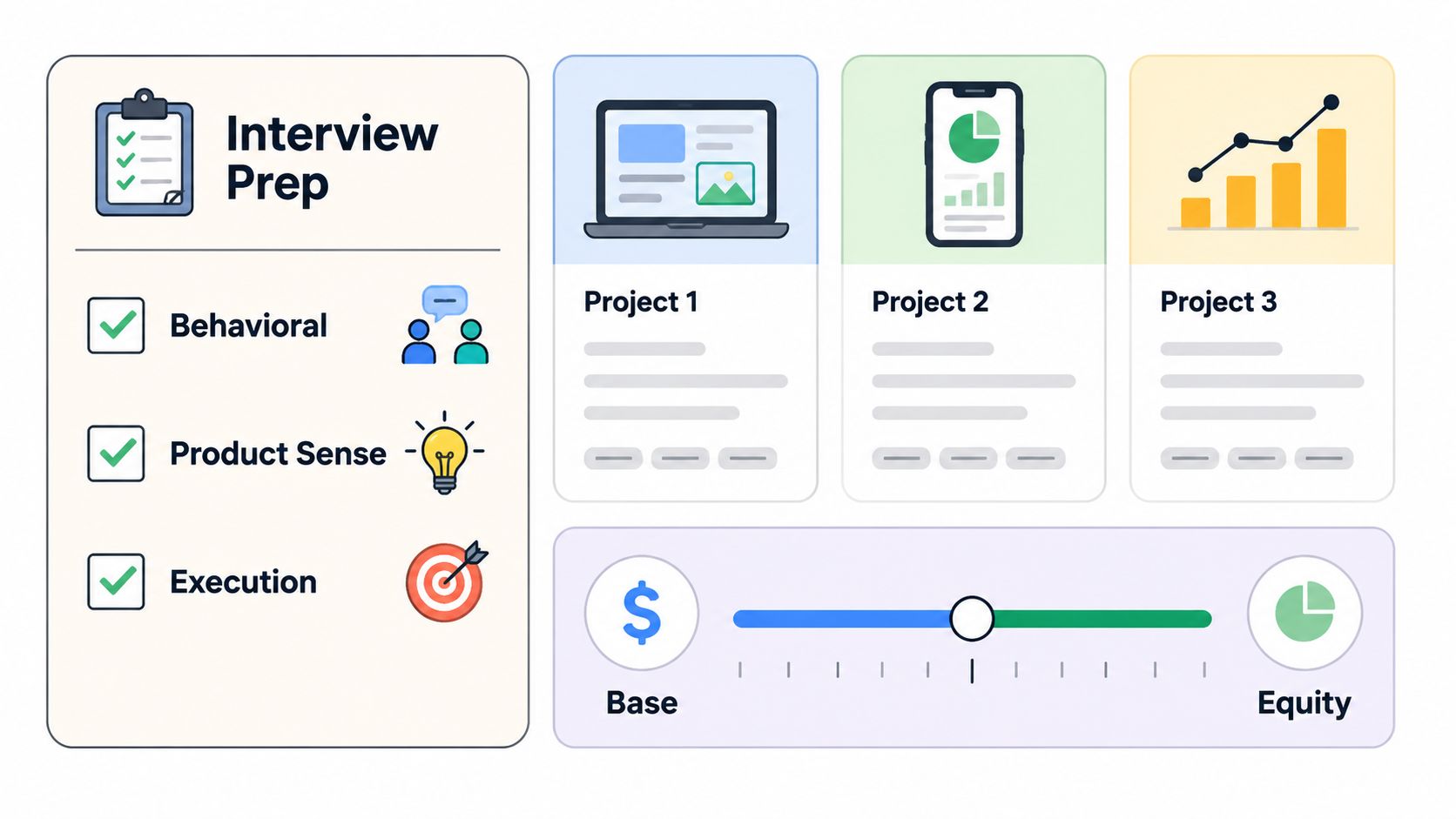
The behavioral interview is where many candidates stumble — not because they lack experience, but because they tell stories that ramble. The fix is simple: use the STAR structure — Situation, Task, Action, Result — and lead with a number. Something like: "Reduced onboarding churn from 40% to 22% in 90 days by A/B testing a simplified flow." That one sentence tells the interviewer you can diagnose a problem, act on data, and deliver measurable results.
For product sense rounds, pick a product you know intimately — one you've used enough to have strong opinions about. Identify a real user pain point, propose a focused solution rather than a kitchen-sink rewrite, and name the success metrics you'd track. For instance, if asked to improve Spotify, you might suggest a feature to help users discover music for specific moods, with success measured by an increase in playlist creation and session duration.
Execution and estimation interviews test how well you break large, ambiguous problems into measurable pieces. When asked to estimate the market size for electric scooters in Chicago, outline your assumptions (population, target demographic, adoption rate), identify the necessary steps (calculating total addressable market), and sketch a rollout plan. The interviewer isn't looking for the "right" number. They want to see how you structure thinking under uncertainty.
Pick three to five projects that clearly moved a metric. Each case should open with the problem and the metric you shifted, then describe what you specifically drove versus what the team contributed. Include at least one technical or data-heavy example (like an API launch) and one growth or UX example (like a funnel optimization) to show range.
Lead with the metric you moved and show the decision you made behind it.
When building a portfolio website, prioritize clarity and fast scanning. Use clear headings, bullet points, and visuals. Hiring managers skim — they don't read every word. If you're choosing a platform, the Webtwizz review of portfolio builders is a solid starting point for picking a builder that's clean and fast-loading.
Start by anchoring on the right median for Product Manager jobs in the USA. Aim for a median base near $135,000 and layer on a 15% to 25% metro premium where the cost of living justifies it. Compare offers by total compensation — base, bonus, equity, and benefits — not base salary alone. Two offers with the same base can differ by tens of thousands once equity and bonuses enter the picture.
A numbered approach to the negotiation conversation:
Equity details matter more than most candidates realize. RSUs at public companies carry real liquidity. Stock options at startups come with exercise costs and dilution considerations that can erode value fast. Ask about vesting schedules and refresher policies directly — nothing about these is standard across companies.
Key insight to remember before each interview loop: total comp beats base salary for apples-to-apples comparisons.
Checklist to Screenshot Before Each Loop:
If you want curated startup exposure while you apply these tactics, explore Underdog.io at https://underdog.io