You're on an offer call for a senior role when the founder says, “We'll include phantom equity.” The number sounds promising, but the offer doesn't tell you when you'll be paid, how the company will be valued, or what happens if an acquisition ends your employment. On the other side, founders often grant phantom equity to avoid dilution, then discover they've created a cash obligation they never modeled.
Phantom equity can be a smart compensation tool, but it isn't automatically valuable. Candidates should treat it as a contract to inspect, not as ownership to celebrate. Founders should treat it as a future liability, not as free upside. The right decision depends on the mechanics.
A senior product candidate asks for ownership. The founder offers phantom equity instead of stock options. The candidate hears “equity,” but receives a contractual promise, not shares. That distinction should shape both the negotiation and the plan design.
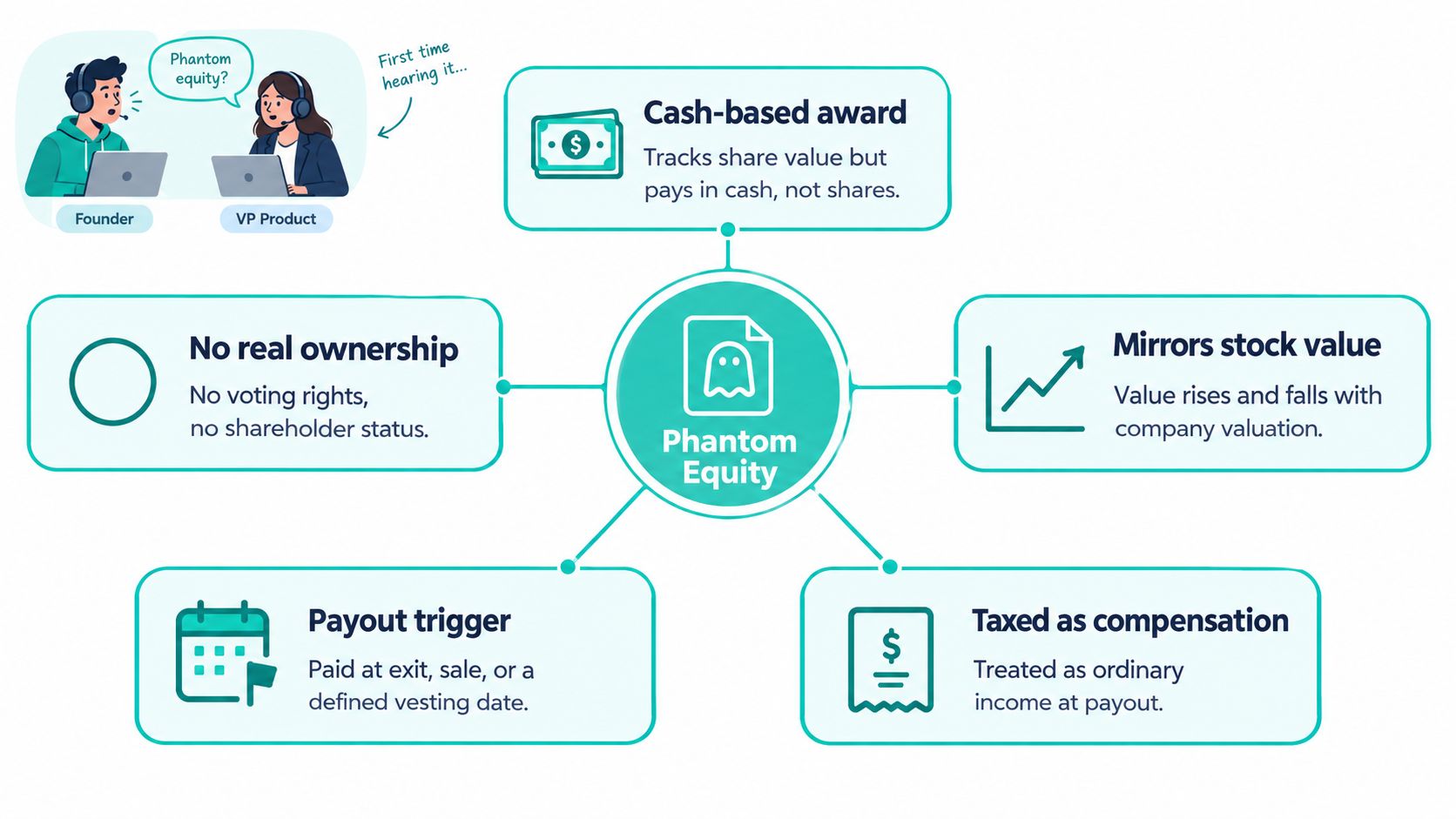
Phantom equity is a contractual right to a future cash payment linked to company value. It provides no actual shares, voting rights, or place on the cap table. Employees receive an economic incentive without changing legal ownership, as described in JPMorgan's overview of phantom equity for startups.
Every award should answer five questions:
Two designs dominate. Phantom stock tracks a share or unit and may pay its full value at settlement. Stock appreciation rights, or SARs, pay only the increase above a stated baseline, similar to an option's strike price.
Practical rule: An offer is incomplete until it states the grant value, vesting terms, trigger, calculation method, and payment date.
Candidates should request those terms in writing and ask what happens after resignation, termination, a sale, or a delayed payout. Founders should model the resulting cash obligation under each likely outcome. Phantom equity avoids issuing shares and preserves control, but payment comes from company cash rather than a liquid market. A valuable award can still become difficult to collect if the plan postpones settlement or the company lacks funds.
The structure has roots in the 1970s and 1980s. It spread among small businesses and LLCs in the 1990s and 2000s, connecting compensation to company value without issuing ownership. An SEC filing for a phantom stock plan adopted in 1994 and still active in 2021 shows how companies have used these arrangements as long-term incentives for at least 30 years.
Common recipients include C-suite hires, senior employees, advisors, and talent at companies that can't yet issue practical options. LLCs and private businesses can also use phantom equity to share value without adding shareholders. The label matters less than the contract. Candidates should negotiate the mechanics, while founders should draft terms that match their future cash capacity.
A candidate evaluating a phantom equity offer should calculate the payout under both full-value and appreciation-only formulas before assigning value to the grant. Use a phantom stock grant of 10,000 units, a $1.00 baseline value, and a four-year vesting schedule.
With equal annual vesting, the recipient earns one-quarter of the grant each year. After four years, all 10,000 units are vested. Leaving earlier generally limits eligibility to the vested portion, subject to the plan's cliff, forfeiture, and termination rules. Founders should model those outcomes before promising a headline value.
Assume the company reaches $8.00 per unit. A full-value phantom stock plan produces $80,000, calculated as 10,000 units multiplied by $8.00. An appreciation-only design subtracts the baseline first. The appreciation is $7.00 per unit, producing a $70,000 SAR-style payout.
“Phantom stock” does not identify the formula. The agreement must state whether the recipient receives the entire unit value or only appreciation above the grant-date baseline. Candidates should ask for that language directly. Founders should avoid describing a grant with a single dollar figure that hides the calculation.
A qualifying sale at $8.00 per unit can trigger the full-value calculation. A fixed payout date at the five-year mark, using a hypothetical fair market value of $8.00, can produce the same gross result if the plan permits settlement then. The trigger determines when payment occurs, while the formula determines how much is owed.
| Exit Price per Unit | Vested Units | Phantom Stock Payout | SAR Payout |
|---|---|---|---|
| $8.00 | 10,000 | $80,000 | $70,000 |
| $8.00 | 5,000 | $40,000 | $35,000 |
A participation threshold can reduce the payout before the formula is applied. The plan may recognize value only above a stated company valuation or unit threshold. Partial vesting normally applies pro rata, but the contract should specify whether fractional units count and how the threshold interacts with vesting.
Use the startup equity calculator from Underdog.io to test scenarios. Change the baseline, vested units, trigger, cap, and valuation assumptions. A single attractive estimate is not enough for either an offer decision or a compensation budget.
Review the provisions that alter the headline amount. Change-of-control acceleration may vest some or all units when the company is sold. A participation cap can limit the total payout. An early-exercise or early-departure provision may impose a discount or forfeiture rule.
Valuation discounts can also reduce the recognized amount. A discount for lack of marketability or minority interest in a 409A valuation may reduce value by 20% to 40%, according to Wilson Group. Candidates should ask which valuation applies, when it is measured, and whether the plan deducts a discount before calculating payment. Founders should include those mechanics plainly in the plan and model the resulting cash obligation.
A candidate receives a phantom equity offer from a company that cannot or does not want to issue shares. The offer may look like ownership, but the decision is different: accept a contractual cash claim, or negotiate for actual equity. Founders face the reverse decision. They must decide whether cash-settled upside is the right hiring tool, or whether the role requires genuine ownership.
Compare each instrument across four questions: Does it dilute ownership? When is it taxed? What does the recipient receive? What control survives after the grant?
| Dimension | Phantom Equity | Stock Options (ISO/NSO) | RSUs |
|---|---|---|---|
| Dilution | Doesn't add shares to the cap table | Uses authorized shares when exercised | Uses authorized shares when settled |
| Tax character | Generally ordinary income at payout or vesting, depending on structure | Tax treatment differs between ISO and NSO, with exercise consequences | Ordinary income at vesting |
| Payout form | Cash from the company | Shares after exercise, with possible sale or holding | Shares at settlement |
| Ownership and control | No voting or shareholder rights | Ownership follows exercise and share issuance | Ownership follows share settlement |
| Liquidity exposure | Depends on company cash and the trigger | Recipient may need to exercise and later sell | Recipient may sell or hold received shares |
| Administrative exposure | Contractual deferred compensation and valuation obligations | Equity plan, option administration, and exercise mechanics | Equity plan, vesting, withholding, and share settlement |
Phantom equity offers economic alignment without issuing shares. It avoids cap-table dilution and can fit late-stage hires, advisors, or employees in jurisdictions where issuing equity creates administrative difficulty. The trade-off is direct: the recipient receives a contractual promise, not ownership. Payment also depends on the plan's trigger, valuation method, vesting rules, and the company's ability to fund the obligation.
Stock options create potential ownership, but the recipient may need to exercise them before receiving shares. ISOs can involve alternative minimum tax exposure, while NSOs generally create ordinary income at exercise on the spread. RSUs remove the exercise decision, but recipients generally recognize ordinary income when the units vest. Both instruments use actual equity and therefore affect share availability and ownership.
Control separates phantom awards from real equity. Phantom holders receive no voting rights, inspection rights, or shareholder status. They also avoid shareholder-level filing and communication obligations. They do not receive the long-term capital-gains treatment that can make actual equity valuable after a long holding period.
For founders comparing a cash-linked award with actual stock issuance, phantom stock senza diluizione provides a concise ownership comparison. Broader equity compensation structures for startups can help frame the choice alongside options and RSUs.
Phantom equity wins when the company needs flexible value sharing. Real equity wins when ownership, control, and whole-token upside are central to the hire.
My recommendation is direct. Candidates should ask for the payout trigger, valuation date, vesting treatment, termination rules, payment timing, and company obligations before accepting phantom equity. Founders should document those terms and model the future cash liability before granting it. Use phantom equity when avoiding dilution and share administration matters more than shareholder rights. Use real equity for early employees whose retention depends on owning a meaningful piece of the company, provided the company can administer it correctly.
Phantom equity is taxable compensation, not a substitute for capital-gains treatment. Recipients generally owe ordinary income tax when the award is paid or otherwise recognized under the plan. Payroll taxes may also apply, depending on the structure, recipient status, and payment timing.
A vested employee at a C-corporation who receives $150,000 at payout illustrates the planning issue. At a 37% federal ordinary-income rate, the payment produces approximately $55,500 in federal income tax before FICA, state tax, withholding differences, and personal circumstances. The actual liability depends on the recipient's situation, so treat this calculation as a planning example, not tax advice. Candidates should ask whether the company will withhold from the payout or require them to reserve cash separately.
Entity structure changes the analysis. For an LLC or S-corporation, a pass-through partner may see the payment divided between ordinary compensation and self-employment tax treatment, depending on status and plan design. Before promising a net amount, the company should have tax counsel determine reporting, withholding, and payment mechanics.
A phantom plan typically falls within nonqualified deferred compensation rules. If the plan fails Section 409A requirements, the recipient may face immediate income inclusion, an additional 20% federal tax, and interest penalties. The agreement therefore needs a defensible valuation process and a payment schedule that follows the applicable rules.
Avoid language such as “paid upon a successful exit.” Define the transaction that triggers payment, who determines the value, which valuation date applies, and when the company must pay. Candidates should request these terms before accepting an award. Founders should have counsel review the plan before using it in an offer.
The employer generally receives a compensation deduction when the payout is recognized. A $400,000 settlement can therefore reduce taxable income dollar for dollar in the year the company recognizes deductible compensation, subject to applicable tax rules. That deduction does not remove the need to fund the payment, so founders should model both tax timing and cash timing.
Financial reporting creates a separate obligation. Once a payout becomes probable, the company may need mark-to-market accounting under ASC 718. If the expected settlement value rises, the company may accrue additional compensation expense during the vesting period. If the value falls, reported expense can change as well.
| Entity Type | Recipient Tax Character | Employer Deduction | ASC 718 Treatment | 409A Risk |
|---|---|---|---|---|
| C-corporation | Ordinary income, generally with payroll taxes | Generally recognized with compensation payout | Track liability and remeasure as required | Deferred-compensation compliance required |
| LLC | Depends on employee or partner status | Generally tied to compensation recognition | Track contractual award and valuation changes | Payment timing and classification require review |
| S-corporation | Depends on recipient status and payroll treatment | Generally tied to deductible compensation | Apply applicable liability accounting | Documented schedule and valuation remain central |
The company should model the cash obligation and accounting expense together. A plan that fits the compensation budget can still create a large liability at a transaction. Require tax, legal, and accounting review before granting awards.
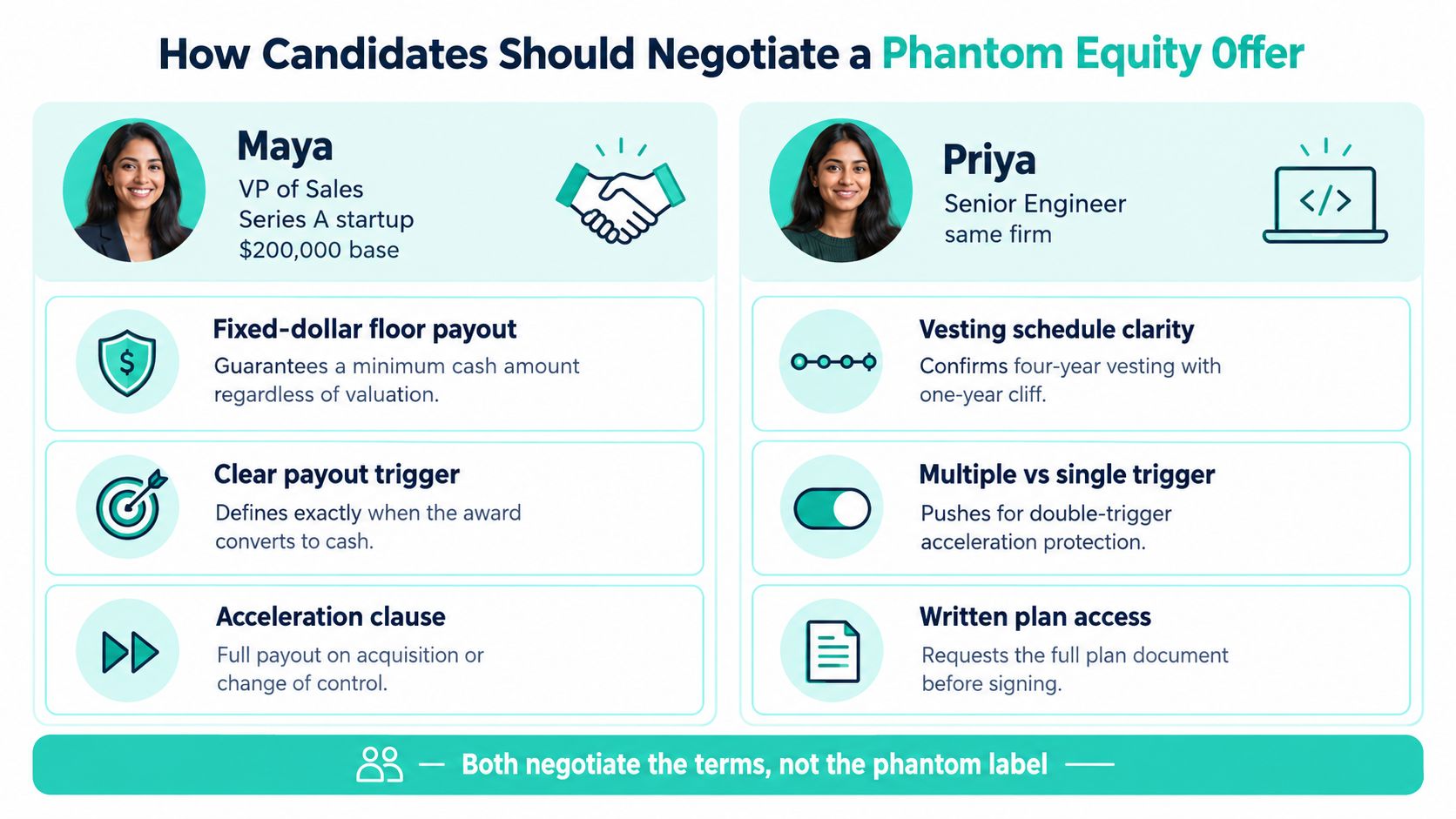
Maya is a VP of Sales joining a Series A startup on a $200,000 base salary. The founder offers phantom equity, but the first draft uses flexible language around valuation and payout. Maya doesn't reject the concept. She negotiates the contract.
She asks for a 0.75% grant, a 2x cash floor, a defined change-of-control trigger, and acceleration if the company is acquired and she is involuntarily terminated within 12 months after the transaction. She also asks the company to explain whether the percentage is calculated against issued shares, fully diluted shares, or a separate phantom pool.
Priya, a senior engineer at the same firm, accepts the boilerplate. Her award is 0.4%, with a soft target payout and no acceleration provision. When the company is acquired and she is laid off, the unvested portion disappears and the payment formula doesn't protect the value she expected. Her problem wasn't accepting phantom equity. It was accepting undefined terms.
Candidates rarely control every provision, but they can focus their influence where it affects the outcome:
Candidates negotiating broader startup packages may find term sheet strategies for MENA founders useful for thinking about negotiating power, definitions, and written protections. The same discipline applies to an employment award.
Before signing, get written answers to four questions:
Maya negotiated the terms that determine whether the award survives a transaction. Priya negotiated the label by accepting it. Candidates should do the former.
Founders should build the plan in an order that protects both compliance and cash flow. Start with the company's objective, then turn that objective into a valuation, a written plan, individual agreements, and a funding model.
A formal plan should also distinguish time-based vesting from performance-based vesting. Time-based vesting rewards continued service. Performance vesting connects payment to revenue, profit, valuation, or another defined company result. Avoid combining broad performance discretion with an undefined payout formula.
Accounting needs a place in the drafting process. At each reporting period, the company may need to record accrued compensation expense for the expected liability. At settlement, it records the payment, removes the related liability, and accounts for withholding and employer payroll obligations.
The most dangerous drafting failures are ordinary-looking omissions:
A grant agreement should say, in substance, how the payment amount is calculated, when it is paid, when vesting begins, and whether double-trigger change-of-control acceleration applies. It should also include the company's intended Section 162(m) compliance language where relevant. Counsel should adapt the language to the company and recipient rather than copying a generic template.
The phantom equity plan guide from Underdog.io can help founders organize the major plan components, but it doesn't replace legal, tax, or accounting review.
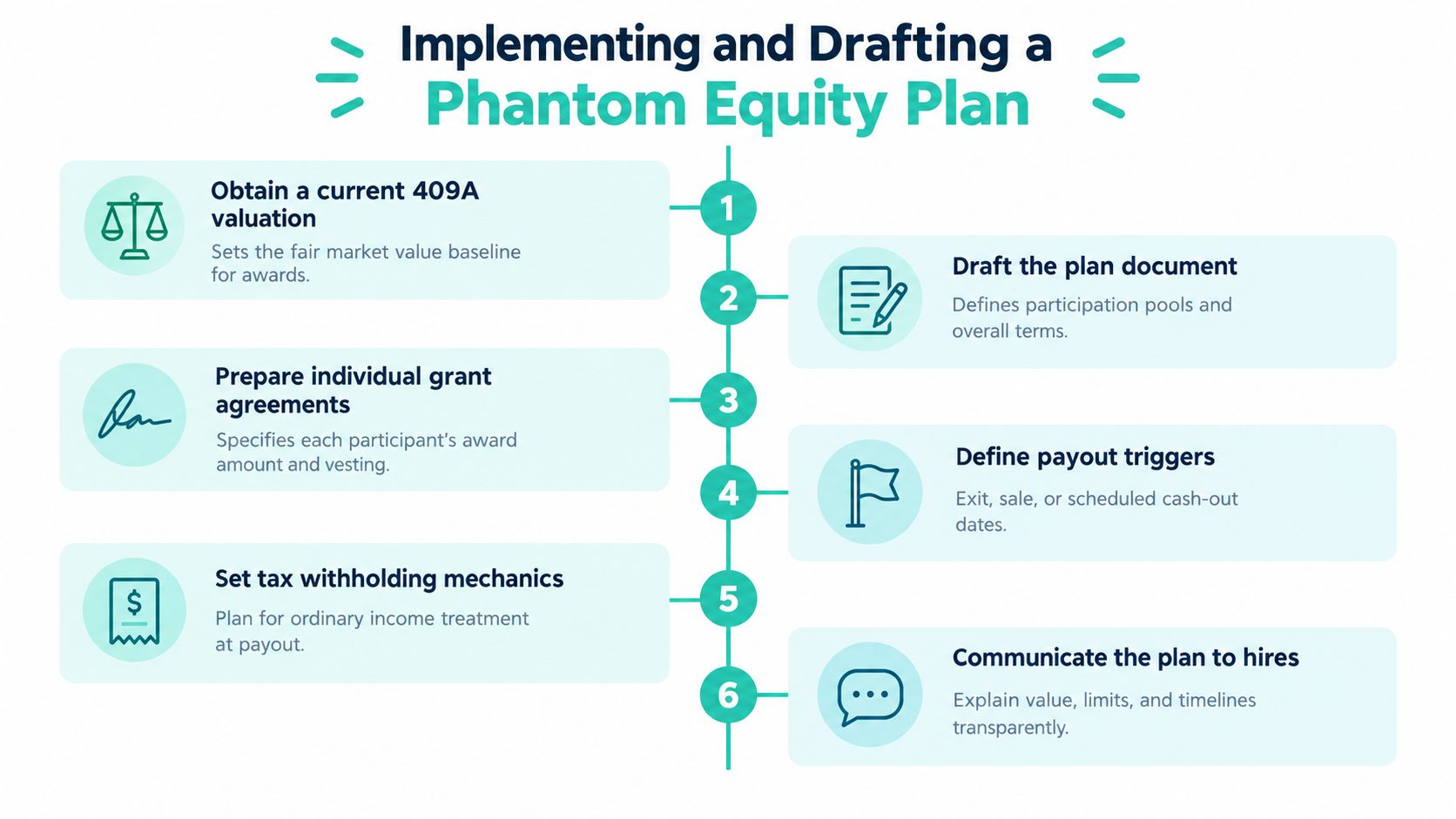
Before issuance, obtain board consent, confirm whether shareholder acknowledgment is needed, verify the valuation, and have outside counsel review the plan and grant agreement. Then model the company's cash obligation under multiple exit and termination outcomes. If the finance team can't explain the liability, the hiring team isn't ready to grant the award.
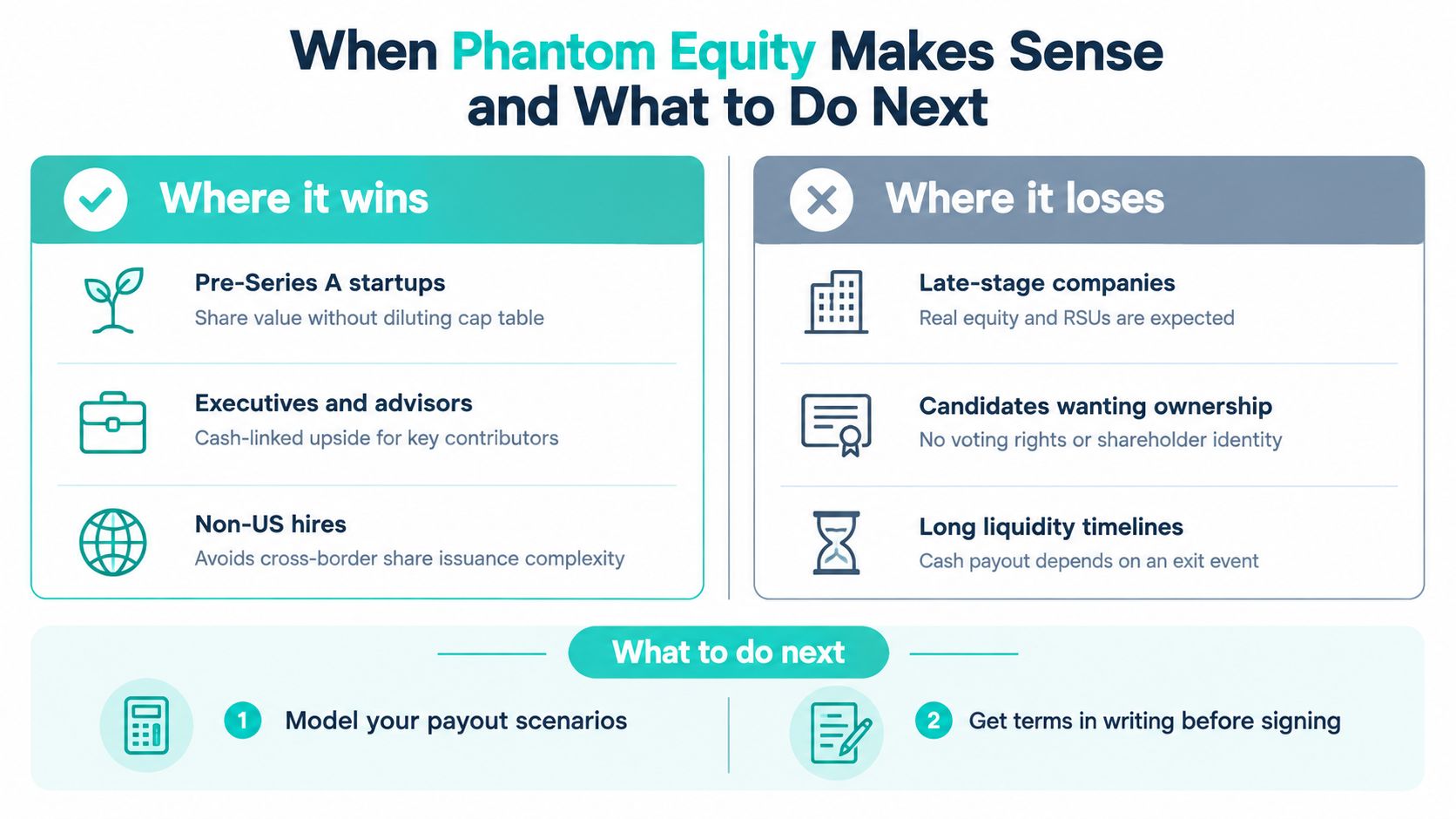
A founder offers phantom equity because the company needs to recruit someone who expects meaningful upside, while the candidate weighs a promise of future cash against the absence of ownership today. That trade-off works best for private businesses, pre-Series A startups, LLCs, and companies hiring executives or advisors who cannot receive practical shares.
The award becomes less compelling once a later-stage company can grant conventional options or RSUs easily. Candidates who want voting rights, shareholder status, or actual equity after an exit should push for another instrument. A long path to liquidity creates another risk: the recipient waits for cash while the company controls the payment trigger.
Private-company adoption makes phantom equity a recognized compensation tool rather than an unusual promise. A 2019 WorldatWork survey found that 15% of privately held companies used phantom equity, compared with 65% using cash-based performance awards, 36% using real equity, and 21% using non-qualified deferred compensation plans, according to Wilson Group's compensation analysis. A 2025 carry and compensation survey reported that 47% of firms used synthetic carry mechanisms, a category that includes phantom equity, deferred bonuses, and long-term incentive plans.
Candidates should request:
Founders should secure:
Retention depends on credible terms, not the label. Founders assessing incentive design alongside broader staff retention to boost profit should explain the award clearly and show how the company can fund settlement.
Use phantom equity when you need to share value without ownership or dilution. Grant it only after the payment mechanics, protections, and funding plan are documented.
Underdog.io connects vetted startup and tech candidates with high-growth companies, giving founders a curated hiring channel and candidates a focused way to explore roles where compensation terms matter. If you're hiring for a role that may include phantom equity, or evaluating startup offers and want a clearer view of the market, visit Underdog.io and review the available opportunities.