Tired of sending your resume out into the void and only hearing crickets? I get it. A solid product manager resume template is more than just a piece of paper; it's your one-shot marketing tool to get your foot in the door for an interview. This guide gives you that template, plus the actionable insights you need to stop listing tasks and start telling a story of real impact.
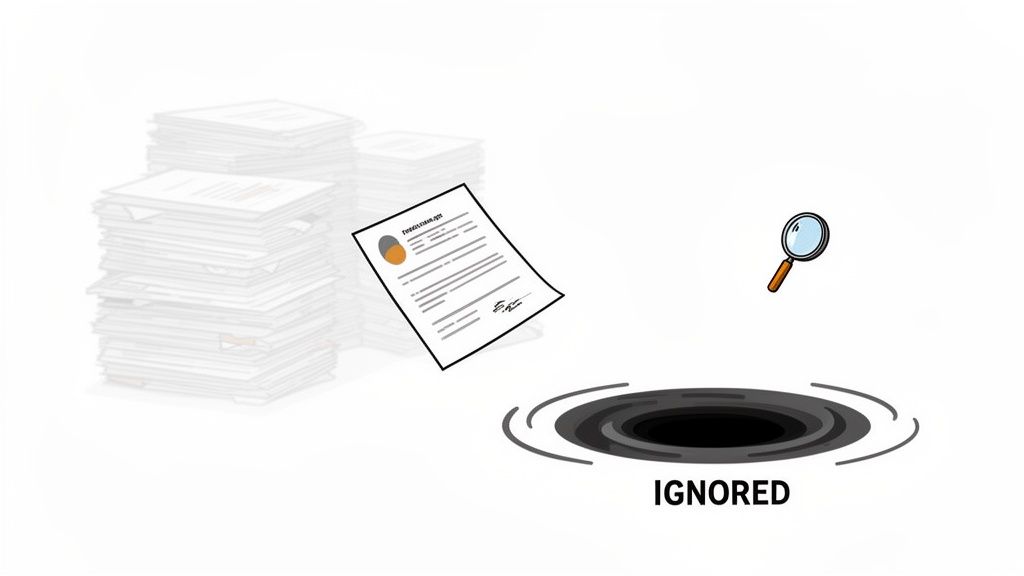
It’s a scenario I’ve seen play out a thousand times. You’ve shipped killer features, wrangled backlogs, and led cross-functional teams, but your resume still gets ghosted. What gives?
Here’s the hard truth: most PM resumes fail because they don't communicate value, not because the experience isn't there. They read like a generic job description—a laundry list of duties—instead of a highlight reel of problems you've solved and results you've delivered.
Especially in the startup world, hiring managers are spending just a few seconds on each resume. They don’t want to see "managed a product roadmap." They want to see someone who "revamped the product roadmap to align with Q3 company goals, resulting in a 20% faster time-to-market for key features." The difference is night and day. One is a task, the other is a tangible business win.
You have to start thinking of your resume as your most important product. And like any great product, it needs to solve a real user problem. The user is the hiring manager, and their problem is finding the one person who can drive their product forward. A resume bogged down with generic responsibilities just makes their job harder.
To cut through that noise, you need a mental shift. Stop treating your resume like a historical archive and start treating it like a strategic pitch. It's all about framing your work around the outcome.
Your resume shouldn't just list your responsibilities; it should tell a compelling story about the value you create. Every bullet point is a chance to prove you're not just a manager, but a driver of growth and innovation.
This guide is much more than just a product manager resume template. It's a complete framework for reframing your accomplishments, getting past the automated screening bots, and building a document that truly sells your skills to any startup. We'll kick things off with a downloadable template you can use right away, then get into the nitty-gritty advice for making it shine.
Think of your product manager resume less like a formal document and more like a lean, effective product. Its one job? To solve a hiring manager's problem: finding the right talent, fast.
A startup-ready resume gets straight to the point. It’s built to be scanned in under ten seconds while still landing your biggest wins. Every section has a purpose, from the initial hook to the final proof points that seal the deal.
This structure isn't random—it's designed to pull the reader's eye straight to what matters. For startups, that means quickly seeing your problem-solving skills, your adaptability, and how you’ve directly helped a business grow.
Ditch the long, rambling professional summary. Startup founders and hiring managers are short on time and need to get your value proposition immediately. This is your elevator pitch, not your life story.
Your summary should be a punchy, two-sentence statement that answers two simple questions: "Who are you?" and "What unique value do you bring?" A strong summary is the hook that convinces them to keep reading.
Practical Example:
To nail this critical first impression, check out our detailed guide on how to write a good professional summary.
The skills section is your toolbox. It’s a quick-scan area where recruiters make sure you have the foundational skills for the job. In a startup, that means showing a mix of technical chops and the people skills to match. You have to prove you can both analyze the data and rally the team.
Organize this section so it’s easy to read:
This balanced approach shows you can handle both the technical and human sides of building a product—a critical skill for any startup PM.
While your experience section is the main event, your education and other activities add important color. If you're an early-career PM, your university projects, hackathons, or relevant coursework can show initiative and a solid knowledge base. And even for seasoned pros, a relevant certification shows you’re committed to staying sharp.
To truly build an 'Anatomy of a Startup Ready PM Resume,' you need to get inside a founder's head. Understanding their journey helps you frame your accomplishments in a way that truly connects with the challenges and goals of a new venture.
A deep grasp of the entrepreneurial journey is a huge advantage. Knowing the fundamentals of how to startup a company gives you real insight into the pressures and priorities that drive founders. This knowledge lets you tailor your resume to speak directly to their pain points, showing you don't just have product skills—you have a true startup mindset.
This is it. This is where your resume goes from a boring list of duties to a powerful story of your wins. When you're aiming for a fast-moving startup, nobody has time to read that you “managed a product backlog” or “conducted user research.” Seriously, that’s just the job description. They want to know the so what—the real, measurable results you delivered.
Think of every bullet point under your experience as a tiny slice of high-value real estate. If you waste it on passive responsibilities, you're missing the whole point. You need to frame every single accomplishment as a mini-case study that screams, "I create value."
The best way to do this consistently is with a simple but killer formula: Achieved X by doing Y, resulting in Z. This framework forces you to connect your actions directly to business outcomes, which is the only language recruiters and hiring managers truly speak.
So, why does this formula work so well? It systematically answers the questions rattling around in a hiring manager's head while they skim your resume for the 20th time that day: What did you accomplish (X)? How, specifically, did you do it (Y)? And what was the actual, quantifiable benefit to the business (Z)?
Here’s how to put it into practice:
Getting this structure right is fundamental. It’s the core of a resume that gets noticed, fitting perfectly within the overall flow of your document.
Each section of your resume should build on the last, with your Experience section providing the hard evidence for the claims you make in your Summary and Skills.
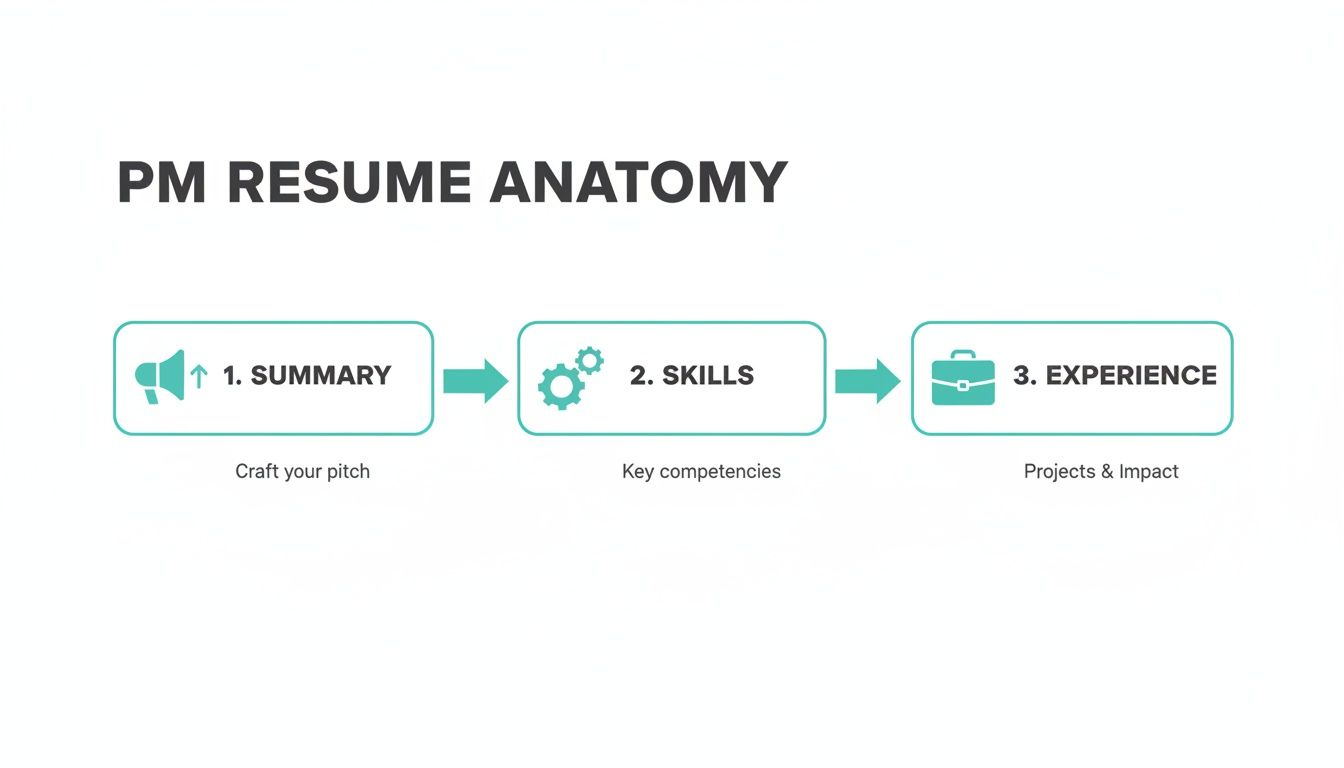
This visual shows how it all connects—your experience bullets are the proof in the pudding.
Let's look at some real-world examples. It’s one thing to talk about the formula, but it’s another to see it in action. Here’s how you can transform bland, task-based statements into compelling, metric-driven achievements that will make a hiring manager stop scrolling.
See the difference? The weak points just state what you did. The strong points prove why it mattered. That's the shift in mindset that will get you interviews.
"But what if I don't have direct revenue numbers?" I hear this all the time, especially from PMs who worked on internal tools, platform features, or early-stage products that weren't monetized yet. Don't sweat it. The key is to get creative and think about impact more broadly. Not every metric needs a dollar sign.
Here are a few other ways to quantify your wins:
Your goal is always to translate your work into the language of business value. Whether it's saving time, boosting engagement, or making customers happier, find a metric that tells a story of positive change.
This focus on metrics isn't just a nice-to-have anymore; it's table stakes. Recent data from LinkedIn's 2025 hiring trends shows that 78% of hiring managers prioritize candidates who back up their claims with concrete numbers. This is even more critical now that Applicant Tracking Systems (ATS) are programmed to scan for quantitative data to rank you against other applicants. Without metrics, you might not even make it past the first digital gatekeeper.
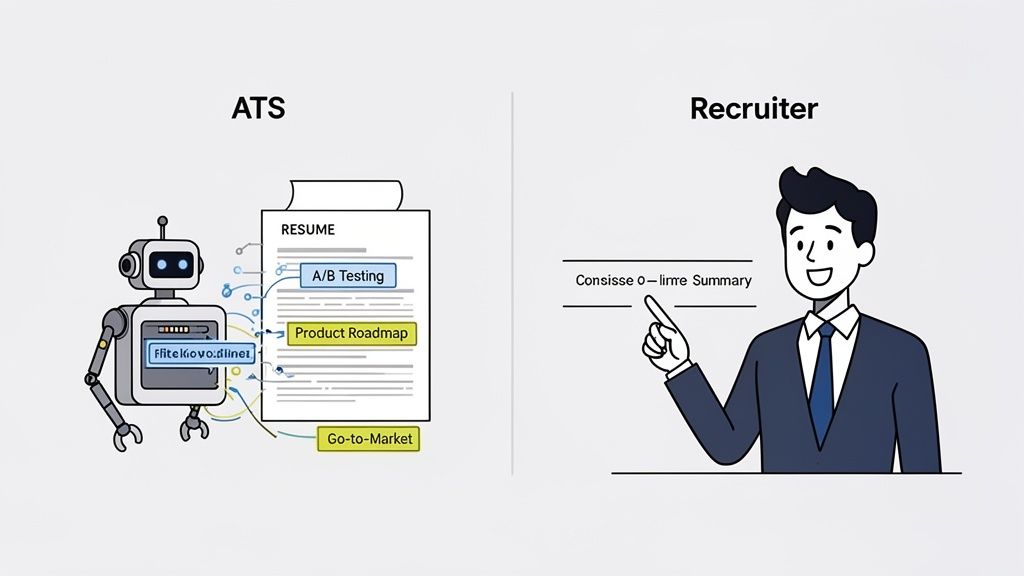
Before your resume ever reaches human eyes, it has to get past the first gatekeeper: the Applicant Tracking System (ATS). These bots are your first audience, and they’re programmed to be ruthless. They don’t care about your beautiful layout or clever design; they’re just scanning for keywords and information they can easily parse.
This is the first major hurdle, and it’s where a lot of otherwise great candidates get tripped up. A staggering 75% of product manager resumes are rejected by an ATS before a recruiter even knows they exist, often due to simple formatting errors or missing keywords like "product strategy" or "agile methodology."
Your resume has to be built on a solid, bot-friendly foundation. Only then can you start thinking about impressing a person.
Getting past the ATS isn't about stuffing your resume with keywords. It's about smart, simple optimization. These systems thrive on clean, predictable formats. Anything too creative—columns, graphics, or funky fonts—can scramble the software and get your information misread or tossed out completely.
To make sure the bots can read your resume correctly, stick to these actionable rules:
Think of ATS optimization as setting the stage. You’re just clearing away any technical roadblocks so your accomplishments can take the spotlight when it really matters.
Following these guidelines ensures the bot can accurately read and categorize your experience. For a deeper dive on structure, check out this complete guide on how to write a tech resume that performs well with both software and people.
Once you’ve cleared the ATS, your resume finally lands in front of a human. The catch? You have mere seconds to make an impression. They aren't reading every word; they're scanning for proof of impact.
This is where visual hierarchy and scannability become absolutely critical. A clean, single-page resume with plenty of white space is your best friend here. A recruiter’s eyes are naturally drawn to specific things when they first glance at a resume.
Here’s a practical look at what they’re scanning for:
Make their job easy. A clear, logical layout guides their eyes directly to your most impressive wins. Using strong action verbs and bolded metrics are your most powerful tools for grabbing and holding a recruiter’s limited attention, turning that quick scan into a definite "yes" for the interview pile.
Let’s be honest: firing off a generic resume is the quickest way to get ghosted. This is especially true at startups, where every single hire is critical. They aren't just looking for a warm body; they're looking for someone who gets them, who has done more than just click "Apply." Customizing your product manager resume for each and every role isn't just a good idea—it's non-negotiable.
But don't panic. This doesn't mean you need to rewrite your entire life story every time you find a cool job. It’s about making small, strategic tweaks that take maybe 10-15 minutes but can seriously boost your callback rate. Think of it like this: you want to hold your resume up next to the job description and make them look like they were made for each other.
Before you touch a single word on your resume, you need to put on your detective hat. Rip apart the job description. I mean, really analyze it. Highlight the keywords, the required skills, and the core responsibilities they mention over and over again.
Are they obsessed with “user acquisition,” laser-focused on “go-to-market strategy,” or constantly talking about “data-driven experimentation”? That language is your roadmap. It tells you exactly what their biggest headaches are right now. Your first move is to mirror that exact language in your resume. This is a core part of learning how to create a resume for startup jobs that actually gets a response.
Your job isn’t just to show you’re a great Product Manager; it’s to show you’re the exact Product Manager they need right now. The job description tells you exactly how to do that.
Once you've identified their top priorities, it's time for a simple but powerful edit. Go to your most recent role and reorder the bullet points. Drag the accomplishments that directly speak to their needs right to the top of the list.
If the job post is all about launching a new mobile app and you spearheaded a killer app launch two years ago, that bullet point is now your headliner. It’s your #1. This simple shuffle ensures that a recruiter, who's likely scanning for just a few seconds, immediately sees your most relevant wins. It's a killer way to control the narrative and make an instant impression.
Let's imagine a fintech startup's job description is practically screaming, "We need someone to drive user engagement for our new investment feature."
Here's how you can transform a decent bullet point into a must-call one:
See the difference? It’s a small change, but it’s packed with power. You’ve directly woven in their keywords ("user engagement," "investment") and shown them you've already solved the exact problem that's keeping them up at night. This is the kind of thoughtful customization that turns a good resume into an irresistible one.
Before you fire off that application, hold on. Taking a few extra minutes for one final quality check can be the difference between landing an interview and getting lost in the noise. It’s easy to get excited and hit ‘submit’ too soon, but a tiny, preventable error can sink an otherwise perfect resume.
This isn't just about catching typos; it’s about making sure your resume is the sharpest, most compelling sales document it can be. Let's run through a quick final scan to give you the confidence that you're presenting the absolute best version of yourself.
Think of this as your final product launch gate. You wouldn't ship a buggy product, so don't ship a resume with flaws. Here's your actionable checklist:
A resume is a living document right up until the moment you hit 'send.' That final five-minute review can literally be the difference between getting an interview and getting ghosted. Treat it like the critical step it is.
Once your resume is polished and out the door, the real game begins: preparing for the interviews. A killer resume gets your foot in the door, but you have to be ready to walk through it. Start sharpening your storytelling and case study skills now by diving into this comprehensive guide to Product Manager interview prep.
Beyond just applying, the smartest move is to get your resume in front of the right people. Flinging applications into the void on massive job boards is a recipe for frustration. Instead, focus on platforms designed to bypass the traditional gatekeepers and connect you directly with hiring managers at the kinds of innovative startups where you can make a real impact. This flips the script, letting the best opportunities find you.
At Underdog.io, we connect top product talent directly with high-growth startups looking for leaders like you. Apply in 60 seconds and let curated opportunities come to you.
The reverse-chronological format is almost universally preferred. It lists your most recent experience first, which helps hiring managers quickly see your career progression and recent impact. A clean, one-column layout with clear section headers is ideal for both human readers and Applicant Tracking Systems (ATS).
Beyond contact information, a strong PM resume must have: a compelling professional summary, a detailed work experience section focused on achievements, a skills section listing both technical (e.g., SQL, Agile) and soft skills (e.g., Stakeholder Management), and optional sections for education, certifications, or notable side projects.
Use bullet points that start with strong action verbs (Launched, Optimized, Drove, Led). Focus on quantifiable achievements and impact, not just duties. For each role, ask yourself: "What problem did I solve, what action did I take, and what was the measurable result?" This turns a duty into a compelling story of value.
Incorporate keywords from the job description you're targeting, such as "product strategy," "roadmap planning," "user research," "Go-to-Market (GTM)," and specific methodologies like "Scrum" or "OKRs." Also include technical terms relevant to the domain (e.g., "A/B testing," "analytics," "API integration").
For most PMs with under 10-15 years of experience, one page is the standard and expected. It forces conciseness and impact. Very senior candidates (e.g., Head of Product, CPO) with extensive relevant experience may extend to two pages, but every line must earn its place.
Common pitfalls include: writing a generic objective statement instead of a tailored summary, listing only job responsibilities without metrics, using weak verbs like "helped with" or "responsible for," having a cluttered or overly designed format that isn't ATS-friendly, and including irrelevant personal information or hobbies.
If you're bound by confidentiality, you can use relative metrics. For example: "Increased user activation by a double-digit percentage," "Reduced churn within a key segment by X%," or "Grew feature adoption to become the #2 most used module." You can also focus on scope: "Led product for a portfolio serving 50+ enterprise clients."