You're in the loop, and the loop is already messy. A recruiter messages you on LinkedIn, you do a screen with someone else, then a hiring manager asks the key questions, and suddenly you're trying to figure out who's in charge. The answer matters because it changes how you talk about compensation, how hard you prep, and who you should follow up with when the process stalls.
At startups, the confusion gets worse because titles don't always match power. Some companies split recruiting and hiring cleanly, some let one person cover both jobs, and some hide the decision-maker until the last round. The cleanest mental model is simple: the recruiter runs the funnel, the hiring manager runs the verdict.
| Criterion | Recruiter | Hiring Manager |
|---|---|---|
| Main job | Keeps the hiring process moving | Decides whether the person fits the role |
| Typical focus | Sourcing, screening, scheduling | Role scope, team needs, final judgment |
| Best questions to ask | Process, timeline, compensation band, logistics | Success metrics, priorities, team gaps, decision criteria |
| Candidate takeaway | Treat them like the process owner | Treat them like the person who can say yes or no |
The confusion usually starts with a message that feels slightly too casual. A stranger on LinkedIn says your background looks relevant, then a calendar invite lands from someone with a title you barely recognize, and the first thought is simple, who matters here?
That question isn't petty. It's the difference between spending your energy on logistics and spending it on the actual decision. Industry guidance is blunt about the split, the recruiter manages the process, while the hiring manager makes the final decision (Ask The Headhunter).
Companies separate the jobs because they optimize for different things. Recruiters live in the pipeline, they move candidates through the funnel, while hiring managers live in the role itself, they know what success looks like on the team. In small startups, one person may wear both hats, but that's a resource constraint, not a better system.
The practical stakes show up immediately. The recruiter is usually the person to ask about process, timeline, and compensation logistics. The hiring manager is the person to pressure-test scope, team priorities, and whether you'll succeed once you're hired.
In a seed-stage company, the distinction can blur fast. A founder might screen resumes, run interviews, and make the final call. In that situation, the question isn't the title, it's whether you're speaking to the person who owns the open role or the person who just keeps the process moving.
Practical rule: if the person can't close the loop on the role, they probably can't answer your deepest questions either.
Recruiting tech also changes the feel of this handoff. Tools and AI workflows can speed up screening and scheduling, but they don't remove the need for a human owner who knows what the role demands, which is why resources like DialNexa recruitment tech insights are useful if you're trying to understand how modern recruiting teams automate the front end without replacing judgment.
Candidates get tripped up because they treat recruiter and hiring manager like two labels for the same job. They are not. The recruiter owns motion. The hiring manager owns the decision quality.

| Criterion | Recruiter | Hiring Manager |
|---|---|---|
| Objective | Efficiency | Quality |
| Daily focus | Pipeline management | Skill assessment |
| Core pressure | Keep candidates moving | Pick the right person |
| Candidate lens | Fit, availability, process | Execution, team fit, long-term value |
The recruiter keeps the process moving. The hiring manager makes sure the team does not hire the wrong person.
That split shows up in how each role gets judged. Recruiters are measured on time-to-fill, candidate volume, and pipeline efficiency, while hiring managers are measured on quality of hire and retention (Survale). If you are a candidate, the recruiter is checking whether you can move through the process cleanly, and the manager is checking whether you will still perform well after you join.
The recruiter's scorecard also lives in the world of process benchmarks. Teams often look at ranges like 30 to 45 days for individual contributor roles, 45 to 75 days for manager and director roles, and 90+ days for VP and executive searches. Offer acceptance often sits around 85% to 95%, and interview-to-offer often runs at about 3 to 4 interviews per offer (Metaview). Those numbers matter because they explain why recruiters care about speed, response rate, and clean handoffs.
The manager's scoreboard is slower and stricter. Quality of hire is usually assessed at 6 and 12 months, and a common benchmark is 75%+ of hires rated meeting or exceeding expectations (Metaview). That is why manager interviews sound more pointed. They are trying to avoid a bad hire, not just fill a seat.
For a sharper read on what engineering managers look for in practice, this guide from Underdog.io on what engineering hiring managers look for is worth reading.
Recruiting tech also changes the front end of the process. Tools and AI workflows can speed up screening and scheduling, but they do not replace the human owner who knows what the role demands, which is why resources like DialNexa recruitment tech insights are useful if you want to understand how modern recruiting teams handle volume without handing judgment over to software.
A candidate can have a strong profile and still get bounced if they ask the wrong person to make the wrong call. Hiring moves through handoffs, and each handoff has a real owner. The recruiter controls the top of the funnel. The hiring manager controls the part that decides whether the person can do the job.
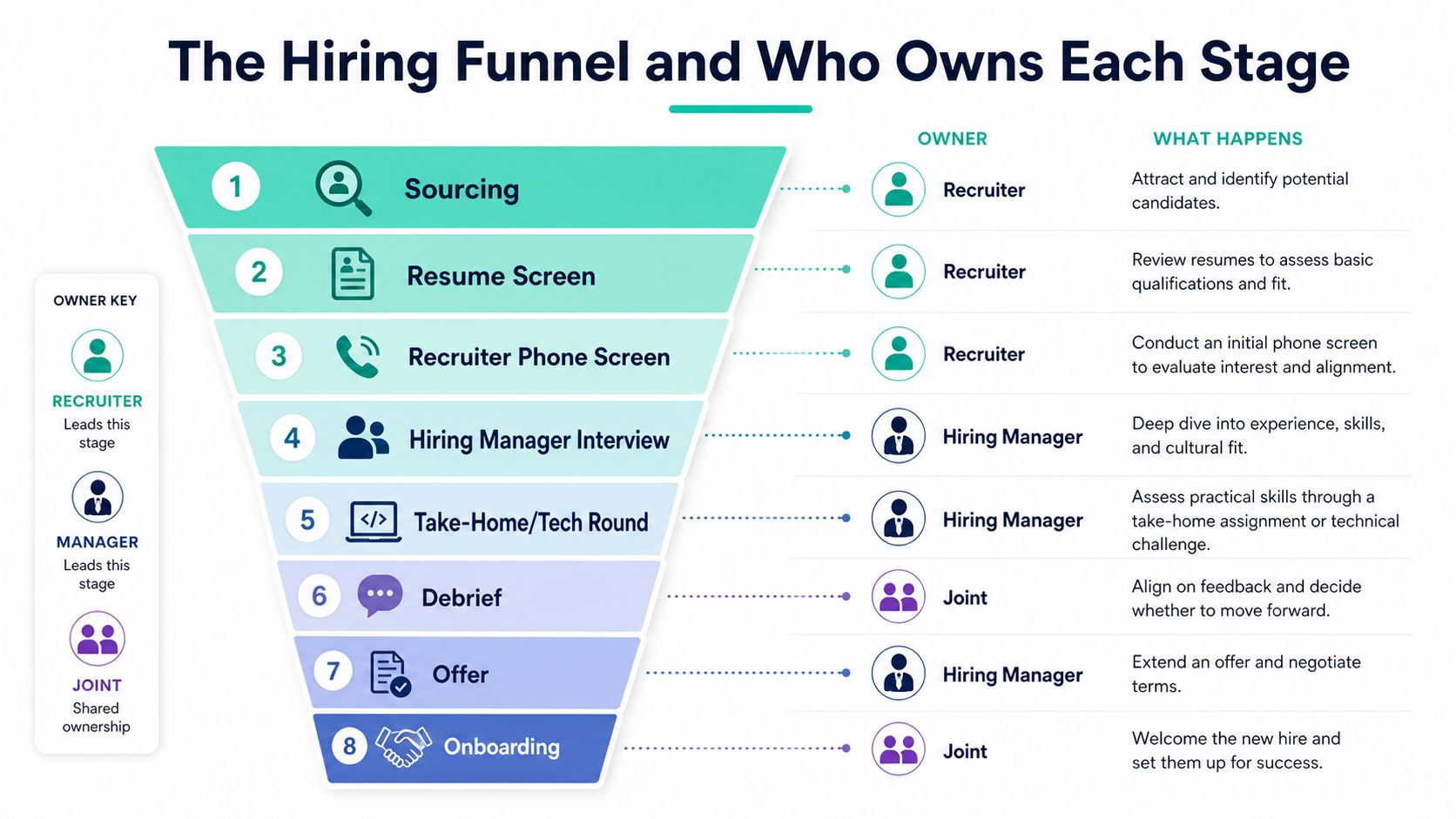
Sourcing belongs to the recruiter. They find candidates, run outbound, and decide who gets a first look.
Resume screen belongs to the recruiter too. They check whether your background clears the basic bar and matches the must-haves for the role.
Recruiter phone screen is still recruiter territory. Here, logistics, availability, communication style, and basic alignment get tested before anyone on the team spends more time.
Hiring manager interview is where real judgment starts. The manager looks at whether your experience lines up with the work that needs to get done and whether you can operate at the level the team needs.
Take-home or technical round usually sits with the manager or a technical lead acting for the manager. At that point, the process shifts from broad fit to proof.
Debrief is joint ownership. The recruiter brings process context, the manager brings role context, and both sides decide whether the candidate stays in motion.
Offer is usually manager-led, with recruiter support. The recruiter coordinates details, but the manager's confidence or hesitation usually decides how hard the team pushes.
Onboarding often becomes a handoff again, and in some startups it stays shared for a while. That happens most often when one person has been carrying both the recruiting and hiring-manager view of the role.
The reason this split matters is simple. Recruiters are filtering harder than ever, and managers are carrying more weight in the decisions that close. Ashby reports that applications per hire rose sharply, interview-stage conversion fell, and only a small share of applicants make it to the interview round. That puts more pressure on the recruiter to screen cleanly and more pressure on the manager to make the final judgment count.
A curated marketplace like Underdog.io compresses that chain into one human-powered match instead of three handoffs. For candidates, that changes the conversation fast. You are no longer trying to decode who owns which slice of the funnel at every step, and you spend less time repeating the same pitch to people who cannot all make the same decision. For a closer look at how recruiters should run that side of the process, how to work with a recruiter lays out the practical version.
Use the recruiter to de-risk the process. Use the hiring manager to de-risk the job. If you blur those two conversations, you usually end up either under-informed or over-exposed.
Ask the recruiter about timeline, must-haves, process, and compensation range. Don't waste the first conversation with a deep dive into team strategy, because they usually don't own that answer, and you'll just sound like you're trying to force a decision they can't make.
Use the recruiter call to find out how many rounds there are, who the next interviewer is, and what would disqualify you early. If they're vague, that's useful information too. It means the company probably doesn't have a tight process.
Save the hard questions for the manager. Ask about scope, team priorities, what the first 90 days need, and what success looks like if you walk in and do a good job.
The manager is also the right person to ask about trade-offs. If the job sounds broad, ask what they want done now versus later. If the role sounds ambiguous, ask where the boundaries are. That's where the signal is.
A recruiter conversation can help you get to the manager. A manager conversation can help you decide whether you want the job.
Here's a simple thread that shows the difference. A candidate tells the recruiter, “I'm only open to fully remote roles and I need a quick process.” That's fine if it's true, but if they repeat it to the manager as their opener, they can look like they care more about convenience than contribution. The better move is to tell the recruiter the constraint, then tell the manager what kind of environment helps you do your best work.
If you want a deeper playbook on working the process without stepping on toes, Underdog.io's guide on how to work with a recruiter is a practical companion to this split.
Rule of thumb: recruiters want clarity and momentum, managers want evidence and specificity.
Do the comp conversation early with the recruiter, not with the hiring manager, unless the hiring manager is the one who opened the conversation. That's the cleanest rule, and it saves everyone time.
The reason is simple. Recruiters are the people who can surface a range, test whether your expectations fit, and keep the loop from grinding on for two weeks before everyone discovers there's a mismatch. Hiring managers should spend their interview time evaluating scope and fit, not discovering that the role and the candidate are miles apart on compensation.
The failure mode is predictable. Candidates who wait too long to raise comp lose negotiating power because they've already invested time, and candidates who make the hiring-manager interview feel like a salary negotiation too early look transactional. The recruiter is the gate for process alignment. The manager is the gate for role judgment.
A useful outside reference on negotiation styles is the PEO pricing leverage playbook, which is worth reading if you want to think more deliberately about how to press on price without turning the conversation adversarial.
That doesn't mean you stay silent. It means you put each question in the right room. If the recruiter says the range won't work, stop early. If the manager wants to keep you moving but refuses to discuss basics, that's a warning sign about internal alignment.
Talk comp with the person who can correct the process, not the person who's trying to evaluate your fit.
For a more detailed view of how offers get discussed once the loop is real, Underdog.io's offer letter negotiation guide is the right follow-up read.
The most expensive candidate mistakes usually come from misunderstanding who owns what. The process is annoying, but the logic is consistent once you stop treating every interviewer like the same person in a different seat.
The silent killer is the last one. A candidate can be charming in the screening call and completely forgettable in the manager round, and that's exactly how you get passed over in debrief. Recruiters can keep a weak process alive, but managers usually don't fight for someone who didn't show clear value.
The fix is not more enthusiasm. It's more specificity. Bring examples, make trade-offs explicit, and stop trying to impress both people in the same way.
A curated marketplace compresses the chain. Instead of a recruiter sourcing a huge pool, screening it, and then handing a hiring manager a shortlist, the marketplace pre-vets candidates and sends selective matches into the loop. That means the manager often meets fewer people, and the recruiter layer shrinks or disappears at the front end.
Underdog.io does this by using a curated, human-powered matching model for tech candidates and startups, so the introduction is already narrower than a normal inbound funnel. The point isn't that recruiters vanish entirely. The point is that the first screen is replaced by a more selective match, and that changes the experience for both sides.
The old model has three handoffs. A recruiter screens, a manager evaluates, and someone else often manages the logistics. In a curated marketplace, the front-end screening is partially absorbed into the matching process, so the manager sees a tighter set of candidates and the recruiter's job becomes more about coordination than discovery.
That matters because it cuts down on black-hole behavior. Candidates spend less time guessing whether a resume even made it past the first screen, and managers spend less time reading profiles that were never a fit. The whole chain gets shorter, which is exactly what busy startups want.
Even in a compressed model, recruiters still add value in process, scheduling, and comp calibration. They're useful when a role has multiple interviewers, when the process needs discipline, or when the company needs help translating a vague need into a clear candidate brief.
The difference is that the marketplace removes some of the cold-start work. Instead of one person starting from scratch with a broad stack of applicants, the match arrives already filtered by human judgment. That changes the candidate experience from “submit and wait” to “be seen and respond.”
Who should I follow up with? Follow up with the recruiter first if your question is about timeline, next steps, or scheduling. Follow up with the hiring manager if you already had the final conversation and you're clarifying role scope or team priorities.
Can the recruiter see my salary history? Don't assume every recruiter knows or needs it. Share only what's necessary for the conversation, and keep the focus on your target range and the value you'd bring.
Should I apply directly to the hiring manager? Usually no. That skips the process owner and can make you look like you don't understand the chain of custody. Use direct outreach only when you have a strong, relevant reason and a real relationship.
Does a curated marketplace mean skipping recruiters entirely? Not really. It usually means skipping the widest part of the funnel, not every human interaction. The process gets shorter, but process, comp, and coordination still need someone to own them.
If you want fewer handoffs and a cleaner path to the people who make the call, Underdog.io is built for that kind of hiring flow. It connects tech candidates with curated startup matches, so you spend less time guessing who owns the process and more time talking to the people who matter. Visit Underdog.io if you want a more direct path into startup hiring.