Most roundups still tell you to buy the hiring tool with the biggest database, or to treat every product labeled “AI recruiting” as a swap-in replacement. That advice collapses when the problem is a reply from someone who already has a job, not another row in a search.
Underdog vs Metaview is not a feature contest. One product is a curated marketplace that puts vetted startup talent in front of a hiring team. The other is recruiter software that records interviews and drafts scorecards after people are already in the process. If nobody qualified is answering, interview notes will not invent a pipeline. If you already have candidates and interviewers disagree, a sourcing network will not standardize the debrief.
The sourcing side should win that first decision when matching is fact-based and the response target sits above 60%. We hold that target at 65% or more. Keep each product's metrics in its own lane, then fix the bottleneck you have.
Buying both before you know the bottleneck is the expensive mistake. Underdog.io launched in 2014 as a closed, invite-only marketplace. Candidates submit one application, and Underdog responds only to those selected for a cohort. Once accepted, companies reach out directly to vetted people. Metaview is AI recruiting software for recording, transcribing, and structuring interviews. Metaview reports that it was founded in 2018 and had passed 3,000 customers and over 3 million captured hiring conversations by June 2025.
Underdog determines who enters the funnel and gives employers access to passive candidates who are employed but open to a better role. Metaview determines what evidence your team captures once candidates are already in process. Judge the marketplace on qualified pipeline and candidate response; judge interview software on evidence quality and consistency across reviewers.
| Factor | Underdog.io | Metaview |
|---|---|---|
| Core purpose | Curated marketplace that matches candidates to startups | AI recruiting software that captures interviews and structures feedback |
| Primary user | Candidates, startups, and hiring managers | Recruiters and hiring teams |
| Hiring stage | Sourcing and first introductions | Screening, interviews, and evaluation |
| Founded | 2014 | 2018 |
| Candidate cost | Free to apply | Not a candidate product |
| Employer pricing | Pay-per-hire or subscription | Not published |
| Reported scale | Hundreds of vetted companies (company-reported) | More than 3,000 customers and over 3 million captured conversations by June 2025 |
| Final decision | Hiring company, after reviewing introduced candidates | Human reviewers; AI drafts outputs but does not decide |
Core purpose and user. Choose Underdog when the missing input is a qualified startup candidate. Choose Metaview when the missing output is a reliable record of what interviewers asked and concluded.
Stage and year. Underdog sits before screening, at sourcing and the first introduction. Metaview sits after people enter the process, covering screening, interviews, and evaluation. The dates show category maturity, not feature overlap.
Cost. Applying is free for candidates. Employers can pay per hire or choose a subscription with unlimited seats and a full year of unlimited hires. Metaview is not a candidate product, so there is no candidate price. Its employer pricing is not published, so get a direct quote before comparing total cost.
Scale and the decision. Do not compare hundreds of vetted companies with millions of captured conversations as if one cancels out the other. The first describes marketplace reach; the second describes product adoption and usage. Both are company-reported. In either workflow, a person makes the employment decision. Metaview drafts documentation, but it does not decide.
Practical rule: Fix the earliest missing input first. If qualified candidates are not entering the pipeline, source first. If they are entering and interview conclusions still conflict, standardize capture first.
The mechanism is selective on purpose. A candidate files one application, built to take about 60 seconds, and it costs nothing. We accept the top 5% of applicants. That acceptance rate is a company-reported claim. Confirm it with us before you plan headcount around it.
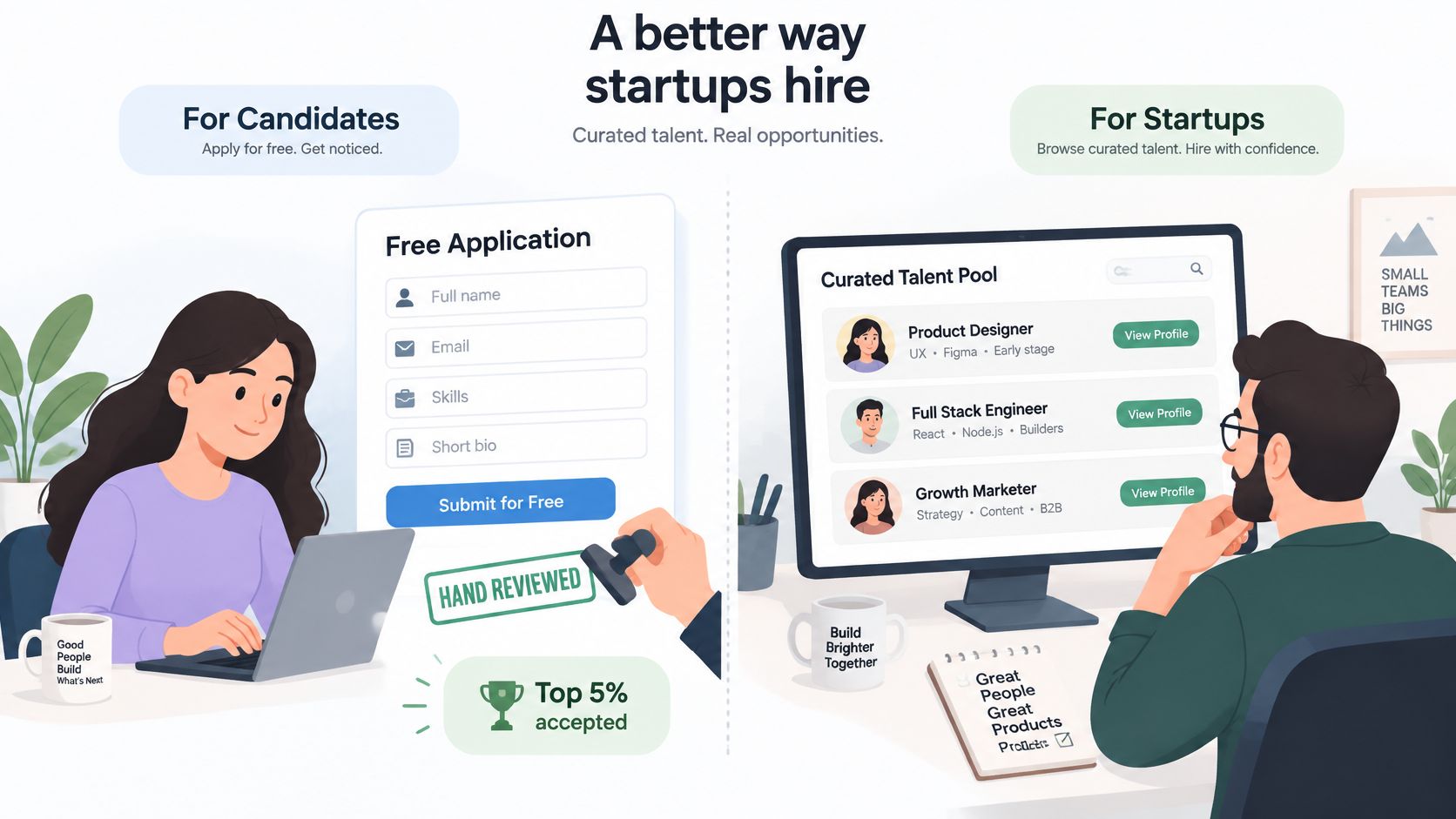
Every profile is reviewed by hand, including the portfolio. For designers, reviewers look at craft, product thinking, and evidence of shipped work, not visual polish alone. A portfolio of tidy case studies with no decisions underneath gets rejected. That filter is what changes your week. You stop reading fifty lookalike decks and start a conversation with someone whose work matches the product.
Matching is fact-based, not a keyword blast. Each designer is matched to the specific company where the background fits, based on the role's stage, product area, and team structure. They are not sprayed at every open design role in a city. The same logic is why a founder with one req should not expect a firehose.
Coverage runs through companies in AI-native products, developer tools, infrastructure, consumer and creator apps, fintech, and healthtech, from seed through Series C. The deepest coverage is in New York City and San Francisco, with reach across the United States. City and stage coverage is company-reported. If your req sits outside those sectors or cities, ask before you onboard.
Accepted candidates typically see one to three selective introductions a month. That monthly range is also company-reported, not an audited placement study. The point of the cap is relevance. Fewer intros means the people who do write back are more likely to be worth a founder's hour. Teams comparing marketplaces can explore options beyond Toptal when they want a shortlist of curated models rather than another searchable database.
The Candidate team helps people tighten a profile, shares how interview processes tend to run, and walks them through an offer. That support sits beside the match. It does not replace the hiring manager's verdict.
Before you apply or post a role, use this checklist:
If the portfolio cannot survive a question about what was cut, it is not ready for a selective introduction.
Metaview is a workflow layer that starts from the interview, not from a candidate marketplace. It records a consented conversation, structures the notes, and drafts a scorecard the interviewer still has to submit. Humans review the outputs and make the hiring decision.
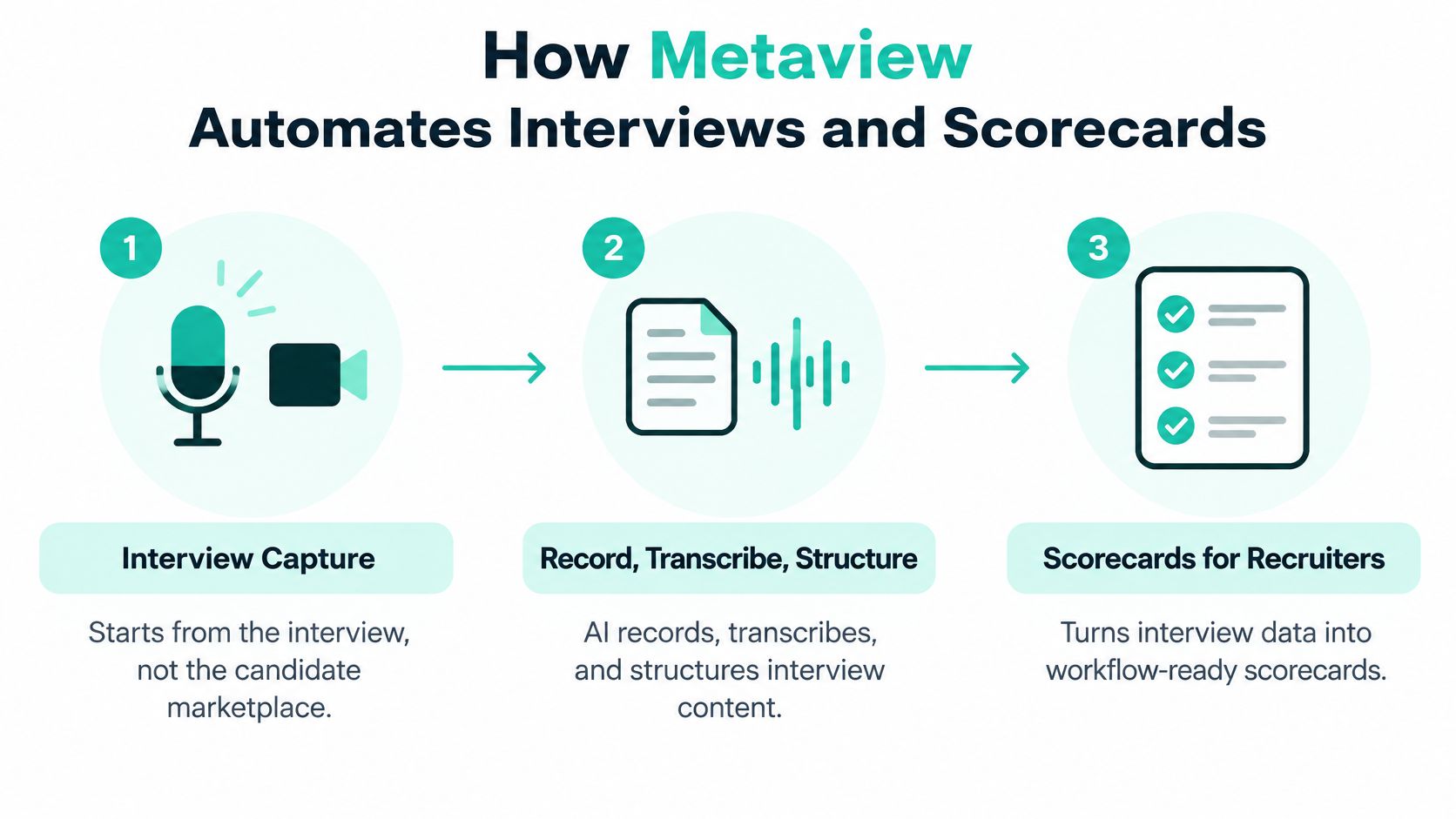
If you are comparing notetakers before you commit, start by evaluating real-time interview tools against consent, edit rights, and whether a human still owns the scorecard. A recorder that nobody reviews is just a transcript archive.
Metaview's own scorecard study puts the documentation gap in numbers. Across 5,207,185 captured candidate interviews, 1,624,988 had at least one attached scorecard, a 31.21% attachment rate. In a capped sample of 120,000 scorecards, 50.3% of scorecards that received a generated first draft were submitted, compared with 28.6% written from scratch. That is a 21.7-point gap, about 1.76 times the from-scratch submission rate. It is an observational comparison, not a randomized test. Do not read it as proof that the draft caused the submission.
Pair the tool with a written rubric. Our notes on structured interview techniques are the right companion, because a clean transcript cannot repair a vague question.
After rollout, a recruiting lead should track three things only: scorecard completion, documentation time, and consistency across interviewers. If those three do not move, the notetaker is overhead.
A large contact study is the right yardstick for outreach, and it is not a test of either product. In an analysis of 58,765 jobs and 1,348,916 candidate contacts, only 14.86% of contacted candidates responded positively, 13.67% responded negatively, and 71.47% did not respond, according to a large-scale recruitment-platform study. A matching service that clears 60% would sit far above that positive-response rate. The 14.86% figure comes from a general dataset on a different platform. Use it as a reference point, not as a head-to-head score.
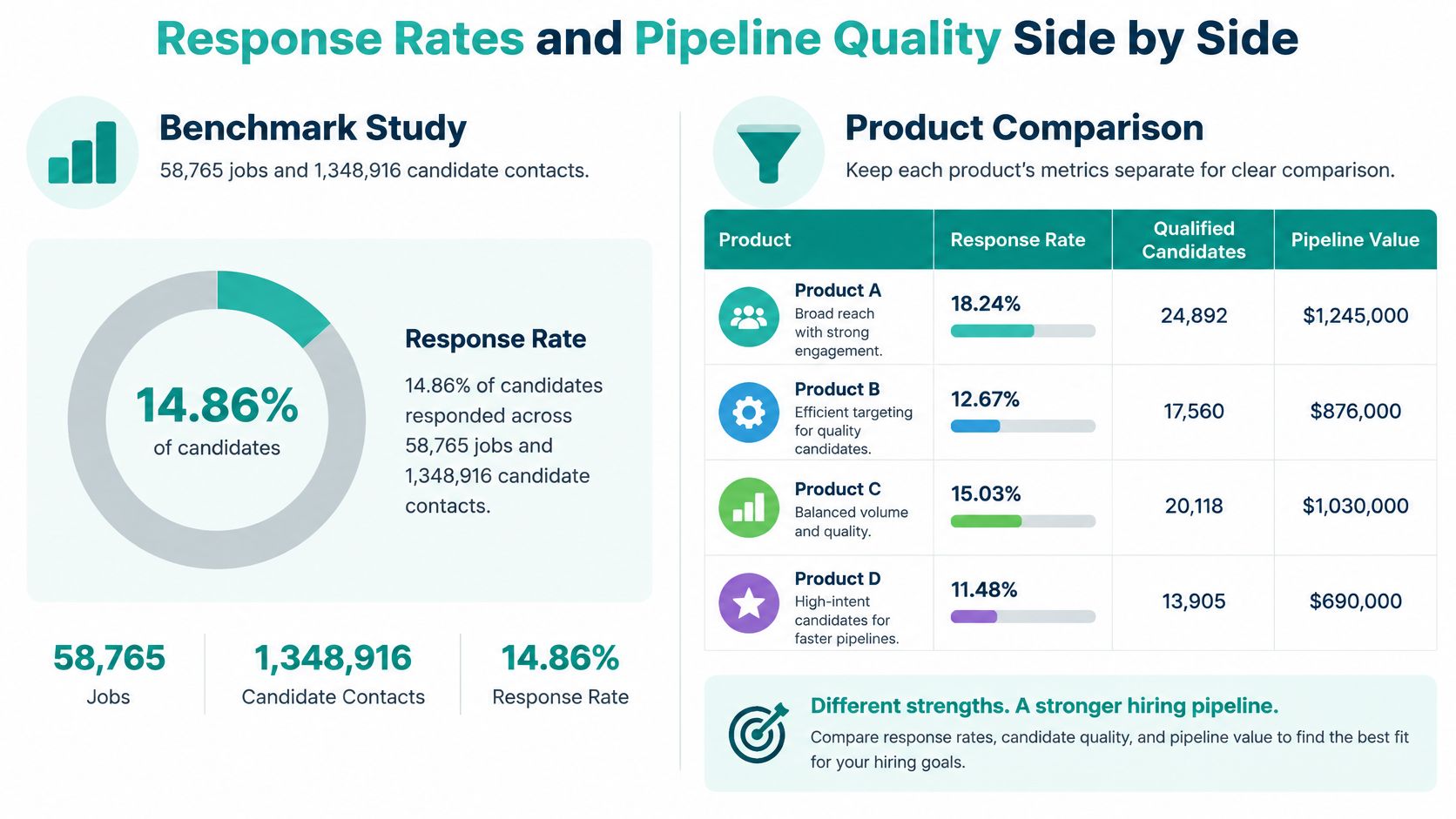
Our company-reported target is a response rate of 65% or more, a self-declared number rather than an independently audited result. The structural reason a curated network can aim that high is selectivity on both sides: candidates pass a manual review of portfolio and craft, accepting roughly the top 5% of applicants, while more than half of applying companies are turned away. Employers then reach out directly to vetted designers matched to their stage, team structure, and open roles, so a reply reflects fit rather than blast volume. On a trial, ask for your own response file: replies from people who match the req, not opens on a sequence.
Metaview has no candidate-response metric because it sits past the sourcing stage. Judge it on scorecard submission and documentation time, using the observational rates from its captured-interview dataset, not on whether someone wrote back to a sourcing email.
Gem's startup funnel benchmarks for companies with fewer than 500 employees show the drop at every stage: 12% of applicants reach a recruiter screen, 58% of screened applicants reach an interview, 22% of interviewed candidates receive an offer, and 84% of offer recipients accept. Curated matching lifts the early stages by removing irrelevant applicants before a recruiter spends a screen on them. Structured evaluation lifts the later stages by making interviewers finish a comparable write-up. The two fixes answer different leaks, so the honest question is which stage is losing you candidates right now.
| Metric | Underdog.io | Metaview | Benchmark |
|---|---|---|---|
| Response rate | Company-reported target of 65% or more | Not a candidate-response metric | 14.86% positive response across 1,348,916 contacts (different platform) |
| Scorecard attachment | Not applicable | 31.21% of 5,207,185 captured interviews | No equivalent rate in the contact study |
| Scorecard submission | Not applicable | 50.3% with AI first draft vs 28.6% from scratch | No equivalent rate in the contact study |
| Startup funnel, under 500 employees | Early-stage gain from curated matches (not quantified) | Later-stage documentation and evaluation | Screen 12%, interview 58%, offer 22%, accept 84% |
Track Underdog.io on qualified profiles delivered, response rate, and time to first relevant conversation. Track Metaview on scorecard completion, documentation time, and stage conversion. For how to define the outcome after the first intro call, use a quality-of-hire metrics framework rather than raw profile count.
A high match count with a silent inbox is a failed sourcing tool. A perfect transcript with no submitted scorecard is a failed evaluation tool.
The risk that matters is who holds the record, what that record does to the decision, and what happens when an automated read is wrong. More interview data does not automatically produce fairer hiring. Transcription and rubric mapping can make interviewers more consistent while still encoding a flawed criterion.
On our side, profiles stay anonymous until interest is mutual. We hide candidates from their current and past employers, and a candidate can hide a profile from any other company they choose. Conversations between registered users pass through an email relay called the Messaging Service. An employed candidate should test those commitments against the terms before relying on them during an active search.
The evidence behind a match carries the same weight. We accept the top 5% of applicants, review every profile and portfolio by hand, and reject designers whose portfolios show polished case studies without the actual decisions underneath. We also turn away more than half of the companies that apply. Filtering hard on both sides produces a cleaner signal than filtering for volume.
Metaview's notetaker records interviews only with consent and turns them into structured notes. Its reporting can analyze captured interview data, including compensation expectations and candidate concerns. In its 2026 aggregate study, salary expectations were detected in 34.9% of 331,872 covered interview sessions, as described in Metaview's talent-market write-up. The company also says its application review does not auto-reject candidates and does not make the hiring decision. Put that limit in the buying notes. An agent that screens stays assistive only while a person owns the yes or no.
A controlled hiring experiment at a Fortune 500 professional-services firm found higher yield from machine-learning selection than from the firm's human process: 32% of applicants selected by one supervised-learning model and 27% selected by an exploratory model were eventually hired, compared with 10% selected by human recruiters, in research on algorithmic hiring. That same work found traditional supervised-learning models selected fewer Black and Hispanic applicants. Yield went up. Fairness did not come along for free.
Hold both products to that standard. Our acceptance rate, response target, and introduction frequency are company-reported figures, and Metaview's aggregate findings come from interviews captured on its own platform, so its tables describe its customer mix rather than the wider market. Test every number on your own reqs before it shapes a decision.
Before you turn either tool on, check:
For the process around those checks, use practical ways to reduce hiring bias so the rubric is written before any model or marketplace ranks people.
Match the starting tool to the constraint. Feature grids are the wrong judge. The first three cases below are sourcing problems, and interview software has nothing useful to do until a qualified person is in the room.
| Hiring situation | Start with | Why |
|---|---|---|
| Seed-stage team needs a founding designer within two months | Underdog.io | The constraint is access to vetted designers who will respond |
| Series B company hiring a design lead | Underdog.io | Matches are based on portfolio evidence and team structure |
| Startup with no pipeline and a small team | Underdog.io | Sourcing gap comes first; interview tooling has nothing to work on yet |
| Mature team with high application volume and inconsistent interviewers | Metaview | Structured notes and scorecards standardize evaluation |
| Contract or overflow roles beyond the network | A staffing agency | Contract and surge work outside a curated startup network is a staffing job |
| Team wants both sourcing and evaluation | Underdog.io, then Metaview | Sourcing first, then capture and evaluation |
A seed-stage founder who needs a founding designer in two months has a sourcing problem. The team needs vetted designers who will take the call. Start with curated intros and measure replies. Underdog.io reviews every portfolio by hand and turns away designers whose case studies show polish without the decisions underneath, so the short list is worth replying to.
A Series B company hiring a design lead should start the same way, for a different reason. The match has to follow portfolio evidence, product, stage, and how the team is built. A scorecard template cannot tell you which designer has shipped the relevant product.
A startup with no pipeline and a three-person team should skip interview automation for now. There is no interview volume to standardize. Get a short list of people who answer, then worry about documentation.
A mature tech team already drowning in applications, with interviewers who skip scorecards, should start with Metaview. The bottleneck is evaluation, and structured notes give the debrief a shared record.
Contract or overflow roles that sit outside a curated startup network are a staffing job. Send them to a staffing agency. Neither platform replaces one when you need contractors, surge capacity, or roles the network does not cover.
Coverage has a hard edge. The network is strongest in New York City and San Francisco, inside AI-native products, developer tools, infrastructure, consumer and creator apps, fintech, and healthtech, from seed through Series C. Hiring outside those cities or outside tech? Check coverage before you onboard. A national logo does not guarantee a local shortlist.
Teams that want both should run them in sequence: curated sourcing first, structured capture second. A small company that also needs an applicant tracker for inbound can review small-business ATS software options as a separate system. An ATS stores applications. It does not replace a selective introduction or a completed scorecard.
Underdog.io is the stronger first step when the bottleneck is access to vetted startup tech talent. Profiles are reviewed by hand, matching uses verifiable evidence about stage, product, and team, and we target a response rate of 65% or more, well above the 14.86% positive-response reference from a different dataset. That win is conditional. It applies to the sourcing problem. Metaview answers a later question. It does not replace a pipeline.
The decision rule is simple. If the 30-day response rate clears that benchmark by a clear margin, keep this as the sourcing layer and add Metaview once you have enough interviews to standardize. If it does not, request the platform's response data before you renew. Do not renew on a slide.
Candidates who get in should use the same month well. The Candidate team will help tighten the profile, share how interview processes tend to run, and guide an offer. That is support, not a promise of a hire.
If the 30-day replies are real and the conversations match the req, keep the sourcing layer. If they are not, the curated model has not earned the renewal.
Underdog.io gives startup hiring teams a curated path to vetted tech candidates, with fact-based matching and a response target of 65% or more, instead of another unread database. If your bottleneck is getting the right person to write back, that is the layer to fix before you automate interviews. Visit Underdog.io to see how employers source startup talent and how candidates apply once, for free.