Forget the old-school image of Wall Street towers. The real action in finance is now happening in home offices, co-working spaces, and coffee shops around the globe. For fintech startups, remote work isn't a perk anymore—it's a core strategy for survival and growth, driven by a relentless need for elite talent, operational smarts, and deep expertise in everything from AI to blockchain.

The fintech world has made a decisive shift. What started as a temporary measure has become the default operating model for a huge number of startups and scale-ups. This isn't just some lingering effect of global events; it's a strategic move baked into the industry's DNA.
Fintech companies live and die by their ability to hire the best engineers, product managers, and designers. By embracing remote work, they can break free from the talent confines of a single city like New York or London. Suddenly, they can hire the absolute best person for the job, whether they’re in Omaha or Oslo. This global talent pool is a massive competitive edge.
But this move isn't just about finding people; it's about building better, more secure products. Fintech is a tricky beast, sitting at the intersection of complex tech and even more complex regulations. It demands specialized skills that are rarely found all in one place.
Here’s what’s really driving this shift:
This isn’t just a feeling; the numbers back it up. We’ve seen the demand for remote and hybrid tech roles jump by 19.8% in late 2025 alone. The momentum is undeniable.
The most innovative fintech companies aren't asking "where are you located?" anymore. They're asking "what can you build?" This is the core principle driving the explosion of opportunities.
These trends have solidified remote work as the new backbone of fintech hiring. Below is a quick breakdown of the key forces at play in 2026.
| Trend | Impact on Hiring | In-Demand Skills |
|---|---|---|
| Global Talent Arbitrage | Companies are sourcing talent from anywhere to find the best skills at a competitive cost, expanding beyond traditional tech hubs. | Cross-cultural communication, fluency in collaboration tools (Slack, Jira, Asana), self-management. |
| AI & Automation Integration | AI is no longer a buzzword; it's a core component. Hiring is focused on talent that can build, integrate, and manage AI systems. | Machine learning engineering, data science, AI ethics, natural language processing (NLP). |
| Decentralized Finance (DeFi) & Blockchain | The rise of DeFi and digital assets has created a huge demand for specialists who understand distributed ledger technology. | Smart contract development (Solidity), blockchain architecture, cybersecurity, cryptography. |
| Focus on Cybersecurity | As financial services become more digital, the attack surface grows. Security is a top priority, driving a constant need for experts. | Cloud security, penetration testing, threat intelligence, security operations (SecOps). |
As you can see, the skills in demand are highly specialized and globally distributed, which only reinforces the industry's commitment to a remote-first approach.
The World Economic Forum's recent Future of Jobs Report confirms this, projecting that fintech engineering roles will be among the fastest-growing jobs through 2030. We’re not talking about a niche market here. Technology-related roles are set to drive a net employment growth of 7%, which translates to millions of new jobs worldwide.
For anyone looking to fully embrace this global shift, it pays to understand the logistics of working remotely from another country.
This new reality is a massive opportunity for tech professionals who can thrive without a daily commute. The demand is red-hot, the work is genuinely impactful, and you can do it from anywhere with a good internet connection.
To grab one of these roles, you need a playbook. This guide gives you that playbook, with actionable steps for finding, applying to, and landing a great remote fintech job. For those looking to cut through the noise, curated platforms focused on high-growth remote startup jobs can be a game-changer.
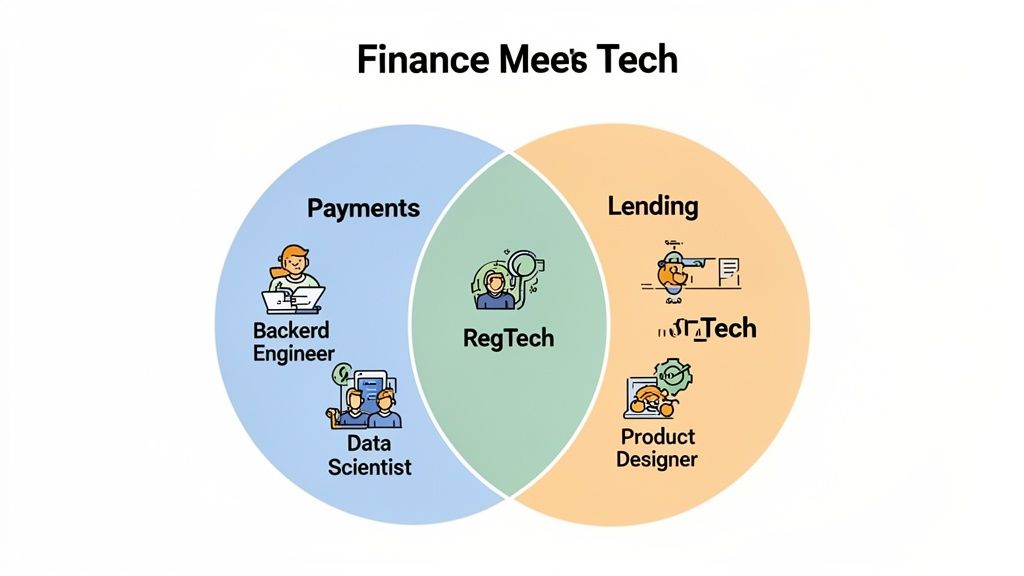
"Fintech" is a massive umbrella, covering everything from mobile banking apps to complex decentralized finance protocols. To land a great remote job, you need to get specific. Figure out where your skills will make the biggest impact.
For example, a backend engineer’s world at a payments giant like Stripe revolves around uptime, shaving milliseconds off latency, and flawlessly processing millions of transactions. In contrast, an engineer at an Insurtech startup might spend their day building machine learning models to assess risk using novel data sources.
While your core skills are transferable, the problems you solve are worlds apart. To make a smart move, you first need to understand the playing field.
Payments and lending are the bedrock of fintech—the sectors most people think of first. They are obsessed with making it frictionless to move and borrow money.
Payments: This is the plumbing of modern commerce. Companies like Stripe and Adyen build the APIs that let any business accept money online. For tech talent, this means working on systems that demand fanatical levels of reliability, security, and scalability. A single minute of downtime can cost millions.
Lending: This vertical reinvents how people and businesses get credit. Companies like Affirm are pioneering "buy now, pay later," while others create new credit-scoring models with machine learning. A data scientist here might work on an algorithm that can approve or deny a loan fairly and instantly.
For a software engineer in payments, success is measured in "nines" of uptime (99.999%) and raw transaction speed. In lending, a product manager’s success might be cutting a loan application process from days to minutes while keeping default rates rock-bottom.
Beyond the giants, you'll find fast-growing niches that tackle specific financial headaches. Two of the most interesting are Insurtech and RegTech.
Insurtech aims to modernize the traditionally slow, paper-choked insurance industry. Think of a company like Lemonade, which uses AI chatbots to process claims in seconds, not weeks. A mobile engineer in this space might focus on an app that makes filing a claim as easy as sending a text. The core challenge is dragging a legacy industry into the modern tech world.
RegTech, or Regulatory Technology, is less flashy but incredibly important. It helps financial companies stay compliant with the law—a massive and expensive challenge. A RegTech company might use AI to scan millions of transactions for subtle signs of money laundering, for example.
Working in RegTech means you're building the guardrails for the entire financial system. It's less about slick UIs and more about creating bulletproof, auditable systems that can stand up to intense scrutiny from regulators. This is a world where security and data privacy are everything.
Then there’s DeFi. This is the wild west of fintech, with the ambitious goal of building an entirely new financial system on public blockchains like Ethereum. There are no central banks or authorities, which creates a whole new universe of technical and product challenges.
A backend engineer in DeFi might be writing smart contracts—self-executing code that directly manages billions of dollars in assets. A security-first mindset isn't just a plus; it's non-negotiable. One bug can lead to catastrophic, irreversible losses. A data scientist might be analyzing on-chain data to spot new investment strategies or identify risks in decentralized lending protocols. The pace is absolutely relentless, and the problems are often entirely new.
Choosing your niche is the first strategic move in your job search. When you align your skills with the specific problems a vertical is trying to solve, you can zero in on companies where you’ll not only be a great fit but also do more meaningful work.
This changes your narrative from, "I'm looking for a remote fintech job," to, "I'm a backend engineer who can help a payments company scale its global infrastructure." That’s a much more powerful position to be in.
In the fintech world, a generic tech resume is dead on arrival. Hiring managers are sorting through stacks of applications from talented people, but they aren't just looking for another skilled engineer or designer. They're looking for someone who understands the immense responsibility that comes with building systems that manage people's money.
Your application needs to convey that you're that person.
This means shifting your entire mindset. Stop thinking about general accomplishments and start zeroing in on fintech-relevant achievements. You have to translate your past experience into the language of finance, which always comes back to three things: scalability, security, and impact. Every single bullet point, every project, needs to hit one of these notes.
Let's get tactical. Go through your resume and reframe every accomplishment. Instead of saying you "improved app performance," quantify it with metrics that a fintech leader would care about. Finance is a numbers game, and your resume should reflect that.
Here are a few "before and after" examples to guide you:
Before: "Worked on a new user signup flow."
After: "Redesigned the user onboarding experience, reducing signup friction by 40% while improving KYC (Know Your Customer) data validation accuracy."
Before: "Helped optimize the database."
After: "Led a database migration that cut transaction latency by 15% during peak hours, successfully supporting a 2x surge in concurrent users."
This reframing shows you don't just ship code; you understand the business impact. You’re not just a developer; you’re a problem-solver who grasps how technology affects the bottom line and a user's financial well-being.
The applications that stand out don't just list skills. They tell a story about how you've handled sensitive data, built systems that scale under pressure, and delivered measurable financial or performance-based outcomes.
Dig into your past projects. Did you ever handle sensitive information, process high-stakes transactions, or work within tight compliance rules? Even if the company wasn't "fintech," those experiences are pure gold. Put them front and center.
Your portfolio is your best shot to prove you belong here. This isn't the place to show off another to-do list app. Create a case study that wrestles with a classic fintech challenge.
Here are a few actionable project ideas that will make a hiring manager stop scrolling:
Projects like these prove you’ve spent time thinking about the industry's real-world problems. They show an initiative and genuine passion for the space that a generic project simply can't match.
For a remote fintech role, being a brilliant developer is only half the battle. You have to prove you’re a fantastic remote colleague, and your application is your first opportunity to do that.
Weaving these elements together does more than just list your qualifications. It sends a clear, powerful signal to hiring managers: you get it. You're ready for the unique challenges and high stakes of building the future of finance.
The remote fintech interview process plays by a different set of rules. It’s not your standard tech interview gauntlet. Here, there’s a heavy emphasis on your ability to handle the unique pressures of finance—especially when no one is looking over your shoulder. It’s a test of your technical chops, sure, but it’s also a test of your trustworthiness with incredibly sensitive systems.
How you perform, particularly on the hurdles designed for remote work, directly shapes the compensation package you’ll get. Nailing these interviews signals that you're a low-risk, high-value hire who gets what’s at stake.
Remote fintech interviews are built to probe for two core traits: technical rigor and the ability to work asynchronously with precision. You'll see this come to a head in two key stages: the take-home assignment and the system design round.
The take-home assignment is more than a simple coding test; it's a simulation. You might be asked to build a small API for a mock ledger system or patch a bug in a sample transaction processor. They aren't just checking if your code runs. They’re assessing:
Then comes the system design round, which is just as intense in a remote setting. You'll likely be on a video call, sharing your screen on a virtual whiteboard like Miro. The questions will almost certainly revolve around core fintech challenges. For example, you might get asked to design a system for real-time fraud detection or architect a scalable stock trading platform.
This is where they separate the contenders from the pretenders.

As the chart shows, your ability to talk through a plan for scalability and security is just as crucial as demonstrating the potential for business impact.
Once you’ve successfully navigated the interviews, you'll get an offer. Fintech startups, especially well-funded ones, are known for putting together highly competitive packages that can rival major tech hubs, regardless of your location.
A typical fintech offer is more than just a base salary. You need to understand every moving part to see the full picture.
Here’s a look at what typical compensation structures can look like for mid-level tech roles at a Series B remote fintech startup in 2026.
| Role | Base Salary Range | Equity (4-Year Vest) | Annual Bonus Target |
|---|---|---|---|
| Mid-Level Backend Engineer | $165,000–$190,000 | 0.05%–0.1% | 10% |
| Mid-Level Product Manager | $160,000–$185,000 | 0.05%–0.1% | 12% |
| Mid-Level Product Designer | $155,000–$180,000 | 0.04%–0.08% | 10% |
This table illustrates that packages are designed to be competitive across different functions, with a strong emphasis on equity to align everyone with the company's long-term success.
To break it down further, here are the core components you'll see:
Receiving an offer isn't the finish line; it’s the start of the final negotiation. In the high-stakes world of remote fintech, companies expect you to negotiate. If you don't, you could be leaving money and equity on the table.
Your leverage comes from a strong interview performance and a solid understanding of market rates. If an offer feels low, it’s completely acceptable to present a counter. Frame your request around data—cite industry salary reports and the specific value you bring, particularly in critical areas like security and system reliability.
For more guidance on this crucial step, check out this detailed guide on how to counter a job offer. A thoughtful, well-researched negotiation demonstrates the exact kind of careful, strategic thinking they’ll want you to use on the job.
If you're tired of endlessly scrolling through job boards, you’re not alone. The traditional job hunt leads to application fatigue. A smarter way to find a high-quality remote fintech job is to let the right opportunities find you.
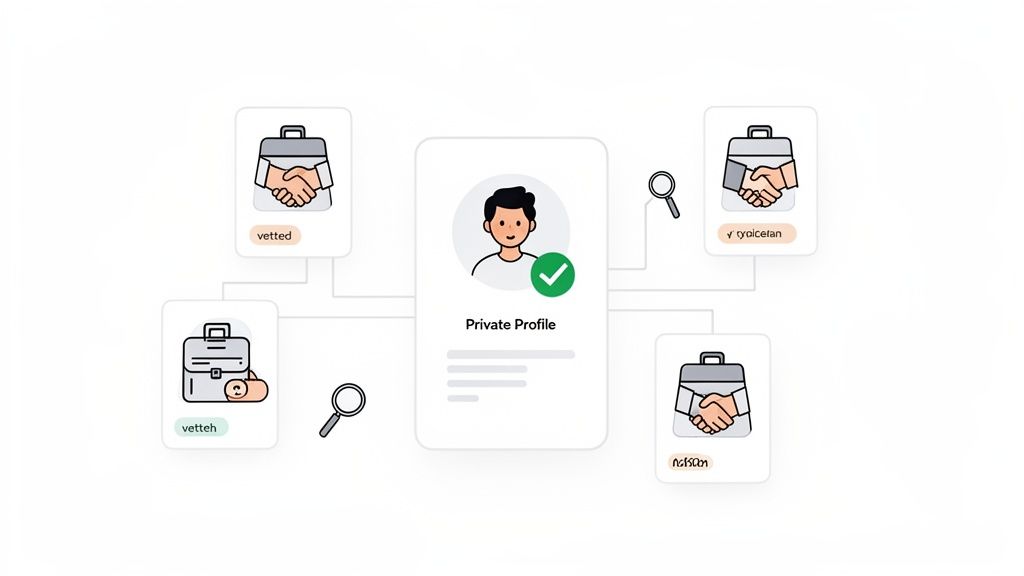
Curated job marketplaces flip the old script. Instead of firing off dozens of applications into a void, you build one simple, private profile. That single profile puts you on the radar of hundreds of vetted, high-growth fintech startups actively hiring for people with your exact skills. It’s a fundamental shift from chasing roles to being sought after for them.
This quality-first approach means every connection has real potential. The result is a job search that’s far more efficient and a lot less stressful.
The biggest problem with finding a great role isn't a shortage of jobs—it's the firehose of irrelevant ones. Traditional job sites are built on a quantity model, which just creates noise for everyone. You get tired of applying, and hiring managers get buried in resumes that don’t fit.
Curated platforms act as a filter. For you, this means:
The benefit for companies is just as clear: a pipeline of pre-vetted, high-intent candidates, which dramatically shrinks their time-to-hire. This win-win is the engine that drives better, faster matches for everyone.
Imagine this: Instead of applying to 50 jobs, you spend an hour polishing one strong profile. A week later, you get a direct message from the Head of Engineering at a Series B neobank about a senior backend role. This isn't a pipe dream; it's the standard experience on a platform like Underdog.io.
This method turns your job search from a frustrating numbers game into a strategic career move. You’re no longer just another application in the pile; you’re a sought-after professional.
Think of a curated marketplace as a personal agent working for you behind the scenes. Platforms like Underdog.io are built around the idea that the right job is about genuine fit, not just keyword matching. They have teams of real people who understand the startup world and can spot connections an algorithm would miss.
The process is simple and powerful. You create one private profile, which is then reviewed by a person to ensure it’s a good fit for the platform’s partner companies.
From there, you only hear about roles from funded, high-growth startups that have also been vetted for quality. When there’s a match, you often get a direct introduction to a hiring manager, not an automated email.
This approach saves you a massive amount of time and mental energy, letting you focus on preparing for interviews with companies that are already excited to talk to you. For more intel on who’s leading the pack, take a look at this list of top companies that hire remotely. By combining a sharp, fintech-focused application with the power of a curated platform, you’ll be in a great position to land a role that truly matches your skills and ambitions.
As you dive into the world of remote fintech, a few common questions always seem to pop up. The landscape has its own quirks, from the skills you actually need to the logistics of working across continents.
Let's clear the air on some of the biggest concerns so you can navigate your job search with confidence.
Let's get this one out of the way first: absolutely not. At their core, fintech companies are tech companies that happen to operate in the financial space. They're on the hunt for top-tier software engineers, product managers, data scientists, and designers who can build world-class products.
Most hiring managers would rather teach a great engineer about financial concepts than try to teach a finance pro how to build scalable software. Your primary focus should be showing off your technical chops and proving you can get up to speed in a complex new domain—fast.
That said, showing you've done your homework never hurts. If you've messed around with a budgeting app, taken an online course about blockchain, or just read a book on payment processing, bring it up. It shows you’re genuinely interested, but it’s almost never a dealbreaker.
This is a make-or-break question, and any mature remote company will have a crisp, clear answer. The most common setup is establishing "core hours"—a 3-to-4-hour block where everyone is expected to be online for real-time collaboration.
For example, a team might set core hours from 10 AM to 2 PM EST. Outside of that window, you’re free to structure your day for deep work and personal flexibility.
A company's approach to time zones is a huge tell about its remote culture. If you get a vague answer, consider it a red flag. Look for teams with explicit, documented norms for asynchronous work.
For globally distributed teams, another smart strategy is structuring teams by region (like Americas, EMEA, and APAC). This maximizes the timezone overlap within any given team, making synchronous work much less painful. Always ask for the specifics during your interviews.
While no job is completely recession-proof, fintech tends to be more resilient than many other corners of the tech world. The reason is simple: its services are essential. People and businesses will always need to manage money, send payments, get loans, or buy insurance. This creates a durable foundation of demand.
Of course, stability varies. A well-funded, post-Series B startup or a profitable public company is a much safer bet than a pre-revenue, seed-stage venture. Do your homework here. Before you even think about an offer, dig into the company’s funding, its path to profitability, and its competitive standing.
The overall growth outlook for fintech remains incredibly strong. The sector is projected to see 11-12% job growth through 2031. With projections from the World Economic Forum suggesting a net creation of 78 million new tech-related jobs by 2030, fintech talent is positioned alongside AI specialists at the forefront of tech hiring.
This is something you need to clarify early in the hiring process. Companies typically hire talent across borders using one of three main models:
Direct Employment: Large, global fintechs often have legal entities in multiple countries. If they have one in yours, they can hire you as a regular, full-time employee with a local contract, benefits, and tax withholding.
Employer of Record (EOR): This is the go-to model for most startups and scale-ups. They partner with an EOR service like Deel or Remote.com that becomes your legal employer in your country. The EOR manages payroll, benefits, and compliance, while you work day-to-day for the fintech company.
Independent Contractor: The third route is being hired as an independent contractor. This gives you the most flexibility but also puts all the responsibility for taxes, insurance, and retirement savings squarely on your shoulders.
Always ask the hiring manager to spell out the exact employment model for your role in your specific country. Getting this clear upfront will save you from any nasty legal or financial surprises later on.
Ready to stop searching and start getting noticed? On Underdog.io, you create one private profile and get in front of hundreds of top fintech startups. Let the best remote fintech jobs find you.