The market for remote Ruby on Rails jobs is hotter than ever, and it’s not by accident. This isn’t a fleeting trend; it’s a direct result of the framework's rock-solid efficiency and the tech industry's massive shift toward distributed teams. Both scrappy startups and established tech giants are constantly on the lookout for skilled Rails developers who can build, launch, and scale applications without friction. For engineers, this translates into a stable and genuinely rewarding career path.
Despite the shiny new toys that pop up in the tech world, Ruby on Rails holds its ground as a go-to framework for companies that value speed and developer happiness. This isn't just about legacy codebases; it's a calculated, strategic choice.
Startups, in particular, lean heavily on Rails. Why? Because it empowers small, nimble teams to build feature-rich MVPs in a fraction of the time. The framework’s famous "convention over configuration" philosophy means you're not bogged down in boilerplate setup. You get to spend your time solving actual business problems, which is exactly what a company needs when it's racing to find product-market fit.
One of the biggest, and frankly, most underrated, advantages of Rails is its incredibly mature and battle-tested ecosystem. We're talking about nearly two decades of community contributions. This has resulted in a massive library of open-source "gems" that elegantly solve just about any common problem you can think of.
You’re almost never starting from scratch. Need to implement complex functionality? There's probably a gem for that.
This ecosystem isn't just a convenience—it directly translates into faster development cycles and lower overhead. For companies, that makes a Rails developer an incredibly valuable hire.
Let's clear the air: the old argument that "Rails doesn't scale" is a myth. It's been thoroughly debunked by some of the biggest names in tech. Companies like GitHub, Shopify, and Airbnb didn't just start with Rails; they built their entire empires on it.
These household names are living proof that with the right architecture and infrastructure—like proper database indexing, caching strategies, and offloading heavy tasks to background workers—Rails can handle enormous traffic and complex operations.
When a hiring manager sees "Ruby on Rails" on a resume, it signals something deeper than just knowledge of a framework. They see a developer who gets pragmatic, full-stack development—someone who can contribute to a product's entire lifecycle, from a sketch on a napkin to deployment and long-term maintenance.
This consistent demand means investing in your Rails skills is one of the smartest career moves you can make today.
The demand for remote Ruby on Rails jobs has only accelerated as companies have gone all-in on distributed work. The job outlook for Rails developers is projected to grow by 13% between 2018 and 2028, a rate that outpaces many other software development roles.
The salary data backs this up, showing strong earning potential, especially in startup-heavy markets.
This table breaks down average annual salaries for remote RoR developers in key US tech hubs, illustrating the earning potential in startup-centric markets.
As you can see, mastering Rails opens the door to highly competitive compensation packages, especially as companies headquartered in these expensive hubs now hire talent from anywhere. You can explore more data on Ruby on Rails developer salaries to see how this trend impacts compensation across different experience levels.
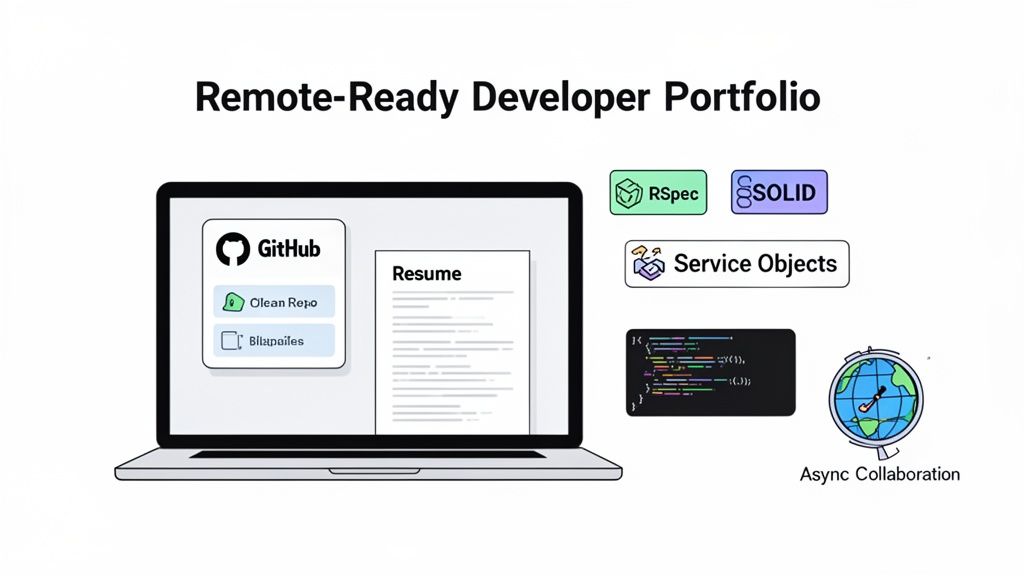
When you’re going after remote Ruby on Rails jobs, your portfolio and resume are more than just a list of technologies. They are your opening argument, proving you can deliver high-impact work without a manager hovering over your shoulder.
A remote hiring manager is scanning for evidence of ownership and clear communication just as much as they are for technical chops. They need to see that you can take a feature from a concept in a Jira ticket to a deployed reality. To do that, you have to build a standout software engineer resume framed for the remote world.
Generic, task-based project descriptions are the fastest way to get your application tossed. Nobody cares that you "built a feature." They care about the problem you solved. Reframing your work this way shifts your narrative from a code monkey to a product-minded engineer.
Here’s a practical, step-by-step example of how to reframe a resume bullet point:
See the difference? The second one proves you understand the "why" behind your code. That’s a massive plus when you're not in the same room as your product manager.
The goal is to present yourself as a problem-solver who uses Rails as a tool, not just a coder who completes tickets. A well-framed portfolio proves you can think strategically and work asynchronously toward a common goal.
For remote roles, your GitHub profile is your digital workspace. Hiring managers will absolutely dig through it, looking for clues about your collaboration style, code quality, and professionalism. A messy, inactive profile is a huge red flag for a remote candidate because it suggests disorganized work.
Here's how to make your GitHub an asset:
Treating your personal projects with this discipline sends a powerful signal. For a deeper dive, our guide on how to make your GitHub more impressive to employers has even more tips. It’ll help you turn your profile from a simple code dump into a powerful testament to your remote readiness.
If you want to land one of the best remote Ruby on Rails jobs, stop doom-scrolling through massive, generic job boards. The highest-quality opportunities are almost always tucked away in more focused, high-signal channels where companies are specifically looking for top-tier remote talent.
Instead of casting a wide, messy net, target specific communities where the right conversations are already happening. These are the places where companies actively participate, not just post a job and ghost applicants.
The Ruby on Rails community is famously active and supportive, which is a goldmine for job seekers who know where to look. Platforms built by and for developers are where you’ll find the most legitimate and interesting roles.
This screenshot from Underdog.io shows a clean, candidate-focused interface that highlights vetted companies.
See how the design emphasizes quality over quantity? It signals that the platform is all about making meaningful connections between engineers and startups, which is a world away from those overwhelming, ad-filled job boards.
While niche boards are a huge step up, curated marketplaces like Underdog.io flip the script entirely. Instead of you applying to dozens of companies, companies apply to you. After a single, vetted application, your profile gets put directly in front of hiring managers at high-growth startups who are actively looking for Rails talent.
A curated marketplace acts as your agent. It filters out all the noise and connects you with serious, well-funded companies that are ready to hire. This saves you countless hours and dramatically increases the signal-to-noise ratio in your search.
This approach is especially powerful for finding remote software engineer jobs where getting the right cultural and technical alignment is absolutely critical. It takes you from being just one of a thousand applicants to being a sought-after candidate.
And the market is definitely thriving. The demand for remote Ruby on Rails expertise has pushed salaries to competitive levels. For instance, data shows the average salary for RoR specialists is around $144k. Roles can range from $80k for senior positions in the EU to well over $200k for staff-level engineers in the US. You can explore detailed salary data on RubyOnRemote.com to see exactly how experience and location affect compensation.
The remote Ruby on Rails interview is a different beast. It’s not just about proving you can architect a clean Rails app; it’s a test of your communication, collaboration, and problem-solving skills when no one else is in the room. Companies need to be sure you can thrive without the structure of a physical office.
Think of it this way: every interaction, from the first screening call to the final technical deep-dive, is a live audition of how you'll operate on a distributed team. It's your chance to show you’re a reliable, proactive engineer who gets things done.
When it comes to the technical part, you'll almost always face one of two scenarios: a live coding session or a take-home project. Both are designed to test your Rails knowledge, but they’re really measuring very different skills.
A live coding session is less about finding the perfect solution and much more about seeing your thought process. The interviewer might give you a broken RSpec test and ask you to fix it.
Your action plan: On the flip side, a take-home project is your chance to show off your craftsmanship. This is where you prove your commitment to clean architecture, solid testing with RSpec, and documentation. It’s a direct simulation of an asynchronous work assignment.
In a live coding session, narrate your thought process constantly. For a take-home, your code and your README must do all the talking. Both are communication tests, just in different formats.
Beyond your technical chops, hiring managers are zeroed in on one thing: can you actually handle working remotely? They’ll use behavioral questions to see if you have the right mindset for a distributed team. Come prepared with concrete examples using the STAR method (Situation, Task, Action, Result).
Your ability to pull up these specific, real-world stories is what will make you stand out. It proves you haven't just thought about the challenges of remote work—you've lived them and you've solved them. This is the evidence that will convince a hiring manager you’re ready to hit the ground running in their remote ruby on rails remote jobs.
You’ve navigated the interviews, crushed the take-home, and now the offer is in your inbox. Getting a remote Ruby on Rails offer is a huge milestone, but don't pop the champagne just yet. This is where you ensure the role, pay, and culture truly align with what you want.
Nailing the negotiation can make a massive difference in your long-term financial and professional happiness.
First things first, you need to know your worth. The market for experienced Rails developers is hot, and the numbers prove it. We're seeing an average salary for remote Rails developers land at $144,006 a year. Junior roles typically start in the $86k range, while top-tier staff engineers can command salaries as high as $395,400. In major US tech hubs like San Francisco, it’s common to see averages push past $143,000. To get a feel for the current landscape, check out the real-time salary data at RubyOnRemote.
Before you even think about a counteroffer, you need to understand how the company structures its pay for a remote team. Most fall into one of two camps.
When the offer comes through, ask the recruiter: "Could you clarify if your compensation bands are location-based or location-agnostic?" Knowing this gives you the context you need to frame your negotiation. For a deeper dive on how to approach this conversation, we've put together a guide on how to effectively counter a job offer.
Don't get tunnel vision on the base salary. Equity, signing bonuses, and even a stipend for your home office setup are all on the table. A slightly lower base might be a great trade-off for a generous equity package at a startup you believe in.
The journey to this offer probably looked something like this, with each stage filtering out more candidates.
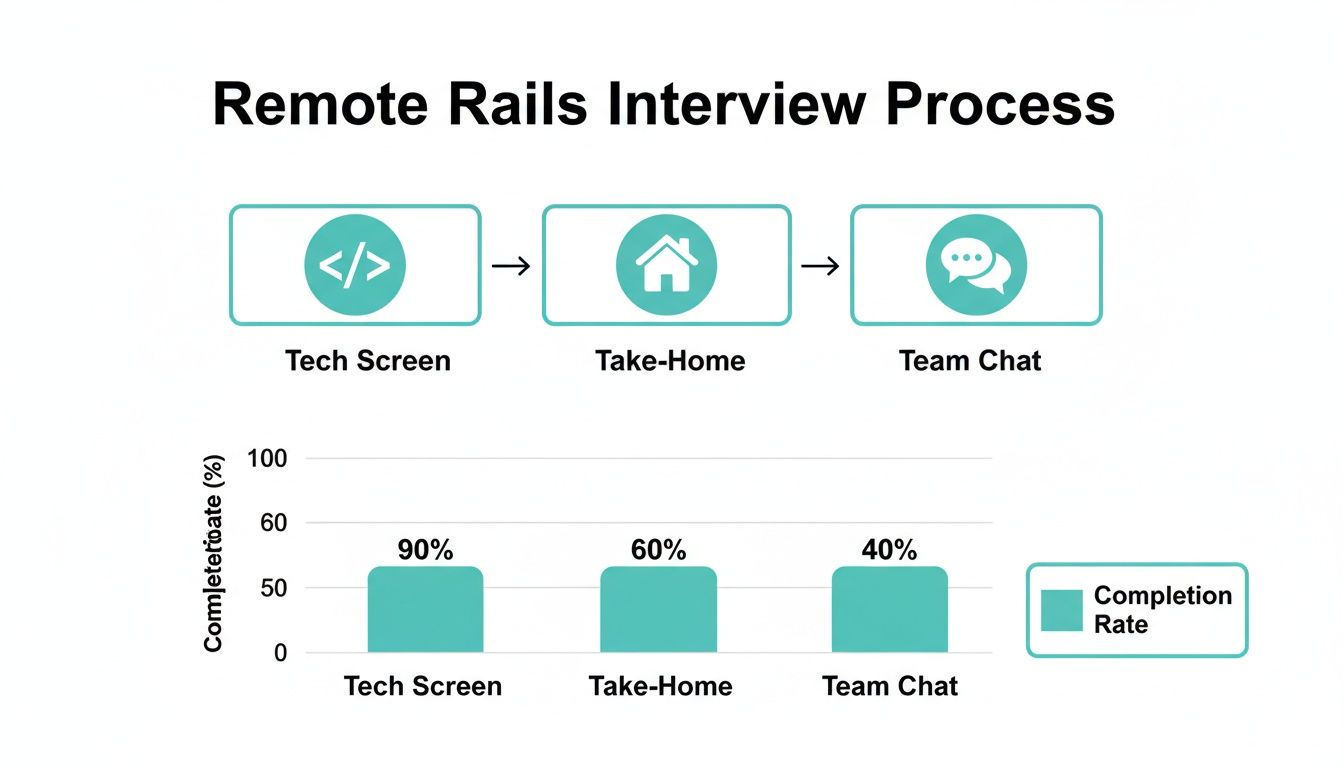
As you can see, passing the initial tech screen is common, but the take-home and team chats are where most people get cut.
Okay, let's talk about the stuff beyond the numbers. You need to put on your detective hat and look for clues about the company's remote culture. Joining a company that just "tolerates" remote work instead of truly embracing it is a fast track to burnout.
Here are actionable questions to ask during the interview process to uncover red flags:
When you're mapping out a career in remote Ruby on Rails development, a lot of questions pop up. It doesn't matter if you're a junior dev trying to land that first gig or a seasoned engineer looking to go fully distributed—getting solid answers is key. Let's tackle some of the most common ones I hear.
Honestly? Not really. While a formal CS degree certainly doesn't hurt, the tech world—especially the startup scene—cares a lot more about what you can do.
A killer portfolio packed with production-ready Rails apps and a clean, well-organized GitHub profile will almost always trump a diploma. Hiring managers want to see that you can build, test, and maintain real-world applications. Your code is your resume.
This one is simple: phenomenal written communication. It’s completely non-negotiable for a remote role. The bulk of your day is spent in Slack threads, writing detailed pull request descriptions, and crafting clear documentation. If you can't write well, you can't collaborate effectively.
Beyond that, a few other things are critical:
Absolutely. Rails is alive and kicking, particularly in the startup world where speed and developer productivity are everything. Its famous "convention over configuration" approach and massive ecosystem of gems mean a small team can build and ship product incredibly fast.
Don't just take my word for it. Giants like GitHub, Shopify, and Airbnb still rely heavily on Rails to scale their massive platforms. That kind of long-term stability creates a consistently strong market for developers specializing in ruby on rails remote jobs.
For junior devs, it's all about demonstrating initiative. You have to prove you're not just waiting for instructions—you're the kind of proactive, passionate person who will thrive in a remote setting.
Here’s an actionable plan:
Tired of scrolling through endless job boards? Underdog.io flips the script. Instead of you searching, hundreds of vetted startups search for you. Create your free profile in 60 seconds and let the best remote Ruby on Rails jobs find you.
Yes, there is a steady and healthy demand. While newer frameworks are popular, Ruby on Rails powers a vast number of established startups, tech companies, and enterprise applications that require ongoing development, scaling, and maintenance. Many of these companies have embraced remote work, creating consistent opportunities for experienced Rails engineers.
Beyond large general boards, use niche job platforms. Tech-specific and startup job boards like Wellfound (AngelList Talent) and Built In have strong Rails filters. Dedicated remote job boards (e.g., We Work Remotely, RemoteOK) and communities like the Ruby on Rails subreddit or Slack groups often list high-quality, direct opportunities not found elsewhere.
Beyond core Rails and Ruby proficiency, emphasize experience with related technologies commonly used in Rails stacks: JavaScript frameworks like Stimulus or Hotwire, testing frameworks (RSpec, Capybara), background job processors (Sidekiq), and deployment tools (Docker, AWS, Heroku). For remote roles, also highlight experience with asynchronous collaboration, clear written communication, and self-management.
Salaries vary based on experience and the company's location policy. For mid-to-senior remote Rails engineers, total compensation often ranges from **$110,000 to **$180,000 or more. Companies with location-agnostic pay scales may offer higher figures. Be sure to research salary data on platforms like Levels.fyi that filter by technology and remote status.
You'll find opportunities across the spectrum: fast-growing SaaS companies, e-commerce platforms, fintech startups, dev agencies, and larger enterprises modernizing legacy Rails applications. Remote-first companies are particularly attractive as they have established distributed work cultures.
Contribute to open-source Rails projects or maintain a personal project built with Rails to demonstrate active, practical skills. In your application, clearly articulate your experience with specific versions of Rails and describe challenges you've solved, such as optimizing database queries, scaling application performance, or implementing complex business logic cleanly.
The technical interview will likely assess your Rails knowledge deeply. Be prepared for live coding or take-home tests focused on building a small Rails feature, code review of a Rails snippet, and system design questions relevant to web applications. For the remote aspect, expect questions about your past experience working independently and collaborating across time zones.