You've built the technical skills, but you're no longer sure you want to spend every day behind the system. You enjoy solving difficult problems, yet you also like explaining your thinking to customers, influencing decisions, and seeing your work create a commercial result. The obvious next question is whether sales engineering is a temporary detour from engineering or a serious career in its own right.
It's a serious career, but it rewards a different profile from pure engineering. The strongest sales engineers combine technical credibility, clear communication, commercial judgment, and the discipline to keep learning in public with customers. This guide maps the sales engineer career path from associate roles through principal-level individual contribution and leadership, then covers the skills, certifications, compensation trade-offs, interview preparation, and practical next steps that can help you move.
A technically minded professional often reaches this decision after a familiar week. You spend Monday debugging an integration, Tuesday answering a colleague's question about system architecture, and Wednesday helping a customer understand why one solution fits better than another. The work feels more rewarding when you're translating complexity into a decision, not just completing a ticket.
That's the central appeal of sales engineering. You remain close to technology, but your work also involves discovery, explanation, negotiation, and customer trust. You're not presenting features. You're helping a buyer decide whether a product can solve a real problem, whether it can fit the existing environment, and whether the proposed solution deserves internal support.
The role also offers a durable career foundation. The U.S. Bureau of Labor Statistics sales engineer outlook projected 51,600 sales engineer jobs in 2025 and a 3% employment increase from 2025 to 2035, about as fast as the average occupation. The same source reported a median annual wage of $121,520 in May 2024, while the top 10% earned more than $202,670.
Those figures point to a specialized profession rather than a mass-market occupation expanding through sheer headcount. Your progress will depend heavily on technical depth, industry selection, performance, and the complexity of the deals you can influence.
Practical rule: Choose sales engineering because you want to connect technical judgment with customer decisions, not because you're trying to escape engineering without learning sales.
The roadmap is straightforward. First, understand what the job really looks like in a deal. Then assess the ladder, choose between the individual contributor and management tracks, build the right skills, set realistic compensation expectations, and prepare for interviews that test behavior rather than vocabulary.
A sales engineer usually enters a deal when a customer's problem has technical consequences. The account executive may have established the business case, but the buyer still needs confidence that the product can work in the environment.
Suppose a prospect says it needs better visibility across several internal systems. That statement is too broad to support a credible demo. You need to ask what data is missing, who uses it, what systems are involved, how information moves between them, and what constraints could block implementation.
The sales engineer becomes the bridge between engineering and revenue teams. You translate the customer's language into technical requirements, then translate the product's capabilities into business consequences the customer can understand. The broader shift toward consultative, technically informed selling has made this bridge function central to modern technology and industrial sales, as described in Apollo's overview of sales engineering.
After discovery, you qualify the solution. You might confirm integration requirements, security questions, data formats, deployment constraints, or the customer's ability to support the proposed workflow. Strong SEs don't promise every requested feature. They identify what the product can do, what requires configuration, and what belongs outside the product's current scope.
That honesty builds credibility. Buyers remember the person who prevented a bad fit, not just the person who delivered the smoothest presentation.
A good demo follows the buyer's priorities. If the customer cares about reducing manual review, start with the workflow that affects that problem. Explain the relevant architecture when technical stakeholders need it, but don't turn the meeting into a feature tour.
You'll often need to adjust in real time. An engineer may ask about an API, a finance leader may ask about operational impact, and an executive may want to know how the solution changes risk. Your job is to maintain one coherent story while giving each stakeholder enough evidence to participate in the decision.
For a practical view of responsibilities, the sales engineer job description guide is useful when you're comparing openings and preparing questions.
A proof of concept is not a free implementation project. Define the question it must answer, the conditions for success, the people responsible, and the evidence the buyer will review. During closing, you may help resolve final objections, support procurement conversations, clarify implementation expectations, or explain why the proposed design is appropriate.
Sales engineering fits people who enjoy structured curiosity. You need to ask good questions, stay calm when the answer isn't obvious, communicate with different audiences, and accept that the work is measured partly by commercial outcomes.
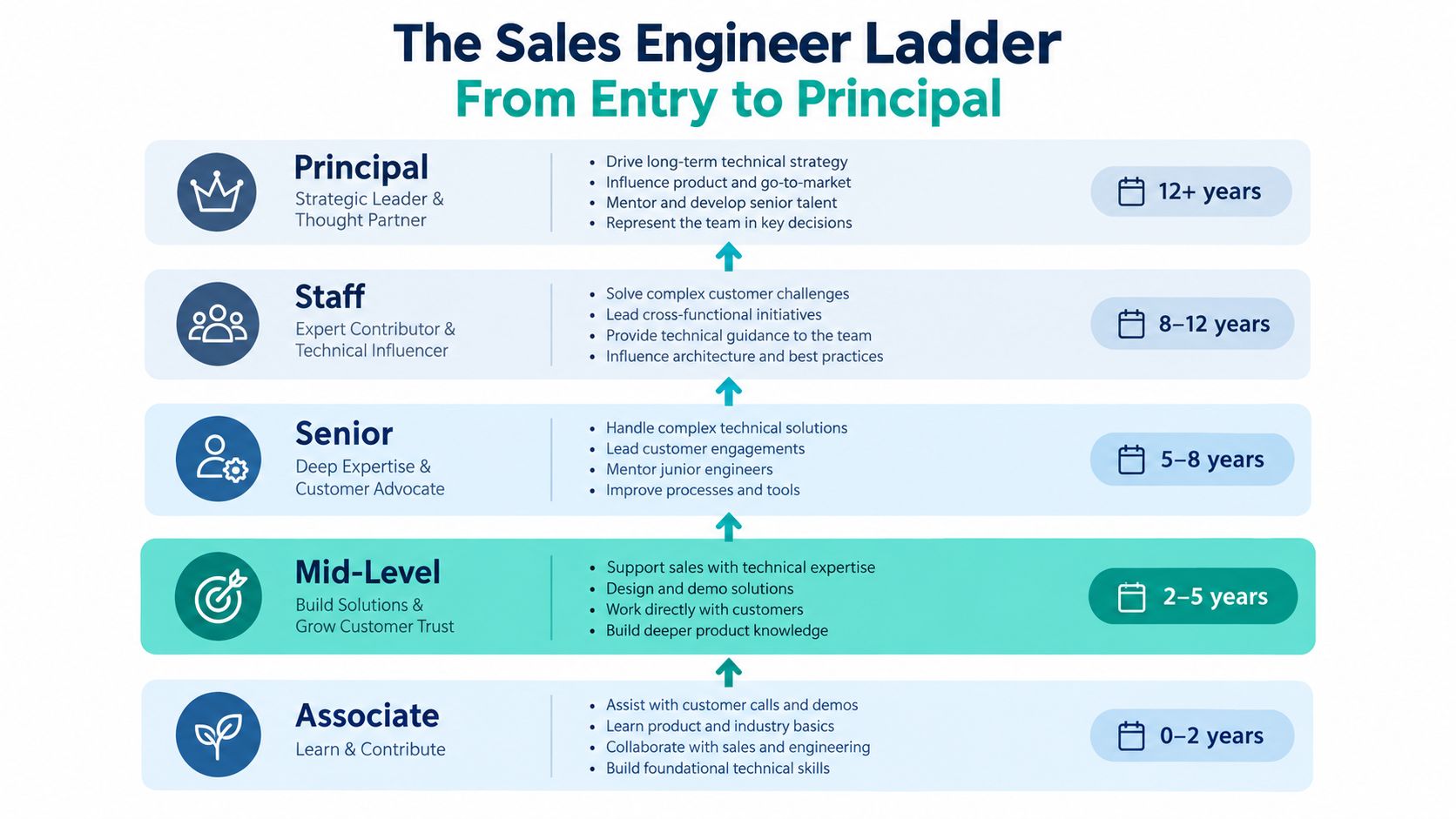
Titles vary by company, but the scope changes in recognizable ways. Early roles are about learning the product and the operating rhythm. Later roles are about owning ambiguity, influencing architecture, and making other people more effective.
At the associate level, expect to shadow demos, prepare environments, answer straightforward technical questions, and support proposals. Your first promotion won't come from memorizing every feature. It will come from becoming dependable.
You should be able to prepare a demo without creating avoidable risk, capture requirements accurately, follow up when you don't know an answer, and explain the product without overpromising. Ask senior SEs why they chose a particular discovery question or demo sequence. Watch how they manage a skeptical engineer and an impatient executive in the same meeting.
Mid-level sales engineers run their own discovery calls, demos, technical proposals, and solution discussions. The account executive should trust you to manage the technical workstream without constant supervision.
The important shift is judgment. You're no longer demonstrating what the product does in general. You're deciding what this buyer needs to see, what evidence is sufficient, and which technical concerns could threaten the deal. You'll also start working across product, security, implementation, and customer success teams.
Senior SEs work on complex integrations, strategic accounts, and opportunities where the technical path isn't obvious. They influence stakeholders who may disagree about requirements, guide proof-of-concept design, and help the sales team make better qualification decisions.
At this level, performance isn't just about delivering excellent demos. It's about choosing where to spend time, reducing deal risk, coaching peers, and turning repeated customer questions into reusable enablement.
A useful adjacent resource for understanding the broader sales development ecosystem is this guide to a BDR role. It can help you see how sales development and presales responsibilities connect without confusing the two career paths.
Staff and principal SEs increasingly influence architecture, proof-of-concept design, technical strategy, and enablement. They may support the hardest enterprise opportunities, shape internal standards, and advise product teams on recurring market requirements.
The progression is commonly mapped across roughly 0 to 10+ years, but time served isn't a promotion plan. An SE who repeats the same demo for years may remain stuck, while another who develops industry expertise, handles difficult buying groups, and improves team execution can advance faster.
The individual contributor track scales through technical depth and deal complexity. A principal SE may remain involved in strategic opportunities, architecture decisions, and customer-facing problem solving without becoming a people manager.
The management track changes the work. Managers hire, coach, allocate presales capacity, build operating processes, and contribute to forecast ownership. You'll spend less time designing a single solution and more time helping an entire team make consistent decisions.
Both tracks are legitimate. Choose management if you get energy from coaching, organizational design, and accountability for other people's performance. Stay on the IC track if you want to remain close to architecture, customer problems, and high-stakes technical selling.
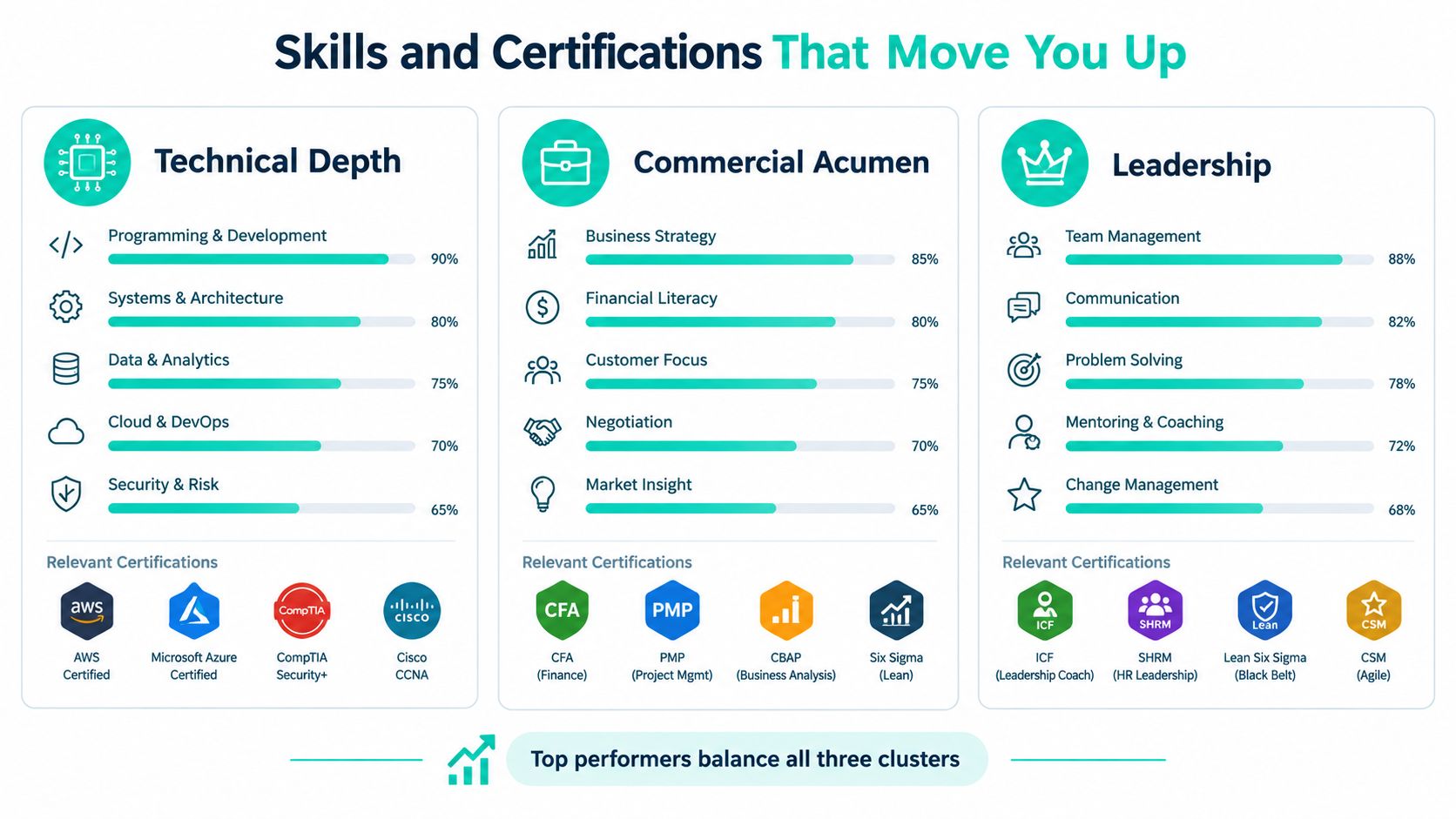
Promotions usually follow demonstrated capability, not a longer list of courses. Build your development plan around three clusters: technical depth, communication, and business acumen.
You need to understand how the product works, how it integrates, where it fails, and what assumptions the customer must accept. Learn the architecture well enough to whiteboard it, explain the data flow, and identify implementation risks before they become late-stage objections.
A bachelor's degree in engineering or a related field is a common entry requirement for the occupation. It's useful evidence of technical training, but it won't replace hands-on product knowledge or customer-facing judgment.
Prioritize practical work:
A technically correct explanation can still lose a deal if the buyer can't connect it to a decision. Practice discovery questions, whiteboarding, demo storytelling, objection handling, and concise written follow-up.
Record yourself delivering a demo and listen for unnecessary detail. Ask whether the story moves from customer problem to recommended workflow to evidence. Senior SEs don't merely know more. They make complex choices easier for other people to evaluate.
Learn how opportunities are qualified, how account executives build deal strategy, how procurement affects timing, and how forecast confidence is formed. You don't need to become an AE, but you do need to understand the commercial context around your technical work.
Technical depth earns attention. Business judgment earns a seat in the decision.
Certifications should support a target role rather than decorate your résumé. Industry guidance identifies role-specific credentials such as NAASE's CSE, SMEI's SCPS, and NASP's CPSP, while platform credentials from AWS, Azure, GCP, Cisco, or Salesforce can strengthen specialization and marketability, as outlined in Hilti's sales engineer career guidance.
Use this order:
Compensation advice becomes misleading when it treats every sales engineer title as equivalent. A startup SE supporting an emerging product, an enterprise SE handling strategic architecture, and a remote SE serving a broad territory may have very different offers despite sharing the same title.
The strongest public anchor is the BLS median of $121,520 in May 2024, with the top 10% earning more than $202,670, as reported in the source linked earlier. Use that as context, not as a promise. Your package will depend on geography, deal size, product complexity, employer maturity, and whether your role carries meaningful variable compensation.
Startups often trade certainty for scope. You may receive a lower base than an established enterprise employer, but the offer may include meaningful equity, faster exposure to product strategy, and broader responsibility. The downside is real. Equity can remain illiquid, priorities can change quickly, and a small team may expect you to create process while still carrying customer work.
Enterprise companies generally offer more structured compensation, established enablement, and clearer segmentation between roles. The trade-off is that title progression can be slower, territories can be narrower, and your influence may be limited to one stage of a large sales process.
| Seniority | Startup Expectations | Enterprise Expectations |
|---|---|---|
| Associate | Broad product exposure, close support from senior SEs, and possible equity alongside base compensation | Structured onboarding, defined responsibilities, and formal enablement |
| Mid-level | Independent demos, varied customer problems, and faster ownership of process | Consistent territory coverage, clearer specialization, and established sales support |
| Senior | Strategic influence, complex ownership, and potentially meaningful equity risk and upside | Larger accounts, deeper specialization, and more structured variable compensation |
| Principal | Architecture influence, enablement, and company-wide technical impact | Strategic account leadership, repeatable standards, and senior technical authority |
Remote compensation requires extra caution. Independent snapshots show average U.S. remote sales engineer pay at about $96,194, while broader remote national salary guides place averages roughly between $135,000 and $170,000, according to ZipRecruiter's remote sales engineer salary data. That spread shows why a remote label alone tells you very little.
Before accepting, ask how the company sets geographic bands, how variable compensation is calculated, whether equity has clear terms, and what performance controls promotion. Compare the complete package against relevant startup compensation benchmarks, not a headline base salary.
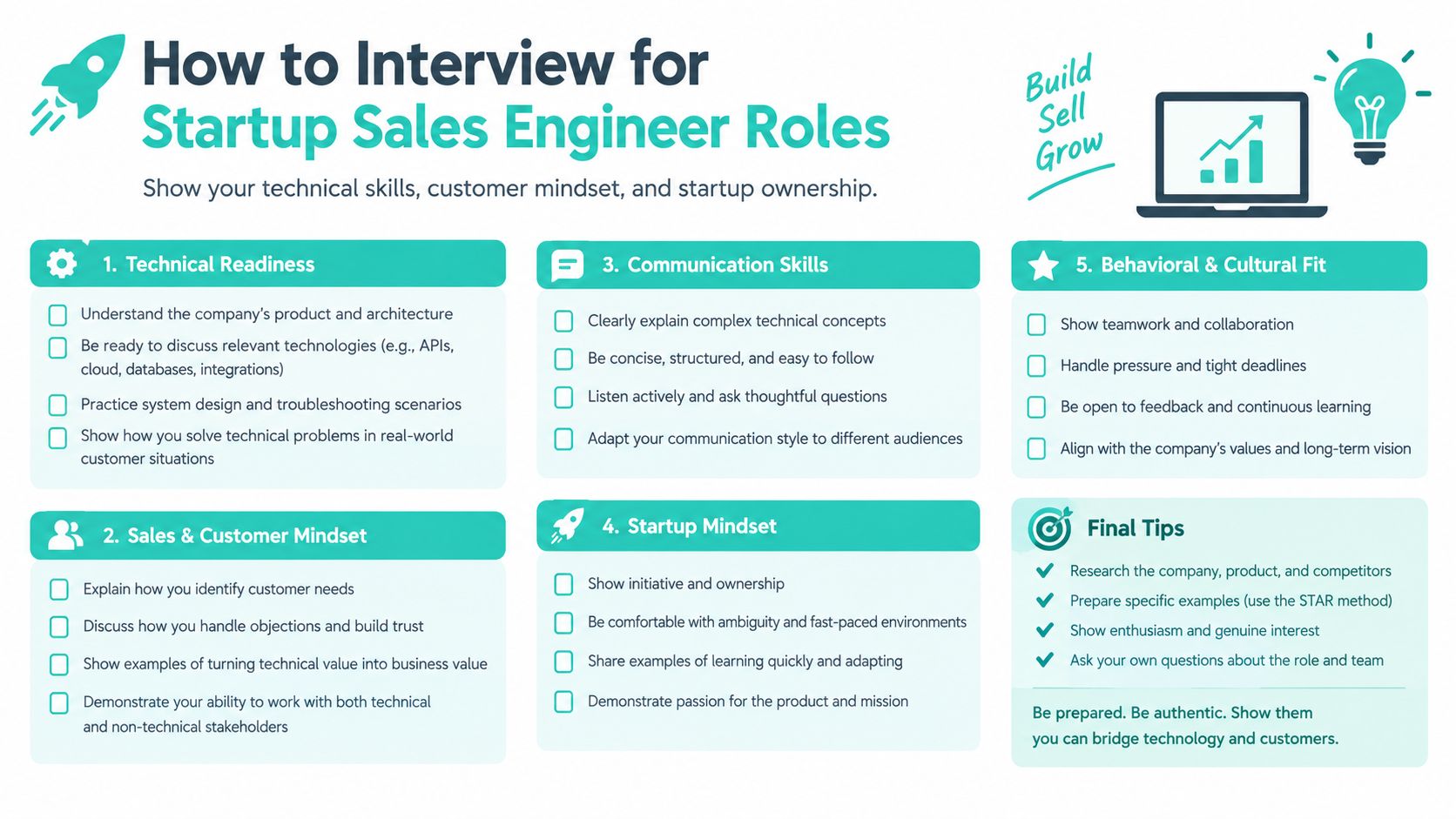
Startup interviews test whether you can create clarity without waiting for a finished playbook. Hiring teams want technical depth, demo fluency, adaptability, and evidence that you can work across sales, product, engineering, and implementation.
Don't prepare by memorizing polished answers. Prepare by building a small portfolio of situations you can explain clearly. Choose one technical problem you solved with a customer, one objection you changed through discovery, one moment when you admitted a product limitation, and one example of working with an internal team to unblock a deal.
A startup may ask you to deliver a live demo, participate in a technical deep dive, or run a role-play discovery call. Prepare for each format differently.
Research the company's product, customers, competitors, funding stage, and recent direction. A Series B company may need repeatability more urgently than a very early startup, while a young team may value someone who can create demo standards from scratch.
Interview warning: If the company can't explain the role's customers, decision rights, success measures, or relationship with sales, treat that confusion as information.
Watch for unpaid work disguised as an interview, vague claims about equity, a process that ignores technical evaluation, or a demand that you promise unsupported capabilities. You're assessing the employer's operating quality as much as they're assessing your presentation skills.
Sales engineering is a transferable ladder because it develops technical judgment, customer insight, commercial awareness, and cross-functional influence. The right next move depends on which part of the job you want more of, and which pressure you're willing to accept.
Product management suits SEs who enjoy identifying recurring customer problems, shaping requirements, and making prioritization decisions. You'll use your market knowledge and technical fluency, but you'll give up some direct deal ownership and accept longer feedback loops.
The product manager career path is worth reviewing if customer conversations energize you more than closing support, and if you're comfortable making decisions without satisfying every stakeholder.
Solutions architecture deepens technical scope. It's a strong fit if you enjoy system design, implementation constraints, and long-term technical outcomes more than commercial urgency. The cost is that you may have less influence over the buying decision and less exposure to revenue strategy.
Moving into an account executive role increases commercial ownership and can create greater commission upside. You'll trade some technical depth for prospecting, negotiation, pipeline management, and direct responsibility for closing.
Choose this route if you enjoy creating urgency, managing stakeholders, and asking for the business. Don't choose it because someone told you every successful SE should become an AE.
Sales engineering management and VP-level leadership reward people who can coach others, build process, allocate resources, and connect presales performance to company strategy. The cost is less time in technical discovery and more time handling hiring, conflict, planning, and organizational accountability.
A simple self-assessment helps. If you want deeper systems work, explore architecture. If you want to shape what gets built, explore product. If you want direct commercial control, explore account executive work. If you want to multiply other people's performance, explore leadership. Staying an individual contributor is also a strong choice when difficult technical problems and strategic customers remain the work you want most.
Turn your career plan into a focused first-week sprint.
Day one: Compare your current skills with the SE ladder. List the product areas you can explain, integrations you understand, demos you have delivered, and customer problems you have helped solve. Mark the gaps plainly.
Day two: Choose your target company type. Decide whether you want startup equity and broader scope or enterprise cash, structure, and specialization. Your interview stories and compensation questions should match that choice. Applying indiscriminately weakens both.
Day three: Rebuild your demo routine. Prepare a short story covering a customer problem, technical qualification, solution walkthrough, objection, and next step. Explain the same solution to an engineer, an operations leader, and an executive. Strong SEs adjust the message without losing technical accuracy.
Day four: Rewrite your résumé around evidence. Replace “supported sales demos” with the technical work you owned, the customers you engaged, and the decisions you influenced. Show increasing scope, not a tool inventory. Hiring managers need proof that you can connect technical judgment to customer and revenue outcomes.
Day five: Apply to Underdog.io through its free, 60-second candidate application. The marketplace presents candidates to hundreds of vetted startups in New York City, San Francisco, and remote-first companies. Profiles stay anonymous until interest is mutual, real people handle matching, and candidates typically receive 1 to 3 selective introductions per month. The platform accepts about 5% of applicants, so state your actual SE experience clearly instead of hiding behind generic technical language.
You do not need to solve the whole career path this week. Set a target, sharpen your story and demo, then use each conversation to identify the next skill or responsibility worth pursuing.
Underdog.io offers a curated route into vetted startup opportunities, including roles involving technical discovery, demos, and proof-of-concept work. Submit your application through Underdog.io to put your sales engineer career plan in front of companies that need technical depth and customer judgment.