Finding a San Francisco engineering job is a bit like stepping into the major leagues. It's a high-stakes, high-reward environment where the best talent competes for incredible opportunities. You're not just looking for a new role; you're making a strategic play to get into the world's premier tech ecosystem.
Think of the San Francisco tech scene as a powerful current, constantly fed by new streams of innovation from startups and established giants. While headlines might change from week to week, one thing doesn't: the city is the global epicenter for venture capital, game-changing ideas, and high-impact engineering careers.
There's a fascinating dynamic at play here. The demand for skilled engineers is through the roof, but so is the competition. In this kind of market, specialized skills aren't just a nice-to-have; they're the price of admission. For example, a company isn't just looking for a "back-end developer"; they need someone who has scaled a system from 10,000 to 1 million users on AWS using Go. They need people who can walk in and start delivering value on day one.
Let's get right to it: the cost of living is notoriously high, but so are the salaries. Your entire financial picture here is about that balance. San Francisco remains a true powerhouse for engineering compensation, and that's a huge part of what draws top talent.
To give you a concrete idea, as of March 2026, the average annual salary for an engineer in the city is a solid $122,170. Top earners are pulling in $159,053—that's nearly 60% higher than the national average. If you're a senior software engineer, you can expect to be in the ballpark of $160,575.
This chart breaks it down visually, comparing SF salaries to the rest of the country.
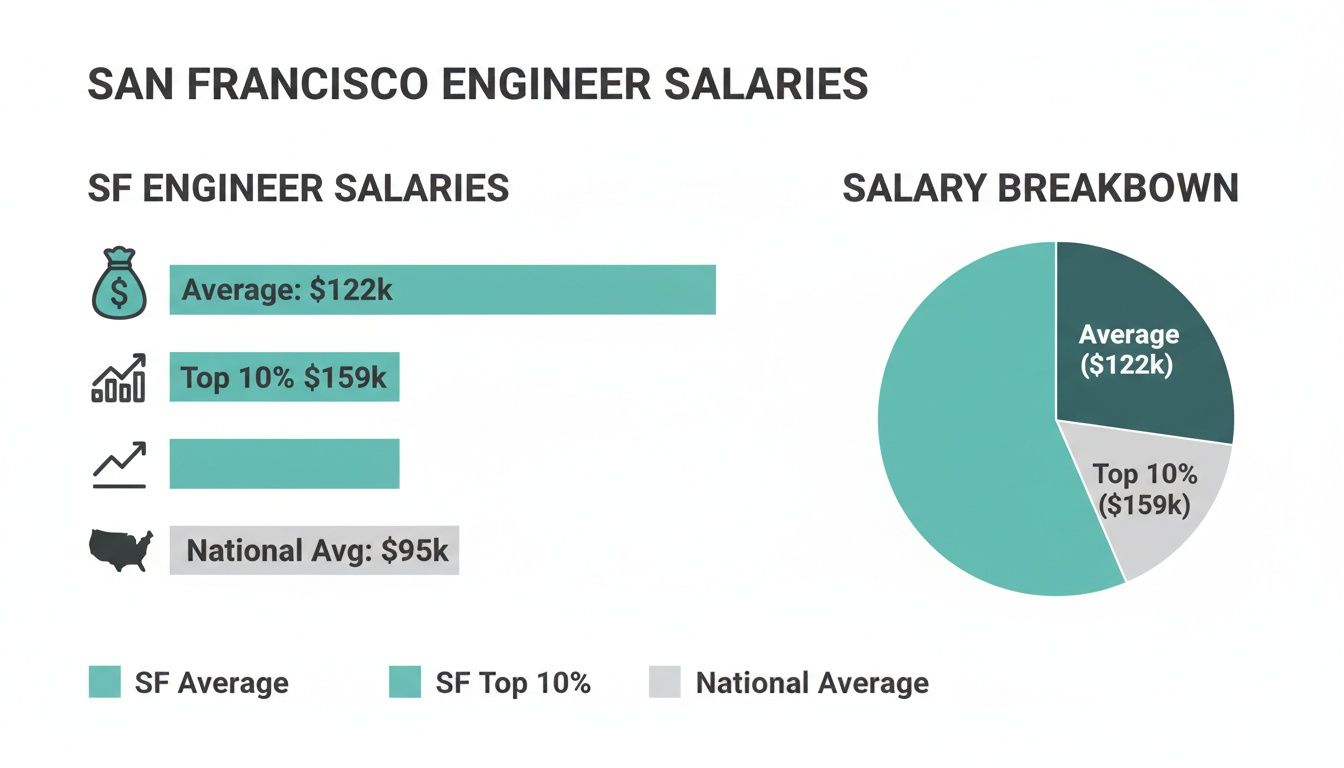
The numbers make it pretty clear. Even an average engineering salary in SF blows the national figures out of the water, and the upside for top-tier roles is massive. This premium isn't just about cash, either. It's about the potential equity you can get at a high-growth startup, which is a major part of the appeal for many engineers.
To give you a quick snapshot, here’s a look at what different salary percentiles look like in the city.
This table just reinforces the point: the financial rewards in San Francisco are substantial, designed to attract and retain the best in the field.
The bottom line is simple: the barrier to entry is high, but the rewards are just as significant. Companies will pay a premium for talent that can deliver immediate value in a fast-paced, product-obsessed culture.
Beyond the numbers, the real draw of an engineering job in San Francisco is the work itself. This is where new industries are born and old ones are completely reinvented. The whole scene is buzzing with advances in AI, fintech, and health tech. You're not just clocking in at a company; you're joining a movement.
A few things really define this unique culture:
To succeed here, you have to understand this trade-off between high expectations and high rewards. Before you even think about applying, the first step is figuring out how your skills align with what this market desperately needs. For a more detailed breakdown of pay across different roles, check out our 2025 tech salary guide.
Cracking the San Francisco engineering market isn't just about having a polished resume. It’s about knowing which skills actually matter right now. Simply calling yourself a "software engineer" won't cut it anymore; the market is too sophisticated for that.
The real action is in specialized roles where companies are in a bidding war for top talent. A generalist might get you in the door for an interview, but a specialist with the right skills gets you multiple offers. From lean startups to tech giants, everyone is hunting for engineers who can solve very specific, high-impact problems from day one.
Data drives everything in modern tech, and the Bay Area’s job market is a perfect reflection of that. The demand for engineers who can build, manage, and interpret data systems has gone through the roof. These roles aren't just trendy—they're fundamental to how companies now operate and innovate.
A quick look at the San Francisco Bay Area market shows just how hot this space is, with 7,084 open data engineer positions and another 1,573 for analytics engineers. You can see the value in high-profile openings at firms like Tubi (offering $212K-$302.8K for staff level) and YouTube ($124K-$178K base pay). After the 2022 layoffs, we saw startups bounce back with an 18% hiring growth spurt in 2024-2025, with a clear focus on adaptable engineers for AI, fintech, and healthtech.
A Data Engineer is like an architect and civil engineer for a city's water supply. They don't just find water; they design and build the entire system of reservoirs, pipes, and treatment plants to ensure clean, reliable data flows to every part of the business.
These roles are so critical because they enable everything else a company does. Product teams need data to make decisions, marketing relies on it for personalization, and machine learning models are useless without clean, well-structured datasets to learn from.
While data engineering is a massive field, other specializations are seeing just as much intense demand. If you're looking to make a strategic career move, focusing on one of these areas is a smart play.
By steering your skills toward these high-demand areas, you’re no longer just another applicant looking for a job. You're targeting the roles where you can make the biggest impact—and find the best opportunities in return.
For a seasoned engineer in San Francisco, there comes a point where the next step isn't just another technical challenge. The move from a senior individual contributor (IC) to an engineering leader is one of the most significant transitions you can make—it’s a pivot from mastering code to mastering communication and strategy.
This jump is about far more than a new title. As a senior IC, your world is focused on cracking complex technical problems and shipping solid features. Once you step into a role like Engineering Manager or Director, your universe expands to include building high-performing teams, mentoring careers, and making sure your team's work drives the company’s bottom line.
Making the leap successfully demands a fundamental change in how you define a "win." Your victories are no longer measured by the elegance of your own code, but by the collective growth and output of your entire team. It’s the classic transition from being the star player to becoming a great coach.
Think of it this way: a senior engineer is like a world-class chef who can single-handedly create a Michelin-star dish. An engineering manager is the executive chef who designs the menu, sources the best ingredients (talent), and empowers their whole kitchen to produce consistently outstanding meals at scale. You stop doing all the work yourself and start enabling others to do their best.
To signal that you're ready for this shift, start taking on responsibilities that live outside your assigned tickets.
These actions show you're already thinking like a leader, which makes a promotion feel like a natural next step, not a sudden jump.
The financial incentive for moving into leadership is significant. Engineering leadership salaries in San Francisco are a clear indicator of the city's role as a tech career launchpad. Data shows engineering managers can earn between $177K and $238K annually, with senior engineering managers reaching up to $291K. For top-tier director roles, compensation can climb as high as $426K. This growth is fueled by SF's 1,000+ startups, which often sweeten the deal with equity and mission-driven work.
The most impactful engineering leaders don’t just manage people; they connect technology to business outcomes. They can explain to the CEO, in plain English, why a specific technical investment will drive revenue or improve user retention.
This business acumen is a non-negotiable skill you'll need to develop. A great way to start is by simply asking "why" more often. Why is this feature on the roadmap? What customer problem are we solving? How does this work help us hit our quarterly goals? You can learn more about the strategic duties of a tech leader by exploring our guide on CTO duties and responsibilities.
Transitioning into management isn't just about what you do at work; it's also about how the broader tech community sees you. In a competitive market like the Bay Area, building a personal brand that opens doors and signals your expertise to recruiters is key.
By actively demonstrating leadership within your current role and getting a firm grasp on the business side of things, you'll be perfectly positioned to seize the unique growth opportunities the San Francisco market has to offer.
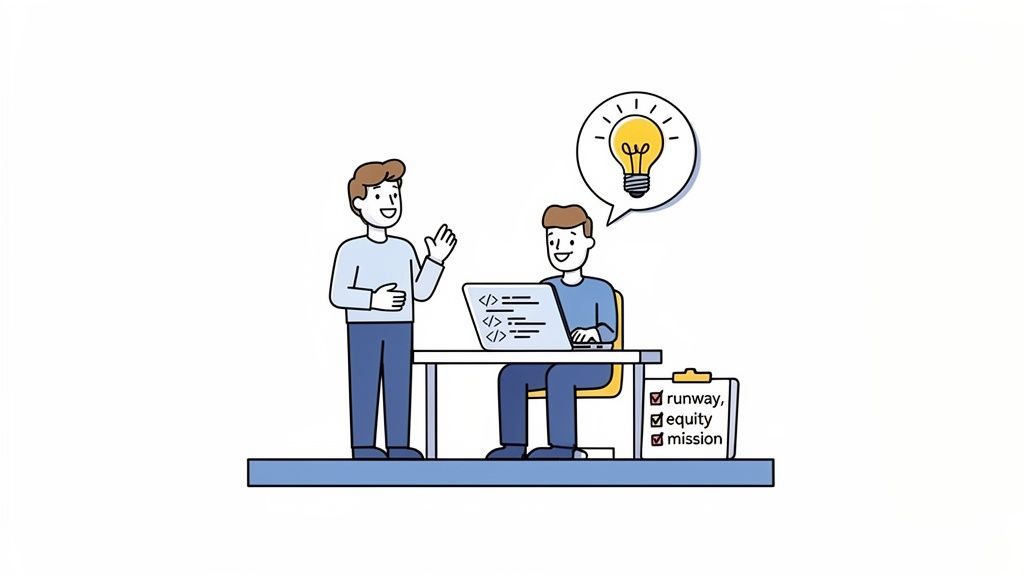
Interviewing at a San Francisco startup is a different beast entirely. Forget the rigid, formal processes you might find at a large corporation. A startup interview is less like an exam and more like an intense, fast-paced audition to join a small, mission-driven crew.
They aren't just trying to fill a seat; they’re vetting a potential co-owner of their dream. The whole process is designed to test your resilience, adaptability, and problem-solving skills in real-time. Success means showing not just what you know, but how you think and how you'll contribute from day one.
While every startup adds its own flavor, the interview process usually follows a predictable pattern. Knowing what’s coming helps you prepare mentally and strategically for each step.
This multi-stage approach gives them a 360-degree view of how you operate. For a closer look at the kinds of technical challenges you might face, you can explore some of the common engineer interview questions that startups often ask.
San Francisco startups value product intuition and a bias for action just as much as technical prowess. While you'll certainly face coding challenges, they are often framed around real-world business problems, not abstract puzzles.
A big tech company might ask you to solve a theoretical algorithm problem on a whiteboard. A startup, on the other hand, is more likely to ask: "Our user engagement has flatlined. Walk us through how you'd diagnose the problem and propose a technical solution in your first 90 days."
This type of question tests your ability to think like an owner, not just a coder. They want to see if you can connect your engineering work to business outcomes. A strong answer involves asking clarifying questions ("Is the drop-off on mobile or web?"), forming hypotheses, and outlining a data-driven plan ("I'd start by analyzing user session data in our analytics tool to pinpoint where users are dropping off.").
The focus of a startup interview differs significantly from that of a large tech corporation. Understanding this distinction is crucial for framing your experience correctly and hitting the right notes.
Below is a quick breakdown of what each side typically cares about most.
This comparison really highlights the key theme: startups are hiring for immediate impact and long-term potential in a constantly changing environment, whereas big tech often optimizes for a very specific, pre-defined role.
The questions you ask are just as important as the ones you answer. They reveal whether you truly understand the startup landscape or are just looking for any job.
Instead of generic questions about "company culture," get specific. Your questions should probe the health and trajectory of the business, showing you’re thinking like a potential partner, not just another employee.
Ask about the company's financial runway ("How many months of runway do you have at your current burn rate?"), the path to profitability, and the specifics of your equity grant ("What percentage of the company does my grant represent, and what is the vesting schedule?"). This signals that you're serious about joining for the long haul and are invested in shared success. It shows you're not just there to code—you're there to help build something that lasts.
Let’s be honest. The traditional job search is a grind. You spend hours scrolling through job boards, tweaking your resume, writing yet another cover letter, and firing applications into what feels like a digital black hole. For engineers trying to break into or move up in the competitive San Francisco market, it’s downright draining.
But what if you could flip the script? Imagine a world where top SF startups are the ones applying to you.
This is where a curated approach makes all the difference. Instead of you chasing down every lead, a platform like Underdog.io becomes your personal agent, putting your profile in front of the right people at high-growth companies—all without broadcasting your job search to your current boss or the entire internet.
In a market as noisy and fast-moving as the Bay Area, this isn't just a convenience; it's a strategic advantage. It cuts through the chaos and connects you directly with serious, well-funded companies that are actually hiring for roles that fit your skills and what you want to do next.
The biggest problem with massive job boards is the signal-to-noise ratio. Your application is just one of hundreds, and it's probably being screened by an algorithm before a human ever lays eyes on it. A curated marketplace fixes this by being selective on both sides—for candidates and for companies.
On Underdog.io, for instance, only about 5% of engineers who apply are accepted into the network. This isn't about being elitist; it's about maintaining quality. It ensures that everyone in the community has relevant, in-demand experience that companies are actively looking for.
This curated approach means that when a company sees your profile, they know you've already been vetted. You're not just another resume in the pile; you're a top-tier candidate worth their immediate attention.
This same filter applies to the companies, too. Every startup is screened for its funding, the strength of its team, and the potential of its product. This way, you’re only connected with legitimate, high-growth businesses, not scrolling past sketchy job postings from companies you’ve never heard of.
Algorithms are great at matching keywords, but they can’t grasp the subtleties of culture, career goals, or that intangible "fit" that makes a great hire. They can’t tell the difference between a role at a scrappy Series A fintech and one at a more established healthtech company. That’s where a real person makes all the difference.
Instead of automated spam, a team of actual people gets to know your profile and hand-picks a small number of opportunities that are right on the money. Think of them as career matchmakers who truly understand the Bay Area tech scene.
This method is especially powerful for the 85% of tech professionals who are employed but open to the right opportunity. It lets you confidentially test the waters and see what your market value is without putting your current job at risk. It’s a targeted, efficient, and ultimately more respectful way to find your next great role.
A successful career move is about so much more than just the job—it's about building a life that feels right. When you’re chasing engineering jobs in San Francisco, you’re not just signing an offer letter; you’re buying into an entire ecosystem. That means weighing the city’s legendary cost of living against its equally legendary salaries and career opportunities.
Let’s get straight to the point: the numbers. With the average tech salary sitting around $185,425, the city’s financial landscape is built to support a high-earning workforce. But housing is the biggest piece of that puzzle. The median rent for a one-bedroom apartment regularly floats around $3,200 per month, so a big chunk of your paycheck is going straight to your landlord.
Where you decide to live will shape almost every part of your daily life, from your morning commute to your weekend plans. Think of it as choosing the home base for your entire SF experience. Every neighborhood has its own distinct personality, and figuring out the trade-offs is everything.
Here’s a quick look at a few popular spots for tech professionals:
To put it in practical terms, choosing the Marina might mean a longer commute to a SoMa office, but you get waterfront runs right outside your door. On the flip side, living in the Mission puts you in a dynamic, central spot but with a much faster, grittier pace of life.
Your neighborhood choice has a direct and immediate impact on your budget and your daily schedule. Shelling out for a place in a central, expensive area like Hayes Valley could mean your commute is a 15-minute walk or Muni ride, saving you a ton of time and transit costs.
On the other hand, you could opt for a neighborhood further out—or even cross the bay to a city like Oakland—and slash your rent significantly. The catch? You'll have to factor in the time and cost of a longer BART ride. For many, that trade-off is absolutely worth it for the extra living space and cash in their pocket.
The real secret is that your lifestyle choices—getting roommates, cooking at home, or mastering the public transit system—will make or break your ability to save money and really thrive. The high salaries give you a great foundation, but smart budgeting is what makes it all work.
Ultimately, working as an engineer in San Francisco is the complete package. It’s a constant balancing act between the financial realities and the incredible professional payoff of being at the very heart of the tech world. If you choose your neighborhood strategically, you can build a life that fuels both your career ambitions and your personal happiness.
Jumping into the San Francisco engineering job market always brings up some practical, real-world questions. Let's cut through the noise and get you direct answers on salary, remote work, and how to get your foot in the door so you can plan your next move.
Let's be direct: a $150,000 salary is a strong starting point, but "comfortable" in San Francisco requires some serious financial savvy. Your biggest line item, without a doubt, will be housing. It's not uncommon to see median rents for a one-bedroom apartment soar past $3,000 a month.
To make it work, many engineers at this salary level live with roommates, split costs with a partner, or look at neighborhoods just outside the city's core. You'll definitely make your income stretch further that way.
The trade-off is clear: you might sacrifice some immediate living space, but you gain access to opportunities and equity potential that can significantly boost your net worth over a few years. It's a strategic investment in your future.
The dust has settled from the great remote work scramble, and a new normal has emerged. For most San Francisco companies, that new normal is hybrid. Expecting engineers to come in two or three days a week is the most common setup you'll find. Startups are trying to get that collaborative, in-person energy back while still offering flexibility.
Fully remote roles are out there, but they’re definitely more competitive. You’ll also find they often have a strong preference for candidates in a compatible time zone, like PST. The silver lining is that SF-based companies are generally progressive on this front. If you’re dead set on a 100% remote gig, just know you'll need a more targeted search.
San Francisco startups care a lot more about what you can build than what logos are on your resume. If you don't have experience at a FAANG-level company, your best bet is to build a portfolio that screams "I get things done."
Your GitHub profile is your single most powerful asset here. Use it to show off projects that prove not just your coding chops, but also your product sense.
The average annual salary for a software engineer in San Francisco is approximately $122,170 as of 2026, with the top 10 percent of earners reaching $159,053 — nearly 60 percent higher than the national average. Senior software engineers can expect salaries around $160,575. Engineering managers earn between $177,000 and $238,000 annually, with senior engineering managers reaching up to $291,000 and director-level roles climbing as high as $426,000. These figures reflect base salary only; total compensation at high-growth startups often includes meaningful equity grants that can significantly increase overall earnings, particularly at the seed through Series B stages where ownership percentages are higher.
The highest demand in the San Francisco Bay Area is currently concentrated in a few specific specializations. Data engineering is an exceptionally hot area, with over 7,000 open data engineer positions in the Bay Area market and strong compensation — staff-level roles at companies like Tubi have been posted with ranges of $212,000 to $302,000. AI and machine learning engineering is similarly in high demand across fintech, health tech, and enterprise software companies building or integrating large language models and other AI-driven systems. Cybersecurity engineering is a growing priority as data regulation and threat complexity increase. Back-end engineers with deep cloud infrastructure experience in Go, Python, AWS, or GCP are also consistently in short supply relative to demand, particularly at growth-stage startups that need engineers who can both build and scale systems independently.
San Francisco remains the global epicenter for venture capital, startup formation, and high-impact engineering careers by a significant margin. The density of well-funded startups, world-class engineering talent, and technology investors creates a compounding career environment that is difficult to replicate elsewhere. That said, the city's calculus has evolved: the rise of distributed teams means that some of the financial upside of being in San Francisco — access to top-funded companies and SF-scale equity packages — is now partially accessible from other locations. For engineers who want to be physically present in the ecosystem for networking, rapid career acceleration, and in-person collaborative roles at early-stage startups, San Francisco remains the premier choice. For those optimizing for cost of living combined with strong compensation, hybrid arrangements or roles at SF-headquartered companies that support remote work are increasingly viable alternatives.
San Francisco startup interviews are designed to test your practical judgment, product instincts, and ownership mentality rather than your ability to solve abstract algorithm problems under pressure. Where a large tech company might ask you to optimize a graph traversal problem on a whiteboard, a startup is more likely to ask how you would diagnose flatlined user engagement or propose an architecture to scale a specific product feature. The process typically moves through an initial founder or recruiter screening focused on mission alignment, a hiring manager deep-dive using the STAR method to assess past impact, a take-home assignment (usually three to six hours) where code quality, documentation, and architectural reasoning all matter, and a final loop with multiple team members. The questions you ask during the interview carry significant weight — probing a startup's runway, equity structure, and product roadmap signals that you're thinking like a future owner, not just filling a role.
The specializations that consistently generate the most competitive offers and the fastest career progression at San Francisco startups are AI and machine learning engineering, data engineering and analytics infrastructure, cloud and infrastructure engineering (particularly with Kubernetes, Terraform, and AWS or GCP), full-stack engineering with modern frameworks and a strong product intuition, and cybersecurity. What separates candidates in all of these areas in the San Francisco market specifically is the ability to connect technical work directly to business outcomes — engineers who can explain how their architecture decisions reduce costs, improve retention, or accelerate shipping are valued significantly more than those who can only discuss technical correctness in isolation. The most sought-after engineers in SF are often described as having a "T-shaped" skill profile: breadth across the stack combined with deep expertise in one high-demand area.
San Francisco startups — particularly at the seed through Series B stage — care more about demonstrated ability and product sense than employer brand pedigree. A well-maintained GitHub portfolio with documented, production-quality projects that solve real problems is more persuasive to most startup hiring managers than a resume featuring large company names. Specifically: a launched side project with clear architectural documentation and real users, contributions to open-source projects that prove you can navigate existing codebases and collaborate through pull requests, and a resume reframed around specific, metric-backed outcomes rather than responsibilities. Getting on curated platforms like Underdog.io, where only the top five percent of applicants are accepted and profiles are shared directly with startup hiring managers, is also a highly effective alternative to cold-applying through generic job boards where brand recognition provides no advantage.
Housing is the dominant expense by a wide margin. The median rent for a one-bedroom apartment in San Francisco regularly sits above $3,200 per month, which means even on a strong engineering salary a large portion of take-home pay goes to rent. The typical financial strategy among engineers in the city involves one or more of the following: living with roommates to split housing costs, choosing a neighborhood with more favorable rent such as the Outer Sunset or living across the bay in Oakland and commuting via BART, or relying on cooking at home and optimizing other lifestyle expenses. The general consensus among engineers who have navigated it successfully is that $150,000 to $160,000 in base salary is a viable foundation for a comfortable single life with careful budgeting, though it requires trade-offs in terms of living space and discretionary spending. Equity upside from startup roles is often the factor that makes the long-term financial equation compelling.
The most popular neighborhoods among tech workers reflect different trade-offs between commute time, cost, and lifestyle preferences. The Mission District offers excellent transit access, vibrant dining and culture, and some of the most moderate rents for a central San Francisco neighborhood. Hayes Valley is centrally located with strong walkability and proximity to downtown SoMa offices, though its popularity is reflected in higher rent. The Marina is favored by engineers who prioritize access to outdoor space, bay views, and a slightly more relaxed pace, though it is further from most tech offices. SoMa (South of Market) itself is convenient for anyone working at a startup in the neighborhood's dense cluster of tech companies, but rent is high relative to other options. Many engineers also choose to live across the bay in Oakland or Berkeley, trading longer BART commutes for meaningfully lower housing costs and more living space.
Yes, though the landscape has shifted since the peak remote work period. The most common arrangement at San Francisco tech companies in 2026 is hybrid — typically two to three days per week in office — reflecting a desire for in-person collaboration while preserving flexibility. Fully remote roles exist but are more competitive and often come with a preference or requirement for candidates in a Pacific or similar time zone. Early-stage startups are somewhat more variable: some are explicitly remote-first and have been since founding, while others prioritize in-person presence for the collaborative intensity of early product development. When evaluating any role at an SF company, it is worth asking specifically about the hybrid expectations for the particular team rather than relying on the company's general policy, since norms can vary significantly across departments even within the same organization.
Equity is a central consideration in any San Francisco startup offer evaluation, and treating it as an afterthought is a significant financial mistake. At early-stage startups (seed and Series A), equity grants typically represent a higher percentage of company ownership and have more potential upside but carry more risk. At growth-stage companies (Series B and beyond), grants represent smaller ownership percentages but come from a more established valuation foundation. To evaluate any equity offer meaningfully, you need to understand four things: the total number of options granted, the strike price, the company's current 409A valuation (which tells you the implied paper value per share), and the total fully diluted shares outstanding (which tells you your actual ownership percentage). A vesting schedule of four years with a one-year cliff is standard. The most financially significant hires at San Francisco startups over the past decade have made life-changing returns on equity rather than salary, which is why asking detailed questions about equity structure in interviews signals that you are thinking like a serious long-term partner in the company's success.
Ready to stop scrolling through job boards and have top SF startups apply to you? With Underdog.io, you create one anonymous profile and get introduced to hundreds of vetted, high-growth companies. It's the smartest way to find your next great role. Get started on Underdog.io.