You've found a Series A role that looks perfect. The company has fresh funding, the product appears to have momentum, and the job description promises ownership. Then you notice the team is still small, the interview process is moving quickly, and the equity section says almost nothing. That combination is normal in 2026, but it rewards a different job-search strategy than the one that worked during the hiring rush of 2021.
Series A startup jobs now favor candidates who can create immediate value, handle incomplete information, and understand the company's next constraint. The winning approach isn't applying to every startup with an attractive logo. It's identifying the right stage, proving relevant impact, moving quickly through a selective process, and evaluating equity with clear eyes.
A Series A company has usually moved beyond the pure discovery phase. It's expected to show meaningful traction, such as users, revenue, or other operating KPIs, before raising the round. The round is generally used to scale the business, and one published funding guide places a typical Series A check at $2 million to $15 million, with a typical valuation of $10 million to $15 million. You can review the broader funding-stage framework in Underdog.io's venture capital funding stages guide.
For candidates, the important point is operational, not merely financial. A 2026 Series A startup should have evidence that something works, a small leadership group with defined responsibilities, and a credible reason to pursue the next financing milestone. Ask what the company has proven, what remains uncertain, and which hiring plan directly supports the next stage.
The market backdrop has also changed. The Kauffman Indicators series records startup early job creation at 5.20 jobs per 1,000 people in 2018, compared with 4.47 in 2010, then 5.0 in 2020, 4.7 in 2021, and 5.3 in 2025. That pattern indicates a recovery above pre-pandemic levels after the COVID-era dip, followed by a recent high in 2025. The figures come from the 2025 Early-Stage Entrepreneurship National Report.
The common 2026 profile is a focused team with specialized gaps rather than a miniature version of a large technology company. You may encounter:
Junior layers are uncommon because the company needs people who can operate without extensive supervision. Your title may sound familiar, but the job will probably combine strategy, execution, and internal process creation.
| Dimension | 2021 Series A | 2026 Series A |
|---|---|---|
| Primary objective | Expand quickly and capture market attention | Scale proven traction with capital discipline |
| Hiring approach | Broad recruiting sprints | Selective, role-sequenced hiring |
| Team design | More generalists and early layers | More senior specialists and immediate owners |
| Candidate profile | Potential and speed of growth | Relevant impact, judgment, and autonomy |
| Interview expectation | High volume and variable structure | Curated, practical, and tightly managed |
| Equity conversation | Larger upside narrative | Smaller grants requiring careful diligence |
Treat the stage as a business model signal. A genuine Series A opportunity should let you explain what the company is scaling, why the role exists now, and how success will be measured.
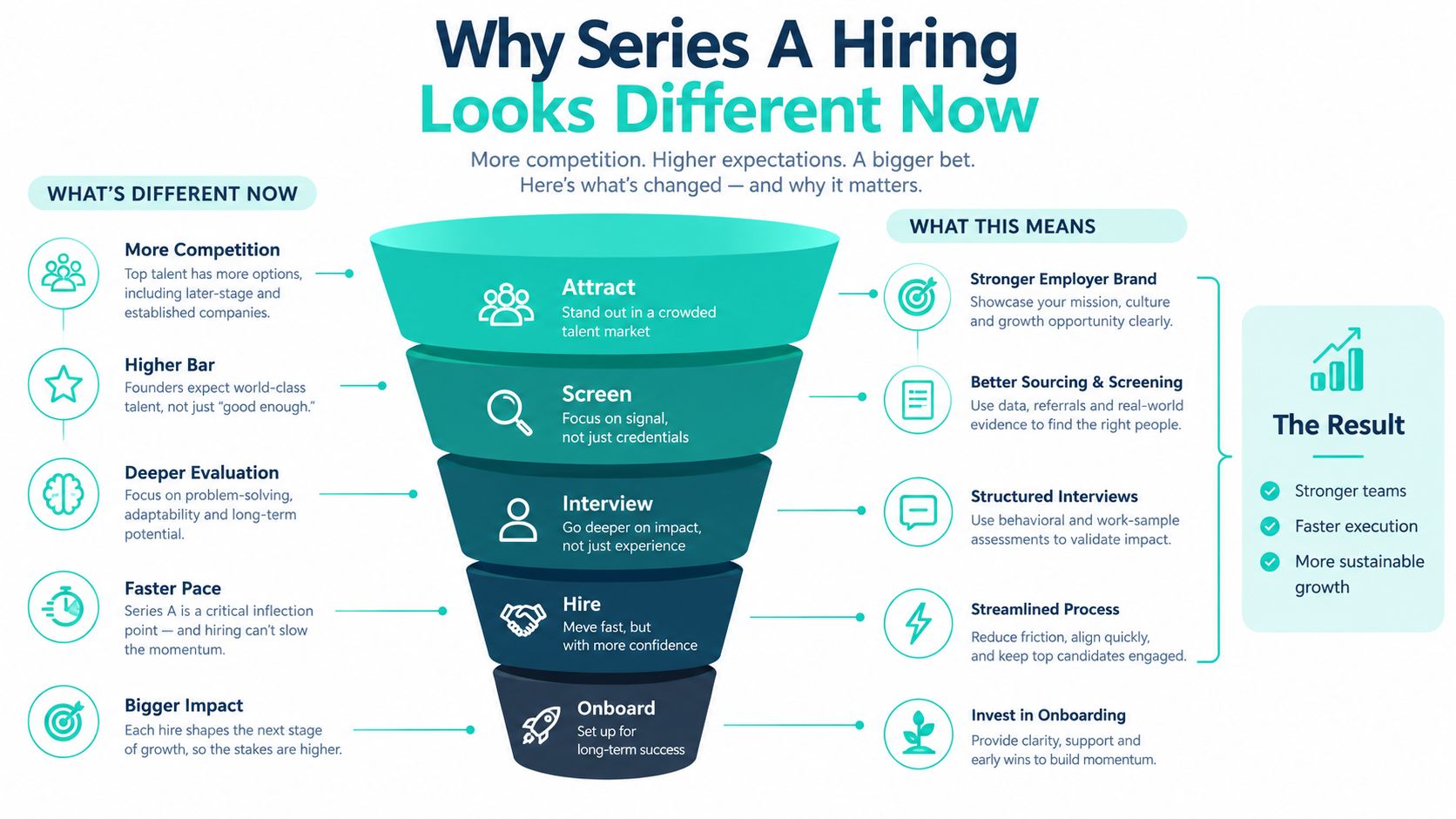
The post-Series A hiring market is leaner and more concentrated than earlier venture cycles. A labor-market analysis found that hiring rates after Series A funding were several percentage points lower in 2024 and 2025 than in 2020 through 2022, according to Revelio Labs' analysis of startup hiring. The implication is straightforward: a funding announcement no longer guarantees a large recruiting wave.
A separate 2026 benchmark reports a median of 7 engineering hires in the first 12 months after Series A, with engineering teams growing from roughly 4 to 6 engineers at funding to 12 to 16 by month 18. It also places the median time to fill for senior engineering roles at 47 days overall, 38 days through marketplaces, and 89 days when founders recruit directly, as documented in the 2026 startup hiring benchmark. Those figures show why specialized sourcing and fast decisions matter.
Practical rule: If a startup says every role is urgent, ask which hire unlocks the next measurable business outcome. A disciplined company can name the constraint.
Series A teams usually hire against a sequence of bottlenecks. Ship-critical engineering comes first when the product roadmap or reliability work limits growth. Founding sales or customer success follows when the company needs repeatable customer acquisition and retention. Product and design expand around validated needs, while operations and broad marketing often arrive after the company has clearer process requirements.
The recent funnel is also more selective. Industry coverage citing 2026 data reports early-stage hiring rates falling from 49% in 2022 to 27% in 2025, converging with growth-stage companies around 30%, as described by RecruitmentZilla's startup hiring coverage. The same coverage describes a shortage of junior engineers even as engineering demand remains relatively resilient.
That selectivity changes how you should apply. Hiring teams have less patience for generic resumes, broad claims, and lengthy ramp-up narratives. They want evidence that you can solve the specific problem they're hiring to address.
Recruiting benchmarks report that about 13% of applicants are selected for an initial screen, while 17% of new candidates reach a screen, and about 30% of screened candidates who proceed onsite advance to an offer. These figures are reported in Lever's recruiting metrics guide for startups and small businesses.
The exact funnel varies, but the lesson holds. Your resume must earn the screen, your examples must earn the onsite, and your questions must help the team trust your judgment before the offer. Prepare for compressed timelines and expect a company to favor a candidate who can connect past work to current priorities.
Job-search volume is a poor target. Conversion quality matters more. I'd rank your channels by how directly they put you in front of a credible hiring decision-maker.
Start with curated marketplaces such as Underdog.io. The platform matches vetted candidates with funded startups and can reduce the resume black hole associated with generic job boards. Its anonymous-profile model allows candidates to keep their identity hidden, block current employers, and decide whether to reveal themselves after an employer shows interest, as described by Axiom People's privacy-first talent platform.
For broader discovery, build a company list rather than searching only for titles. Use Crunchbase and TechCrunch to identify recently funded businesses, then inspect their product, leadership, customer profile, and open roles. A company that raised recently may not be hiring for the role you want today, but its hiring manager may know when the position opens.
Track 15 to 25 active targets in a simple spreadsheet. Record the company, funding stage, product category, hiring manager, role, source of the introduction, date contacted, follow-up date, interview status, and unresolved diligence questions.
Use LinkedIn filters for company size, location, function, and keywords, but don't rely on keywords alone. Search for companies with a clear stage signal, then review their people and posts. A warm introduction from a former colleague, investor connection, customer, alumni group, or professional community can turn a cold application into a substantive conversation.
Your outreach should be short and specific:
Hi [Name]. I'm exploring Series A product roles focused on workflow-heavy B2B products. I saw that [Company] is expanding [specific area], and I recently owned [relevant outcome] at [prior company]. I'd value a brief conversation about the problem this role needs to solve. I've attached a concise overview of the work most relevant to it.
Don't send a biography. Give the recipient a reason to believe you understand the company's immediate need.
Y Combinator's Work at a Startup is useful for founder-led and early-function roles. Wellfound can provide startup listings and direct access to founders or hiring managers. Startup-focused Slack groups and vertical communities can be particularly valuable for fintech, healthtech, and AI positions because members often share context that job descriptions omit.
LinkedIn is best used as a sourcing and relationship tool, not just an application queue. Follow target companies, monitor leadership posts, and ask mutual connections for insight before requesting a referral. If you're comparing remote recruiting channels or staffing approaches, Virtustant's guide to remote staffing agencies offers useful context on how different models work.
For an expanded list of discovery channels, consult this guide to the best sites for startup jobs. The key is to balance inbound applications with proactive outreach. Apply where the fit is strong, then create direct context around the application.

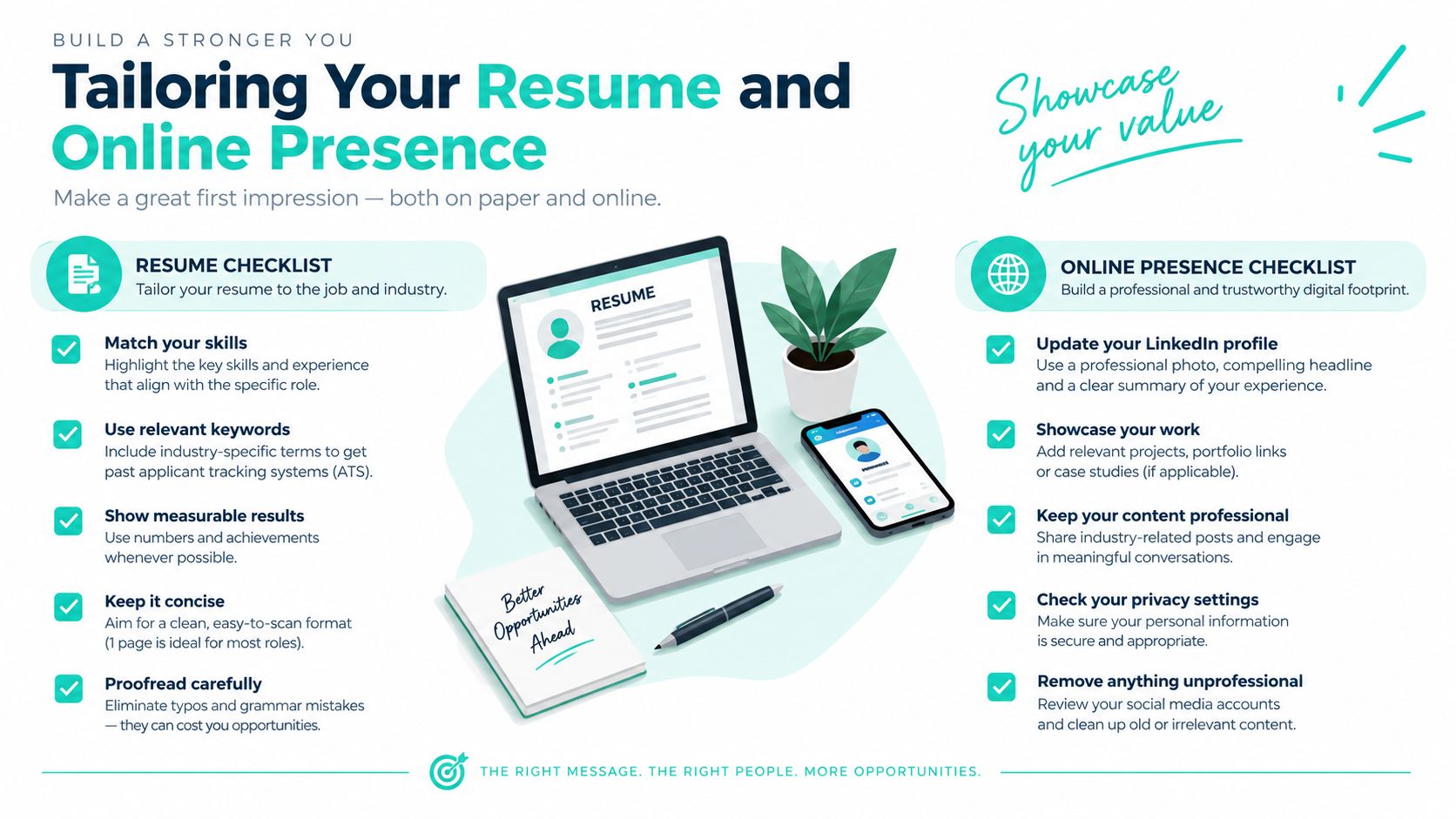
Your resume should answer one question quickly: why should this company trust you with a high-consequence problem? Series A hiring managers aren't impressed by a long list of responsibilities. They want evidence of ownership, technical or functional judgment, and outcomes that relate to the role in front of them.
Use a one-page format unless your experience requires more room. Reduce corporate job descriptions to two or three bullets and replace generic language with scale signals. Name the product, customer type, technical stack, company stage, and business context when confidentiality allows.
A strong bullet contains the situation, your action, and the result. “Managed platform improvements” says almost nothing. “Reworked the billing workflow for enterprise customers, partnering with engineering and support to remove a recurring implementation bottleneck” gives the reader a reason to ask for details.
Use numbers only when you can defend them. If you can't disclose revenue, users, or performance figures, describe the scale qualitatively and explain the complexity. Confidentiality doesn't excuse vagueness, but it does require disciplined redaction.
Prioritize examples that show:
Your headline should mirror how founders and recruiters search. “Senior Backend Engineer, payments infrastructure, 0-to-1 builder” is stronger than a vague description of your interests. A product candidate might use “Product Manager, B2B workflow automation, customer-led discovery,” while a designer could signal “Founding Product Designer, complex SaaS, research to shipped product.”
Write the About section as a three-paragraph positioning statement. First, state the problems you solve. Second, describe the environments where you've done your best work. Third, specify the Series A role, product category, and ownership level you want next.
Keep your portfolio or GitHub focused. Public repositories should be current, readable, and relevant. A small number of well-explained projects beats a crowded archive with no context. Turn off activity broadcasts during a confidential search, and keep a password-protected or deliberately obscured file that shows what your redacted resume looks like so trusted contacts can understand your work without exposing sensitive information.
Series A interviews are usually more founder-led and practical than Big Tech loops. The company is testing whether you can do the work, not just whether you can pass a standardized assessment. Expect a founder or hiring manager screen, a technical or craft round, a practical exercise, and a conversation about working style.
The process may include a 20-minute founder or hiring manager screen, a four-to-six-hour take-home, system design or product critique, and a values conversation compressed into five to ten business days. Those process details are role-dependent, so ask for the complete sequence at the first contact rather than discovering each stage one at a time.
Choose two recent projects and rehearse them from beginning to end. For each one, write down:
Founders listen for decision quality. They want to know whether you can distinguish a hard problem from a noisy one, whether you communicate constraints early, and whether you can revise your view without becoming passive.
Interview standard: Don't describe your project as a success story with no friction. Explain the choice you made, the option you rejected, and what the decision cost.
For a take-home, ship something small, readable, and production-shaped. Include tests where they add signal, a short README, clear assumptions, and a brief note about what you'd do next. Don't build a sprawling artifact to prove enthusiasm. At this stage, scope control is part of the evaluation.
For system design, avoid defaulting to FAANG-scale architecture. Discuss the smallest reliable version, the expected load qualitatively if no data is provided, the dependencies that could fail, and the decisions you'd defer until the product proves demand. Product managers should apply the same discipline to critiques. Start with the user problem, identify the constraint, propose a focused improvement, and define how you'd learn whether it worked.
Prepare five pointed questions about runway, team shape, board involvement, decision rights, and the role's first priorities. Ask who owns the roadmap, how disagreements get resolved, what the founders still control, and which deliverable would make the hire successful.
The values conversation should be evidence-based storytelling, not cheerleading. Explain how you handled conflict, changed direction, gave difficult feedback, or worked through a production issue. A candidate who can discuss failure without blaming others often gives a more credible signal than one who offers polished enthusiasm.

Evaluate a Series A offer in two separate parts: cash you can rely on and ownership that may or may not become valuable. Don't let a large headline equity percentage compensate for weak disclosure. Ask for the grant size in shares, the fully diluted share count, the latest preferred share price, the exercise price, the vesting schedule, and the company's explanation of likely dilution.
Independent 2026 benchmarks place Series A engineer cash compensation in a broad $130,000 to $240,000 base range, depending on level. One benchmark places Series A senior engineer equity around 0.07% to 0.20%, while another reports that median new-hire grant fair market value rose to about $65,000 year to date in 2026, as summarized in Remvix's 2026 startup compensation and equity benchmark. These figures aren't a substitute for a company-specific valuation and cap-table review.
| Role | Level | Base Salary (USD) | Equity Grant (% fully diluted) | Notes |
|---|---|---|---|---|
| Engineer | Mid-level | $130,000 to $240,000 | Not specified by the verified benchmark | Confirm level, share count, and dilution assumptions |
| Engineer | Senior | Within the benchmark's broad engineering range | 0.07% to 0.20% | Ask for the grant in shares and its fully diluted denominator |
| Engineering | First-year Series A hiring plan | Not specified | Not specified | A benchmark's median mix includes 4 senior ICs, 1 staff engineer, 1 engineering manager, and 1 specialist hire |
| Other roles | Product, design, sales, or operations | Company-specific | Company-specific | Don't infer value from an engineering benchmark |
A separate compensation benchmark can be useful for context, but don't treat a percentage without its denominator as meaningful. The practical economics depend on the strike price, liquidation preferences, future fundraising, dilution, tax treatment, and whether the company reaches an outcome that creates value for common shareholders. This startup equity compensation guide can help you frame the questions.
Ask whether the options are ISOs or NSOs, what the post-termination exercise window is, and whether the company offers acceleration on a change of control. Four-year vesting with a one-year cliff is common market language, but you still need the written terms. A post-termination window described as 90 days can create a serious cash and tax decision if you leave.
Compare offers using after-tax, after-dilution expected value rather than the percentage printed in the offer letter. If the company won't provide the essential grant terms, treat that omission as a compensation problem, not a minor administrative delay.
A strong search needs operating cadence. Set a weekly target for research, outreach, interview preparation, and offer diligence, then review the results every week. Don't judge progress by applications sent. Judge it by qualified conversations, completed interviews, written offers, and the quality of information you're gaining about the market.
Start with a target list of 15 to 25 Series A companies. Divide it into roles you'd accept immediately, roles worth exploring, and companies you'd contact even without an open position. For each target, record the product, funding context, relevant hiring manager, role hypothesis, and one reason you could create value quickly.
Refresh your resume and LinkedIn profile using the outcome-led approach above. Prepare a reusable project brief, a concise outreach note, and a portfolio link that can be adapted without becoming generic. Submit targeted applications through curated platforms and contact founders or hiring managers directly when you can explain the business problem you'd help solve.
Use the first month to test positioning. If engineering leaders respond to your reliability experience but ignore your broad “full-stack builder” language, narrow the headline. If product founders ask about customer discovery, make that evidence more prominent.
Run two parallel interview tracks so one delayed process doesn't control your decisions. Keep a reusable take-home structure, but never submit the same answer to different companies. Adapt the assumptions, terminology, and success criteria to the product.
For every serious finalist company, collect three reference calls. Ask references about your judgment under ambiguity, speed of execution, communication during conflict, and ability to operate without a large support structure. Request that the company provide its own references or introduce you to current employees who can answer questions candidly.
Track process speed. A startup that communicates clearly and gives you access to decision-makers is showing operating behavior, not merely offering good candidate experience.
When offers arrive, compare base salary, equity refresh cadence, exercise terms, vesting, acceleration, and severance. Run reverse diligence on runway, the cap table, financing history, board influence, revenue concentration, and the reason the company is hiring now.
Walk away when core facts remain hidden. Specific red flags include:
Before signing, put the final offer on one page and check each item:
A Series A job can change your trajectory, but only if the company's needs match your strengths and the deal reflects the risk. Use the next week to build the target list, rewrite the first page of your resume, and send focused outreach to people who can make a hiring decision.
Underdog.io offers a curated hiring marketplace where one application can connect qualified candidates with vetted startups, including companies hiring for Series A engineering, product, design, data, and go-to-market roles. If you want a more focused alternative to broad job-board volume, visit Underdog.io and submit a profile built around the ownership and outcomes Series A teams need.