84% of developers used or planned to use AI tools in 2025, according to Stack Overflow's developer survey announcement. For engineers pursuing front-end jobs, that changes what useful proof looks like. Generating a component isn't the strongest selling point anymore. Explaining why it's correct, accessible, fast, and safe to release is.
If you're searching for software engineer front end jobs in a competitive market, build your application around production judgment rather than framework vocabulary. Start by choosing the level your shipped work supports, then show a startup exactly what you can own without creating cleanup work for the rest of its team.
Front-end engineering sits inside broader occupational categories, not a standalone U.S. government job title. The U.S. Bureau of Labor Statistics reports May 2025 median pay of $92,650 for web developers, $104,000 for web and digital interface designers, and $99,520 for the combined group; it projects combined employment to grow 5% from 2025 to 2035, from approximately 220,100 to 231,400 jobs, with roughly 11,300 openings annually from growth and replacement.
Those annual openings aren't the same thing as net new positions. Nor are these wage figures a salary promise for a React engineer at a startup. They describe a broader occupation covering website development, interface layouts, maintenance, and testing of functionality, navigation, and usability.
That scope matters. A portfolio that demonstrates styling but never handles failed requests, keyboard interaction, or deployment leaves much of the actual job unproven.
Treat the market as uneven, not uniformly healthy or hopeless. Routine junior and generalist implementation work faces greater pressure, while engineers who can resolve architectural ambiguity remain more competitive, a distinction discussed in GreatFrontEnd's front-end demand analysis.
Before applying, choose the row whose proof you can show.
What each front-end level is hired to own
| Level | Scope you own | Proof that gets interviews | Common miss |
|---|---|---|---|
| Junior | Components, bug fixes, and tests under review | One shipped UI with tests and a readable pull request | Tutorial clones with no users or constraints |
| Mid-level | A feature from design handoff to production | A metric change plus an accessibility fix you verified by hand | A tool list with no before-and-after result |
| Senior | Architecture, performance budgets, and review standards | Core Web Vitals work and a critique of generated UI | Framework trivia without production ownership |
| Staff | Patterns and quality bars used by more than one team | Design-system or platform impact beyond one squad | A senior title backed only by single-feature stories |
These are practical hiring briefs, not universal title definitions. A small startup might call its first interface engineer senior while expecting a mixture of product discovery, implementation, deployment, and support. Another company may reserve that title for someone who guides other engineers.
Apply at the level your evidence supports, not the level your current title implies.
Say a posting asks for React, TypeScript, and experience collaborating with design. A junior candidate might show a well-tested form contribution. A mid-level candidate should explain how they took the entire onboarding flow through release, including validation, API errors, and rollout decisions.
A senior candidate needs a different story: why the team chose a rendering approach, where state belongs, how performance regressions are caught, and which generated code shouldn't pass review. Staff-level proof must extend beyond personal implementation into reusable patterns and adoption by other teams.
If you're still separating web development from adjacent interface and product roles, the web development career insights from Mojolin provide useful occupational context. Then return to the postings you're considering and underline the ownership verbs: implement, deliver, architect, standardize.
Let those verbs determine which applications are realistic this month.
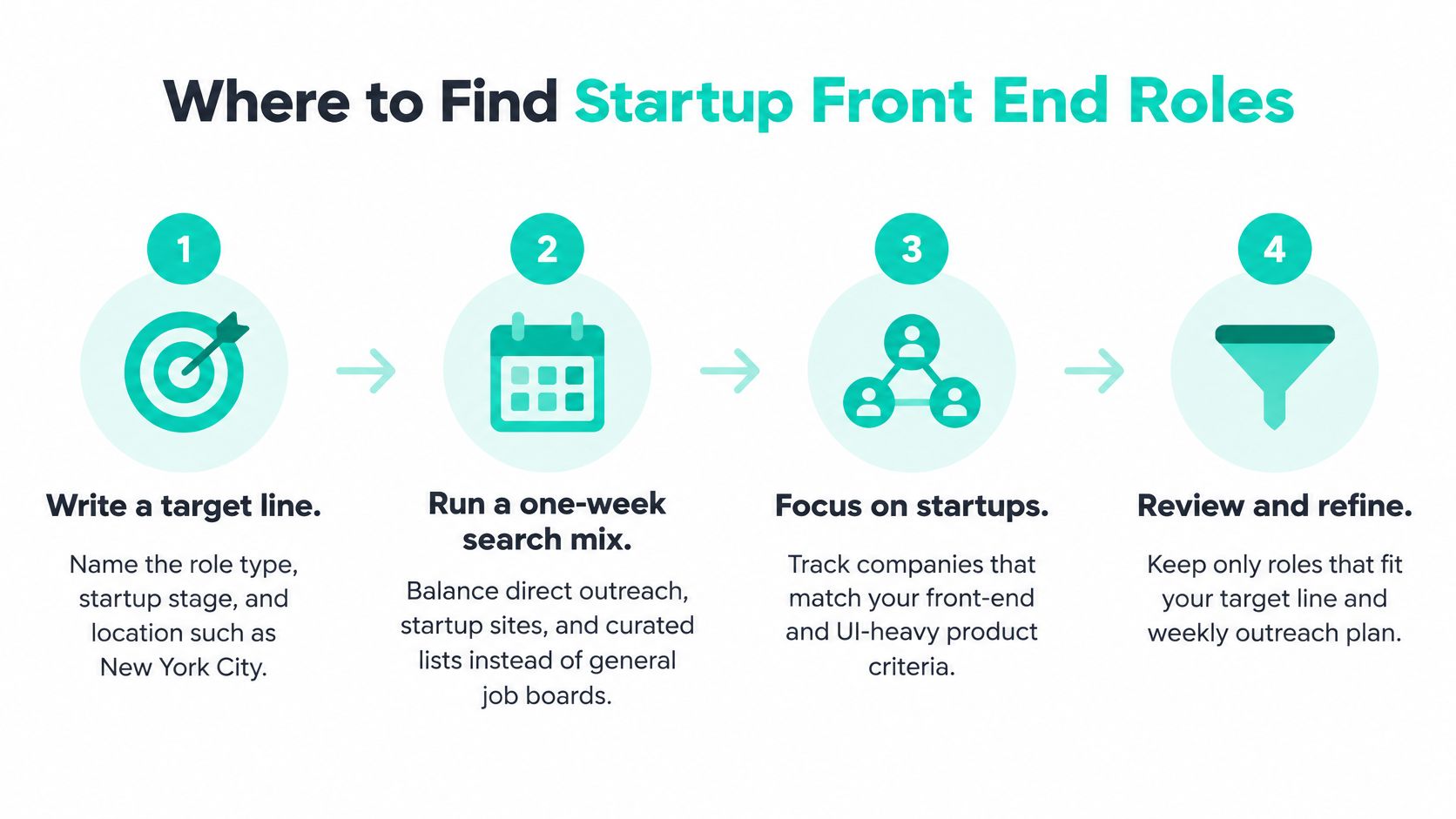
Write a target line. Name the role type, startup stage, location, and sponsorship requirement before opening job boards. For example: full-time front-end or UI-heavy product engineering at an early-stage startup, based in New York City or eligible for U.S. remote work, with no sponsorship needed. Add the ownership level your evidence supports.
Create a curated startup profile. At Underdog.io, we review profiles and make selective introductions to vetted startups, with profiles anonymous until interest is mutual. Our candidates have the most success when they want full-time positions, haven't recently graduated from a coding bootcamp, and don't require visa sponsorship. We list startup openings in New York City, San Francisco, and remote roles, and share a new curated cohort of active job seekers with growing technology companies every week.
Send two direct applications. Choose companies whose products you can discuss intelligently. Name a screen you'd investigate, explain the user friction, and propose how you'd test your interpretation. If you need sponsorship, recently finished a bootcamp, or want contract work, give this route more attention rather than relying on curated matching alone.
Ask two former teammates for targeted introductions. Identify the company and team, then provide a short explanation they can forward. Ask whether they'd feel comfortable introducing you to the engineer responsible for a particular product area, not whether they know anyone hiring anywhere.
Keep a single search sheet. Record the stack, location rules, compensation, ownership scope, and next action. Remove listings that won't clarify their stack, hiring geography, or compensation before asking you to invest heavily in interviews.
Use this as a one-week search mix, not a permanent quota. The point is to combine selective exposure with applications you can justify.
Front-end developer or engineer roles represented 28.71% of developer hiring demand in the 2024 CoderPad and CodinGame State of Tech Hiring survey. That's evidence that the role category matters, not that every listing matches your background.
Search adjacent titles such as product engineer, UI engineer, web engineer, and design systems engineer. Read carefully: a product engineer posting may require substantial backend ownership, while a UI engineer role may emphasize interaction detail and accessibility.
Our guide to the best job boards for engineers can help you choose supplementary channels without maintaining an endless collection of alerts. For LinkedIn outreach and discovery, RedactAI's LinkedIn job search guide offers another practical resource.
Don't send a company an unsolicited redesign presented as a verdict. Describe a hypothesis instead: the filter state appears to reset after navigation, so you'd inspect URL state and user expectations before changing it. That shows curiosity without pretending you know the company's constraints.
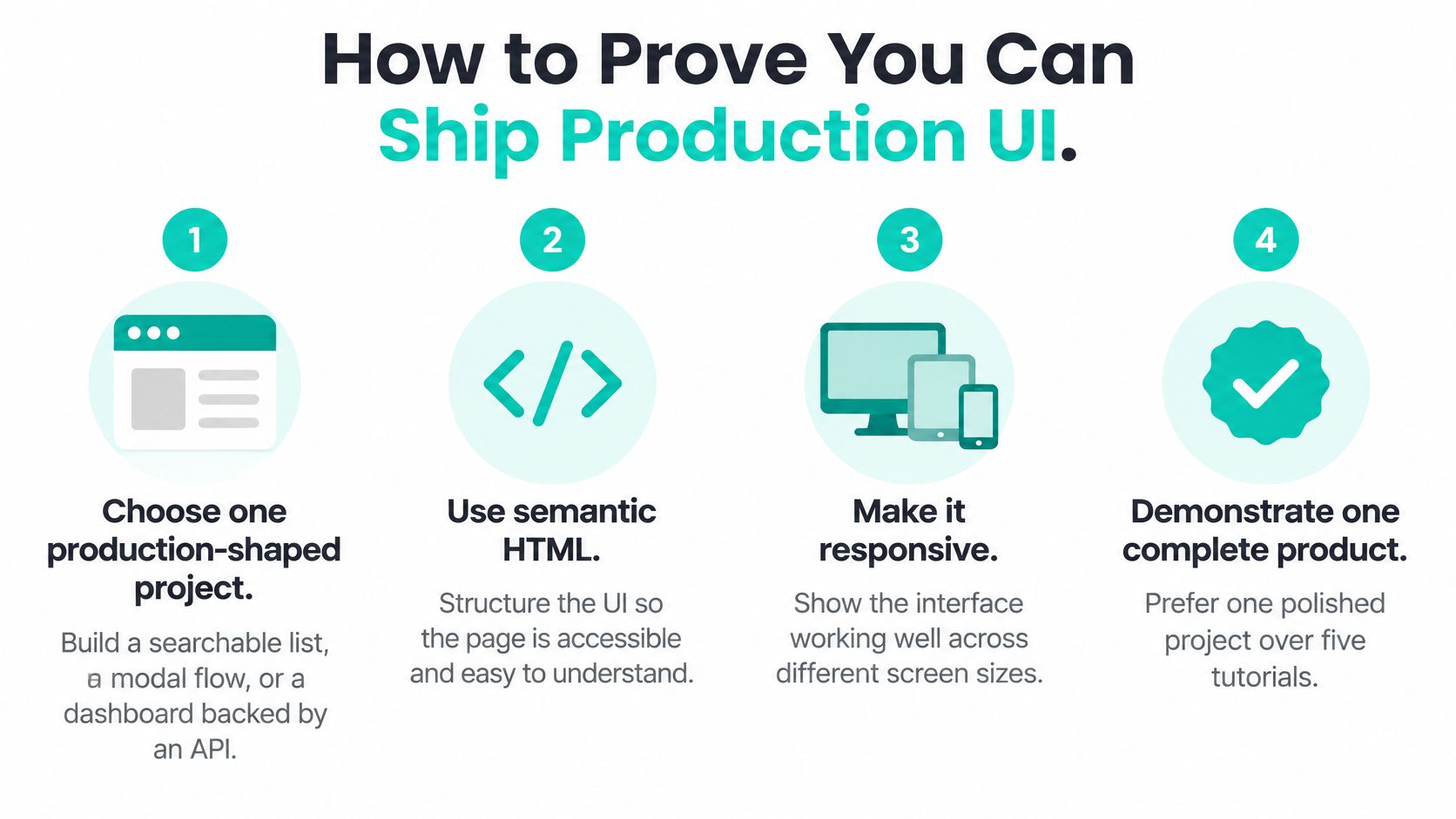
Build a production-shaped project rather than a collection of disconnected demos. A hiring manager should be able to identify the user task, inspect the risky behavior, and understand your verification work without reconstructing the application from scratch.
Choose a complete interface. Build a searchable list, modal flow, or API-backed dashboard. Include loading, empty, error, and successful states. For a searchable inventory screen, handle stale responses and failed requests, not just the happy-path results.
Use foundations you can explain. Write semantic HTML, responsive CSS, and JavaScript with TypeScript. React is a reasonable choice when it matches your target roles, but explain your decision. A small filterable page doesn't automatically need a global state library, elaborate abstraction layer, or server-rendering framework.
Make accessibility verification the central proof. Test keyboard-only navigation, focus order, focus restoration, semantic roles, and screen-reader announcements. Then run axe-core or Lighthouse and manually revisit dynamic states. In a study of 131 developers published through ACM, 22.3% reported frequent use of automated accessibility tools, 30.8% reported practicing accessibility frequently, and 39.2% either knew about accessibility but rarely practiced it or were unaware of it.
Change a performance problem. Record the baseline, the change, and the result in milliseconds under comparable conditions. Explain whether you reduced unnecessary rendering, delayed nonessential JavaScript, or corrected an oversized image. Don't imply a laboratory improvement proves a real-user outcome.
Document your review of AI-written code. Keep a short example of something you rejected. Perhaps generated search code allowed an older response to overwrite newer results. Explain the race condition, the correction, and the regression test you added.
Package the evidence. Link the repository, deployed application, and a three-sentence impact note from your profile. State the user problem, your intervention, and how you verified it. Arrange the README so someone can assess the essentials in under five minutes.
A useful accessibility note describes behavior, not just a passing scan. For a modal, record whether opening it moves focus appropriately, whether keyboard users can reach its controls, and whether closing it returns focus to the trigger.
Use a WCAG-informed checklist, but don't treat it as a decorative badge. Include a reproducible failure, the expected behavior, your fix, and the test that now covers it.
A zero-violation automated report isn't proof that an interface is accessible. Dynamic announcements and focus behavior still need human verification.
If the project has no real users, say so. You can still prove implementation quality and testing discipline; you cannot claim conversion or retention impact.
Before sharing the repository, use our guide to what hiring managers look for on GitHub to check whether your decisions are discoverable. A clear pull request and reproducible setup often communicate more than a polished screenshot.
A weak résumé line says you built responsive UI. A stronger replacement says you corrected focus restoration in a checkout modal after screen-reader testing and added a regression test. The second version identifies a failure, an intervention, and verification.
For performance work, name the page, device context, metric, and measurement method. Use your actual before-and-after values, not attractive numbers borrowed from someone else's case study.
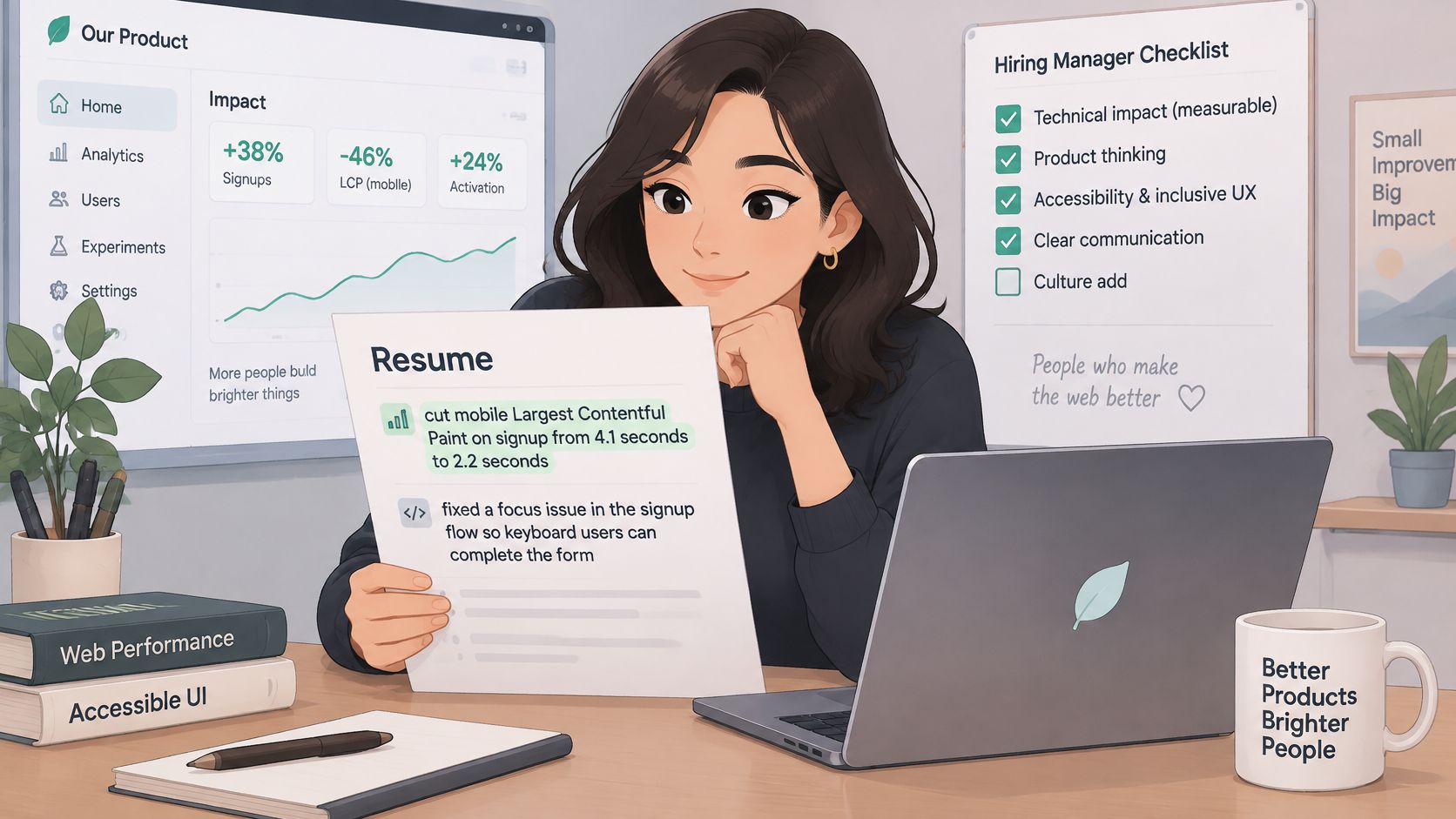
The Page Speed Matters Core Web Vitals analysis identifies good thresholds as Largest Contentful Paint of 2.5 seconds or less, Interaction to Next Paint of 200 milliseconds or less, and Cumulative Layout Shift of 0.1 or less; its 2026 analysis of 13.75 million origins found 49.1% of mobile sites and 58.0% of desktop sites passed all three.
For field reporting, use the 75th percentile over a rolling 28-day window, as described in that analysis. Keep the device segment and reporting period visible. An average can conceal slow experiences, and a fast desktop result doesn't establish acceptable mobile behavior.
Profile before prescribing. Inspect network waterfalls, image payloads, JavaScript execution, and layout shifts, then make a controlled change and validate the result. If you lack enough field traffic, label your evidence as laboratory testing rather than presenting it as production validation.
Walk through a component and its tradeoff. Explain where state lives, why you chose that boundary, and what would force you to revisit it. Don't spend the whole answer narrating JSX.
Debug a small interface aloud. Reproduce the issue before editing. Describe keyboard behavior, network timing, and state transitions so the interviewer can follow your reasoning. Distinguish a symptom from its cause.
Review generated code critically. Identify a concrete bug, the missing test, and an accessibility or security risk. For example, inspect whether generated rich-text rendering trusts untrusted HTML or whether a button submits a form.
Ask how ownership is shared. Find out who resolves incomplete designs, changes API contracts, approves releases, and investigates production failures. You're assessing whether the responsibility matches your experience, not just trying to sound senior.
Prepare a 90-second account of a regression you shipped. Describe what escaped, how you detected it, the repair, and the CI budget or bundle-size check that would prevent a repeat.
A credible failure story includes a changed engineering practice, not merely an apology and a hotfix.
Keep individual contributions separate from team outcomes. If another engineer diagnosed the bottleneck and you implemented the fix, explain that division clearly. Interviewers can probe ownership; precise attribution makes your account stronger.
How location changes a front-end search
| Location model | What to expect | Comp context | Constraint to confirm |
|---|---|---|---|
| New York City startups | Dense startup market with hybrid and in-office roles common | Ask for the posted range before a loop; national web medians are context only | Required office days and commute |
| San Francisco Bay Area | Senior and founding roles, some remote or occasional on-site | Treat compensation as unknown until the posted band is shared | Payroll entity and on-site cadence |
| Remote in the US | Real demand, not an automatic yes | Don't price yourself from a global blended median | Time zone, employment law, and proximity rules |
| Other US cities | Hiring differs by company; confirm local demand | Local cost of labor can move the band | Whether the company can hire in your state |
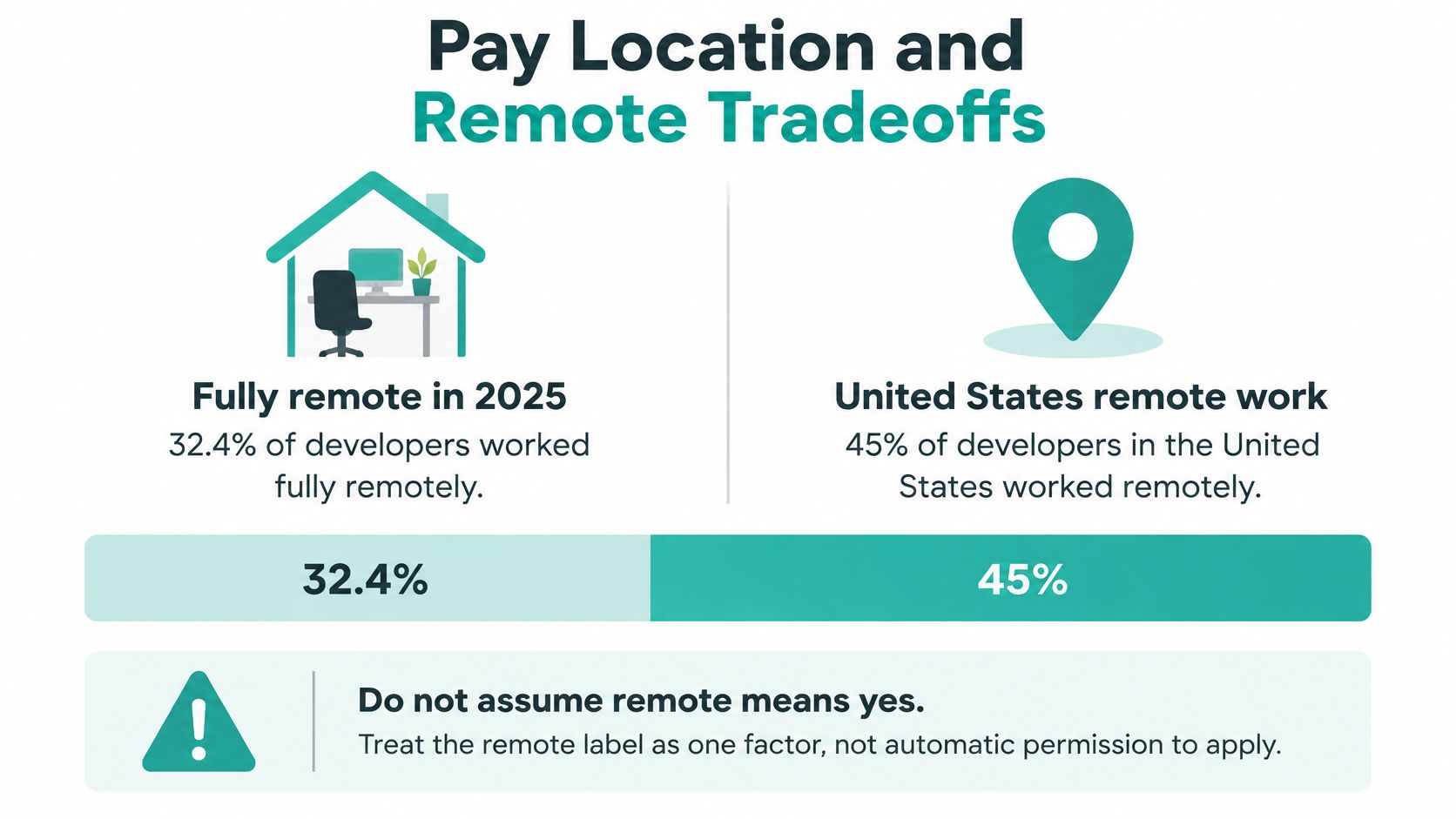
Don't treat remote as permission to apply from anywhere. A company may support distributed work while hiring only in particular states, requiring overlapping hours, or expecting occasional travel.
In the 2025 Stack Overflow Developer Survey, 32.4% of developers worked fully remotely, while 45% of developers in the United States worked remotely, the highest remote-work share among the survey's top-reporting countries. Those figures describe work arrangements, not your eligibility for a particular opening.
Ask for the compensation band before a long interview loop. Then compare base salary, equity, responsibilities, support expectations, and location requirements as a package. A larger title doesn't compensate for an ownership scope you can't realistically sustain.
Use these questions to make offers comparable:
Avoid setting your expectations from a global blended median. It combines different countries, employment arrangements, and experience levels. Our front-end developer salary guide can support a more role-specific comparison, but the employer's actual band and expectations still need scrutiny.
Bring a pull request with a clear explanation, a short architecture note, and an example of coordinating across time zones. Show how you documented a decision so a designer or backend engineer could continue without waiting for a meeting.
A useful asynchronous update distinguishes what changed, what remains blocked, and who needs to act. That's stronger evidence than listing remote experience as a skill.
We have hiring partners across the United States, but national reach doesn't erase each employer's hiring constraints. Decide your acceptable commute, travel, and working-hour boundaries before interviews begin. You should be able to reject an otherwise appealing role when its operating model doesn't fit your life.
Choose a path and submit something before the week ends. More browsing won't resolve missing evidence or unclear preferences.
If you want full-time startup work, have shipped product experience, and match our candidate fit, create a profile with Underdog.io. Applying to join is totally free. State your seniority, stack, and preference for in-office, hybrid, or remote work so a person can understand the match you're seeking.
If you need visa sponsorship, recently graduated from a bootcamp, or want contract work, prioritize direct outreach. Send three short notes to selected companies, each naming an interface problem you'd investigate during your first month. Present it as an investigation, not a promise to fix a product you haven't worked on.
Submit the strongest application your current work supports. Don't wait until you can claim every skill in the posting.
Block two hours this week to finish your accessibility checklist and before-and-after performance note. Remove unsupported claims, check the live application, and make your repository easy to use.
Then stop opening new job boards. Choose the curated startup path or a direct application, and complete that submission this week.
Underdog.io connects engineers with vetted startups through a curated profile and selective introductions rather than repeated applications to individual postings. Visit Underdog.io to share your shipped front-end work, preferred ownership level, and location requirements so we can consider you for relevant opportunities.