You’ve shipped features that users notice. Your pull requests move fast. You’ve probably become the person who catches design edge cases, fixes layout regressions before launch, and gets blamed when Lighthouse scores dip. Then an offer lands in your inbox, or a recruiter asks for your number, and the question gets uncomfortable fast.
What is your front end developer salary supposed to be now?
Most salary guides stop at base pay. That’s not enough if you’re targeting startups. In startup hiring, the key question isn’t just “What’s the salary?” It’s “What’s the package, what’s the upside, what’s the risk, and what are you giving up to get it?” A lower base with meaningful equity can beat a higher cash offer. A shiny salary in a major tech hub can look weaker once you factor in what that role will demand from you. A remote role can buy back time and flexibility, or flatten your upside if the company treats remote engineers like replaceable contractors.
That’s the lens worth using if you’re evaluating a front end developer salary in 2026. Not as a single number, but as a bundle of cash, ownership, influence, and career signal.
A front end developer’s pay now comes from several layers. Base salary is the obvious one. Then there’s cash bonus, equity, and the practical value of benefits like health coverage, paid time off, and learning budget. At startups, those pieces don’t carry equal weight.

The clearest mistake I see candidates make is comparing offers by base alone. That’s how people talk themselves into “higher paying” roles that don’t improve their financial position or career trajectory. A startup offer with a lower salary can still be stronger if the company is well-funded, the equity grant is meaningful, and the role expands your scope into design systems, performance work, or product ownership.
Three factors usually matter most:
Practical rule: Treat salary as one line item. Evaluate the whole offer like an investor evaluating a portfolio.
Large companies usually optimize for predictability. Startups often optimize for upside and speed. That changes how offers are built. Some startups will pay slightly below what a mature public company offers in cash, then try to close the gap with equity and broader ownership. Sometimes that’s smart. Sometimes it’s a way to underpay you with a story.
The difference comes down to whether the company can explain the offer clearly. If they can’t tell you what the equity is, how it vests, what the exercise terms are, and how compensation changes after strong performance, you don’t have enough information to value the package.
A lot of startup candidates make the same mistake here. They hear a founder talk about upside, then skip past the cash number too quickly.
Before you can judge whether equity is generous or whether a startup is asking you to trade salary for growth, you need a clean national baseline. In the United States, the average front-end developer salary reached $120,351 per year in base pay as of December 2025, with an additional $5,000 cash bonus, bringing total compensation to about $125,351, according to Clarusway’s summary of front-end salary data.
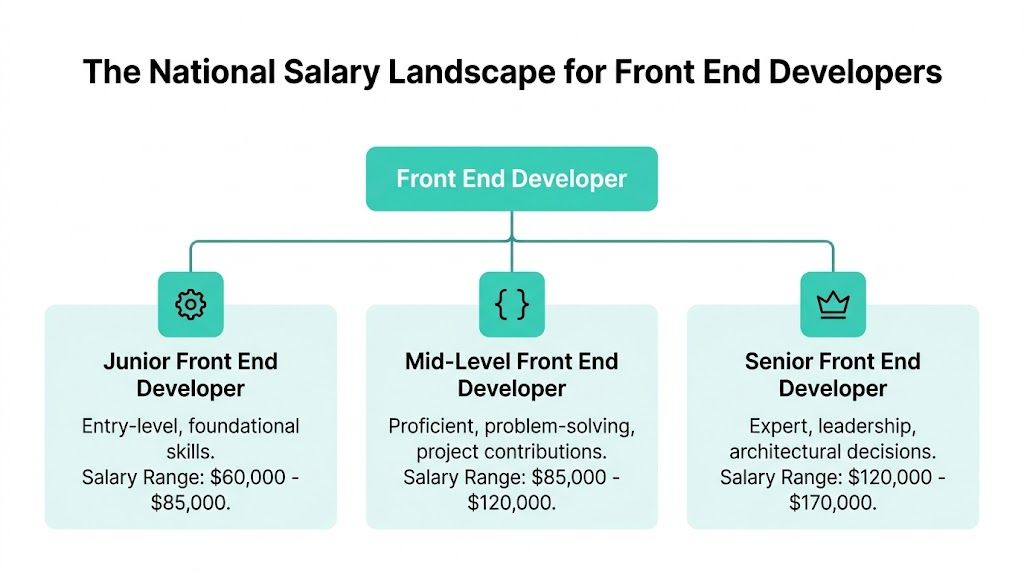
That average helps, but it hides a lot. Front end pay widens fast once companies start pricing for ownership instead of output.
If you want a wider benchmark across engineering roles, this software engineering salary guide gives useful context for how front end compensation compares with adjacent paths.
For junior candidates, the national numbers from that same Clarusway source show a steady climb:
In practice, startups are not paying those early-career numbers just because someone knows React or can reproduce a mockup. They pay more when a developer can ship production UI with fewer review cycles, catch accessibility issues before QA does, and work comfortably with design and product without constant direction.
That distinction matters because startup hiring managers usually care less about years in the abstract and more about whether you reduce supervision costs.
Nationally, front end developers around the five-year mark often move into a different pay band. Clarusway places mid-level compensation between $113,000 and $140,000 nationally.
That jump usually reflects a change in expectations as much as a change in title.
| Career stage | Typical compensation signal | What companies expect |
|---|---|---|
| Early career | Lower cash, narrower range | Execution on assigned tasks, strong fundamentals |
| Mid-level | Bigger cash jump | Feature ownership, clean component architecture, better judgment |
| Senior | Highest leverage | System design input, mentoring, performance and quality standards |
At startup companies, the separation between mid-level and senior front end talent often comes down to judgment. Can you choose patterns that hold up six months later? Can you prevent product speed from turning into front end debt? Can you make trade-offs clearly enough that founders trust you with more scope?
Higher pay usually follows that kind of trust.
National averages are a reference point, not a target. I tell candidates to use them to sanity-check an offer, then adjust for the actual job in front of them.
A startup asking you to own design systems, performance, experimentation infrastructure, or customer-facing product decisions is not hiring for a generic front end seat. It may still quote a national average to frame the offer. That does not mean the offer is competitive.
The reverse is true too. A cash number that looks slightly below a large-company benchmark can still be reasonable if the equity is meaningful, the strike price is clear, and the company can explain how refresh grants or promotion reviews work. That valuation work comes later. At this stage, the point is simpler. Know the national baseline so you can tell when a startup is paying for real scope and when it is selling ambition at a discount.
Location still changes the front end developer salary conversation. The market may be more distributed than it used to be, but startup pay remains heavily shaped by where the company competes for talent and what kind of urgency it has around product execution.
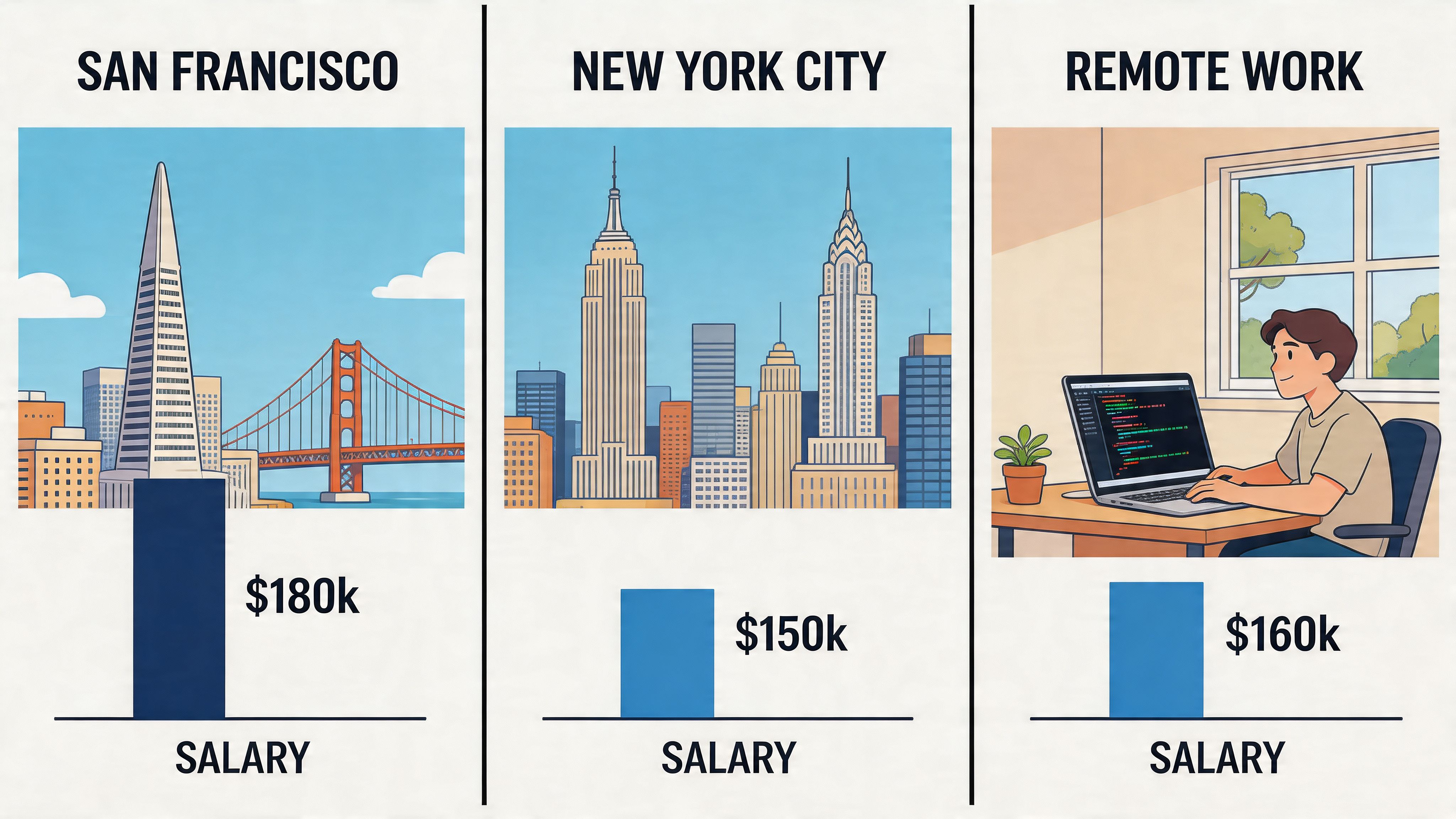
In major US tech hubs like San Francisco, mid-level front-end developers earn $140,000 to $174,000, with senior talent at $200,000+, according to Coursera’s review of front-end salary data. That’s a very different market from generic national averages, and it reflects what startups in those ecosystems need from front end hires.
San Francisco companies usually aren’t paying a premium because they like expensive payroll. They’re paying because they need engineers who can move product quickly without creating long-term mess.
A startup in that market often expects a front end developer to do several jobs at once:
The money is better, but the expectation bar is higher too. If you want top-of-band hub pay, you need to show more than framework literacy.
New York isn’t identical to San Francisco. The startup mix often includes more product-heavy environments where customer-facing polish, experimentation, internal tools, fintech UX, and complex business workflows all matter. The pay can still be strong, especially for engineers who can balance front end craft with commercial awareness.
The important point isn’t that NYC is “better” or “worse.” It’s that companies there often respond well to developers who understand why the interface matters to revenue, retention, and trust. If you can talk through onboarding friction, dashboard usability, design system consistency, or conversion-sensitive flows, you become easier to justify at the high end of a salary band.
The strongest startup candidates don’t talk only about components. They talk about user outcomes, product constraints, and what their engineering choices unlocked.
Candidates lump remote jobs together too often. That creates bad comparisons.
There’s a major difference between:
Those are not the same labor market. A US startup paying remote engineers on a national band may still compete closely with SF or NYC cash comp, especially if it wants experienced startup operators. Another startup may use remote hiring to widen the funnel while discreetly lowering salary bands for candidates outside the biggest hubs. Then there are companies using global contracting to cut payroll costs, which creates a totally different baseline.
Raw salary comparison often falls short. A higher city salary can still be a worse deal if the role requires constant office presence, heavy on-call pressure, or long-term housing costs you don’t want. A remote job can be better if the company pays serious US-market cash and gives you room to do deep work. It can be worse if “remote” is code for “we want senior output at discount rates.”
Use a short decision filter:
| Work setup | Upside | Risk |
|---|---|---|
| San Francisco | Highest cash bands, dense startup network | Expensive lifestyle, intense expectations |
| New York City | Strong startup market, high product exposure | Cost pressure, competitive hiring bar |
| US remote | Flexibility, broader company access | Band compression, less visibility if team culture is weak |
The right answer depends on what you value more right now. If you want maximum cash and career signaling, major hubs still matter. If you want flexibility with strong pay, remote can absolutely work, but only if the company treats remote engineers as core builders rather than budget labor.
Startup compensation gets misunderstood because candidates often compare it to public company offers using the wrong framework. A public company package is easier to value. A startup package takes more judgment.
That doesn’t mean startup offers are vague by nature. It means you need to separate the pieces correctly: salary, bonus, equity, and terms.
Base salary pays your bills. Bonus, if offered, adds short-term upside but shouldn’t be treated as guaranteed unless the company explains how it works. Equity is where startup compensation gets interesting, and where candidates either create real upside or accept a package they don’t fully understand.
Most startup front end developers will see stock options, not RSUs. Options give you the right to buy shares under specific terms. What matters isn’t just the grant itself. You need to understand vesting schedule, cliff, exercise window after departure, and whether the company is transparent about valuation and dilution. Public company RSUs are generally easier to value because they’re tied to liquid stock. Startup options are less liquid and higher risk, but they can matter a lot if the company executes.
If you want a more detailed reference point on how startups typically structure these packages, Underdog.io’s overview of startup compensation benchmarks is a useful companion.
Don’t force precision where precision doesn’t exist. Instead, compare offers by risk profile.
| Component | Series A Startup (Example) | Large Public Tech Company (Example) |
|---|---|---|
| Base salary | Usually lower cash relative to mature tech | Usually higher and more predictable |
| Equity type | Often stock options | Often RSUs |
| Liquidity | Illiquid until major company event | More straightforward to value |
| Upside potential | Higher if company grows significantly | Lower upside, lower uncertainty |
| Performance path | Scope can expand quickly | Compensation ladders are usually more structured |
| Role shape | Broader ownership across product and UI | More specialization is common |
That table won’t tell you which offer is better. It tells you what kind of bet you’re making.
A serious startup should be able to answer direct questions without getting defensive. Ask for the details plainly.
Equity is only “valuable” if you understand the terms well enough to explain them back to someone else.
What works is a company that offers a coherent package. Lower base, meaningful equity, transparent terms, and a role with room to grow can be a very strong deal.
What doesn’t work is a company that uses equity as a substitute for clarity. If they wave away your questions with startup mythology, assume they’ll be equally vague when promotion and refresh conversations come up later.
Two engineers can have the same title and years of experience, yet command very different compensation. The difference usually shows up in what they can own without help.
A company may list “React” or “Vue” on the job description, but hiring teams don’t pay a premium for keyword matching alone. They pay more when your skills reduce risk on important product work.

The strongest salary conversations usually come from combinations like these:
The mistake is saying, “I know React, TypeScript, and testing.” That’s too generic. Better candidates tie skill to a business problem they solved.
Try framing your work like this in interviews:
You don’t need inflated claims. You need clear ownership.
If you want a higher salary band, tell stories that prove you make product teams faster and codebases safer.
If you’re already employed and trying to increase your front end developer salary, don’t spread your learning across every new tool. Pick the capabilities that map to high-trust work.
A practical progression looks like this:
| Skill focus | Why it matters |
|---|---|
| TypeScript | Supports larger, safer codebases |
| Performance work | Helps on user-facing, high-visibility problems |
| Testing strategy | Builds trust in delivery |
| Accessibility | Improves product quality and cross-functional credibility |
| Design systems | Raises your impact beyond one-off tickets |
Candidates usually get paid more when they stop positioning themselves as implementers and start positioning themselves as owners.
Contracting can look better on paper than it feels in practice. The rate may be higher, but the package is thinner, the stability is weaker, and the long-term upside usually changes.
For front end developers, the trade-off starts with how you want to get paid. Contractors often optimize for near-term cash flow and schedule control. Full-time employees usually trade some flexibility for benefits, clearer career progression, and access to equity.
Self-reported data shows remote global front-end developers average $71,213 annually, below the US average of $103,000. The same data puts developers in CIS regions at around $45,000 max and developers in India at $25,000, according to Newxel’s front-end engineer salary analysis. That spread explains why some startups lean on global contractor pools when they want to control payroll costs.
For US-based candidates, this matters in two ways. First, a remote contract offer from a US company may not be anchored to US full-time compensation at all. Second, some companies use contractors for short-term execution but reserve strategic ownership, promotion paths, and equity for employees.
Contracting can be a smart choice if you care most about flexibility, need a bridge between full-time roles, or prefer a portfolio-style career. It can also work well for engineers who already know how to price their time, manage client expectations, and handle the operational side of independent work.
For developers in the UK or those working with UK clients, guidance on operating as a Front End Developer through an Umbrella Company can help clarify how payroll administration and compliance fit into contract work.
Full-time startup roles tend to be stronger if you want deeper product ownership. You’re more likely to influence roadmap decisions, build context over time, and participate in whatever upside the company creates.
A quick comparison helps:
| Path | Usually strongest for | Usually weakest for |
|---|---|---|
| Contracting | Flexibility and immediate cash focus | Stability and long-term upside |
| Full-time startup | Equity, ownership, team influence | Short-term freedom and rate agility |
If you’re deciding between the two, don’t compare only the headline number. Compare the kind of career each one builds.
Negotiation isn’t about posturing. It’s about making the company choose what they value most. Cash. Equity. Title. Scope. Timing. Good candidates don’t just ask for “more.” They redirect the conversation to the parts of the package that matter.
The biggest miss I see is accepting the first offer because it already feels decent. If the company wants you, there is usually room to discuss structure, even when base salary is tight.
You don’t need a dramatic script. You need a clear one.
A strong response sounds like this:
“I’m excited about the role and the team. Based on my experience shipping production front end work and the scope we discussed, I’d be more comfortable at a higher total package. Is there room to improve the base, equity, or both?”
That works because it’s collaborative and specific. It signals interest without losing your advantage.
Startup offers often have more flexibility than candidates assume. If the company says base is constrained, move to the adjacent levers.
For a deeper read on the mechanics behind option negotiations, this guide on how to negotiate stock options is worth reviewing before you sign.
The greatest advantage usually comes from fit and scarcity. If the team needs someone who can own front end quality, partner with design, and move quickly in a startup setting, say that directly. Tie your ask to what they said they need.
A useful structure is:
That sounds like a professional peer, not a hardball negotiator.
If a company can’t move on base, ask which part of the package has the most flexibility. That question often reveals more than the first offer did.
Avoid three common errors:
The strongest negotiation posture is simple. You know your value, you understand startup trade-offs, and you’re willing to walk away from vague or unbalanced offers.
Sometimes yes. It depends on company quality, stage, your cash needs, and whether the equity terms are clear. If the company can’t explain the grant well, a lower salary rarely makes sense.
Not always. Some companies maintain national bands. Others adjust by location. The important part is knowing which market they’re pricing against before you compare offers.
Only if the company backs it up with level-appropriate pay and responsibilities. A “senior” title with mid-level compensation doesn’t improve much.
Treat that as one data point, not the end of the conversation. Base may be fixed while equity, signing bonus, title, or review timing still has room.
It can be, but startup bonus structures vary a lot. I’d treat guaranteed salary and understandable equity as more important than a loosely defined bonus plan.
A good offer fits three tests. The cash works for your life. The role expands your skills and scope. The package is clear enough that you can explain the trade-offs to yourself without hand-waving.
If you’re actively comparing startup opportunities, Underdog.io is one practical way to see roles where compensation range is disclosed up front and companies are already operating in the startup hiring market this article is talking about. That makes it easier to compare cash, scope, and upside before you spend time in another vague interview loop.