Joining or investing in a startup is a significant commitment. While the promise of innovation and equity is compelling, a strong mission statement alone isn't enough to build a career or secure a return. A surprising number of candidates, investors, and even hiring managers bypass the crucial step of detailed due diligence, which can lead to misaligned expectations, professional setbacks, and lost capital. This guide provides a definitive, role-aware startup due diligence checklist designed for everyone involved in the startup ecosystem.
Whether you are an ambitious candidate vetting your next opportunity, a founder benchmarking your own operations, an investor searching for a high-growth venture, or a hiring manager aiming to attract top talent, this framework is for you. We will move beyond surface-level metrics to provide practical, actionable questions and outline the specific evidence you need to gather.
This article breaks down the 10 critical areas you must investigate to confidently assess any startup. By following this structured approach, you can learn to distinguish high-potential companies from high-risk gambles. This process ensures you have the clarity needed to make an informed decision, protecting your time, career, and capital. Let's get started.
A startup’s capitalization table, or “cap table,” is a definitive record of its ownership structure. Examining this document, along with the company's funding history, is a fundamental piece of any due diligence. It reveals who owns what percentage of the company, how much has been raised, and from whom. This insight is critical for understanding the true value of an equity offer and the stability of the business.
The cap table tells a story about the startup's journey. It shows the founders' initial splits, the entry of angel investors, and the terms of venture capital rounds. For candidates, this information clarifies how much your potential equity stake is worth and how future funding rounds might affect it. For founders and investors, it’s about maintaining a "clean" cap table that is attractive for future investment.
A complicated or messy cap table can be a significant red flag, often signaling founder disputes, unfavorable investor terms, or a history of desperate funding rounds that have excessively diluted ownership.
To properly assess a startup’s financial foundation, follow a structured verification process. Don’t just take a founder’s word for it; ask for the evidence.
Verifying a startup's legal foundation is a non-negotiable part of any due diligence. This involves checking its official registration, corporate structure, and, most importantly, the ownership of its intellectual property (IP). A solid legal and IP framework ensures the company is a legitimate entity that owns its core technology, free from hidden liabilities that could jeopardize its future.
A startup's legal status and IP are its bedrock. An improper setup can lead to founder disputes, regulatory fines, or even existential lawsuits that halt operations. For candidates, this diligence confirms the company has the right to conduct business and that its primary assets, like source code or brand identity, are secure. The infamous Theranos case serves as an extreme but powerful reminder of the consequences when legal and IP claims are not rigorously verified.
A clean legal history and bulletproof IP ownership are not just formalities; they are indicators of operational maturity and a founding team that respects process, which directly impacts long-term stability and employee security.
To confirm a startup’s legal and IP health, you need to go beyond surface-level claims and review the primary source documents. This protects you from future surprises.
A startup's trajectory is often a direct reflection of its leadership. As venture capitalists frequently state, they invest in people first and ideas second. A comprehensive evaluation of the founding team’s credentials, past experiences, and domain expertise is a vital component of any due diligence. This verification helps determine if the leaders have the resilience, knowledge, and network to navigate the turbulent startup journey.
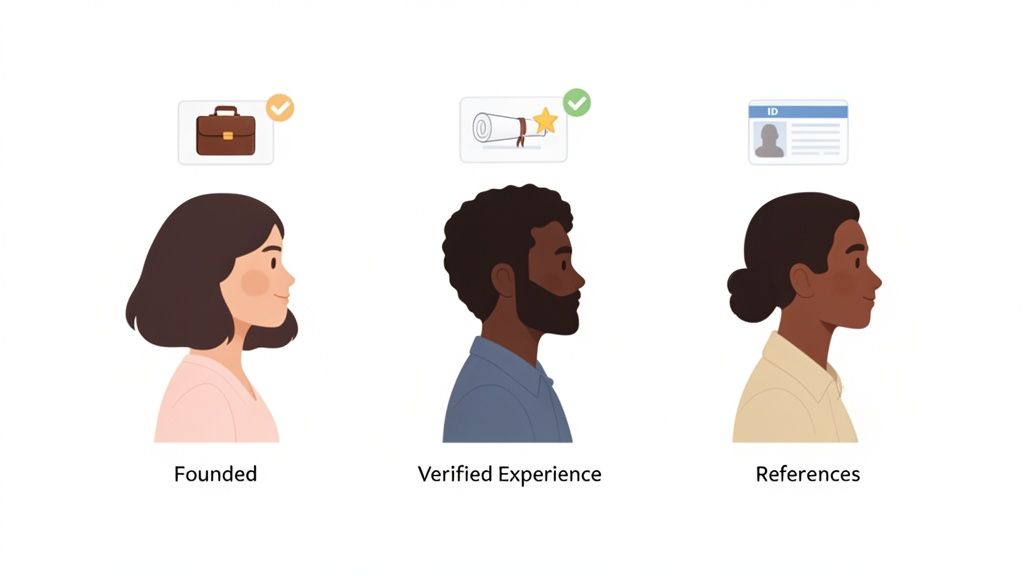
Strong leadership inspires confidence, attracts top-tier talent, and secures funding. Founders with relevant experience, such as Drew Houston whose prior startup failures informed the successful culture at Dropbox, are better equipped to avoid common pitfalls. For candidates, joining a team led by credible, respected founders can accelerate career growth and provide invaluable mentorship. For investors, a seasoned and complementary team significantly de-risks the investment.
A founder team with a pattern of rapid departures from previous roles or an inability to clearly articulate their company's mission is a major red flag. It can signal a lack of commitment, strategic direction, or communication skills essential for scaling a business.
To gain confidence in the leadership team, go beyond surface-level biographies and conduct a thorough background assessment. This process is about verifying claims and understanding the people behind the pitch.
Product-market fit (PMF) is the degree to which a startup's product satisfies strong market demand. Assessing this, along with revenue data, is a core part of any due diligence because it validates that the company is solving a real problem customers are willing to pay for. This analysis separates a business with genuine traction from one built on a theoretical idea, signaling long-term stability and growth potential.

Strong PMF is the engine of a startup. As Marc Andreessen popularized, it's the only thing that matters for a new company. It drives organic growth, customer loyalty, and ultimately, revenue. For candidates, joining a company with proven PMF means you're building a product people genuinely want, which correlates with greater job security and impact. For founders, it's the green light to start scaling operations and sales.
A startup that has achieved product-market fit often feels like it's being pulled forward by the market, rather than having to push its product onto it. A lack of PMF, however, often manifests as slow growth, high churn, and a constant struggle to find paying customers.
To confirm a startup has found its footing in the market, you need to go beyond the pitch deck and analyze the real numbers and customer behaviors.
A startup is its people. Evaluating the current team, its structure, and its growth plans is a vital part of any due diligence. This analysis reveals the company’s maturity, its operational priorities, and whether it possesses the right talent to execute its vision. For candidates, it helps determine if you'll have adequate support and mentorship.
The team's composition tells you where a company invests its resources and what it values. An engineering-heavy team suggests a product-led focus, while a large sales department indicates an aggressive go-to-market strategy. Understanding the hiring roadmap shows where the company is headed and whether its growth ambitions are realistic or reckless.
A lopsided team or an unfunded hiring plan is a major red flag. It can signal poor strategic planning, a disconnect between vision and budget, or a high-pressure environment where departments are understaffed and overworked.
To properly assess a startup’s human capital and growth strategy, you need to look beyond the surface-level job description. Ask for concrete evidence of their organizational structure and plans.
A startup’s product can be impressive in a demo, but its true value is proven by customer satisfaction. Conducting reference calls with actual customers bypasses founder narratives and provides direct verification of product-market fit. This part of the due diligence reveals unfiltered insights into product stickiness, support quality, and retention likelihood.
Customer interviews tell you if the product is a "must-have" or just a "nice-to-have." For candidates, this feedback indicates whether you'd be joining a company with a genuinely valued product or one struggling to find its footing. For investors and founders, these conversations are the most authentic validation of a startup's claims, confirming the market need and the solution’s effectiveness.
A founder’s reluctance to provide customer references, or providing only recently acquired ones, can be a major red flag. It may suggest high churn, low satisfaction, or that the product’s value proposition isn't as strong as presented.
To get an honest picture of the startup's market position, you need to speak directly with the people using the product. A structured approach to these conversations will yield the most valuable information.
Beyond the ownership story told by the cap table, a startup's financial statements reveal its operational health and sustainability. Examining the Profit & Loss (P&L), balance sheet, burn rate, and runway is an essential part of any due diligence. These documents show how the company manages its money, how quickly it spends capital, and how long it can survive before needing more funding or becoming profitable.

Financial discipline is a powerful indicator of a startup's long-term viability. While early-stage companies are expected to lose money as they invest in growth, the rate and nature of this spending matter immensely. This analysis tells you whether the company has a realistic plan to reach its goals or if it's on a collision course with insolvency. It determines if there's enough cash to make payroll for the foreseeable future, a fundamental concern for any prospective employee.
A high burn rate isn't inherently bad if it's fueling efficient growth, but a high burn rate with stagnant revenue or poor unit economics is a serious red flag. It suggests the business model is fundamentally broken or that leadership is not spending capital effectively.
To get a clear picture of the company's financial stability, you need to dig into the numbers with a methodical approach. Projections are useful, but historical data provides the ground truth.
Assessing a startup’s culture goes beyond surface-level perks like ping-pong tables and free snacks. It involves a deep dive into the company’s authentic values, day-to-day work environment, and overall employee satisfaction. For candidates, especially those seeking alignment with their personal and professional values, this part of the due diligence is non-negotiable for preventing a toxic mismatch and ensuring long-term success.
A startup's culture is its operating system for people. It dictates how decisions are made, how feedback is given, how conflicts are resolved, and what behaviors are rewarded or penalized. A strong, positive culture can be a powerful competitive advantage, fostering high performance and retention. Conversely, a disconnect between stated values and actual practices often leads to high turnover and low morale.
A high employee turnover rate, especially for the same role, is a major red flag. It often points to systemic issues with management, unrealistic expectations, or a fundamental break in the company's cultural promises.
To get an honest read on a startup’s culture, you need to go beyond the polished career page and talk to the people who live it every day. Your goal is to validate the company's claims through direct evidence and observation.
A startup's success is not determined in a vacuum; it is shaped by the market it operates in and the competitors it faces. Analyzing the competitive landscape and the company's market position is a core part of any due diligence. This process evaluates the total addressable market (TAM), identifies key rivals, and scrutinizes the startup's unique advantages or "moats" that protect it from competition. It helps answer whether the company has a realistic shot at becoming a significant player or is just a minor feature in a crowded space.
Understanding the market dynamics reveals the company's growth ceiling and its long-term viability. For candidates, this analysis helps gauge if you're joining a future market leader like Stripe, which differentiated on developer experience in a crowded payments field, or a company with a flawed model like WeWork, which struggled with unit economics. For founders and investors, this step is fundamental to building a sustainable business strategy and a compelling investment case.
A startup without a clear understanding of its competition or a defensible moat is vulnerable. Even with a great product, it risks being outmaneuvered by better-funded incumbents or faster-moving new entrants.
To properly assess a startup’s market position, you need to go beyond the founder's pitch and conduct independent research. A structured approach will give you a clearer picture of the opportunity and its associated risks.
A startup's approach to regulatory compliance, risk management, and insurance coverage reveals its operational maturity and long-term viability. This part of the due diligence examines whether the company adheres to relevant laws (industry-specific, data privacy, employment) and is prepared for potential liabilities. Overlooking these areas can expose a business to fines, lawsuits, and operational shutdowns.
Startups often operate in fast-moving, sometimes legally ambiguous spaces. However, a "move fast and break things" attitude toward regulations is a recipe for disaster. For candidates, understanding a company's compliance posture helps avoid joining a business like Theranos, built on regulatory failure. For founders and investors, robust compliance and risk management are foundational for building a sustainable, defensible enterprise.
A casual or dismissive attitude toward compliance is a major red flag. It suggests a leadership team that is either naive or reckless, putting the entire company, its employees, and its investors at significant risk.
To properly evaluate a startup's operational integrity, dig into its legal and risk management frameworks. This goes beyond simple questions and requires a look at their actual practices and preparedness.
| Item | Implementation complexity | Resource requirements | Expected outcomes | Ideal use cases | Key advantages |
|---|---|---|---|---|---|
| Capitalization Table & Funding History Verification | Medium–High: requires sensitive doc access and investor checks | Cap table exports (Carta/Excel), funding docs, Crunchbase/PitchBook cross-checks, investor contacts | Verified ownership, dilution history, funding rounds, runway signal | Vetting equity offers; ensuring ability to pay placement fees; marketplace curation | Reveals dilution/runway risks; validates equity value and investor influence |
| Company Registration, Legal Structure & IP Ownership | High: multi-jurisdiction legal checks and document review | Incorporation filings, articles/bylaws, IP assignments, USPTO/WIPO searches, WHOIS | Confirmation of legal entity, IP ownership clarity, hidden liabilities flagged | IP-sensitive hires; international entity verification; fraud prevention | Prevents placements into sham entities; protects candidate equity and IP rights |
| Leadership Team Background & Experience Verification | Medium: research plus reference outreach | LinkedIn, Crunchbase, news archives, 2–3 reference interviews (investors/colleagues) | Validated founder credentials, past outcomes, red-flag detection | Senior hires; assessing founder-led execution risk; investor-style diligence | Predicts execution capability; uncovers misrepresentations and credibility gaps |
| Product-Market Fit & Revenue Validation | Medium: requires access to metrics and benchmarking | MRR/ARR reports, MAU/engagement data, CAC/LTV, customer lists, financial snapshots | Traction assessment, revenue sustainability, growth trajectory | Hiring at growth stage; revenue-dependent roles; assessing market demand | Confirms demand and budget capacity; indicates stability and hiring runway |
| Team Composition, Headcount & Hiring Plans | Low–Medium: primarily document collection and interviews | Org chart, headcount by function, hiring roadmap, onboarding docs, turnover data | Assessment of maturity, management capacity, onboarding readiness | Matching candidates to teams; planning integrations; assessing mentorship | Ensures hires have support and clear reporting; identifies skill gaps |
| Customer References & Market Validation Interviews | High: coordination-intensive and qualitative | Referenceable customers, NPS/survey data, scheduled interviews, case studies | Unbiased customer feedback, product stickiness, support quality insights | Enterprise/customer-facing roles; confirming real-world adoption | Provides authentic validation of product value and customer satisfaction |
| Financial Statements, Burn Rate & Runway Analysis | High: sensitive financial review and modeling | Last 12 months P&L, cash balance, forecasts, expense breakdown, debt details | Burn rate, runway months, payroll sustainability, funding needs | Assessing financial viability before placement; salary/fee validation | Identifies short-runway/high-risk companies; validates ability to sustain hires |
| Company Culture, Values & Employee Satisfaction | Medium: qualitative interviews and survey analysis | Employee surveys, retention metrics, benefits package, Glassdoor/Blind data, exit interviews | Culture fit assessment, retention risk, D&I indicators, workplace expectations | Culture-aligned placements; long-term retention focus | Reduces mismatches; improves candidate satisfaction and retention rates |
| Competitive Landscape & Market Position Analysis | Medium–High: market research and competitor benchmarking | TAM/SOM estimates, competitor analysis, analyst reports (Gartner/CB Insights), patents/partnerships | Differentiation clarity, market opportunity size, defensibility assessment | Strategic hires; assessing growth potential and moat strength | Validates market upside and sustainability; identifies competitive risks |
| Regulatory Compliance, Risk Management & Insurance | High: legal/compliance review and certifications | Compliance records (SOC2/GDPR/CCPA), licenses, insurance policies (D&O, cyber), security audits | Regulatory risk profile, compliance gaps, insurance coverage adequacy | Regulated-industry hires (fintech/healthcare); data-sensitive roles | Prevents regulatory surprises; demonstrates operational maturity and risk awareness |
Moving through a detailed due diligence checklist is not just about ticking boxes; it's a structured investigation into a company's very foundation. You've now examined the critical pillars that support any successful venture, from the hard numbers on the capitalization table to the human element of team culture. This process transforms abstract excitement about an opportunity into a concrete, evidence-based assessment. Whether you are a software engineer weighing a job offer, a product manager evaluating growth potential, or an investor considering a capital injection, you are now equipped to make a decision grounded in data, not just a story.
The purpose of this extensive checklist isn't to unearth a mythical, flawless startup. Those simply do not exist. Every company, especially in its early stages, is a collection of calculated risks, ambitious bets, and unforeseen challenges. The true goal of your diligence is to understand the specific nature of those risks and weigh them against the potential rewards. It’s about separating manageable hurdles from insurmountable red flags.
After gathering information across all ten areas, from legal structure to competitive positioning, the final step is synthesis. Avoid getting lost in the weeds of a single data point. Instead, look for patterns and connections between different checklist items.
For example:
By connecting these dots, you build a holistic picture of the organization. This allows you to move beyond a simple "good" or "bad" verdict and into a more nuanced understanding of the opportunity.
Key Insight: A startup's weaknesses are just as important as its strengths. Your job during due diligence is not to find a company with no weaknesses, but to decide if you can tolerate the specific ones you uncover.
Your completed due diligence is a powerful personal asset. The final stage is turning this knowledge into a decisive action.
Ultimately, mastering this process is about more than just avoiding a bad startup experience. It’s about proactively choosing the right one for you. It empowers you to confidently accept an offer, invest capital with conviction, or walk away from a situation that doesn’t align with your objectives for stability, growth, or financial return. This diligence framework is your personal toolkit for navigating the high-stakes, high-reward world of startups.
Tired of doing all the heavy lifting yourself? Underdog.io pre-vets high-growth startups, giving you a curated list of opportunities where much of this initial diligence on company stability and quality is already done. Apply once to connect with top tech companies in NYC, SF, and remote that are actively hiring.