You've spent an hour on a take-home, cleared a recruiter call, and now a founder wants to “add just one more conversation.” Nobody can tell you who owns the decision, what the rubric is, or when you'll hear back. That's not startup speed. That's an interview process with no operating system.
A good startup interview process is compact, structured, and honest about what the company needs to learn. It tests the work without creating unpaid labor, gives candidates a clear timeline, and makes ownership visible at every stage. A broken process hides behind improvisation, adds interviews whenever someone feels uncertain, and treats candidate patience as an unlimited resource.
The difference matters to both sides. Candidates can use the process itself to assess how the company makes decisions. Founders and hiring managers can use a disciplined loop to reduce false positives without recreating enterprise hiring bureaucracy.
At 9 a.m. on Tuesday, a software engineer joins a recruiter screen from a spare bedroom. By late morning, they're in two back-to-back technical panels with engineers from a small team. After lunch comes a system design whiteboard on Zoom, followed by a product sense conversation with the hiring manager. The final slot is a 15-minute “culture” chat with the CEO, who has to leave early for a board update.
That schedule feels familiar because startup loops are often denser than large-company loops. The interviewers aren't drawn from a massive specialist organization. They're usually people who will work directly with the hire, including a founder, hiring manager, skip-level leader, peer individual contributor, or cross-functional partner. The setting can shift just as quickly, from Zoom to a Slack Huddle to the literal kitchen during an office visit.
The informality can be useful. A candidate might see how an engineer explains a production problem, how a product manager handles disagreement, or whether the founder answers difficult questions directly. But improvisation becomes a liability when nobody knows what each conversation is supposed to evaluate.
Practical rule: A casual setting is fine. An unclear decision process isn't.
For every interview, ask yourself what signal the company is collecting. A technical panel should test technical judgment or execution. A hiring-manager conversation should clarify ownership, scope, and decision-making. A founder conversation should explain the mission, constraints, and expectations. If three people ask the same generic questions, the company is spending time without adding much signal.
The benchmark published in startup hiring guidance from Unusual Ventures found that startups interview 15 applicants for every hire, with the figure rising to 18 applicants per technical hire and falling to 13 per business hire. It also reported that hired candidates spend 2.5 to 3 hours interviewing overall, while larger startups average about 29 interviewer hours per hire. The takeaway isn't that every loop should be short at any cost. It's that a mature startup can measure interview load and still keep the candidate experience focused.
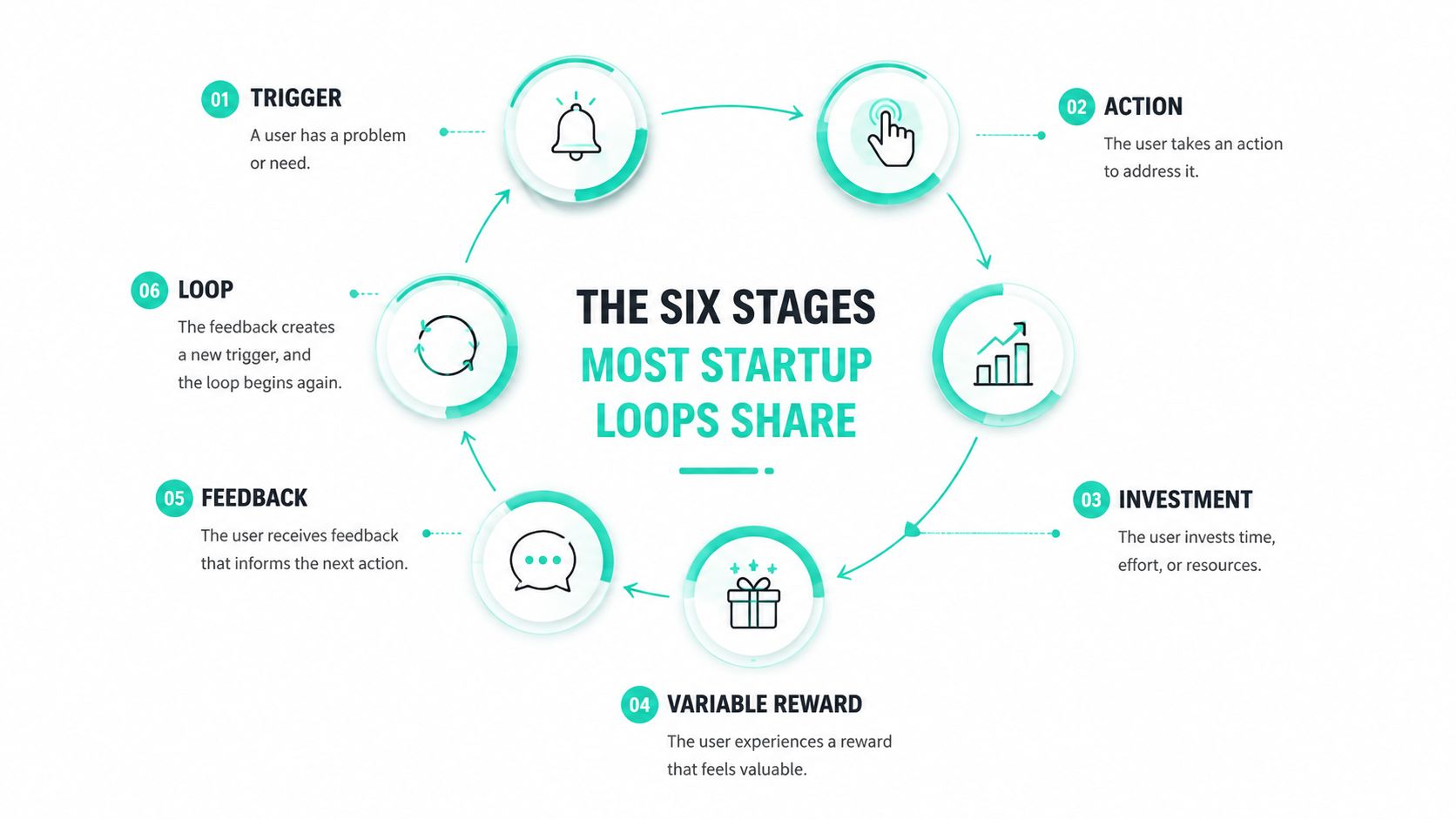
The six stages below describe the order candidates commonly experience, not a rigid corporate checklist. Smaller companies often collapse stages, with the founder handling the recruiter conversation or the hiring manager combining the screen and role discussion.
Application or curated introduction, about 30 minutes of candidate effort. This stage establishes basic relevance. A resume, referral, or curated introduction should give the company enough context to decide whether the role is worth a conversation. If the company asks for extensive unpaid work before speaking with anyone, treat that as an early warning.
Recruiter phone screen, about 30 minutes. The recruiter checks scope, motivation, location, compensation expectations, and obvious role fit. You should leave knowing who owns the next step and what the process is expected to include.
Hiring-manager call, about 45 minutes. The hiring manager tests experience against the actual problems behind the job description. Strong managers discuss priorities, team gaps, and success measures. Weak ones repeat the resume and can't explain why the role exists.
Technical or craft round, about 60 to 90 minutes. Engineers may work through coding, debugging, or system design. Product managers may handle prioritization or metrics. Designers may discuss a portfolio or complete a focused craft exercise. The company should tell you whether the session is collaborative, timed, open-book, or supported by tools.
Full loop or onsite, about 180 to 240 minutes. This usually includes 3 to 5 interviews in one day, with peers and cross-functional partners adding independent signal. The schedule should identify each interviewer and topic. Surprise additions make the loop harder to evaluate and often reveal poor internal coordination.
References and offer, about 60 minutes for the reference conversation. References validate working patterns, ownership, and collaboration. An offer conversation should explain cash compensation, equity, expectations, and the response timeline. Reference checks that happen after an offer can be reasonable, but an offer issued before references or before the team has aligned deserves careful scrutiny.
A missing stage can tell you more than an extra stage. If there's no hiring-manager conversation, nobody may own the role. If there's no practical evaluation for a hands-on job, the company may be selecting for polish rather than execution. If there's no opportunity to meet future teammates, the company may be protecting access to information instead of helping you make an informed choice.
A sensible startup loop moves quickly because the company has fewer layers, not because it skips evaluation. A recruiter screen should usually happen within 3 to 5 business days, the full loop should be scheduled within 1 to 2 weeks, and references and the decision should follow within 3 to 5 days after the loop. A company that wants to hire should extend the offer within a week of the final round.
| Pace | End-to-End Duration | Typical Signal | Candidate Action |
|---|---|---|---|
| Fast | About 10 business days | Clear rubric, available interviewers, decisive owner | Confirm the role scope and move quickly |
| Typical | 3 to 4 weeks | Structured process with some scheduling friction | Ask for dates and decision criteria |
| Slow | 6 or more weeks | Unclear ownership, indecision, or a low-priority search | Request a firm timeline and reconsider continuing |
Industry guidance reports that startup processes commonly last four to six weeks, with 52% of companies in that duration range, as described in startup interview timeline research. That range can be perfectly acceptable when the company communicates consistently. Silence between stages is the problem.
Use a direct question: “What's the timeline from here to offer, and who owns each decision?” A serious hiring manager can answer. If the response is vague, the process may have stalled in a “maybe” pile or the panel may be unable to agree.
Same-day debriefs matter because interviewers' impressions are freshest and the candidate isn't left in limbo. Startup hiring guidance associates same-day feedback with 2.5 times higher offer acceptance rates, and identifies completion rates below 80% as a warning sign for communication breakdowns, according to this startup hiring workflow analysis. Curated marketplaces such as Underdog.io can compress the front end because a pre-vetted introduction replaces some initial screening work. Candidates comparing processes can also use time-to-hire metrics to ask sharper questions about where a company loses time.
The role determines what the company should test. A startup that uses the same interview loop for engineering, product, and design is saving internal effort by sacrificing signal.
| Role | Typical Stages | Work Sample | Panel | Primary Rubric |
|---|---|---|---|---|
| Engineering | Recruiter, manager, coding, design, debugging, team loop | Take-home or live coding, system design, debugging | Peer engineer, senior engineer, product or infrastructure partner | Technical depth, tradeoffs, execution |
| Product | Recruiter, manager, execution case, prioritization, product critique, team loop | Metrics case, strategy exercise, written teardown | Founder, product leader, engineering or design partner | Judgment, prioritization, communication |
| Design | Recruiter, manager, portfolio, critique, craft exercise, team loop | Portfolio defense, whiteboard critique, focused exercise | Design peer, product partner, founder or brand lead | Craft, rationale, collaboration |
Engineering loops often contain the most technical variety. A company may ask for live coding, system design, and debugging or architecture work. That can be appropriate for a senior engineer, but startups regularly over-test engineers by stacking multiple versions of the same technical challenge while under-testing how candidates operate in messy production conditions.
Product interviews need sharper separation between storytelling and judgment. A polished candidate can describe past launches without showing how they prioritize when data is incomplete. Look for cases that require execution planning, metrics selection, tradeoff discussion, and a product critique grounded in the company's actual market.
Design loops frequently take longer because portfolio reviews require live explanation and can't be parallelized as cheaply as standardized screens. The company should still explain why each exercise exists and how much time it expects. A craft task that mirrors the role is useful. A vague redesign assignment that expands through feedback is free consulting.
The panel composition reveals the company's priorities. Founders tend to test mission alignment and autonomy. Peer individual contributors test working style and practical credibility. Cross-functional partners test whether the candidate can make decisions without turning every disagreement into escalation.
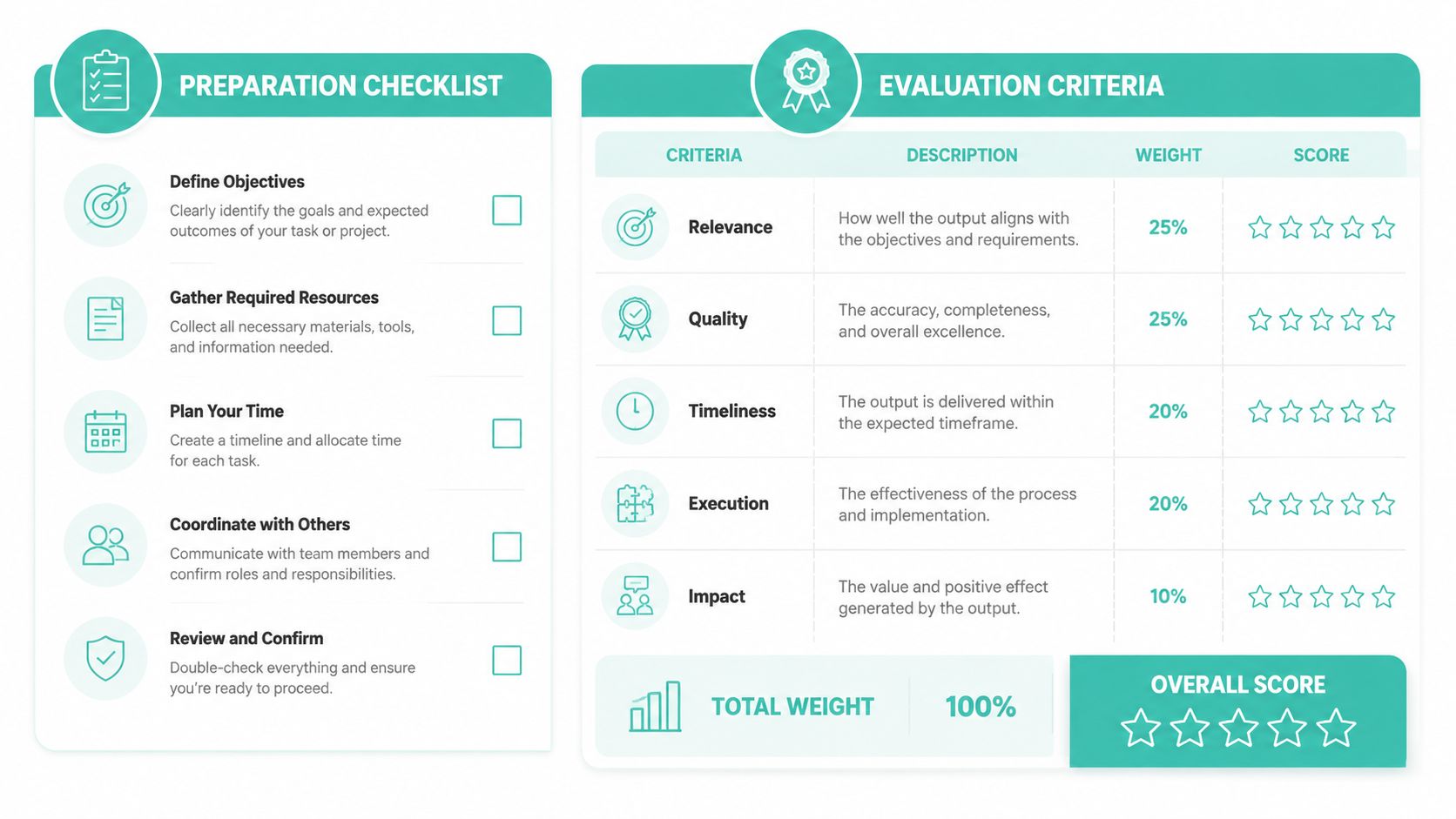
Preparation should follow the company's stages, not a generic collection of interview questions. The night before each conversation, reread the job post, identify the problem the role appears to solve, and review the interviewer's background. Then prepare two clarifying questions for that person and write down one specific idea you want them to remember.
Use three concise stories in STAR format, covering ownership, conflict, and a difficult tradeoff. Refresh the role's core stack, but don't spend preparation time memorizing trivia unrelated to the job. Startup interviewers usually care more about how you decompose an unfamiliar problem than whether you can recite an isolated fact.
Score yourself from 1 to 5 on the criteria below. The score isn't a prediction of the hiring decision. It's a way to expose weak spots before a panel does.
A score of 1 means you lack a concrete example. A score of 3 means you can answer with prompting. A score of 5 means you can answer clearly, explain the reasoning, and handle a follow-up that changes the constraints.
The strongest candidates don't just provide answers. They show the interviewer how they think when the original question stops being neat.
Run role-specific drills. Engineers should practice a system design response timed at 45 minutes, including requirements, architecture, failure modes, and tradeoffs. Product managers should write a product teardown that identifies the user, problem, metric, and likely prioritization conflict. Designers should rehearse a portfolio narrative that stays under five minutes before opening space for critique.
Good candidate emails are short, specific, and easy to answer. Customize the bracketed detail before sending.
Initial recruiter reply
Subject: Re: [Role title]
Hi [Recruiter name],
Thanks for reaching out about the [Role title] position. The work on [specific product, customer problem, or technical challenge] caught my attention, especially because of my experience with [relevant experience]. I'd be happy to learn more about the team, scope, and interview process. I'm available [two or three time windows], and I'm also glad to work around the team's schedule.
Best,
[Name]
Application confirmation
Subject: Application for [Role title]
Hi [Hiring team or recruiter name],
I've submitted my application for [Role title]. I'm particularly interested in [specific company detail], and my background in [relevant skill or outcome] seems closely aligned with the role's needs. If the team is open to a conversation, I'd welcome the chance to discuss how I'd approach [specific responsibility from the job description]. Thanks for reviewing my application.
Best,
[Name]
Phone-screen scheduling
Subject: Scheduling [Role title] conversation
Hi [Name],
Thanks for the invitation. I can meet on [date and time], [date and time], or [date and time] in [time zone]. Could you also share who I'll be speaking with and what the conversation will cover? I'd like to prepare appropriately, particularly around [specific area from the role]. I'm looking forward to learning more about [company or team detail].
Best,
[Name]
Rescheduling
Subject: Request to reschedule [interview stage]
Hi [Name],
I need to reschedule our conversation on [date] because of [brief, professional reason]. I'm sorry for the change and remain very interested in [Role title]. I can make [new time], [new time], or [new time]. If those don't work, please send alternatives and I'll prioritize finding a fit. Thanks for your flexibility.
Best,
[Name]
Post-interview thank-you
Subject: Thank you for [interview stage]
Hi [Interviewer name],
Thank you for the conversation about [specific topic]. Your explanation of [specific team challenge] helped me understand where the role could have immediate impact. I'd approach [relevant problem] by [brief, concrete thought], and I'd be excited to explore that further with the team. I appreciated your direct answer about [specific question]. Please let me know if I can clarify anything.
Best,
[Name]
Most candidates get this wrong by sending gratitude without adding signal. A concrete observation gives the interviewer something useful to remember. This follow-up email guide covers the same principle in more detail.
Polite withdrawal
Subject: Withdrawing from [Role title] process
Hi [Name],
Thank you for the time you and the team have invested in my candidacy. I'm withdrawing from consideration for [Role title] because I've decided to pursue an opportunity that is a closer fit for my current priorities. I've enjoyed learning about [specific company detail], and I appreciate the professionalism of the process. I hope our paths cross again.
Best,
[Name]
Rejection response
Subject: Re: [Role title] decision
Hi [Name],
Thank you for letting me know, and please thank the team for the conversations. I enjoyed learning about [specific project or challenge]. If you're able to share one area where my experience fell short for this role, I'd value the feedback. I'd also be glad to stay in touch about future roles that may better match my background.
Best,
[Name]
Offer deadline request
Subject: Offer timeline for [Role title]
Hi [Recruiter name],
Thank you for the offer for [Role title]. I'm excited about the opportunity, particularly [specific reason]. I'm reviewing the compensation, equity, and role scope carefully, and I'd like to make a thoughtful decision. Could we discuss extending the response deadline to [specific date]? I'm happy to keep you updated and can schedule a call to resolve any open questions. Thanks for your consideration.
Best,
[Name]
The offer template works because it signals genuine interest before asking for time. Don't write “I need more time” without a reason or date. Give the recruiter a concrete decision point and explain what you're evaluating.
An early-stage offer can look generous until you separate reliable cash from uncertain ownership. Review the package in four parts: base salary, sign-on payment, bonus, and equity. Compare dependable annual cash first, then assess whether the equity justifies the company and liquidity risk.
An equity grant may list shares or options, a vesting schedule, a strike price, and the company's current 409A valuation. A frequently used structure is four years with a one-year cliff, but the written grant controls. Incentive stock options (ISOs) and non-statutory stock options (NSOs) have different tax treatments. Stock units (RSUs and NSUs) are taxed differently still. Consult a tax professional before exercising anything.
For a practical explanation, read startup equity basics for job seekers. Ask the recruiter to provide these details in writing:
| Component | Seed | Series A | Series B |
|---|---|---|---|
| Base | More variable, with greater emphasis on mission and upside | Usually more defined against the company's hiring market | Often more competitive and internally standardized |
| Sign-on | May be limited or negotiated around cash constraints | Can be used to offset a candidate's forfeited compensation | More likely to be available for a difficult hire |
| Bonus | May be informal or role-dependent | Usually tied to documented expectations when offered | More likely to have clearer targets and eligibility |
| Equity | Greater uncertainty and potentially greater ownership relevance | Meaningful ownership may remain central to the package | Usually smaller ownership percentage, with more company information available |
| Risk profile | Highest company and liquidity uncertainty | Considerable risk, with more operating history | More evidence to evaluate, but no guarantee of liquidity |
A larger equity number does not establish a fair offer. Compare your percentage of the fully diluted company, the option or unit type, vesting terms, strike price, dilution risk, and liquidity prospects. Ask what happens if the company raises another round, and whether the grant includes acceleration or a post-termination exercise window.
Negotiate the whole package. If salary is fixed, request a sign-on payment, a larger grant, a refresh review, or clearer written terms. Ask the recruiter to distinguish board-approved details from verbal upside language. A well-designed process should make those distinctions easy to obtain. If basic offer questions produce evasive answers, treat that communication failure as evidence about how the company operates.
A strong startup loop is short on calendar and dense in signal. The company sends a rubric or at least explains the criteria, gives you one point of contact, puts the timeline in writing, and lets you meet the people you would work with.
Red flags are operational, not mysterious:
Use direct scripts. “Could you share the rubric before the loop so I can understand what the team will evaluate?” “Please send the timeline and decision owner in writing.” “I'm happy to complete a focused exercise, but I can't commit to unpaid work beyond the agreed scope.” For broader context on how process failures become expensive hiring errors, review these common hiring pitfalls for UAE founders.
A startup that can't describe its own hiring loop clearly will rarely run product or sales loops clearly. Candidates shouldn't judge a company only by how quickly it moves. Judge whether every stage earns its place.
Underdog.io connects vetted tech candidates with startups and high-growth tech companies, with hiring managers reaching out directly when there's a potential match. If you want a more focused way to evaluate startup interview processes and opportunities, apply through Underdog.io and start the conversation with teams that fit your goals.