Imagine getting to help build a world-changing product before anyone even knows it exists. That’s the entire premise of working at a stealth startup, where you join a small team operating in complete secrecy to protect a big idea. It's a high-stakes, high-reward path—one that’s perfect for innovators who want to make a massive impact right from day one.
A stealth startup is a company that intentionally keeps a low profile. Think of it as a secret mission in the tech world: a small, elite team works on something groundbreaking, completely under the radar. They’re free from the pressures of competitors, market expectations, and media hype.
This secrecy isn't just for show—it's a strategic shield. It gives the team the space they need to develop their core technology, nail down their business model, and secure a first-mover advantage before ever showing their cards. For example, a company developing a novel AI chip might operate in stealth to prevent larger competitors from co-opting their research before they've secured patents and a market lead.
So, what makes these confidential roles such a magnet for top-tier talent? It really boils down to a few key things:
This kind of environment is a perfect fit for anyone who values making a real impact more than having a famous company logo on their resume.
For talented engineers, designers, and product managers, these stealth startup careers offer a blend of risk and reward that you just can't find anywhere else. The recent economic climate has only made these opportunities more common.
A major downturn in global VC funding forced even tech giants to slash headcount, flooding the market with incredible talent. This shift allows stealth startups to snag experienced leaders who might have otherwise landed at a FAANG company. It’s a unique moment in the startup ecosystem.
To put it all in perspective, here’s a quick breakdown of how working at a stealth startup compares to joining a more established, public company. The differences are pretty stark.
As you can see, it's a completely different ballgame. Joining a stealth company is a bet—a bet on the founders, the mission, and your own ability to build something from the ground up. If that sounds exciting, exploring confidential careers can be a discreet way to find your next big challenge.
Joining a stealth startup is a career-defining bet. It’s a high-stakes environment where the potential rewards are massive, but the risks are just as real. Getting your head around this trade-off is the first step in deciding if this path is the right move for you. The whole experience is fundamentally different from joining an established company.
Think about it this way: you could be the sole designer defining a new brand's entire visual identity from the ground up. Every color, font, and logo choice is yours. Now, compare that to tweaking a button on an already successful app used by millions. Both are valuable jobs, but only one gives you the chance to build a legacy from scratch.

The biggest draw of a stealth role is the sheer scale of your impact. Early employees don't just execute tasks; they build the machine. You’ll find yourself wearing multiple hats, which accelerates your learning curve at a speed unheard of in larger organizations. One week you might be coding a core feature, and the next, you're helping interview the next hire or giving product feedback directly to a founder.
This intense, cross-functional work builds a unique and highly valuable skill set. But beyond personal growth, the financial upside can be life-changing.
Equity in a successful startup can generate wealth that far exceeds what’s possible through salary alone. You are betting on your team's ability to create immense value from nothing.
On the flip side, the risks are significant and shouldn't be ignored. The most obvious one is job instability. Most startups fail, and those in stealth mode are in their most fragile stage. There’s no guarantee the company will ever find product-market fit or secure its next funding round.
This pre-funding stage is where hiring is leanest and expectations are highest. For instance, hiring data shows a clear pattern where Series A companies post huge numbers of jobs—over 153,000 in one recent quarter—but early-stage stealth teams hire only a handful of versatile generalists. This just highlights the high-risk, high-reward nature of joining before a company has truly scaled.
Beyond instability, you'll face other challenges:
Ultimately, choosing a stealth startup career requires a careful look at your personal risk tolerance versus the incredible opportunity to build something truly new.
Forget everything you know about a traditional job search. Landing a role at a stealth startup isn’t about blasting your resume across massive job boards. It's about positioning yourself as an indispensable builder and tapping into the right, often hidden, networks.
This is truer than ever in the current market. Data shows that stealth startups are overwhelmingly hiring experienced pros who can make an immediate impact. With new grad hiring down a staggering 50% since 2019 and startups hiring under 6% new grads, the message is clear: founders want talent that can hit the ground running. You can dig into the full story in SignalFire's latest report on the state of the talent market.
Generic applications are a waste of time. To get noticed, you need to think like a founder and frame your experience through that lens.
Your network is your golden ticket for stealth startup careers. These roles are almost never posted publicly; they're filled through trusted referrals.
Founders and VCs rely on their inner circles to find early hires. Your goal is to get into those circles by providing value and demonstrating you understand their world.
Start by identifying venture capital firms that focus on seed-stage investments in your industry (e.g., a16z, Sequoia, Lightspeed). Follow the partners on social media, engage with their content thoughtfully, and look for warm introductions.
When you do reach out directly, make it count. Your message needs to be sharp, concise, and respectful of their time. Never send a generic "I'm looking for a job" email. Instead, show them you've done your homework.
Example Outreach Template
Subject: Building in [Their Industry] - Engineer with [Your Key Skill]
Hi [Name],
I've been following [Their VC Firm/Company]'s investments in the [Industry] space and was particularly impressed by your thesis on [Specific Topic].
My background is in building [Your Core Skill, e.g., scalable data pipelines] from the ground up at [Previous Company], where I [Quantifiable Achievement, e.g., reduced data processing time by 40%]. I thrive in early-stage environments and am currently exploring opportunities to help a founding team solve a major problem in this space.
If you know any founders in your portfolio who need someone with my skill set, I'd appreciate any connection.
Best,
[Your Name]
This kind of outreach shows you get the ecosystem and aren't just another applicant firing off resumes. While this is a long game, it's the most effective way to uncover those hidden gems. Of course, you can find helpful strategies for applying and landing jobs to complement this targeted approach. For more tactical advice, check out our guide on how to find startup jobs.
The hiring process for a stealth startup is unlike anything you’ve experienced. It’s a deliberate dance of secrecy and skill assessment, all designed to protect a core idea while finding people who can build something from nothing. Forget the standard application process; this feels more like being recruited for a confidential mission.
You won't find these jobs plastered all over public job boards. Instead, they pop up in more exclusive, trust-based circles.
Before you learn anything meaningful about the company, the product, or even the role, you'll almost certainly be asked to sign a Non-Disclosure Agreement (NDA). Don't mistake this for a simple formality. It’s your first test of professionalism and discretion.
The NDA is a legally binding contract that prevents you from sharing any proprietary information you learn during the interviews. For the startup, it's a critical shield. For you, it's a clear signal that you’re about to be let into the inner circle, even if just for a quick look. Signing it promptly shows you get it—you understand the rules of the game.
Once the NDA is out of the way, the real evaluation begins. Stealth startup interviews are built to test your raw problem-solving skills and your comfort with ambiguity, because the team can't just tell you what they're building.
Expect the questions to be intentionally vague. They aren't trying to trick you; they’re trying to see how you build structure from chaos. They care less about a single "right" answer and more about your thought process, the assumptions you make, and how you defend your choices. Your ability to think on your feet is what's truly on display.
The core of a stealth interview is evaluating your ability to build from zero. Can you create a solution, a process, or a system when no playbook exists? This is the fundamental skill they are hiring for.
You'll face hypothetical scenarios and wide-open technical challenges designed to probe your foundational skills, not your knowledge of a specific, pre-existing product.
To give you a better idea of what to expect, here are a few sample questions you might run into, tailored to different roles:
These questions are your moment to shine. They give you the stage to demonstrate your expertise, creativity, and resilience when facing the unknown. Showcasing a structured, first-principles approach will prove you have what it takes to thrive in a stealth startup career.
So, you’ve got an offer from a stealth startup. That’s a huge moment, and it's easy to get swept up in the excitement. But this isn't a typical job offer—it demands a much closer look. You're not just taking a job; you’re placing a bet on an unproven venture with your time and talent. Doing your homework is the difference between making a smart, calculated risk and taking a blind leap of faith.
The entire process of finding and interviewing for these roles is designed to be secretive. This is generally what the hiring flow looks like once you’re in the door.
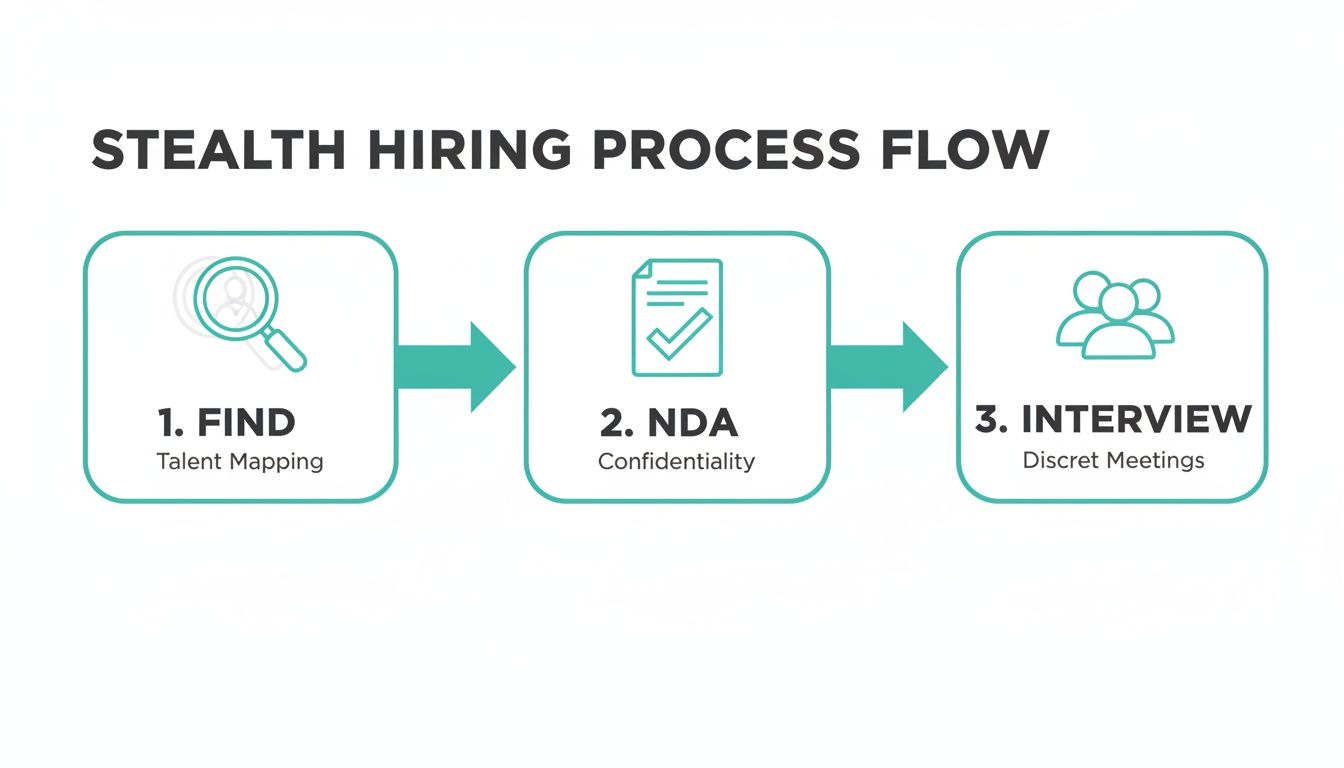
It’s a process built on speed and trust. Once you sign that NDA, things move fast from initial contact to deep, confidential conversations where they validate your skills.
This is where things can get fuzzy. With no public valuation, figuring out what your equity is actually worth feels like guesswork. The trick is to stop thinking about a hypothetical dollar amount and start focusing on your real ownership stake in the company.
You need to get clear on three things:
If the salary feels a little light, don't hesitate to negotiate for more equity. You can frame it as a partnership: "I'm all in on this mission and willing to take a lower cash salary to help us extend the runway. In return, would you consider increasing my equity grant to reflect that shared risk?"
Before you sign anything, you have to be ready to ask direct, even tough, questions. How the founders respond—their transparency or lack thereof—is often more revealing than the answers themselves.
A founder who gets cagey when you ask about funding, runway, or the core mission is a massive red flag. Real leaders build confidence by being upfront, even when the news isn't perfect.
Walk into that final conversation prepared. Think of it as your own due diligence for a potential stealth startup career.
Critical Questions to Ask the Founders:
Asking these questions helps you gauge the venture's stability, the clarity of the vision, and the health of the leadership team. A strong, confident founding team will welcome this kind of scrutiny. It shows you're serious, and it proves they're building something meant to last.
Trying to find a job at a stealth startup on your own can feel like navigating a maze in the dark. You know the opportunities are out there, but they’re hidden from public view. This is where a curated hiring platform acts as your confidential guide, connecting you to roles that you'll never see on a public job board. At Underdog.io, we’ve built our entire approach around this exact challenge, with a candidate-first model designed for a discreet search.
It all starts with a single, anonymous profile. This is key. It protects your privacy, letting you explore what's out there without tipping off your current employer. From there, you can forget about endlessly firing off applications into the void. Our human-powered matching system takes over, putting your profile directly in front of vetted, high-growth startups—many of which are still in stealth mode.
We’ve completely flipped the traditional hiring script. Instead of you chasing companies, the top startups apply directly to you based on your skills and experience. It’s a much more efficient way to land a job at a stealth company, cutting through the noise and giving you a direct line to the founders building something new and exciting. You can get a deeper look into how our curated marketplace works in our detailed guide.
Our goal is to make your job search smarter, not harder. By connecting you with pre-vetted stealth companies, we ensure every introduction is a high-signal opportunity worth your time.
This curated process gives you exclusive access to some of the most compelling new companies in major tech hubs, making it the perfect tool for your confidential job search.
Jumping into the world of stealth startups is exciting, but it definitely raises some unique questions. It's a different ballgame, after all. Here are some straightforward answers to the things candidates usually ask when they're thinking about a confidential role.
When you can’t drop the company name, you have to make what you built the hero of the story.
Instead of a specific title, you can go with a generic but clear description, like "Founding Engineer @ Stealth AI Startup (Seed Stage)." Then, use your bullet points to show off your concrete achievements. Think less about the company and more about your impact. For example: "Architected and deployed the initial cloud infrastructure on AWS, enabling the platform to scale from 0 to 10,000 users in the first six months."
The key is to focus on the tech you mastered and the measurable results you drove. Once the company finally launches, you can go back and proudly update your resume and LinkedIn with its real name.
Honestly? It’s a calculated bet, not a sure thing.
That equity could become life-changing if the company nails a big exit, whether that’s an acquisition or an IPO. But on the flip side, if the company can't find its footing and fizzles out, that equity is worth exactly zero.
Before you take an equity-heavy offer, you need to get real with yourself about your financial runway and how much risk you're truly comfortable with. It's a bet on the founders, their vision, and the market itself.
This environment is perfect for people who are incredibly adaptable, scrappy, and genuinely comfortable with ambiguity. You have to be the kind of person who enjoys solving problems without a playbook and building things from scratch.
If you're someone who is fired up by the mission and gets a real charge out of creating something the world has never seen before, a stealth startup is probably a great fit. It’s a world that rewards builders who can navigate uncharted territory and make things happen.
Ready to discreetly explore the most exciting stealth opportunities out there? With Underdog.io, you can create a single, anonymous profile and have top startups apply directly to you. Sign up for free today.