You're probably looking at tech jobs from the outside and seeing one giant barrier: coding. Job posts mention SQL, APIs, Jira, Figma, analytics, sprint planning, product sense, stakeholder management, and half the internet makes it sound like if you can't ship code, you don't belong.
That's the wrong read.
A tech company hires software engineers because it needs software built. It hires everyone else because software alone doesn't solve a business problem. Someone has to figure out what to build, explain it, test it, document it, support customers, improve onboarding, shape the interface, manage launch timelines, and reduce risk. That work is not peripheral. It's what turns a product into a company.
If you want a tech job without coding, the main challenge usually isn't capability. It's translation. People coming from education, operations, sales, recruiting, healthcare, hospitality, marketing, or admin work often already have the underlying skills. They just don't know how to present those skills in a way a startup hiring manager immediately understands.
That's why the usual advice to “learn to code first” often sends people down the wrong path. Before you spend months chasing a skill you may not even need, read Before You Learn to Code, Ask Yourself Why. For many candidates, the better move is choosing the right role, then learning only the tools and concepts that role employs.
The fastest way to get unstuck is to stop treating “tech” as a job title. It's an industry.
Industries hire many functions. Healthcare hires finance people, operations managers, analysts, coordinators, marketers, trainers, and customer-facing teams. Tech does the same. The difference is that outsiders often confuse the product being technical with every job around it being technical in the same way.
That confusion costs people time.
I've seen candidates spend months trying to become entry-level developers when they were already a much stronger fit for customer success, product operations, technical writing, QA, or project coordination. In many cases, their prior experience already matched the daily work. What was missing was a clearer target and better framing.
It usually comes down to three problems:
Practical rule: Don't ask, “Can I get into tech?” Ask, “Which function inside a tech company already matches how I work?”
A non-technical background is often an advantage when the job depends on empathy, process, writing, prioritization, or handling ambiguity. Startups in particular care less about whether your previous employer was “in tech” and more about whether you can solve messy problems without needing constant direction.
The path is rarely about becoming someone else. It's about recasting what you've already done into language a tech team recognizes.
A hiring manager at a startup reviews 200 applicants for one opening. The strongest candidate often is not the person with the most technical buzzwords. It is the person who understands where the role sits, what problems that team owns, and how their past work maps to those problems.
That is the part many career changers miss. Tech is not one job market. It is a collection of teams with different goals, tools, pressure points, and hiring filters. If you treat all non-coding roles as interchangeable, your search gets noisy fast.
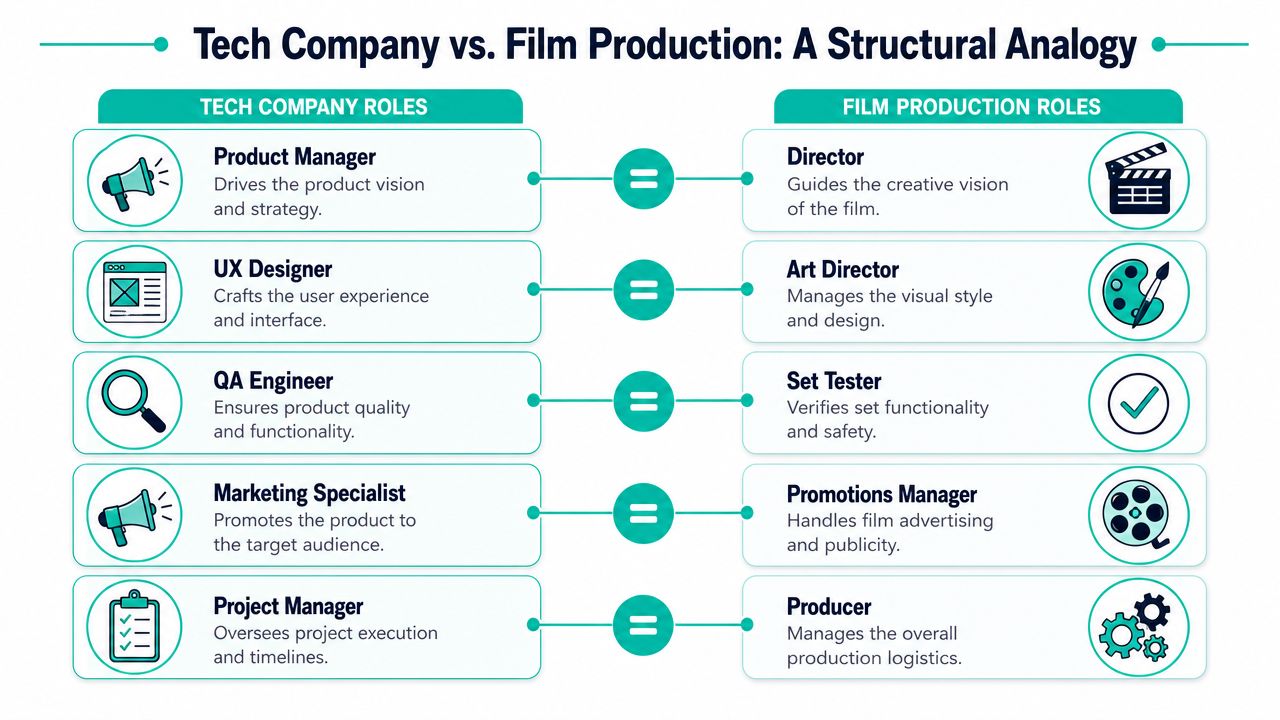
Here's the framework I use with candidates who are changing industries.
| Job family | What the team owns | Good fit for people who enjoy |
|---|---|---|
| Product | Prioritization, requirements, roadmap support, coordination | Problem solving, communication, trade-offs |
| Design | User flows, interface decisions, usability, content design | Visual thinking, empathy, research |
| Operations | Process, tools, workflows, internal systems | Organization, process improvement, execution |
| Go-to-market | Sales support, customer success, onboarding, enablement | Relationship building, persuasion, education |
| Risk and systems | Security, admin, compliance, system reliability | Detail, process discipline, structured thinking |
| Content and documentation | Technical writing, training, knowledge management | Writing, explaining, structuring information |
These categories matter because hiring teams evaluate experience differently. A product coordinator gets screened for judgment, documentation, and cross-functional communication. A customer success candidate gets screened for account handling, retention instincts, and calm under pressure. A technical writer gets screened for clarity, structure, and accuracy.
This is also why broad lists of “tech jobs without coding” often disappoint people. They group together roles that share an industry but not a day-to-day reality.
Early-stage startups usually hire for coverage. One person may handle project coordination, vendor management, and internal tooling in the same week. Larger companies split those responsibilities into narrower roles with clearer scope.
That difference changes your entry strategy.
If you come from education, hospitality, recruiting, healthcare administration, or agency work, startup roles are often easier to break into because they reward range. The question is less “Have you worked in tech before?” and more “Can you handle ambiguity, communicate clearly, and keep work moving?” Candidates who understand how product manager careers typically develop make better decisions about where to start and what titles are realistic early on.
Operations is a good example. In one company, operations means fixing broken internal processes, cleaning up CRM workflows, and improving reporting. In another, it means supporting sales compensation, renewals, and forecasting. If you want to understand revenue operations functions, study the actual workflow behind the title, not just the label.
The compensation and growth can be strong because these teams solve expensive problems. Security protects the business. Product coordination reduces wasted engineering time. Customer success protects renewals. Documentation cuts support volume and speeds onboarding.
The U.S. Bureau of Labor Statistics projects 29% growth for information security analysts from 2024 to 2034, with a median annual wage of $124,910, and adjacent roles like web and digital interface designers averaged $98,090 in May 2024, according to this industry analysis citing BLS labor data.
In practice, I've seen candidates raise their odds once they stop asking, “Which non-coding tech job should I apply for?” and start asking, “Which team already works like I do?” That shift leads to better targeting, better interview stories, and fewer random applications.
Start with your strongest repeated pattern at work.
A smart move into tech usually comes from matching your existing operating style to the right team, then learning that team's tools and language fast enough to sound credible in interviews.
A lot of career changers get stuck here. They search job titles, open 20 tabs, and still cannot tell which roles are realistic for their background.
The better approach is to sort roles by the kind of problems you would solve every day. Tech companies hire non-coding talent to keep products usable, customers retained, systems organized, and teams aligned. That is why roles such as technical writer, instructional designer, UX/UI designer, cybersecurity analyst, systems administrator, product or project coordinator, and customer success manager show up across startups and larger companies, as outlined by the University of Washington Professional & Continuing Education overview.
| Role Title | Core Responsibility | Key Skills | Typical Salary Range (USD) |
|---|---|---|---|
| Product Coordinator or Associate PM | Keeps product work organized, gathers requirements, aligns teams | Prioritization, communication, documentation, Jira, stakeholder management | Varies by company and market |
| UX/UI Designer | Improves flows, layouts, usability, and interface decisions | Figma, user empathy, wireframing, visual hierarchy, research | Related design roles can reach strong compensation |
| QA Analyst | Tests product behavior, catches bugs, validates releases | Attention to detail, test cases, communication, curiosity, process discipline | Varies by company and market |
| Technical Writer | Creates product docs, help centers, internal knowledge, release notes | Clear writing, structure, interviewing subject matter experts, information architecture | Technical writers are often solid entry points for strong writers, as noted in this overview of high-paying non-coding jobs in tech |
| Customer Success Manager | Onboards customers, drives adoption, handles renewals and escalations | Communication, account management, empathy, troubleshooting, presentation | Varies by company and market |
| Cybersecurity Analyst | Monitors risk, supports compliance, investigates incidents | Risk analysis, process, alert handling, communication, security fundamentals | Information security analysts show strong growth and compensation, as covered earlier |
| Systems Administrator | Manages tools, access, permissions, and internal systems | Systems thinking, troubleshooting, process, documentation | Varies by company and market |
| Instructional Designer | Builds training materials, onboarding content, and learning systems | Learning design, writing, curriculum thinking, collaboration | Varies by company and market |
| Project Manager | Owns timelines, dependencies, and execution across teams | Planning, follow-through, communication, organization | Varies by company and market |
| Technical Sales or Solutions | Explains product value, handles demos, supports sales cycles | Discovery, communication, product understanding, persuasion | Varies by company and market |
Product coordination is one of the clearest entry points for candidates coming from operations, admin, client service, or account support. The day-to-day work is less about having product ideas and more about keeping work moving. That means cleaning up requirements, following up on decisions, tracking dependencies, and making sure a team does not lose context between meetings.
UX/UI design pulls in a lot of career changers because the output is visible. The trade-off is that entry-level hiring is crowded, and a portfolio matters more than enthusiasm. Candidates with a background in teaching, support, hospitality, or research often do well if they can show how they observed user behavior, simplified confusing experiences, and turned feedback into better flows.
Customer success is a stronger fit for former account managers, recruiters, educators, and service leads than many guides admit. Good teams want someone who can run onboarding, reduce churn risk, handle difficult conversations, and surface product issues clearly. Friendly communication helps, but the core value is judgment, pattern recognition, and steady follow-through.
Technical writing is a practical route for candidates who already write SOPs, training docs, help articles, policy updates, or internal process guides. Hiring managers look for clean structure and accuracy. They also look for someone who can interview subject matter experts and turn scattered information into documentation people can use.
QA and systems administration usually appeal to people who are methodical. If your background includes auditing records, troubleshooting tools, maintaining permissions, or checking work for errors, these roles can make sense. They reward consistency and process discipline more than personal branding.
The candidates who transition fastest usually stop trying to sound more technical than they are. They learn how to describe their past work in terms a tech team already respects.
That reframing matters. A restaurant manager did not just supervise shifts. They handled staffing gaps, customer escalations, process adherence, and time-sensitive coordination. A teacher did not just deliver lessons. They managed stakeholder expectations, created repeatable learning materials, and adapted explanations based on user confusion. In startup hiring, that translation often matters more than a perfect title match.
Some of the best entry points sit outside the roles people search first. Revenue operations, lifecycle operations, onboarding, enablement, and implementation often reward the same traits that startups want in product-adjacent hires. If that direction interests you, it helps to understand revenue operations functions before you start applying, because the same title can mean CRM hygiene at one company and cross-functional reporting, process design, and forecasting support at another.
Product still gets the most attention, often from smart generalists who like problem-solving and cross-functional work. That interest makes sense. It also creates confusion, because many candidates aim for product manager roles when associate product, product operations, product support, or coordinator roles are the more realistic first step. If you are considering that route, review this explanation of the product manager career path and compare the actual expectations with the work you have already done.
People often overestimate what they need to learn from scratch and underestimate what they already know.
That's the first mindset shift. A transition into a tech job without coding is usually about combining two assets: transferable experience you already have, and a short list of tools or concepts that make you legible to hiring teams.

Take your last two or three jobs and strip away the industry labels.
Did you train new hires? That maps to onboarding, enablement, documentation, or instructional design.
Did you manage demanding clients? That maps to customer success, account management, implementation, or support escalation.
Did you coordinate schedules, vendors, handoffs, or approvals? That maps to project management, operations, and cross-functional execution.
A simple inventory works well:
Now get specific. Don't “learn tech.” Learn the tools your target role uses.
For UX, that might be Figma, basic user flows, wireframes, and usability thinking.
For project and product coordination, it might be Jira, Notion, ticket writing, roadmap hygiene, and release communication.
For customer success, it might be CRM workflows, onboarding plans, knowledge-base writing, and handling renewals or escalations.
For technical writing, it's structured writing, docs strategy, version awareness, and interviewing subject matter experts.
Hiring test: If a recruiter asks, “What tools have you used that are closest to this role?” you need a clear answer within ten seconds.
Build proof, not just knowledge. One mock onboarding guide, one sample help-center article, one Figma flow, one release checklist, or one cleaned-up project plan is often more useful than another course certificate.
“Non-coding” doesn't mean low-tech anymore. It means your work is increasingly tool-heavy, system-heavy, and AI-assisted.
The World Economic Forum's 2025 research says 39% of workers' core skills are expected to change by 2030, and it identifies analytical thinking, resilience, flexibility, and AI and big-data literacy among the fastest-growing skills, as summarized in this discussion of tech careers beyond coding.
That changes the strategy. Don't just avoid code. Learn how AI tools help you write drafts faster, summarize interviews, organize knowledge, analyze patterns, and produce cleaner work.
Useful habits include:
Candidates who combine domain experience with good AI judgment look much stronger than candidates who present themselves as proudly non-technical.
A common pattern looks like this: someone spends weeks learning Jira, Figma, or Zendesk, builds one or two decent samples, then applies to 80 jobs with the same resume and gets almost nothing back.
The problem usually is not effort. It is positioning.
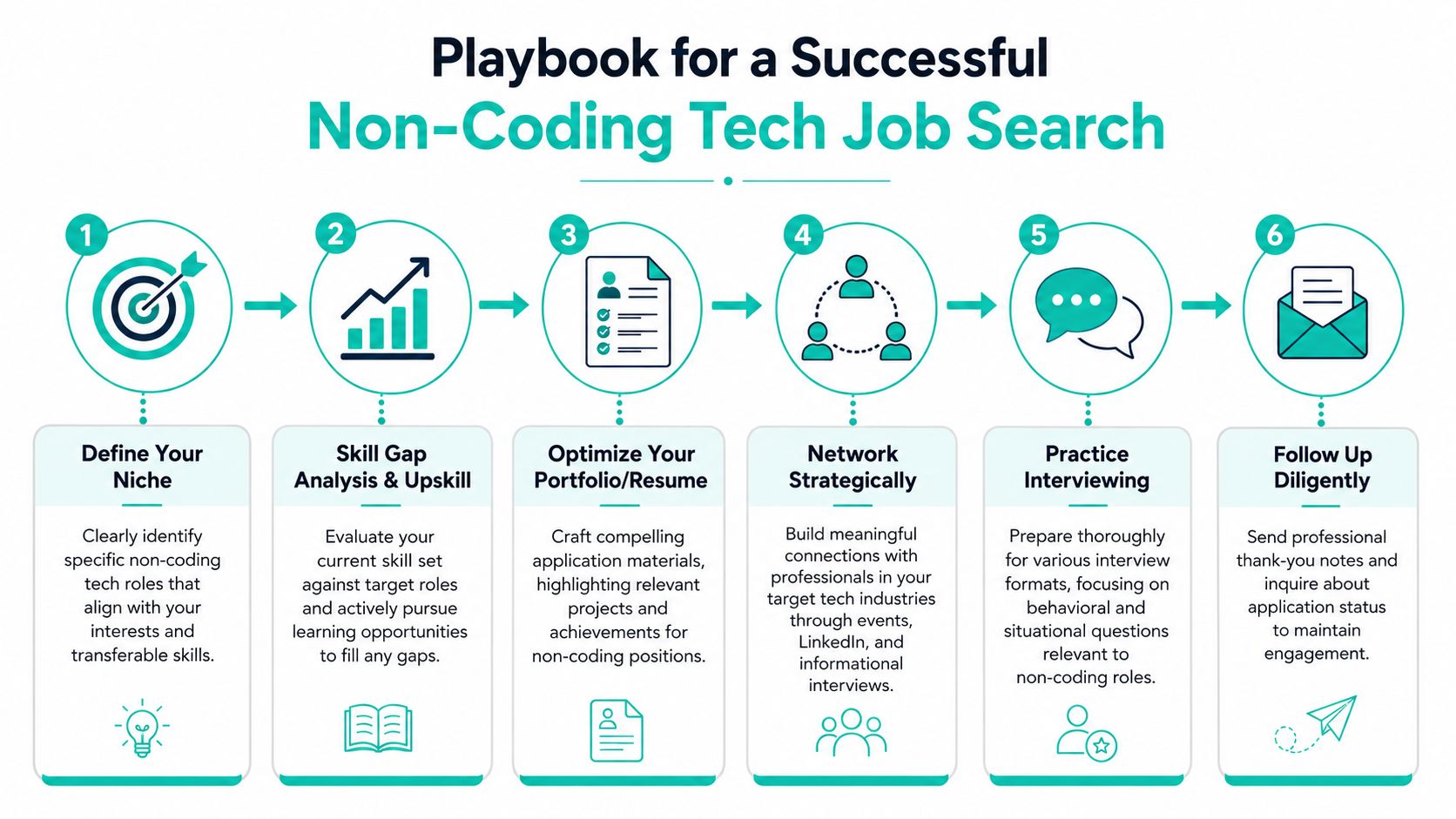
A resume that worked in healthcare, education, retail, operations, or admin can still miss in tech because the language is off. Hiring teams want to see ownership, judgment, and outcomes. They also want to see whether you can work across functions without waiting for perfect instructions.
That is why generic bullets underperform.
Instead of this:
Use this:
Instead of this:
Use this:
The strongest formula is simple: accomplished X by doing Y in context Z. That structure forces you to show contribution, not just duties.
If you need examples, this guide on how to write a tech resume is a solid reference.
Career changers lose time by targeting too many roles at once. “Open to operations, project management, customer success, product, UX, and marketing” reads like uncertainty, even when the person is capable.
Pick two role families that share skills and hiring signals. Then build your search around them.
A practical sequence works well:
This is the mindset shift that matters most. You are not asking tech companies to ignore your background. You are translating your background into problems they already need solved.
Startups often respond well to candidates with mixed experience because the work itself is mixed. A former teacher who can write clear docs, calm frustrated users, and organize messy workflows may be a stronger onboarding hire than a candidate with a cleaner title and weaker execution.
Useful networking is not about asking strangers to refer you after one message. It is research.
Talk to people one level ahead of where you want to be. Ask what they do on a normal Tuesday, what tools they use every week, what mistakes they see from new hires, and how their team evaluates candidates without direct tech experience.
Those conversations help you fix the parts of your story that are still too vague. They also help you avoid targeting the wrong version of a role. For example, if you are exploring insight-related paths, read about user research jobs early so you can separate research operations, participant recruiting, and hands-on research work before you start applying.
A good informational chat should give you something you can act on the same day. A better keyword. A missing tool. A clearer title. One corrected assumption can save you a month of bad applications.
Non-coding roles still get tested hard. The test is usually how you think, how you communicate, and how you make trade-offs.
For product or project roles, expect questions about priorities, deadlines, and conflicting stakeholder requests. For customer success, expect retention scenarios, escalation judgment, and communication under pressure. For UX or content roles, expect a walkthrough of your work and the reasoning behind your decisions. For QA or systems-heavy support roles, expect process questions and edge cases.
Prepare examples around:
Keep the stories specific. Strong candidates sound like people who have done the work, not people who memorized tech vocabulary.
You do not need a perfect plan. You need movement.
Start with three actions today.
Choose two roles that fit your actual strengths, not your aspirational online identity. Good pairings are often close together, like customer success and onboarding, project coordination and product ops, or technical writing and enablement.
Write down why each one fits your background. If you can't explain the fit in two or three lines, it's probably not the right target yet.
Pick a core tool for one of those roles and spend time using it, not just reading about it. Build something small and concrete: a Figma wireframe, a Jira project board, a sample help-center article, a mock onboarding plan, or a short research summary.
If you want a simple way to publish that work, a lightweight personal site helps. This own.page tutorial shows one straightforward no-code option for putting samples in one place.
Take one achievement from your current or previous job and translate it into tech language.
Not inflated language. Clear language.
“Handled front desk communication” can become “managed high-volume customer communication, resolved issues quickly, and coordinated next steps across teams.”
“Trained new staff” can become “created repeatable onboarding guidance and coached new team members on process execution.”
That one rewritten bullet often tells you whether you're thinking like a candidate for a tech job without coding, or still describing yourself like an outsider.
If you're ready to test the market, create a profile on Underdog.io. It's a curated hiring marketplace where candidates can apply once and get considered by vetted startups and high-growth tech companies, which is a practical way to explore real opportunities without relying only on traditional job boards.