At 11 p.m., a mid-career engineer or product manager can spend an hour moving between NYC startup career pages, LinkedIn tabs, and a spreadsheet of compensation notes, trying to decide whether a move is worth the disruption. The roles look promising, but the practical questions are harder: is the job flexible, will the salary justify the commute, and can a confidential search produce better options than another round of cold applications?
The market is large enough to reward a targeted strategy, but uneven enough to punish a generic one. The New York metro area reached 394,300 tech talent jobs in 2025, ahead of San Francisco's 375,730, according to CBRE data reported by Commercial Observer. Yet growth is concentrating in particular skills, neighborhoods, and company stages. This guide covers the demand by role, compensation evidence, geography, startup hiring mechanics, search tactics, and the role of curated confidential marketplaces in helping candidates find opportunities without broadcasting a job search.
A senior engineer comparing offers on a weeknight is rarely choosing between “tech” and “no tech.” The choice may be fintech versus healthcare, a venture-backed startup versus an established media company, or a role that requires Midtown presence versus one built for hybrid work. New York's employer mix gives the same technical background several possible applications, but job titles alone do not reveal the differences in scope, pace, or compensation.
The metro area had 394,300 tech talent jobs in 2025, compared with 375,730 in San Francisco, and added 30,640 jobs since 2022, based on CBRE data cited by Commercial Observer. That headcount gives New York the largest U.S. tech talent market by headcount in that analysis. For candidates, the advantage is optionality: more employer types, more adjacent industries, and more ways to change companies without leaving the region.
AI is concentrating demand rather than lifting every role equally. The Fortune analysis of New York's technology workforce reported that AI-related roles in NYC grew 120% year over year. That growth does not turn every software engineer, designer, or marketer into a foundation-model candidate. It increases pressure around machine learning, model integration, data infrastructure, evaluation, and products that put AI into a usable workflow.
A large metro market can still feel slow from inside a specific hiring funnel. NYCEDC reported tech employment growth of only 0.7% between 2022 and 2024, according to the same Commercial Observer coverage of CBRE and city-level data. Candidates therefore encounter expanding regional headcount alongside cautious employers, narrow searches, and intense competition for well-scoped roles.
The practical response is to define the target more precisely than “tech jobs in New York.” A platform engineer at a fintech scale-up, a product manager at a healthcare startup, and a designer at an AI company face different interview loops, office expectations, and negotiating power. Timing and specialization often matter as much as brand recognition.
Curated, confidential marketplaces such as Underdog.io can change the search calculus. Passive candidates can test relevant opportunities without broadcasting a move, while active candidates can spend less time on generic applications and more time on roles that fit their experience, location, and timing.
Practical rule: Treat 2026 as a timing window, not a reason to apply everywhere. Identify the growing skill clusters, acceptable commute zones, company stage, and hiring channels before increasing application volume.
New York's technology workforce is larger than any single definition of “tech” suggests. One independent study found that tech employment rose from 80,020 jobs in 2010 to 193,929 in December 2021, an increase of 113,909 jobs, or roughly 142%. The sector represented 5.2% of the city's private-sector employment and contributed to about a quarter of total city job growth over the prior decade, according to the Center for an Urban Future report.
A separate New York State Comptroller report found that NYC tech-sector employment rose 33.6%, or 43,430 jobs, from 2016 to 2021, reaching 172,570 jobs. During that period, overall private-sector employment fell by 3.3%. After combining tech-sector jobs with broader tech-industry roles, the report counted 281,100 tech jobs in 2021, 58% higher than in 2011.
These figures establish a substantial base before the latest AI hiring cycle. The current metro headcount is larger, but growth remains uneven by occupation, company type, and location.
The metro market extends beyond the five boroughs into nearby New York counties, New Jersey, and other commuter-linked areas. That geography affects recruiting directly. A Manhattan employer may compete for candidates in Brooklyn, Long Island City, Westchester, Jersey City, and other parts of the region, while a candidate can accept an NYC-area role without commuting to a Manhattan office every day.
The city-level picture is more restrained in some segments. NYCEDC reported 0.7% growth between 2022 and 2024, a pace that points to a plateau for parts of the local market rather than uniform expansion. AI, financial technology, data infrastructure, and specialized software can continue hiring while generalist openings attract heavy competition. Commercial Observer's market coverage places that city-level movement alongside broader metro growth.
| Metric | NYC Metro Figure | Trend vs. 2024 |
|---|---|---|
| Tech talent jobs | 394,300 in 2025 | Larger than the five-borough picture |
| San Francisco comparison | 375,730 in 2025 | NYC led by headcount in the cited analysis |
| Jobs added since 2022 | 30,640 | Clear metro-level expansion |
| NYC tech employment growth | 0.7% from 2022 to 2024 | City-level plateauing |
Candidate negotiating power is strongest in roles that connect AI applications with reliable production systems. Foundation-model companies draw attention, yet New York employers also need people who can build data pipelines, platform tooling, security controls, evaluation systems, and customer-facing products around those models. The same pattern reaches product and design. Product managers who define measurable AI workflows, designers who make model behavior understandable, and marketers who explain technical products in regulated industries can benefit from this demand.
Large incumbents offer stability, recognizable systems, and established processes. Venture-backed startups provide broader ownership, faster decisions, and more direct access to founders, with greater uncertainty around process and equity. Candidates should choose based on the trade-off that fits their current objective, then target employers whose hiring behavior matches it. Curated, confidential marketplaces such as Underdog.io can help passive candidates test relevant opportunities privately, while active candidates can focus on better-matched roles instead of sending generic applications.
Role labels hide important differences in NYC. “Software engineer” might mean a frontend contributor at a consumer startup, a distributed-systems specialist at a financial company, or an infrastructure engineer supporting an AI product. The title matters less than the system being built, the stage of the company, and the amount of ownership expected.
Salary evidence shows a wide market. Motion Recruitment's 2026 New York technology salary guide reports an average base salary of $162,038 for all NYC tech workers. It places mid-level technical support analysts around $76,000 to $91,000, while QA engineers range from about $98,000 at mid-level to $157,000 at senior level. These figures aren't universal offer bands, but they provide useful anchors when a recruiter asks for expectations before sharing a complete compensation package.
Platform engineering, machine learning, and data engineering tend to command the strongest premiums when the candidate has production evidence rather than only course or prototype experience. An AI feature that shipped, an evaluation pipeline used by a team, or a data platform that improved reliability gives the hiring manager something concrete to assess.
Contract rates reinforce the distinction between general technical hiring and scarce specialist work. Langley James' New York technology and AI salary guide lists contractor day rates of $1,800 for AI/ML engineers, $1,300 for senior software developers, and $1,650 for senior data scientists. Those rates don't translate directly into permanent salary, but they show how NYC employers price specialized capability when speed matters.
Product, design, and growth roles can be excellent opportunities, but their ranges are more sensitive to company stage and portfolio quality. A product manager with fintech workflow experience may be more attractive to a payments company than a generalist with a longer résumé. A product designer who can demonstrate shipped research, interaction decisions, and collaboration with engineering usually beats a portfolio built entirely from polished concept work.
Public data doesn't provide verified base, equity, and bonus bands for seed, Series A, and Series B startups across every role. A candidate shouldn't pretend that a single table can resolve that uncertainty. Instead, use the comparison below as a negotiation framework, then ask the company to state the actual cash, equity instrument, vesting terms, and variable compensation.
| Role | Base Salary Range | Equity Norm | Demand Level |
|---|---|---|---|
| Engineering | Varies by specialization and seniority. Use the Motion and contractor benchmarks as anchors | Ask for instrument, vesting, strike price, and refresh policy | High for platform, infrastructure, and AI-adjacent work |
| Data | Specialist rates can exceed general software rates when production experience is scarce | Clarify whether the role owns models, pipelines, or analytics | High when tied to product or operational systems |
| Product | Highly dependent on domain, stage, and technical depth | Ask how ownership changes with company growth | Active, but selective |
| Design | Portfolio and product domain create major variation | Confirm whether equity reflects individual or team scope | Competitive and variable |
| Growth marketing | Technical fluency and measurable pipeline ownership matter | Ask whether incentives include bonus or equity | Strongest in product-led and B2B environments |
Across roles, AI fluency is becoming a multiplier rather than a standalone job category. LLM integration, vector databases, evaluation pipelines, model observability, and careful user experience design can improve a candidate's positioning even when the job title doesn't mention machine learning. The best framing is specific: explain what you built, which users relied on it, what trade-off you made, and how the team maintained it after launch.
Hiring speed differs too. A startup with an urgent platform gap may close an experienced engineer quickly, while a product or design search can remain open while founders compare working styles and portfolio judgment. Candidates should ask directly where the role sits in the company's current plan. “How many people are already interviewing?” and “What decision must this hire enable?” reveal more than a generic description of the process.
NYC compensation is partly a geography problem disguised as a salary conversation. Two jobs with similar base pay can feel very different when one expects regular attendance near Union Square and the other supports a hybrid schedule from Long Island City or Jersey City. Office location affects commute time, lunch and transit costs, the value of workplace perks, and how much flexibility a candidate can realistically negotiate.
Flatiron, Union Square, and the SoHo corridor remain associated with growth-stage startups and dense founder networks. DUMBO and the Brooklyn waterfront attract early product and engineering teams, while Hudson Yards and Manhattan West accommodate larger employers with more formal operating structures. Midtown continues to absorb engineering work connected to financial services and established businesses.
Industry City and the Brooklyn Navy Yard are useful areas to watch for hardware, climate-tech, and industrial innovation. Long Island City and Jersey City can offer rent arbitrage and practical hybrid options, although the benefit depends on how often the employer expects people in the office. A commute that looks manageable on a map can become a retention issue when a team changes its attendance policy.
| Neighborhood | Dominant Company Stages | Typical Roles | Commute & Comp Impact |
|---|---|---|---|
| Flatiron and Union Square | Growth-stage startups | Product, engineering, operations | Dense hiring network, often higher in-person expectations |
| SoHo | Growth-stage and established digital companies | Design, product, marketing | Strong office access, competitive candidate pool |
| DUMBO | Early-stage startups | Product and engineering | Brooklyn access can improve fit for local candidates |
| Brooklyn waterfront | Early-stage and scaling teams | Engineering, design, product | Commute varies sharply by subway and ferry access |
| Hudson Yards and Manhattan West | Larger employers | Engineering, data, product, enterprise technology | Formal offices and structured compensation |
| Midtown | Financial-services and incumbent employers | Software, data, security | Central access, often more regulated environments |
| Industry City and Brooklyn Navy Yard | Hardware and climate-tech | Hardware, engineering, operations | Specialized work, location can narrow the candidate pool |
| Long Island City and Jersey City | Hybrid regional employers | Engineering, support, data, product | Potential rent and commute advantage, policy matters |
For a salary-specific reference point, candidates can review this guide to software engineer salary in New York, then adjust the discussion for stage, specialization, equity, and office requirements. The number on the offer letter isn't the whole package. A lower base can be reasonable when the role provides genuine flexibility and meaningful ownership, but not when “hybrid” means daily attendance.
Your address doesn't determine your value, but it can determine which offers feel viable before you discuss compensation.
Before interviewing, map the office against your actual weekly routine. A candidate in Queens may value Midtown access, while someone in New Jersey may prioritize a predictable Hudson River commute. Ask about anchor days, late meetings, equipment, and whether the team has changed its policy recently. These details shape the offer's real value more than a polished workplace page.
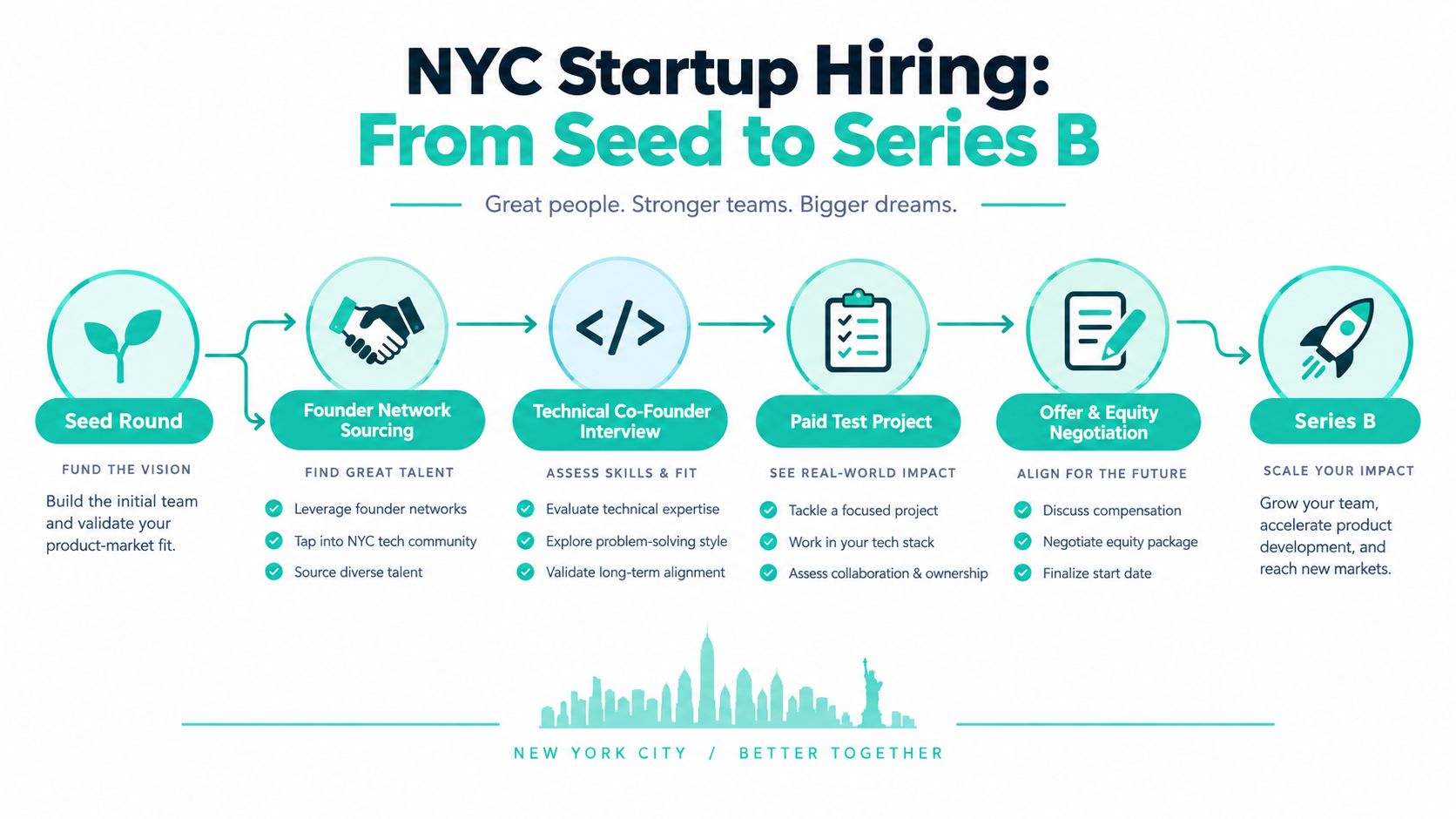
A seed-stage startup can't hide a weak hire inside a large department. The founder may be selling the company to candidates, running the first screen, reviewing code or product work, and deciding whether the person can operate without a mature support structure. By Series B, the company may have a recruiter, hiring managers, interview panels, and a more repeatable process, but speed still matters because an unfilled technical role can delay a product milestone.
The sourcing channel usually reflects that operating reality. Founders start with people they trust, then extend into targeted LinkedIn outreach, niche Slack and Discord groups, university pipelines, advisors, and curated marketplaces. A candidate who arrives through a credible introduction often gets context that a cold applicant doesn't, but direct applications still work when the profile clearly matches an active need.
At a small team, the technical co-founder or founding engineer may assess architecture, coding judgment, and practical ownership in a single conversation. A paid test project can reveal more than an abstract interview when the task resembles the product's real constraints. At a larger Series B company, the process may include a recruiter screen, manager interview, technical assessment, cross-functional panel, and founder or executive conversation.
The following flow captures the typical shift in emphasis.
Teams that need a physical base may also use a startup office in New York City as part of their operating setup. For candidates, the relevant question isn't whether the office looks attractive. It's how the workspace supports collaboration, what attendance is expected, and whether the company has designed the role around that location.
Founders often over-index on recognizable employer names. A FAANG background can help, but it doesn't prove that someone can define an ambiguous problem, work with incomplete information, or make sound trade-offs without a large platform team. Candidates should counter pedigree bias with evidence of scope, decisions, and shipped outcomes.
Other failures are operational:
NYC startups hire with urgency because every open role competes with product deadlines and fundraising narratives. Candidates who bring a concise portfolio, clear technical examples, references, and a realistic start timeline reduce decision friction. Preparation doesn't guarantee an offer, but it makes the candidate easier to approve.
A serious search needs sequence. Start by choosing a narrow target rather than collecting every appealing listing. An engineer might focus on platform and AI infrastructure, a product manager on fintech or healthtech workflows, and a designer on B2B products where research and systems thinking matter. A narrow position makes networking messages more credible and helps recruiters remember what to send.
NYC communities can work when the candidate participates before asking for a referral. NY Tech events, TechWeek gatherings, Brooklyn Beta alumni circles, NYC Engineering groups, and NYC Data communities can create useful conversations, but attendance alone rarely creates momentum. Bring a question about a company's technical direction, share a relevant project, and follow up with a short note that makes the next conversation easy.
Portfolio framing should reflect the role's actual decision surface.
GitHub, LinkedIn, a personal site, and a concise portfolio should tell the same story. A polished case study that doesn't show shipped work won't compensate for a missing technical discussion. Tailor examples to New York's mix of fintech, healthtech, climate, media, and B2B software rather than presenting yourself as interchangeable across every industry.
Ask what the take-home is intended to measure and how much time the team expects. For senior engineering roles, prepare to discuss system boundaries, failure modes, observability, security, and migration choices. For product and design, expect founder screens to test judgment, communication, and comfort with ambiguity more than framework vocabulary.
Equity deserves direct questions. Ask whether the grant is options or restricted stock, how the 409A valuation relates to the option strike price, how preferred-share pricing differs from the employee common-stock valuation, and whether the company offers refresh grants. Don't evaluate equity separately from base pay. Consider the stage, dilution risk, vesting schedule, exercise terms, and the role's actual influence on company value.
Candidates who need a lower-risk entry can consider contract-to-hire or fractional work through staffing partners such as nexusITgroup.com. That route can create a practical way to evaluate team quality and working conditions before making a permanent move.
For broader preparation ideas, candidates can also review these 2026 job search tips, then adapt the advice for experienced startup hiring. Use the NYC tech startup jobs guide when you want a targeted view of startup opportunities rather than a general job-board search.
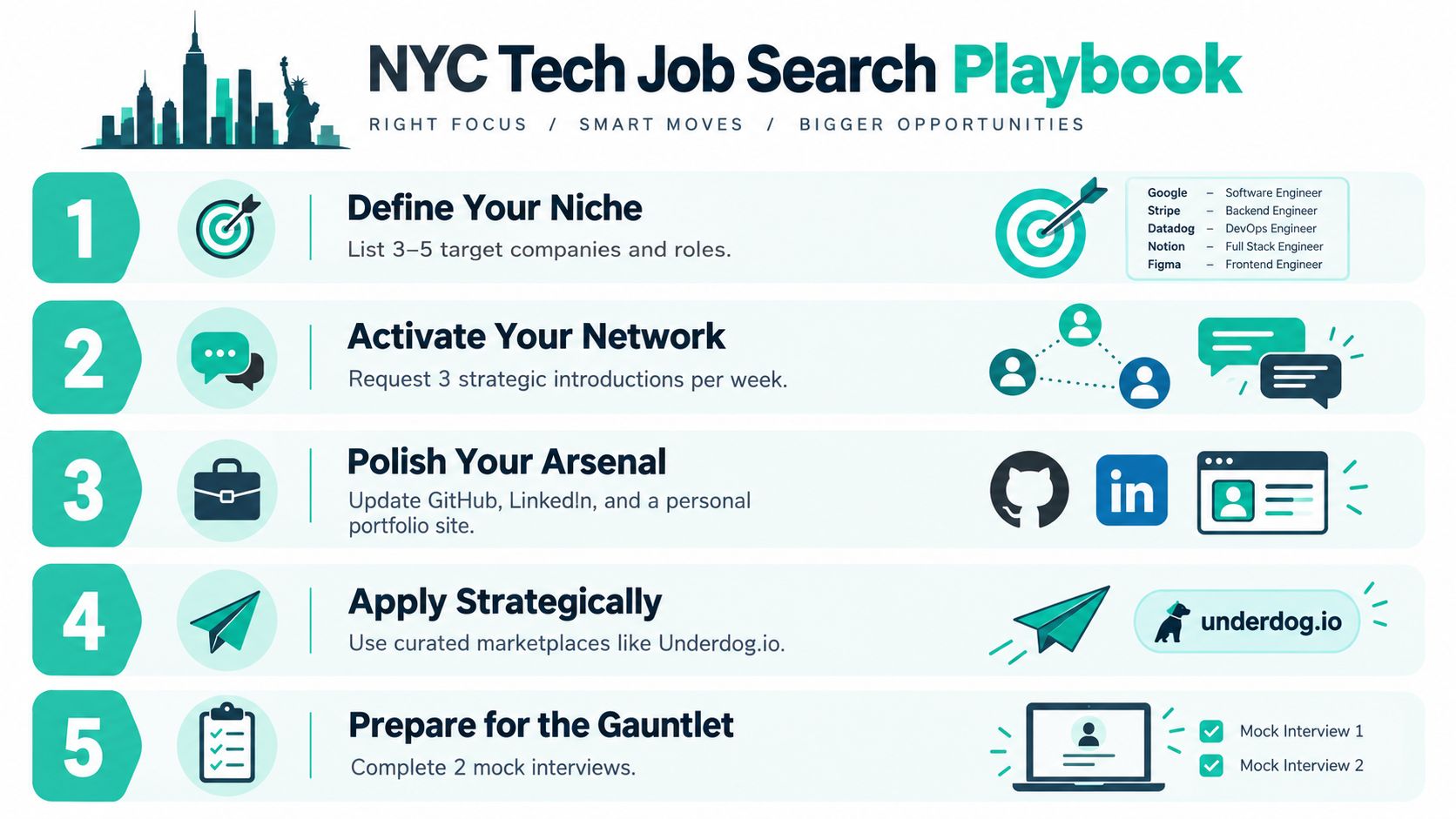
A workable weekly rhythm is simple. Reserve one block for research, one for targeted outreach, one for portfolio or interview preparation, and one for conversations. Candidates with current jobs should protect those blocks rather than trying to search continuously. Consistency creates more useful momentum than a weekend of indiscriminate applications.
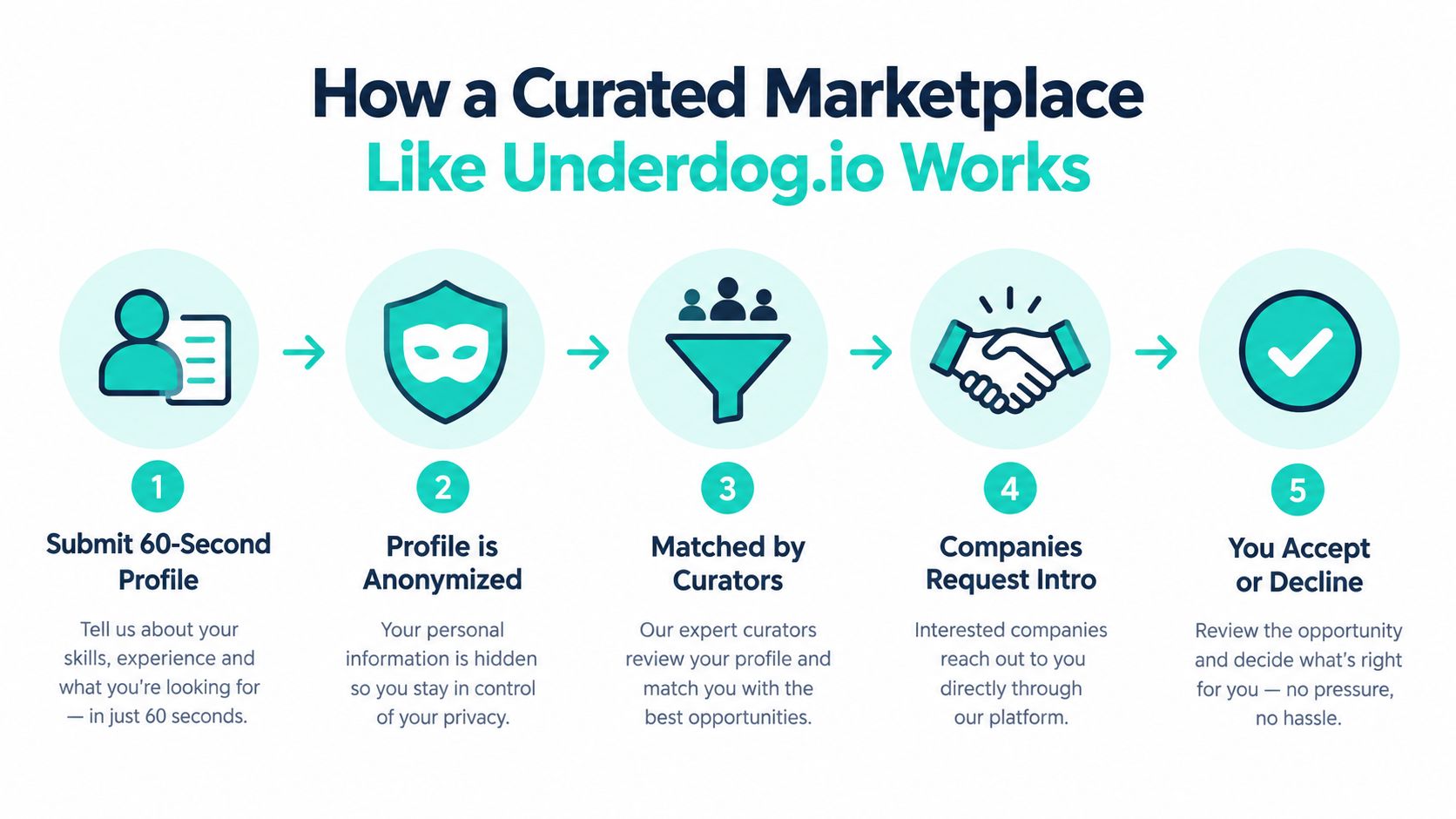
A curated marketplace solves a specific problem: a qualified candidate may want to explore NYC startups without publishing a job search or sending the same résumé to dozens of recruiters. The candidate submits a short profile, gives the marketplace enough context to assess role, stage, salary, and stack fit, and waits for relevant companies to request an introduction.
The useful distinction is between a marketplace that ranks keywords and one that applies human judgment. In a confidential process, the candidate's profile can remain anonymized until interest is mutual. That matters for someone with unvested RSUs, a sensitive relationship with a current employer, or a desire to create a stronger negotiating position without announcing that they're interviewing.
A curated marketplace is most useful for mid-career and senior candidates who are exploring passively, niche specialists whose skills are difficult to categorize, and professionals who want several early-stage conversations without managing a large outbound campaign. It can also help someone who knows the desired company stage and role but lacks a warm connection to every relevant founder.
The channel isn't right for every search. Entry-level candidates may need broader access to internships and junior openings. Highly publicized roles at brand-name employers may receive enough direct traffic that a referral or company application is more efficient. A candidate with a strong relationship inside a target company should use that relationship rather than route around it.
The trust calculation depends on control. A candidate should know what information is visible, when a name is shared, how introductions are accepted, and whether declining a company affects future matching. Confidentiality is valuable only when the candidate retains the ability to say yes or no before contact details move forward.
Candidates should also keep expectations realistic. A curated introduction doesn't replace interview preparation, compensation diligence, or technical proof. It changes the top of the funnel by reducing irrelevant outreach and making the initial conversation more intentional.
The practical process is outlined in how the marketplace works. Before joining any marketplace, clarify whether companies are screened, whether humans review profiles, and how the service handles location, salary expectations, employment status, and specialized skills. Those questions reveal whether the experience is designed around candidate fit or application volume.
For passive candidates, the value is discretion and optionality. You can keep your search quiet, compare company stages, and avoid explaining to every LinkedIn recruiter why you're not ready to move immediately. For active candidates, the value is focus. Direct applications, referrals, and curated introductions can run in parallel, as long as each application supports the same positioning.
A quarter is long enough to create meaningful momentum and short enough to manage with discipline. The plan below treats salary, geography, and channel as connected decisions rather than separate checklists.
Start with market value. Use the verified salary anchors for your role, then adjust for seniority, specialization, stage, office attendance, equity, and contract versus permanent employment. Audit your résumé, LinkedIn profile, GitHub, and portfolio so they show the same professional thesis.
Map three target geography clusters. For example, compare a Manhattan growth-stage corridor, a Brooklyn product and engineering hub, and a regional hybrid option. Record commute requirements, company stage, likely role types, and the compensation trade-offs you can accept.
Submit two curated-marketplace applications through Underdog.io and three direct startup applications during this phase. The purpose isn't to maximize volume. It's to test which positioning attracts responses and whether your target companies align with your actual constraints.
Set a repeatable networking rhythm:
Track every conversation in a simple spreadsheet. Note the role, stage, neighborhood, office policy, salary expectations, equity structure, and next step. This record prevents attractive branding from overshadowing an impractical commute or unclear offer.
Close loops promptly. Send references, complete requested work, and ask what remains before a decision. When offers arrive, evaluate base, bonus, equity, vesting, exercise terms, refresh policy, commute, manager quality, and company stage together.
Counter strategically. Explain the value you bring, identify the specific gap, and ask whether the company can adjust base, equity, sign-on compensation, title, start date, or flexibility. Don't negotiate one isolated number while ignoring the rest of the package.
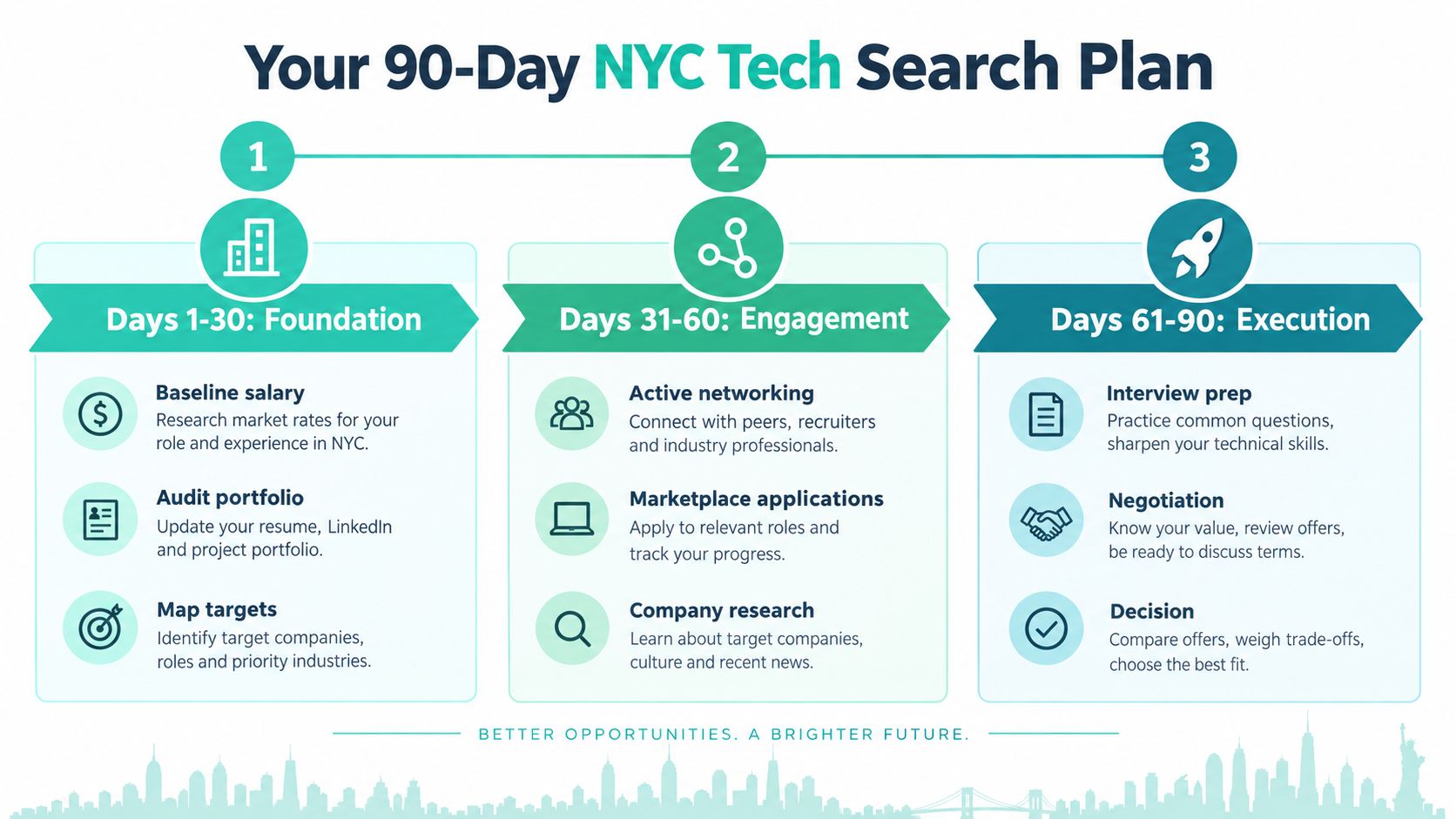
The strongest search is measurable. At the end of each week, ask whether you've improved your market positioning, expanded relevant conversations, learned more about a target neighborhood, or advanced a real process. If not, change the channel or narrow the target rather than applying harder.
Underdog.io offers a confidential, curated way to introduce qualified tech candidates to startup and high-growth opportunities without requiring a public job search. If you're evaluating tech jobs in New York and want to compare relevant companies by role, stage, and fit, visit Underdog.io and submit a focused profile.