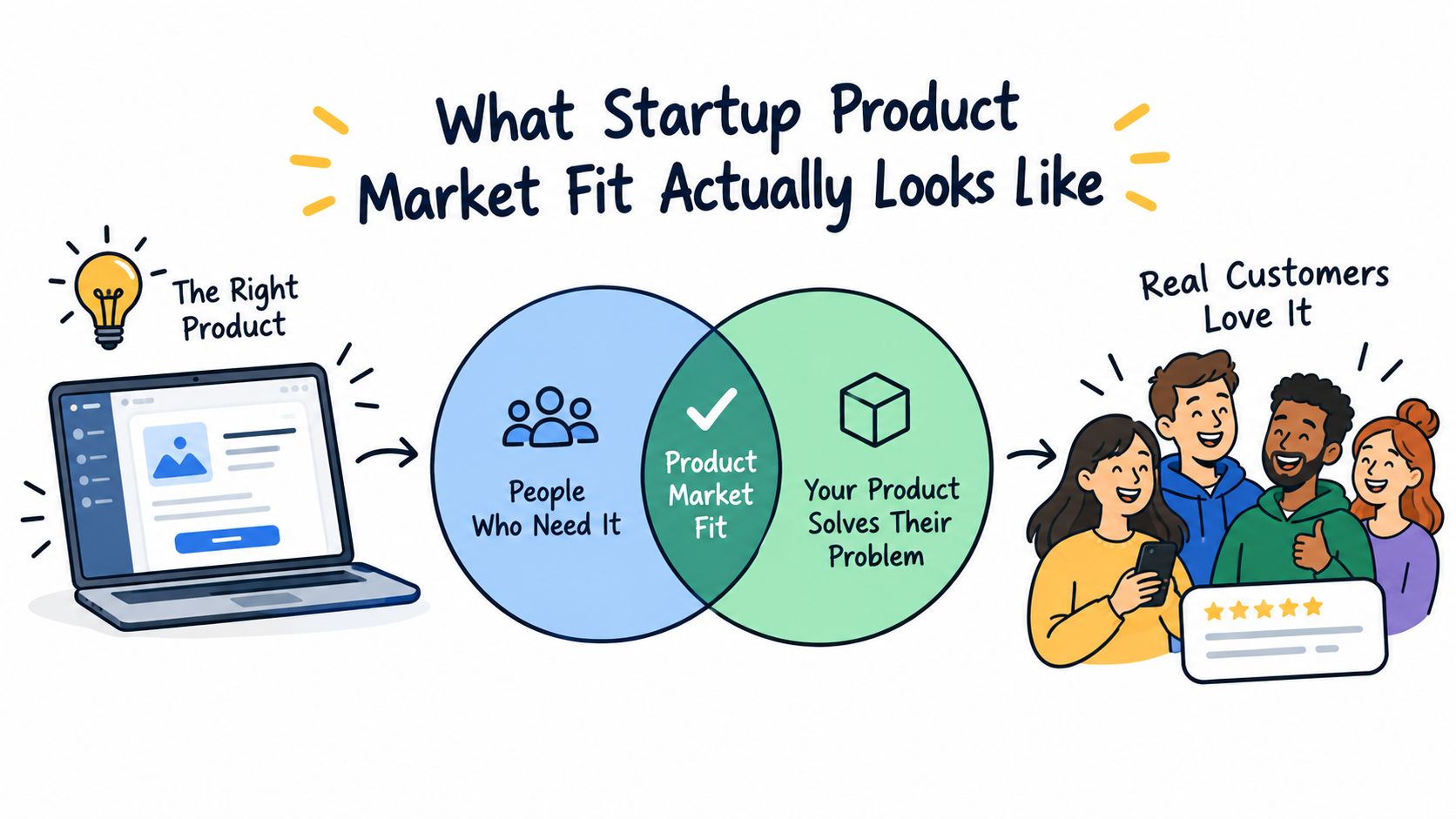
CB Insights' analysis of 483 startup post-mortems found that 42% failed because they built something nobody wanted. That finding makes product-market fit more than a milestone for investor updates. It's the point where a team proves that a defined group of customers has a persistent problem, values the solution, and keeps choosing it.
The practical test isn't whether people praise the product in interviews. It's whether they return without reminders, recommend it without being prompted, and notice when it stops working. A strong startup product market fit process combines customer sentiment with retention, organic growth, and unit economics before the founders add headcount or increase acquisition spend.
A founding team can mistake activity for demand very easily. A launch earns press coverage, signups arrive, and the product roadmap fills with requested features. Yet the team may still be serving a problem that customers can tolerate rather than one they need solved. The 42% failure rate attributed to building something nobody wanted is cited in the startup failure analysis summarized by this review of product-market fit statistics.
Consider a small B2B software company that launched with a polished onboarding flow and a long list of integrations. The founders celebrated every new trial, but most users never reached the core workflow. They kept improving acquisition because the dashboard looked active. A few months later, the company had more leads, more features, and no reliable evidence that customers would miss the product.
A different team resisted that pattern. Its first version looked narrow and attracted little attention, but a specific group of users returned repeatedly and complained when a key task failed. Those complaints were inconvenient, yet they gave the founders something valuable: evidence that the product had become part of a real workflow.
Practical rule: Don't scale a product because more people are willing to try it. Scale when the right users repeatedly choose it and the business can support that choice.
PMF work should follow a deliberate sequence:
Teams often confuse product-market fit with a successful launch, a large waitlist, or enthusiastic investor feedback. Those signals can help you learn, but they don't establish demand. Founders who want a practical overview of the build and validation process can also use AppLighter's app development for startups guide as a companion resource.
Premature hiring creates its own trap. New employees need direction, and a team that hasn't settled on its customer or core use case tends to spread that uncertainty across more people. The operational cost of scaling before the model is clear is one reason founders should examine common startup scaling challenges before treating headcount as proof of progress.
Product-market fit appears in customer behavior before it appears in a founder's confidence. A product has a stronger claim to fit when a defined group repeatedly uses it to solve a meaningful problem, returns without constant persuasion, and tells other suitable users about it. The product doesn't need to be perfect. It needs to be valuable enough that customers change their behavior around it.
The difference becomes clear when comparing two early products. Product A receives favorable press, attracts curious signups, and earns compliments during demos, but usage falls after the first session. Product B receives little public attention, yet its users build it into a daily workflow, invite colleagues, and contact support when a central feature breaks. Product A has awareness. Product B has stronger evidence of demand.
A useful diagnostic is to ask what customers do after the conversation ends. Polite enthusiasm usually sounds like, “That could be useful,” followed by no meaningful change. Dependency produces more concrete behavior:
A product can earn high satisfaction among users who rarely use it. It can also attract people who love the concept but aren't the target segment. Segment every signal by role, use case, company context, and engagement level. Otherwise, a small passionate niche may be hidden inside a broad average, or casual users may dilute the experience of customers who have a genuine need.
Customer discovery remains useful after launch. Speak with active users, recently inactive users, and qualified prospects, but don't give every opinion equal weight. A customer who uses the product frequently and pays for the relevant outcome can tell you more about product value than a visitor who only saw a landing page.
Ask what happened immediately before the customer sought a solution, what they tried instead, and which result matters most. Then compare those answers with product analytics. If customers describe a critical workflow but rarely complete it, the issue may be activation, onboarding, usability, or a mistaken assumption about the problem.
Market fit also depends on the market you choose. A narrow product for a clearly defined need can show stronger fit than a broad product that attempts to satisfy everyone. Founders examining how positioning, customer value, and unconventional distribution interact may find this guide to disruptive business models useful, but the test remains behavioral: do the intended customers keep choosing the product?
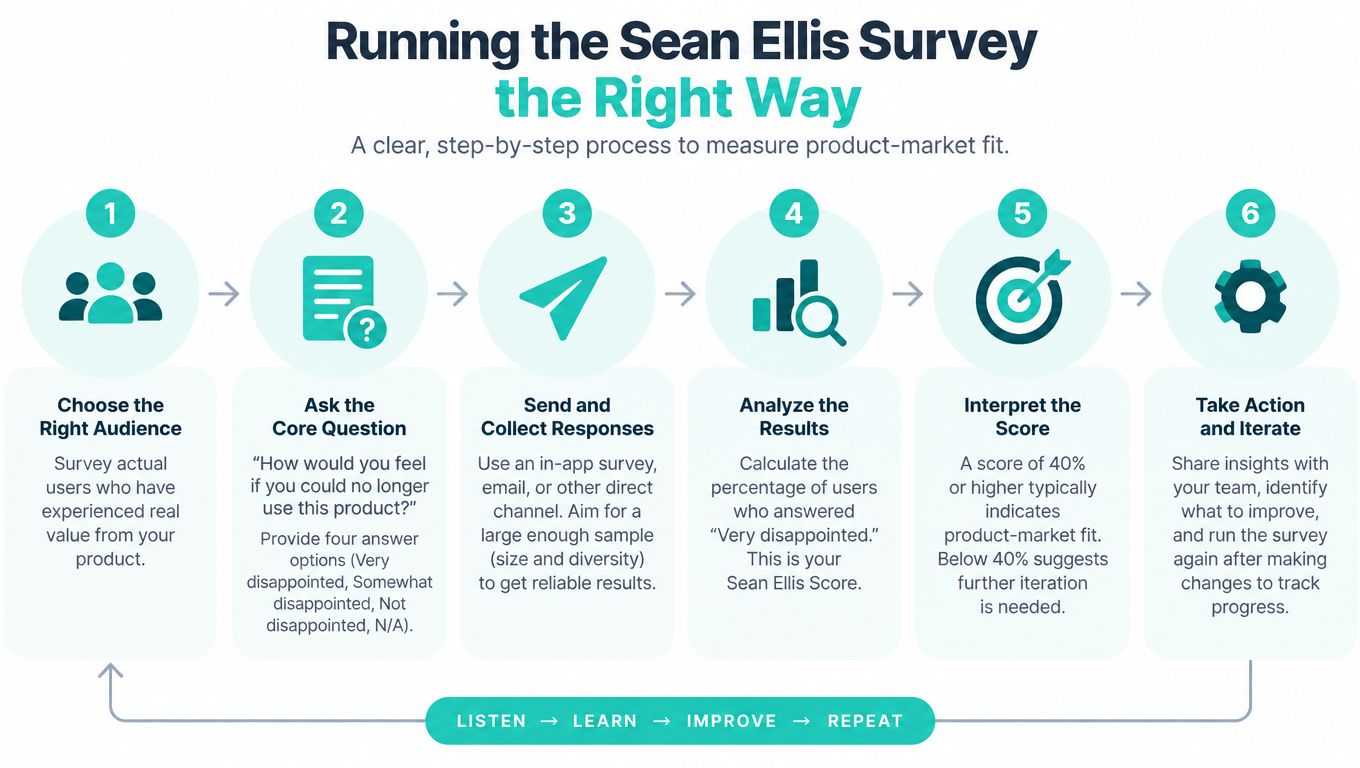
The Sean Ellis survey is useful because it asks customers to express the cost of losing the product. The standard question is: “How would you feel if you could no longer use this product?” The usual answers are “very disappointed,” “somewhat disappointed,” “not disappointed,” or “I no longer use this product.”
The commonly used benchmark is 40% or more answering “very disappointed.” The threshold is described in the Sean Ellis survey guidance from CRV, which also emphasizes combining the answer with behavioral evidence. Treat the result as a heuristic, not a law. A score just above the benchmark doesn't rescue weak retention, and a score just below it doesn't automatically invalidate a product serving a narrow or unusual market.
Survey active users who have experienced the product's core value. Total signups are a poor sample because they include people who never activated, never understood the offer, or joined for reasons unrelated to the target use case. Churned users can reveal why value failed, but they shouldn't be mixed casually with active users when calculating the primary sentiment signal.
A practical workflow is:
Suppose the overall result crosses the benchmark, but nearly all of the enthusiasm comes from one role or use case. That isn't necessarily bad. It may identify the beachhead market you should serve more deliberately. It does mean you shouldn't claim broad fit until other important segments show similar evidence.
The follow-up answers often reveal more than the percentage. “I would be very disappointed” is encouraging, but the reason might be a minor convenience, a temporary promotion, or a feature that only one team member uses. Stronger evidence appears when respondents describe a costly problem, a repeated workflow, and a credible alternative they would struggle to find.
Run the survey after customers have had enough time to experience the product's central outcome, then repeat it when the customer mix or product changes. Don't use the result to justify a predetermined scaling plan. Use it to decide which segment deserves deeper investment and which assumptions need to be discarded.
Surveys measure what customers say. Metrics reveal whether customers behave as if the product matters. A founder doesn't need a dashboard filled with every available measure, but the company does need evidence that demand persists after the initial excitement fades.
A simple early-stage approach tracks three metrics, two leading indicators and one lagging indicator. The framework described by PostHog's product-market fit measurement guide focuses on new users or signups as an early demand signal, engagement or usage as evidence that users reach value, and retention as the confirmation that value persists.
| Metric | Question it answers | Healthy signal | Warning sign |
|---|---|---|---|
| New qualified users | Are more suitable customers entering the funnel? | Growth in users who match the target profile | Signups rise while target users remain flat |
| Engagement | Do users reach and repeat the core value action? | Repeated use of the central workflow | Activity concentrates in exploration or low-value actions |
| Cohort retention | Do customers continue after the initial experience? | A cohort settles into ongoing use instead of disappearing | Each cohort steadily declines toward inactivity |
| Organic referrals | Do customers bring in similar users? | Customers mention, invite, or recommend the product without heavy prompting | Acquisition depends entirely on paid or founder-led effort |
| LTV:CAC | Can customer value support acquisition cost? | A ratio above 3:1, a commonly used healthy benchmark cited by Mercury's PMF measurement guidance | Acquisition costs approach or exceed customer value |
| Growth plus margin | Is growth translating into durable business performance? | Growth rate plus profit margin at or above 40%, the commonly cited Rule of 40 benchmark | Growth requires economics that worsen as volume increases |
The table isn't a substitute for context. Retention differs by product category, buying cycle, and frequency of need. A product used for an occasional business event shouldn't be judged with the same usage expectation as a daily workflow tool. Compare cohorts with similar use cases, not one blended line.
A customer may love a product while the company still lacks scalable fit. If reaching that customer requires expensive manual sales, extensive implementation, or support that grows faster than revenue, founders need to understand the constraint before hiring. LTV:CAC helps connect customer value with acquisition cost, while the Rule of 40 provides a broad lens on growth and profitability.
Use economics as a constraint, not as a vanity target. A favorable ratio can result from underinvesting in acquisition or support, and a weak ratio can reflect an immature channel rather than a bad product. Investigate the drivers by segment. The important question is whether the product can create and retain value without requiring every future customer to receive founder-level attention.
Founders waste time when they treat each metric as an independent vote. A strong survey score, weak retention, and no organic referrals aren't three separate reasons to keep experimenting. Together, they suggest that customers like the concept or the initial experience but aren't receiving enough lasting value.
Use the three-signal model as a decision system:
A green decision requires the signals to reinforce one another. They don't need to be equally strong, but they shouldn't contradict each other without an explanation grounded in customer behavior.
Prioritize experiments by the assumption that could make the entire business irrelevant. If the team hasn't confirmed the ideal customer profile, test the segment before polishing acquisition creative. If users activate but don't return, investigate the value moment and onboarding before adding sales capacity. If users return but won't pay, test packaging, pricing, and the urgency of the problem.
Useful experiments include:
Don't call an experiment successful because a landing page receives more clicks. The result matters only if it improves the next meaningful behavior, such as activation, repeat use, paid commitment, or qualified referral.
Strong survey responses with flat retention usually mean customers understand the promise but don't experience it consistently. Examine time to value, missing integrations, workflow friction, and whether the surveyed users represent the retained population. Strong retention in a tiny niche with weak acquisition may indicate real fit in a beachhead segment, not a reason to broaden immediately.
“No-go” doesn't always mean shut down. It can mean stop serving the current segment, stop funding a feature, or stop treating a channel as strategic. Pivot the customer, problem, or product when the evidence points elsewhere. Set a clear re-test condition after the change, then judge the new hypothesis on behavior rather than the emotional appeal of the revised story.
Before fit, every hire should help the team learn faster or deliver the current value proposition. Hiring aggressively at that stage burns runway and creates coordination costs before the company knows which work deserves scale. A large team can make an uncertain strategy look more legitimate while making it harder to change.
The hiring plan changes when the signals turn green. Founders no longer need only adaptable generalists who can investigate several possibilities. They need specialists who can strengthen a proven motion without taking ownership away from the people closest to customers.
A practical sequence is functional rather than founder-led:
A startup shouldn't copy the hiring plan of a mature company. Early employees need adaptability, comfort with incomplete information, and the ability to work close to customers. Founders should explain the mission, decision rights, compensation, and equity clearly, then evaluate whether candidates can operate at the company's current pace.
Once a bottleneck is clear, founders shouldn't spend every productive hour searching through unqualified applications. Curated marketplaces can reduce sourcing noise, while specialist recruiters can help when the role requires a narrow technical profile or rapid hiring. For teams evaluating regional engineering options, Hire developers Mexico provides a focused starting point for exploring that talent market.
A staffing specialist such as nexusITgroup.com can also support technical hiring when internal recruiting capacity is limited. The selection method still matters. Ask each candidate to connect their experience to the company's current constraint, and test how they make decisions when customer evidence changes the plan.
The first post-fit hires should make the existing engine stronger, not invent a second business. Use a written role scorecard, define the bottleneck the hire will own, and identify the evidence that will show whether the hire is working. Founders looking for a more detailed view of startup recruiting can also review this guide to recruitment for startups.
PMF isn't a trophy that a company wins once. Customer needs shift, competitors change the alternatives, and a product can lose relevance even after a period of strong demand. Treat the decision as a repeatable operating review rather than a permanent label.
Run the review in this order:
The discipline is knowing when to stop iterating on a product that customers don't need. More features can disguise a weak problem, and more traffic can make an unretained product look busy. If the same evidence stays negative after focused changes, preserve the learning and redirect resources instead of protecting the original idea.
Decision standard: A founder's confidence is useful for choosing what to test. Customer behavior decides what to scale.
Re-run the survey when the customer mix, pricing, core workflow, or competitive context changes. Compare the new evidence with earlier cohorts, and investigate any gap between sentiment and usage. The strongest teams don't ask whether they have achieved PMF in the abstract. They ask which customers have it, which behaviors prove it, and what constraint now prevents the business from serving them better.
Underdog.io connects startup and high-growth tech companies with curated candidates across engineering, product, design, data, and related functions. Visit Underdog.io when your product-market fit signals are strong enough to define the next hiring bottleneck and scale with the right talent.