The median total compensation for a software engineer in the New York City area is $195,000. That's the number that matters, because in NYC the full picture isn't just base salary. It's salary plus bonus, equity, and how those pieces change the value of an offer.
A lot of software engineer salary New York content gets this wrong. It treats compensation like a single salary line, even though two offers with similar base pay can land very differently once you account for startup equity, bonus structure, and the trade-off between liquid stock and private upside. In this market, the biggest mistake candidates make is comparing offers as if all dollars are equal.
NYC is also one of the few markets where that mistake gets expensive fast. You can take a “higher paying” role and still leave meaningful upside behind. Or you can chase startup equity without understanding strike price, vesting, dilution, and the very real chance that the paper value never turns into cash. The right choice depends less on prestige and more on your runway, risk tolerance, and what kind of wealth-building path you want.
If you're evaluating software engineer salary New York opportunities, start with one rule: base salary is only the entry point.
A public company can offer a strong cash package with clearer stock value. A startup can offer a lower base and still beat the public-company offer over time if the equity grant is meaningful and the company performs. The reverse is also true. I've seen candidates focus so hard on the top-line salary that they miss the underlying factors that make an offer financially smart.
In NYC, comp packages are layered. You're usually looking at some mix of:
A startup offer with a lower base can be the better bet if you believe in the company, understand the equity terms, and can comfortably handle the cash-flow trade-off. A big tech offer can be the better choice if you want predictability, easier planning, and stock that's easier to value.
Practical rule: If two offers are close on base, don't make the decision until you've translated both into one comparable total-comp view.
The same offer can be excellent for one engineer and wrong for another.
If you're early in your career, a startup might give you faster scope, broader ownership, and a shot at equity upside. If you've got a mortgage, family obligations, or limited risk appetite, the cash-heavy structure of a larger company may fit your life better. Neither choice is universally smarter.
That's why generic salary guides fall short. They tell you what a software engineer might earn. They usually don't help you decide what an offer is worth, especially in startup hiring where comp is less standardized and more negotiable.
A clean comparison beats a glamorous offer. Write out base, bonus, vesting terms, and realistic liquidity assumptions before you say yes.
The headline number for New York software engineer pay is high. The useful part is understanding what that number does and does not help you decide.
As of October 2025, the average base salary for a software engineer in New York, NY is $158,764, which is 24% above the national average, based on over 1,000 reported salaries on Indeed from the past 36 months. The reported range runs from $101,532 to $248,258, and the average cash bonus is $5,000, bringing average total compensation to about $168,878, according to Indeed's New York software engineer salary data.
As of June 2026, the median salary for a software engineer in New York, NY is $149,500, with 80% of salaries falling between $83,700 and $200,000. The 25th percentile starts at $131,300 and the 90th percentile reaches $224,825, based on Gusto's New York software engineer salary benchmarks.
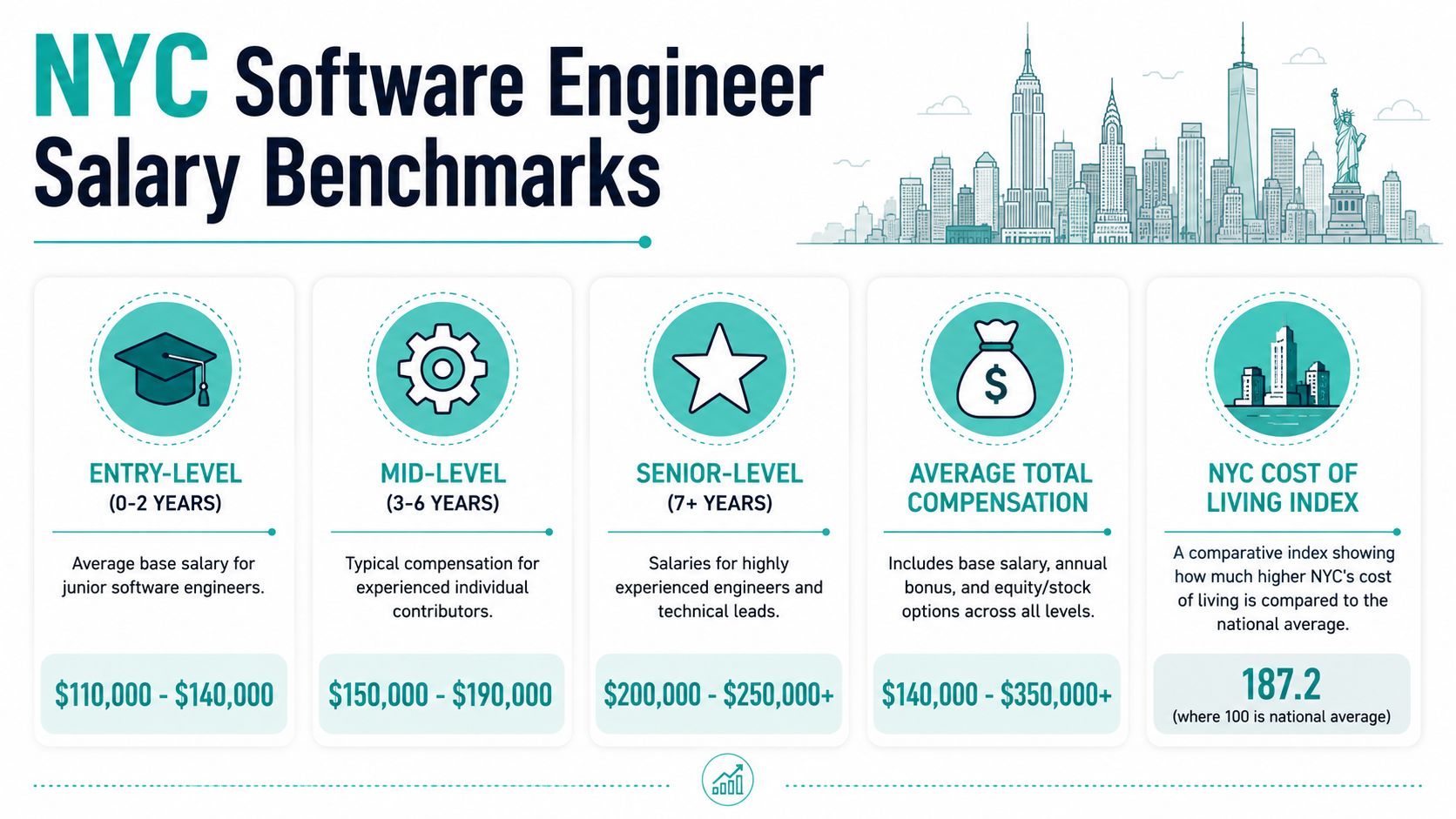
New York pays well. It also prices engineers unevenly.
I tell candidates to treat citywide averages as a starting point, not a target. An offer near the lower end of the range can still be fair for a smaller company, a generalist backend role, or a team with strong benefits and good work-life fit. An offer near the top often reflects something more specific: hard-to-fill infra work, a revenue-heavy sector like fintech, or a company that needs to close quickly.
That is why benchmark data gets misused so often. Averages help you check whether an offer is in the market. They do not tell you whether the package is strong for your background, or whether a startup is asking you to take too much risk for the cash being offered.
The cleanest way to use NYC salary data is by level first, company type second.
For startup candidates who want another reference point beyond broad city averages, Underdog's 2025 tech salary guide gives more context on how startup packages stack up in practice.
Use benchmarks to answer three questions:
That third question matters more in startups than generic salary guides admit.
In NYC startup hiring, a company can cite a respectable base salary while shifting a lot of the offer's value into options that may never become liquid. Candidates on curated platforms usually have better options than average, which means the right comparison is not just "Is this above the city median?" The better question is "How does this package compare with other startup offers I could reasonably get at my level?"
Benchmarks are for calibration. Offer quality comes from the full package, the level, and the risk you are being asked to take.
Startup compensation in NYC can look competitive on paper, but the mix matters more than the headline number. Startup cash pay in New York often runs higher than national startup averages, while the spread between lower and upper-end offers is wide enough that two roles with similar base salary can produce very different outcomes for the candidate, according to Wellfound's New York startup developer data.
For candidates choosing between a startup and a big tech offer, the useful comparison is simple: how much of your compensation is certain, how much is delayed, and how much depends on company performance.
Big tech usually wins on predictability. Startups usually win on variance, scope, and the chance that a smaller grant today becomes meaningful later. In practice, that means a FAANG-level package often comes with a stronger base, a defined bonus target, and RSUs you can price with reasonable confidence. A startup package often asks you to accept a lower cash floor in exchange for options that may be valuable, or may stay paper value for years.
That trade-off is not abstract. It changes how aggressively you can save, what rent feels comfortable, and how much career risk you are taking at once.
Ask what job the offer needs to do for you.
| Component | High-Growth Startup (Series A/B) | Big Tech (FAANG-level) |
|---|---|---|
| Base salary | Often lower than top public-market cash offers, but can still be strong for NYC | Usually more standardized and often stronger in cash terms |
| Bonus | May be small, discretionary, or absent | More likely to be structured and predictable |
| Equity type | Usually stock options, often ISOs for employees | Usually RSUs with clearer current value |
| Liquidity | Private and uncertain | Public and easier to value or sell |
| Upside profile | High variance, potentially meaningful if the company performs | Lower variance, but often substantial in aggregate |
| Scope and growth | Broader ownership, faster title compression, more ambiguity | Narrower scope at times, but stronger process and leveling |
If you cannot explain the equity in one paragraph, you are not ready to compare the offer.
I tell candidates to watch for one common mistake. They compare a startup offer to big tech as if both equity lines mean the same thing. They do not. RSUs at a public company are closer to delayed cash. Startup options are a bet with terms attached, including strike price, vesting, dilution, and an unknown path to liquidity.
A startup offer can be the better move if three things are true. The company has credible traction, the equity grant is large enough to matter, and the role gives you a real increase in scope or title trajectory. If one of those is missing, you are often just subsidizing the company's risk with your compensation.
A big tech offer works well when you want reliable earnings, cleaner benchmarking, and equity you can value without building a spreadsheet full of assumptions. A startup offer works well when the upside is matched by genuine responsibility and the company has a believable case for growth.
For a more practical reference on how early and growth-stage packages are typically put together, review these startup compensation benchmarks before you negotiate.
An offer letter is a financial document disguised as a hiring document. Read it that way.
The biggest blind spot in NYC startup hiring is that many candidates compare base salaries while ignoring the rest of the package. That misses where a lot of the value sits. The “total compensation” gap in NYC startup roles is often underreported because many salary guides focus on base pay while startup equity and bonuses can add materially more to total comp, according to HackerX's New York tech salary analysis.
Don't lump everything together. Each component answers a different question.
Often, a lot of strong candidates get tripped up.
RSUs from a public company are easier to understand. You receive shares over time, and there's usually a clear market value. ISOs at a startup are different. You're getting the option to purchase shares, usually at a strike price. Whether that becomes valuable depends on future company outcomes, your exercise decisions, and timing.
That doesn't make startup equity bad. It means you need a sharper framework.
Ask these questions before you attach value to options:
Offer-letter test: If the recruiter can explain the option grant clearly, that's usually a good sign. If every answer stays vague, be careful.
For a deeper walkthrough of startup equity mechanics, an engineer's guide to stock options is worth reading before you sign anything.
Build a one-page side-by-side sheet.
Include cash comp, realistic bonus assumptions, equity details, vesting, benefits differences, and one line for your own risk assessment. Don't assign fantasy value to startup equity. Also don't assign zero value by default. Put it in a separate bucket and judge whether the package still works if that upside never materializes.
Engineers can earn what looks like a strong NYC salary and still feel cash-constrained within a few months. The gap usually comes down to taxes, housing, commute choices, and whether the offer is built for your day-to-day life or just looks good in a comp spreadsheet.
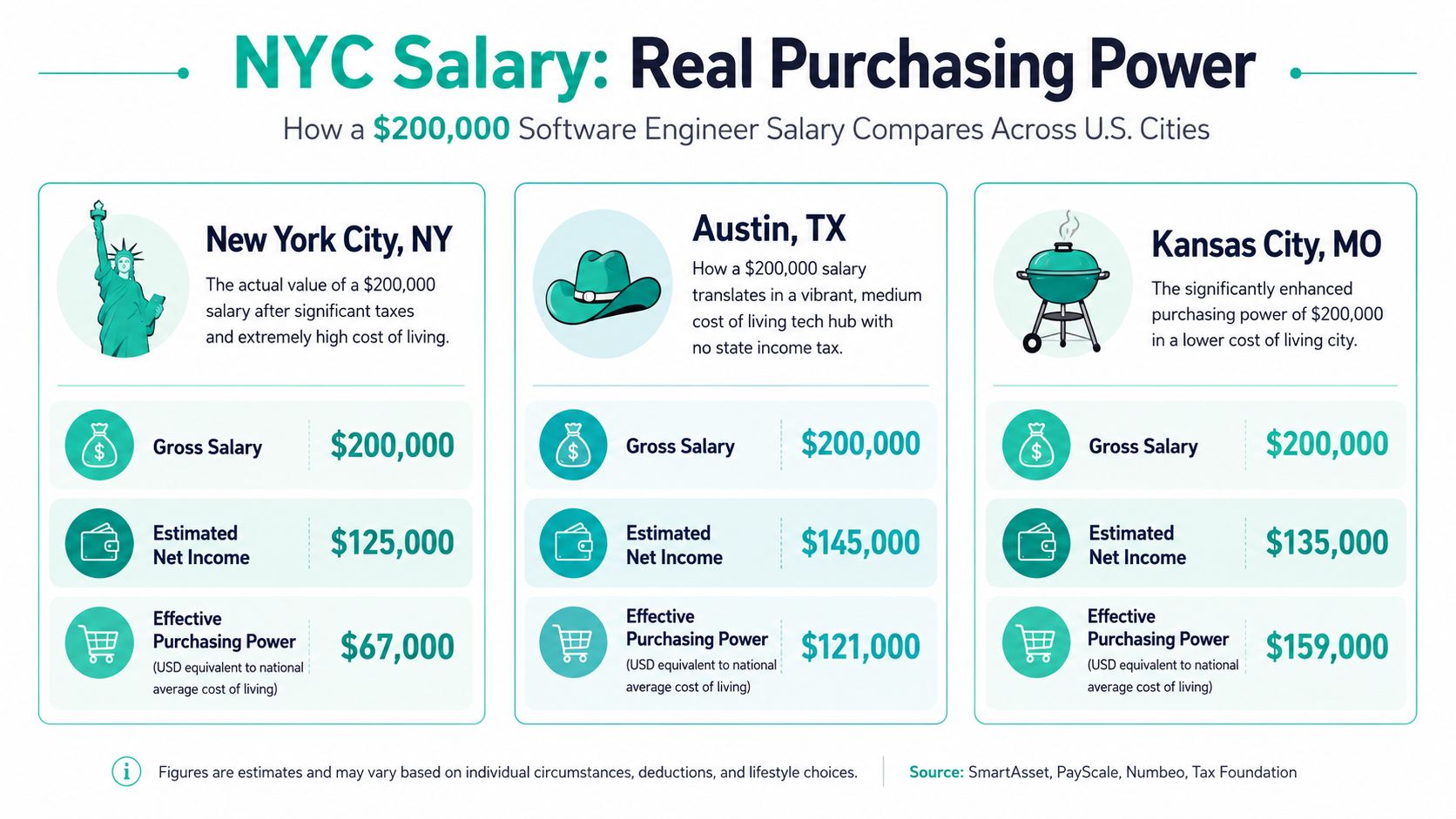
I tell candidates to judge an NYC offer by post-tax cash flow first, then by upside.
That matters even more with startup offers. Two roles can show similar total compensation on paper, but one may put more of your package into salary and the other may push value into options that may take years to matter, or may never matter at all. If your monthly burn is high, that distinction is not academic. It determines how much room you have to save, invest, or handle a layoff without stress.
Your spending power depends on a few practical variables:
I have seen candidates choose the higher headline package, then realize the lower-cash startup offer left them stretched every month because rent and fixed costs were already doing the damage.
Use three budget scenarios before you say yes.
Run the offer once for a convenience-first setup, close to the office, higher rent, lower commute friction. Run it again for a savings-first setup, with cheaper housing and a longer commute. Then run a third version where you count salary, bonus, and benefits, but assign no current value to startup equity.
That third view is the one many generic salary guides skip. For startup candidates in NYC, it is often the difference between a smart bet and a stressful one.
For a grounded reference point on typical living expenses, Koru's budgeting insights are useful because they make it easier to compare city costs against your likely take-home pay.
In New York, a good offer gives you room after fixed costs. That room is what buys flexibility.
Candidates rarely misread the salary line. They misread the lifestyle cost of the job.
A longer in-office commute can push you toward higher rent. A demanding team can increase spending on convenience, delivery, childcare, or rides. A startup with meaningful equity upside can still be the right choice, but only if the cash portion of the package supports the version of NYC life you are likely to live, not the cheapest version you can sketch into a spreadsheet.
That is the trade-off to get clear on. Big tech often gives you more immediate predictability. Startups can offer stronger upside and faster scope growth, but in New York, cash flow still sets the floor.
Software engineers in New York see a wide spread in pay, from solid mid-market startup packages to top-of-band offers that look nothing alike once equity, bonus, and level are included. Analysts at Levels.fyi found that average total compensation in the New York City area is about $195,000, while top firms can sit far above that. That gap is why negotiation matters. In NYC, two offers with similar salaries can produce very different outcomes for your cash flow, upside, and promotion path.

Startups and larger companies usually give ground in different places.
At startups, base salary is often tied to cash discipline and board-approved ranges. The true value often lies in equity, title, scope, signing support, and review timing. For NYC candidates, that distinction matters more than generic salary guides admit, because startup compensation often looks weaker on the salary line and stronger only if the equity grant is meaningful and the role grows fast.
At larger companies, base salary bands are usually more structured. The negotiable areas are often sign-on bonus, initial level, refresh expectations, and the exact place you land within the band.
Use the company type to shape your ask:
Strong negotiation is tied to business value and role fit.
A better version sounds like this: “The role expects ownership across distributed systems and production reliability. Given my experience leading those systems and the range I'm seeing for comparable NYC roles, I'd like to revisit the base and equity mix.”
That works because it is concrete. It connects your ask to the work, not to personal need or a vague sense that the offer should be higher.
For startup candidates, preparation is paramount to changing the outcome. Equity only becomes worth pushing on if you can explain why your background reduces execution risk or increases the chance that the company reaches the next stage. If your resume does not make that obvious, fix that first. A practical starting point is to build an ATS-compatible software engineer resume so your experience reads clearly before compensation talks begin.
Ask for the one or two changes that matter most to your actual decision.
Candidates usually negotiate better when they are in more than one real process at the same time. That is especially true in NYC startup hiring, where the market moves quickly and companies know strong engineers compare offers across stage, mission, and cash versus equity mix.
Curated hiring channels can help here because they create cleaner comparisons. Instead of treating every company like the same negotiation, candidates can see how a Series A backend role differs from a late-stage platform role, or how a startup with modest salary but real ownership compares with a larger company offering more immediate cash. That context matters more than generic advice about “always ask for 10% more.”
Good negotiation is situational. A company with fixed salary bands will not respond the same way as a venture-backed startup trying to close an engineer who can have outsized impact in the next 12 months. The goal is not to ask for everything. The goal is to understand which part of the offer is movable, and which version of compensation fits the risk you are taking.
Sometimes, but borough alone is a weak predictor.
Pay usually follows company stage, revenue profile, and how hard the role is to fill. A Series B startup in Brooklyn can outpay a smaller Manhattan startup if it has stronger funding, tighter hiring needs, or a more mature compensation plan. For candidates, location matters more for commute expectations, office policy, and the weekly cost of showing up.
Companies handle this differently, and the policy matters more than the office address.
Some teams peg compensation to a New York band no matter where you live. Others use geographic bands and lower cash for fully remote hires outside the city. Ask how location affects raises, promotions, and refresh grants. A strong starting salary can look less attractive if future compensation growth is tied to a lower-cost market.
Specialized skills can push compensation higher, especially when the skill is tied to revenue, scale, or a hard-to-hire team.
In practice, companies pay for proven depth. There is a real difference between being adjacent to ML infrastructure and owning production systems that shipped, scaled, and were measured against business goals. The same goes for security, distributed systems, data engineering, and cloud cost optimization. In the NYC startup market, the premium is usually strongest when a company needs someone to solve a painful problem now, not when a resume just lists the right keywords.
The first five years usually produce the fastest compensation growth.
That does not come from time served. It comes from taking on harder problems, getting trusted with ambiguous work, and building a track record that transfers across companies. Engineers who move from task execution to ownership often see the biggest jumps, whether through promotion or a well-timed job change. In startup hiring, visible scope matters a lot because small teams reward people who reduce risk and ship without heavy oversight.
Count equity as upside. Price your life off salary.
That is the cleanest way to evaluate startup offers in New York. If the base salary does not support your rent, savings goals, and margin for error, more options do not solve the problem. If the salary is workable, then equity becomes a meaningful part of total compensation, but only after you examine dilution, vesting, strike price, and how realistic the company's next milestones are. Generic salary guides miss this point. For startup candidates, equity is often the biggest source of confusion and the biggest source of offer-to-offer variation.
They compare offers on base salary alone.
That misses the trade-off that matters most in NYC. Big tech usually offers more immediate cash and clearer bands. Startups can offer faster scope growth, more title acceleration, and equity that matters if the company performs. Good comparisons look at total compensation, risk, learning curve, manager quality, and what the role does for your next move. A lower-cash startup offer can be the better decision. A flashy equity package can also be overpriced.
If you're exploring startup and high-growth tech roles and want a cleaner way to compare compensation, Underdog.io lets you apply once and get introduced to vetted companies. It's a practical option for engineers who want salary transparency, structured outreach, and a better read on how NYC startup offers stack up.