Most advice about the types of coding starts with a language list. Learn Python, learn JavaScript, learn Java, and hope the right job appears. That advice is incomplete. Your career choice isn't really about which syntax you enjoy typing. It's about the problems you want to solve, the feedback loop you prefer, and the engineering context where you can create value.
A startup hiring manager usually cares less about whether you can recite language features and more about whether you can ship a reliable interface, protect data integrity, automate a deployment, or diagnose a system under pressure. The right coding path connects your technical preferences to a business outcome. Choose that context first, then choose the language.
Beginner guides often treat programming as a supermarket aisle. Python is one shelf, JavaScript is another, and Rust sits somewhere near the specialist products. That model is easy to understand, but it encourages a weak career decision. A language doesn't tell you enough about the work you'll do every day.
A better question is, what kind of system do you want to build or improve? You might create interfaces that respond to human behavior, services that manage transactions, models that identify patterns, or infrastructure that keeps other software running. Each context uses different languages, tools, testing habits, and definitions of quality.
The labor market increasingly reinforces this distinction. A 2026 labor-market snapshot recorded 1,163 mentions of Python, up 20% month over month, 447 mentions of Java, up 18%, and 309 mentions of JavaScript, up 28%. Those figures don't mean Python is automatically the best choice for every candidate. They show why popularity alone is a poor guide. Python has a strong connection to AI and data work, while cloud-native and infrastructure roles are drawing attention toward Go and Rust.
If you like immediate visual feedback, frontend development may suit you. If you enjoy data models, APIs, and failure handling, backend work is a stronger fit. If you prefer performance constraints and machine behavior, systems programming deserves your attention.
That choice also affects your portfolio. A polished dashboard demonstrates different skills from a command-line deployment tool, a recommendation model, or a distributed service. Recruiters can assess your judgment more easily when your project reflects a real context instead of a collection of disconnected tutorials.
Recruiter rule: Don't say, “I want to learn a programming language.” Say, “I want to build software for this type of user or operational problem.”
This approach doesn't make syntax irrelevant. You still need language fluency, debugging ability, and knowledge of the surrounding ecosystem. It puts those skills in the right order. Start with the engineering environment, then select the language that gives you credible access to it.
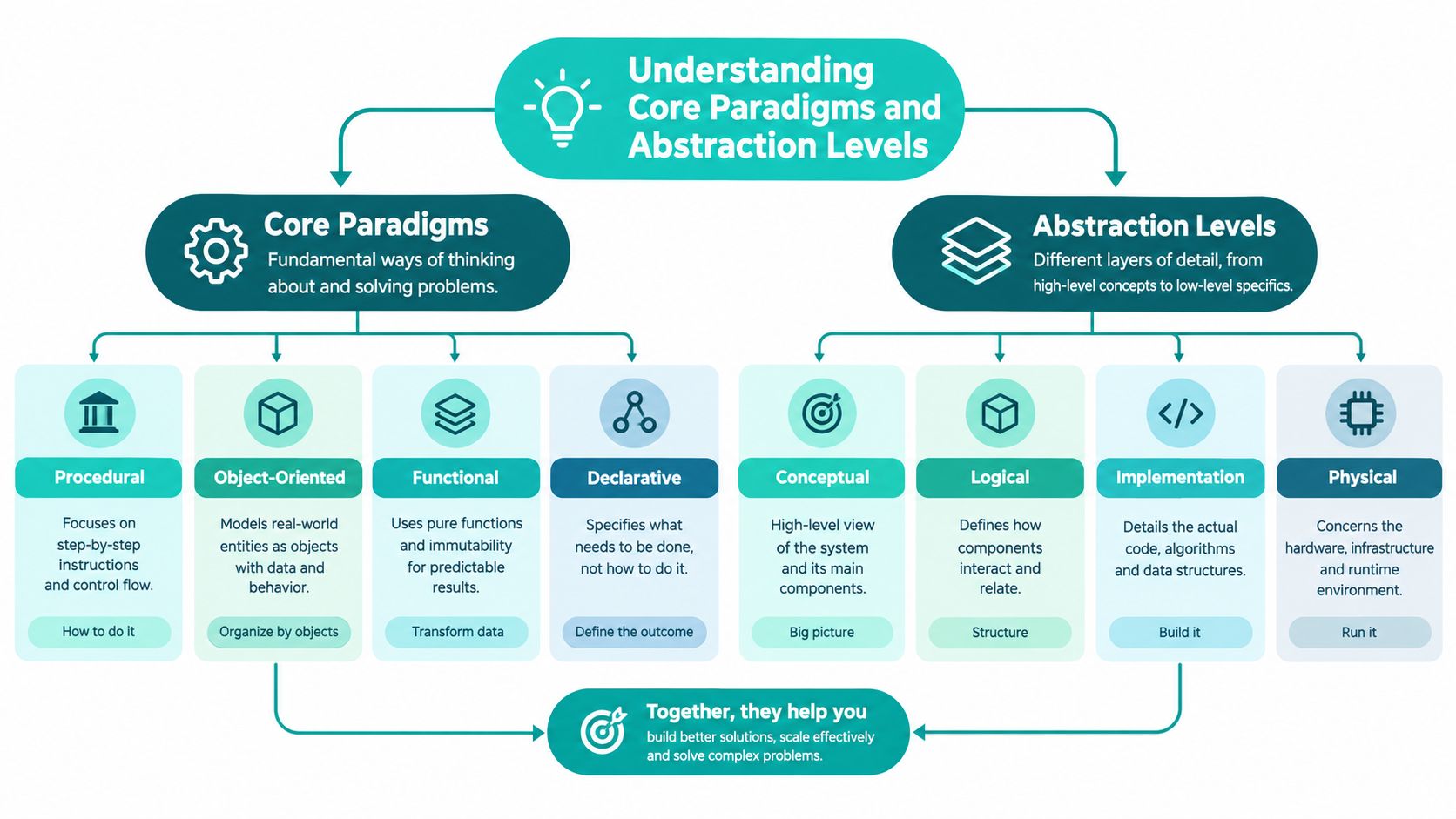
Language syntax is a weak basis for choosing an engineering track. Recruiters care more about how you structure problems, control complexity, and work within a product's technical constraints. Two ideas explain much of that difference: approaches to programming and abstraction levels. They shape how you express a solution, how much machine detail you manage, and how easily another engineer can review the result.
Programming styles generally fall into two broad approaches, imperative and declarative. Imperative code tells the computer how to proceed through commands that update variables and maintain state. Declarative code describes the desired result and lets a runtime or solver determine the control flow, as explained in these programming style notes.
Driving directions show the distinction clearly. Imperative directions tell you to turn left, continue for two blocks, take the second exit, and stop at the next light. Declarative directions give the destination and let the navigation system calculate the route. Both reach the same destination, but they place responsibility in different parts of the system.
Imperative programming gives engineers direct control over sequencing. That control suits state transitions, resource lifecycles, and precise operations, but it also creates more opportunities for bugs caused by unexpected state or side effects. Declarative approaches reduce boilerplate in areas such as SQL, logic programming, and some functional systems, making the intended result easier to inspect.
A strong candidate uses both styles instead of treating them as competing identities. A backend engineer may write imperative application logic, use declarative SQL for database queries, and configure deployment through declarative infrastructure files. Startup teams value that flexibility because a small product often combines application code, cloud services, databases, and automation.
Abstraction describes how closely code maps to hardware. Low-level languages, such as assembly, expose machine operations and provide fine-grained control. High-level languages hide many machine details and prioritize readability, development speed, and productivity.
A technical classification of programming language types groups coding into low-level, high-level, system, scripting, functional, object-oriented, procedural, and declarative categories. These categories overlap. A language can be high-level and object-oriented while also supporting procedural and functional styles.
Use the spectrum to connect technical choices with hiring signals:
The career implication is direct. High-level scripting can help you produce a working prototype quickly, while systems work demands closer attention to memory and process management. AI-assisted development increases the value of judgment at both levels. Tools can generate familiar code, but employers still need engineers who can select the right abstraction, inspect failure modes, and understand cloud or hardware constraints.
For an accessible introduction to language families, this guide to computer programming languages provides a useful starting point. Use it to build vocabulary, then choose projects that demonstrate the coding context you want employers to recognize.
Web and application development remain the most visible entry points into software engineering because companies need products that users can access, understand, and trust. The main tracks are frontend, backend, and full-stack, but the differences go beyond which side of a screen you work on.
The 2025 Stack Overflow Developer Survey usage figures report that 66% of respondents used JavaScript, 61.9% used HTML/CSS, 58.6% used SQL, 57.9% used Python, 43.6% used TypeScript, and 29.4% used Java. The same source summarizes JetBrains' 2024 ecosystem data, where TypeScript rose from 12% in 2017 to 35% in 2024, Python from 32% to 57%, and Rust from 2% to 11%. The practical message is that web fundamentals remain broadly useful, while newer language adoption is changing the surrounding stack.
Frontend engineers work at the intersection of software and user behavior. They turn product requirements into interfaces, manage browser state, handle accessibility, and create feedback that helps users understand whether an action succeeded.
JavaScript remains central, while TypeScript is a strong choice for teams that want clearer contracts in larger codebases. React is common in startup environments, but the framework matters less than your ability to manage component boundaries, asynchronous behavior, performance, testing, and responsive design.
Choose frontend if you enjoy:
Backend engineers own the less visible behavior that makes a product dependable. They design APIs, validate inputs, model data, handle authentication, manage queues, and decide what happens when a dependency fails.
Python, JavaScript with Node.js, Java, Go, and other languages can all support backend work. Hiring teams will usually care more about your command of HTTP, SQL, data modeling, observability, testing, and service boundaries than about a language preference in isolation.
Backend work suits candidates who enjoy tracing cause and effect through a system. A successful feature isn't just a response that works in the happy path. It must behave sensibly when a request is duplicated, data is missing, a downstream service is unavailable, or traffic arrives in an unexpected order.
Full-stack engineers connect product behavior across the browser, service layer, and data store. Startups value this range because a small team may need one person to build a screen, expose an API, write a migration, and investigate the deployment.
The risk is shallow knowledge. Calling yourself full-stack doesn't mean you need equal mastery of every layer, but you should have a clear anchor. A frontend-led full-stack engineer might specialize in React and TypeScript while understanding Node.js and SQL. A backend-led engineer might focus on Python or Java while confidently delivering a usable interface.
| Track | Primary focus | Core languages | Startup deliverable |
|---|---|---|---|
| Frontend | User interface and browser behavior | JavaScript, TypeScript, HTML/CSS | A usable, accessible product experience |
| Backend | APIs, business rules, and data | Python, JavaScript, Java, Go, SQL | A reliable service that supports product workflows |
| Full-stack | Product delivery across layers | TypeScript, JavaScript, Python, Java, SQL | A complete feature from interface to persistence |
Testing is part of all three tracks. If browser automation interests you, compare the trade-offs in this practical resource on Playwright vs selenium. The tool choice matters less than showing that you can test the behavior users depend on.
Product screens are visible, but infrastructure and data work decide whether a startup can run its product safely. These coding contexts suit candidates who prefer systems, repeatability, measurement, and difficult failures over constant visual changes. Cloud services and AI features have expanded this work: teams now need engineers who can move data reliably, automate operations, and keep production behavior understandable.
Low-level languages stay close to hardware. High-level languages abstract machine details for readability. System languages emphasize memory and process management, while scripting languages support automation and rapid execution. Use these categories as a starting point, then judge a role by its production responsibilities and the evidence it expects from candidates.
Systems engineers work close to operating systems, runtimes, networks, and hardware. Depending on the environment, they may use C, C++, Rust, or assembly. The work rewards precision because memory ownership, concurrency, latency, and resource limits can become product-level concerns. A startup hiring for performance-sensitive software will look for evidence that you can measure behavior, isolate bottlenecks, and reason about failure.
Embedded coding adds physical constraints. The software may control a sensor, vehicle component, device, or industrial system where an error affects equipment or operations, not just a screen. You need patience with debugging tools, technical documentation, and behavior that cannot always be observed through a browser.
Choose this track if you enjoy asking what the machine is doing. The learning curve is steeper, yet the work builds durable skills in performance, resource management, and failure analysis. Those skills also transfer to cloud infrastructure and developer tools.
Data-focused coding turns raw information into decisions, predictions, or product behavior. Python provides a practical entry point because it connects numerical work, data manipulation, experimentation, and machine learning libraries. SQL matters just as much. A model is only useful when its data is correctly defined, accessible, and maintained.
A data scientist might explore a dataset, test a hypothesis, and communicate uncertainty. A machine learning engineer must also build repeatable pipelines, serve models, monitor inputs, and manage the gap between an experiment and a production feature. AI hiring increasingly reflects this distinction. Familiarity with a model library is less persuasive than showing that you can make a data workflow dependable.
Build a portfolio project that exposes the full workflow. Show how you collected or prepared data, defined the target, evaluated the result, and handled a bad or incomplete input. A notebook demonstrates exploration. A small service or scheduled pipeline demonstrates engineering judgment.
DevOps and site reliability roles focus on delivery, observability, resilience, and operational safety. Engineers write automation, define infrastructure as code, improve deployment workflows, and help teams understand production behavior. In cloud-first startups, hiring managers often value engineers who can reduce manual work without hiding operational risk.
Go and Rust are relevant to cloud-native and infrastructure contexts, while Python and shell scripting remain useful for automation. Treat the tools as evidence of a broader skill set, not as a checklist. Kubernetes, Terraform, and a cloud provider will not compensate for weak knowledge of networking, Linux processes, logs, permissions, and failure modes.
For candidates interested in the platform side of these careers, this overview of platform software development offers useful context. Connect every infrastructure or automation project to a developer or customer outcome, such as safer releases, clearer diagnostics, or more predictable environments.
Quality engineering is coding with a different definition of success. You ask whether a system continues to behave correctly across browsers, data states, releases, and unexpected user actions.
Test automation can include unit, API, integration, browser, and load tests. Strong candidates explain the risk each test covers and why it belongs at that level. Practical rule: Automation is valuable when it removes a repeatable decision from a human workflow. Automating a brittle process without understanding its failure modes only creates faster confusion.
Job titles are compressed descriptions, not reliable definitions. A startup may advertise for a backend engineer and expect ownership of deployment, analytics instrumentation, and customer-facing debugging. Another company may use “full-stack” for a frontend specialist who occasionally changes an API.
Read the responsibilities before the title. Look for the nouns and verbs that reveal the actual work.
A candidate who enjoys model training, feature engineering, and production inference should investigate Machine Learning Engineer roles. The key question is whether the position focuses on experimentation, platform integration, or model operations. Those environments require different evidence.
Someone who prefers incident prevention, monitoring, and capacity planning may fit a Site Reliability Engineer role. Look for language about observability, service ownership, deployment safety, and reliability practices. If the description only lists cloud products, ask how the team measures operational quality.
A developer who wants close contact with product decisions may target a Product-Focused Full-Stack Developer position. These roles often reward people who can move from a user problem to an interface, an API, and a sensible data model without waiting for every detail to be specified.
Other useful translations include:
Early-stage companies often combine responsibilities because teams are small. A backend role may require enough frontend knowledge to diagnose a customer issue. An AI role may involve data pipelines and cloud deployment. A platform role may require strong communication with application engineers.
Don't apply based on a keyword match alone. Extract the first deliverable you would own, the systems you would touch, and the failure that would matter most. Then prepare a portfolio example that addresses those three points.
Specialized staffing partners such as nexusITgroup.com can also help candidates interpret stack-specific requirements and position adjacent experience. The useful question isn't whether you match every listed technology. It's whether your experience proves that you can handle the underlying engineering context.
AI-assisted coding has changed the value of typing speed. Developers can now generate scaffolding, explore implementation options, and create prototypes without writing every line manually. Candidates who refuse these tools will look less prepared, but candidates who accept generated code without inspection will create a different liability.
GitHub's 2025 Octoverse discussion of AI and vibe coding describes vibe coding as a workflow where developers move from an idea to a runnable proof of concept in a single evening using AI autocomplete and cloud tooling. It also reports that a new developer joins GitHub every second, a sign that AI-shaped workflows are becoming part of a rapidly expanding developer environment.
AI tools compress boilerplate and make experimentation cheaper. They don't remove the need to define requirements, choose boundaries, validate assumptions, secure data, or understand operational consequences.
A strong workflow looks like this:
Founders and small teams may find AI coding tools for founders useful when comparing ways to prototype product ideas. Engineers should treat those tools as accelerators, not as substitutes for architecture and review.
The most durable coding skills sit above boilerplate. They include system design, data modeling, threat analysis, debugging under ambiguity, and decisions that depend on business context. AI can suggest several implementations, but it doesn't own the consequences of choosing the wrong one.
Novel integrations also require judgment. Connecting a model to a product may involve privacy, evaluation, latency, cost, user trust, and fallback behavior. The code is only one part of the work.
Technical interviews are changing for the same reason. Be ready to explain where you used AI, what it produced, which defects you found, and how you verified the result. This guide to vibe coding interviews for engineers can help you prepare for conversations where reasoning matters as much as implementation.
Choose a coding track by examining your preferred feedback loop, your tolerance for ambiguity, and the type of failure you want to investigate. Don't choose solely because a language appears frequently in a job listing.
Use this decision process:
If you want immediate visual results, begin with TypeScript and a frontend framework, then add API and SQL fundamentals. If you prefer analytical problems, start with Python and SQL, then learn how to turn an experiment into a service. If you want systems depth, pursue Go or Rust alongside Linux, networking, concurrency, and observability. If you enjoy reliability, build deployment and monitoring projects rather than collecting cloud certifications.
The strongest career path is the one you can demonstrate. Build something a startup could understand, explain the trade-offs clearly, and target roles where your preferred coding context matches the company's immediate needs.
Underdog.io offers a curated hiring marketplace connecting tech candidates with startups and high-growth companies across New York City, San Francisco, and the wider US, including engineering roles across frontend, backend, full-stack, data, infrastructure, DevOps, and AI/ML. Create a profile through the Underdog.io application if you want your coding context and project evidence presented to companies looking for practical engineering talent.