So, what does it really mean to work at a tech startup? It’s a career path that trades the predictable comfort of a corporate job for a unique mix of high impact, accelerated learning, and the potential for a serious financial upside through equity.
Unlike the well-trodden paths in large companies, startup roles are all about speed, autonomy, and taking direct ownership of your work.

The classic image of a startup—a handful of founders in a garage fueled by pizza and ambition—doesn't quite capture the full picture anymore. Today’s startup world is more mature, but the core spirit is the same. It’s about building something from scratch with a small, focused team moving at an incredible pace.
Here’s a good way to think about it: working at a huge corporation is like being on an ocean liner. The journey is stable and the amenities are great, but your ability to actually change the ship's course is practically zero.
A startup, on the other hand, is a speedboat. You feel every wave, and your hand is one of just a few on the wheel. Every decision you make has a direct, immediate impact on the boat's direction and speed.
To give you a clearer picture, here's a quick comparison of the fundamental differences between working at a tech startup and a large enterprise company.
This table just scratches the surface, but it highlights the core trade-offs you're making when you choose one path over the other.
That fast-paced environment means you'll almost certainly wear multiple hats. An engineer might find themselves giving input on product strategy, or a marketer could be digging into user data to guide a design change.
This cross-functional work is one of the best parts of startup life. It forces you to develop new skills at a speed that would take years inside a bigger company. But this speed and freedom come with a healthy dose of ambiguity. Processes aren't always set in stone, and you'll often have to create the playbook yourself. For example, you might be tasked with launching the company’s first podcast, requiring you to research recording software, outline episodes, and find guests, all without a pre-existing guide.
The central promise of a startup is the chance to have an outsized impact. Your contributions aren't just a line item on a massive P&L statement; they are the very engine of the company's growth and survival.
This direct line between your work and the company's success is an incredible motivator. You see the results of your efforts right away, whether it's shipping a new feature that users love or landing a deal that doubles your company's revenue. For many, this tangible impact is what makes a startup career so compelling.
Beyond the day-to-day thrill, there are solid strategic reasons to join a startup. These roles are more than just jobs; they are powerful accelerators for your career and financial future. The appeal really boils down to three key areas:
Ultimately, choosing a startup career is a bet on yourself and on a small team with a big vision. It's an environment that rewards initiative, adaptability, and a relentless drive to build something that matters.
If you think of a startup as a high-performance vehicle, you need more than just a driver. You need a crew of specialists who know how to build the engine, navigate the course, and make the entire experience feel effortless. These core functions are less about rigid job titles and more about owning a critical piece of the company’s mission.
Getting a handle on how these teams work together is the first step to finding your fit. Let's pull back the curtain on the key roles that turn a great idea into a business people love.
Engineers are the ones who actually build the thing. They write the code that powers the features, infrastructure, and apps that customers use every single day. But in a startup, their job goes way beyond just churning out code.
A startup engineer’s day is anything but predictable. Forget waiting around for a perfectly detailed ticket. It’s more likely to look like this:
Engineers in a startup have to be product-minded. You're expected to think about why you're building something, not just how. That means you’ll question assumptions, suggest better alternatives, and feel a deep sense of ownership over the final user experience.
In a startup, an engineer's value isn't just in the code they ship, but in the product impact they create. They're partners in solving problems, not just a pair of hands to execute a plan.
If engineering builds the engine, product management provides the navigation. Product Managers (PMs) are responsible for defining the what and the why. They act as the voice of the customer within the company, using their deep understanding of user needs and market trends to set the product's direction.
A "Day in the Life" for a PM is a masterclass in context-switching. They might spend their day:
PMs are the connective tissue holding the team together. They make sure everyone is aligned and pulling in the same direction, making the tough trade-off decisions that keep the company on course.
Startup design isn't just about making things look good. It’s about shaping the entire user experience (UX) to be intuitive, effective, and maybe even a little delightful. Designers are the ultimate user advocates, ensuring the product is not only functional but also easy and enjoyable to use.
For a designer at a startup, a typical day could involve a mix of activities:
Designers don't just create static mockups and throw them over the wall. They are active partners throughout the entire development process, helping to solve problems as they come up.
The demand for talent in these core areas isn't slowing down. Projections show a robust future, with the U.S. tech job market expected to grow from 6.09 million jobs in 2025 to 7.03 million by 2035.
Some specialties are on track for incredible growth over the next decade. The number of data scientists is projected to grow by 414% and software developers by 297%, showing just how durable these careers are, even with short-term market ups and downs. You can explore the full tech job market outlook to dig into these trends. This growth highlights the massive opportunity that still exists inside the startup world.
Figuring out compensation is often the most confusing part of evaluating a tech startup career. Unlike a simple corporate salary, a startup offer is a package with a few moving parts, and each one is meant to reward you for the risk you're taking on.
A typical startup comp package usually has three pieces: a base salary, maybe a performance bonus, and the most important part of the puzzle—equity.
This mix of immediate cash and long-term ownership is how startups compete for talent. The base salary pays your bills, while equity gives you a shot at a much bigger payday if the company succeeds.
Your base salary is the guaranteed cash you get, just like any other job. For really early-stage startups (think Seed or Series A), this number might be a bit lower than what a big tech company would offer. Why? Because cash is their most precious resource, and they have to pour it into growth.
As a startup gets more mature and raises more funding (Series B and beyond), base salaries usually become more competitive with the rest of the market. The company is more stable and can afford to pay higher guaranteed salaries to bring in experienced people.
Performance bonuses are less common at the very beginning but start showing up as the company grows. They're usually tied to hitting specific company-wide or individual goals, giving you an extra cash reward for great work.
This is where the real potential of a startup career kicks in. Think of equity as being handed a small slice of a pie that everyone is working to grow into a much, much bigger pie. If the company does well and gets acquired or goes public, your small slice can become incredibly valuable.
Equity is ownership. It aligns your personal financial interests directly with the company's success. When the company wins, you win.
This is the classic trade-off: you might take a lower base salary in exchange for a bigger ownership stake. It’s a bet on the company's future and your ability to help build it.
For a deeper dive into the mechanics, you can learn more about the startup equity basics for job seekers in our detailed guide.
Most of the time, equity comes in the form of stock options. This isn't a direct gift of stock. Instead, it's the right to buy shares of the company's stock later on at a predetermined price, known as the strike price.
The idea is simple. You get the option to buy shares at today's low price. As the company grows and its value goes up, so does the price of its shares. Your ability to buy at that old, low price is what creates the financial upside.
But you don't get all your options on day one. They're tied to a vesting schedule, which is a timeline for earning your shares. This is designed to give you an incentive to stick around and help the company grow long-term.
A very common structure you'll see is:
This structure protects the company from giving away valuable ownership to someone who leaves after just a few months. It makes sure that equity is earned by the people who are there for the long haul, building the business. The value they help create often comes from a clear development process. For instance, a new feature might move from product ideation to design and finally to engineering.
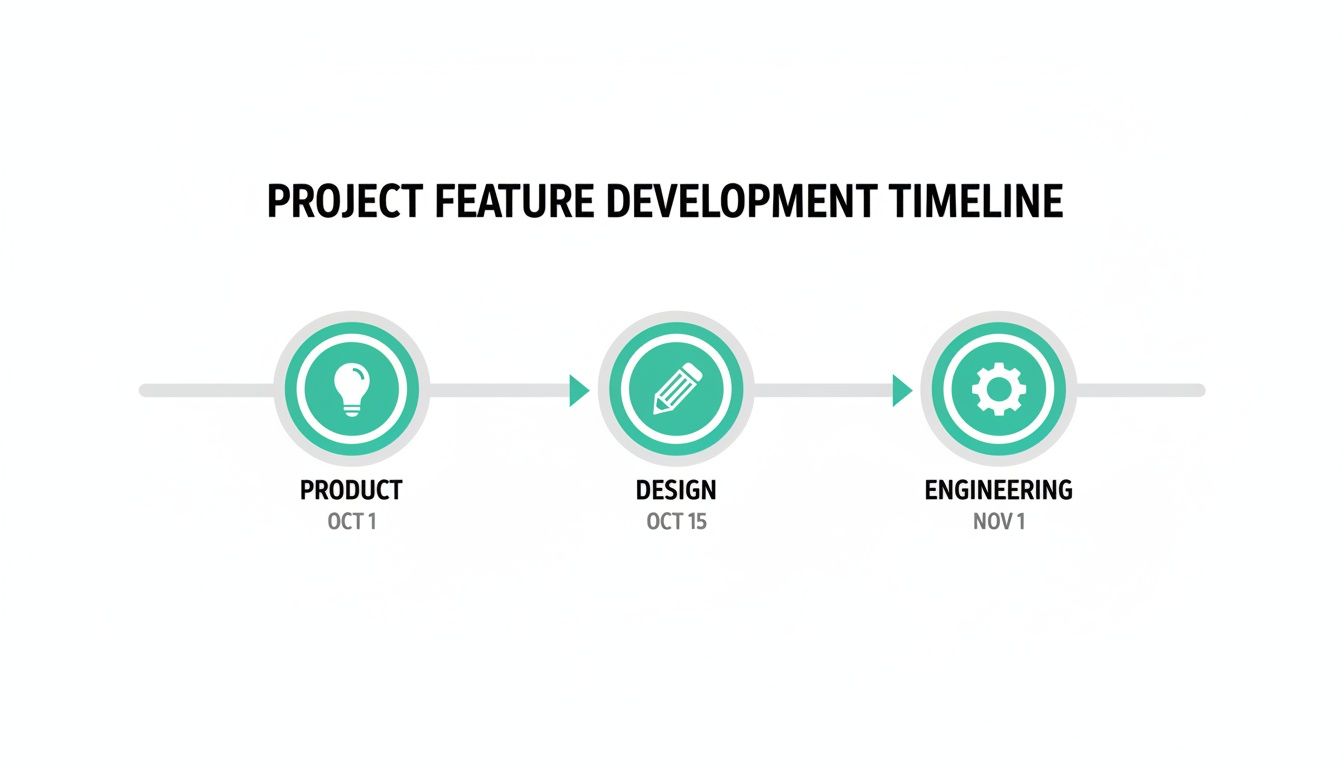
This timeline shows how different teams own distinct phases, highlighting the collaborative but sequential nature of development that ultimately drives the company's value—and by extension, the value of your equity.
Landing a job at a startup today is a different ballgame. The old "hire fast, fail fast" mentality is long gone. Founders are now building incredibly lean, high-impact teams right from the start, which makes the whole interview process more thoughtful—and a lot more competitive.
This isn't just a local trend. Across the European tech scene, for instance, the hiring rate for early-stage startups has dropped from 49% in 2022-2023 to just 27%. It’s a clear signal that founders are focused on building smarter, not just bigger, often using AI to amplify what a smaller, more talented team can do. For anyone chasing a startup career, this means you need to bring your A-game. For a deeper look at these numbers, you can explore detailed insights on tech hiring patterns.
So, while there are still plenty of amazing roles out there, the bar has been raised. Startups aren't just looking for someone who can check off a list of technical skills. They’re hunting for people with a true ownership mentality and a serious bias for action.
Every startup has its own flavor, but most interview loops follow a pretty standard path. Think of it as a series of gates, each designed to test a different aspect of what you bring to the table—your skills, your mindset, and whether you'll vibe with the team.
The real key to success? Treat every single stage like a two-way street. You’re interviewing them just as much as they are interviewing you. This signals that you're a thoughtful candidate who’s looking for the right long-term partnership, not just any job.
To really make an impression, you have to do more than just answer questions. You need to consistently demonstrate the traits startups crave: ownership, initiative, and a relentless focus on results. A polished professional image is also a must, which starts with knowing how to update your LinkedIn profile for 2026 success.
Let's say you're an engineer interviewing at a fintech startup. They hand you a take-home challenge: "Build a simple API endpoint that retrieves a user's transaction history."
README.md, containerize the app with Docker so it’s dead simple to run, and write a quick note explaining their technical choices and ideas for scaling it later.That little bit of extra effort shows a powerful bias for action and an ownership mentality. You didn't just complete the task—you thought about the person on the other end and made their life easier. That, right there, is the startup mindset.
Now, imagine you're a product manager in a final round. They hit you with this: "User engagement for one of our key features just dropped by 15% this month. What do you do?"
A rookie might jump straight to proposing solutions. A seasoned pro starts by asking smart, clarifying questions:
By digging in with questions, you’re showing a structured, data-informed way of thinking. You’re proving that you operate like a business owner—focused on deeply understanding the "why" before you ever jump to the "what." For more tactical advice, our guide on how to get a job at a startup has you covered.
Picking the right startup is more than just landing a new job. A slick job description or a cool office might get your attention, but long-term happiness depends on what’s under the hood. You're not just accepting a role; you're making a calculated bet on a company with your time and talent.
To make the right call, you need a way to look past the hype. This means digging into the founding team's track record, understanding the product's real-world appeal, and getting a clear picture of the company's financial health. The goal is to find a place where you can genuinely make an impact, not just ride out the clock.
The single most crucial factor in any startup's journey is its leadership. A founding team with a sharp, compelling vision and the grit to execute it can steer the ship through almost any storm. Your first move should be to get to know the founders.
Look into their professional histories. Have they built companies before? Do they have deep roots in the industry they’re trying to change? A team of first-time founders isn't an automatic deal-breaker, but a history of successful execution adds a massive layer of security.
When you join an early-stage company, you are not just betting on an idea; you are betting on the people behind it. A great team can pivot from a bad idea, but a bad team will ruin even the best idea.
Don't be shy during your interviews. Ask direct questions about their long-term vision. Where do they see the company in five years? What’s the roadmap to get there? Their answers will show you how they think strategically and whether their ambition is actually tied to a realistic plan.
A brilliant idea is just an idea until people are willing to pay for it. Product-market fit is that magic moment when a startup finds a group of customers who are truly excited about what they're building. You need to figure out how close the company is to hitting that milestone.
Ask pointed questions to get a feel for this:
Just as important is the company's financial runway. You need to know how much cash they have in the bank and how long it’s expected to last. It’s completely fair to ask about their funding status in the later stages of the interview process.
A startup that is well-funded or already profitable offers a much more stable environment, lowering the immediate risk of layoffs or a sudden shutdown. You can often find funding details on platforms like Crunchbase.
For experienced professionals, the decision-making calculus changes. Recent data shows that among new hires at growth-stage startups, the median employee brings 6.6 years of prior work experience. For these candidates, ‘growth potential’ and ‘team quality’ are the two most critical factors. Highlighting this trend, 72% of surveyed job seekers now say they are actively looking for roles at AI companies. You can discover more insights on the 2026 startup job market and see how talent priorities are shifting.
This focus is smart. A role that stretches you and forces you to learn new skills is ultimately more valuable than one with a slightly bigger paycheck. Similarly, working alongside sharp, driven people you respect will not only make your days more engaging but also accelerate your own professional development. This is a core part of the equation when weighing different tech startup careers.

Let’s be honest: wading through startup job postings can feel like searching for a needle in a haystack. The market is incredibly noisy, and telling a high-potential opportunity from a dead end is practically a full-time job. This is where a curated marketplace like Underdog.io comes in, completely flipping the script on the traditional job search.
Instead of firing off countless applications into a void, Underdog.io puts you in control. It’s built around the candidate, meaning vetted companies apply directly to you. This simple change saves you from the dreaded resume black hole and ensures you’re seen as a serious contender from day one.
Unlike the massive job boards that list anything and everything, Underdog.io is all about quality over quantity. Every single company on the platform is carefully screened for critical factors like funding status, team quality, and product-market fit.
This strict curation means you’re only exposed to legitimate, high-growth opportunities. You won’t waste your time sifting through stagnant companies or roles that don’t align with the dynamic startup environment you’re looking for. It’s simply a more efficient way to get your profile in front of the right kind of hiring managers.
The value proposition is simple: you create one profile in about 60 seconds, and hundreds of top tech companies get instant access to it. This model transforms your job search from an active, time-consuming hunt into a passive stream of inbound interest from employers already impressed by your background.
Algorithms have their place, but the nuance of a great hire often gets lost in simple keyword matching. Underdog.io uses a human-powered approach to connect talent with opportunities. Real people who live and breathe the startup ecosystem review profiles and personally facilitate introductions.
This means every match is based on a much deeper understanding of your skills, career goals, and ideal cultural fit. You’re not just a collection of keywords on a page; you're a professional with a unique story, and our platform is designed to honor that. If you want to get a feel for the kinds of roles available, you can browse the startup job board to see which companies are actively hiring.
The whole process is designed to be both discreet and effective. Your profile stays anonymous until you decide to accept an introduction, allowing you to explore the market with confidence. This unique blend of curation, human touch, and candidate privacy makes it a powerful tool for anyone serious about landing their next great role.
Diving into the startup world can feel like you're learning a whole new language, complete with its own lingo and unwritten rules. To help clear things up, we’ve put together some straightforward answers to the questions we hear from candidates all the time.
Let's be real: the risk is there. It’s not just about whether the company will make it or fold. You have the financial risk—your equity could become worthless—and the career risk of pouring your time into a project that never quite finds its footing. But that risk is the price of admission for some pretty incredible rewards.
The experience you get in just one year at an early-stage startup is unlike anything else. You're solving tough problems with minimal resources, juggling multiple roles, and seeing your work make a direct, tangible impact. That kind of accelerated learning is like several years in a big corporate job, and it’s a huge career asset no matter how the company fares.
Even if the startup doesn't succeed, the skills you built and the resilience you gained will make you a top-tier candidate for whatever comes next.
Absolutely. It’s all about how you frame your experience and show a genuine drive to build things. Skills from fields like law, finance, or even education are often directly transferable to roles in operations, business development, and growth.
For instance, a lawyer's knack for contract negotiation is gold for a Head of Operations. A teacher’s ability to break down complex ideas is a massive advantage in a customer success role. If you're looking to make that jump, focus on these steps:
A great culture is so much more than ping-pong tables and a stocked snack drawer. It's about creating an environment where people feel they can do their best work, period. The bedrock of a healthy startup culture is psychological safety—a space where everyone feels secure enough to voice opinions, ask questions, and even fail without being punished.
It also comes down to transparent communication from the top. When leadership is open about goals, challenges, and progress, and everyone is rallied around a mission they believe in, the team becomes an unstoppable force.
As you look at different opportunities, keep an eye out for red flags like high employee turnover, fuzzy answers about company values, or a team that just seems completely burnt out. A great culture is something you can feel, not just something you read about on a website.
The risks are real and include financial uncertainty—equity could become worthless—and the chance you'll invest time in a venture that doesn't succeed. However, the rewards can be exceptional. You gain accelerated learning, working across disciplines and solving complex problems with minimal resources. This often compresses years of experience into a single year. Even if the startup doesn't succeed, the skills, resilience, and network you build are invaluable career assets.
Absolutely. Startups need expertise across operations, sales, marketing, customer success, and business development. Skills from fields like law, finance, or education are highly transferable. For example, a lawyer’s contract expertise is perfect for a Head of Operations role. To make the leap, focus on building a portfolio with side projects or certifications, learn the basic language of tech, and clearly connect your past achievements to the startup’s specific needs.
Healthy startup culture is about more than perks like snacks or ping-pong tables. Look for the foundation of psychological safety—an environment where people feel secure voicing opinions, asking questions, and even admitting mistakes without fear. Pay attention to transparency from leadership about goals and challenges, and watch for red flags like high employee turnover, vague answers about company values, or a team that appears burnt out. Trust your instincts during interviews about the energy and interactions you observe.
Equity, usually in the form of stock options, is designed to reward long-term commitment. The most common structure you’ll see is a 4-year vesting schedule with a 1-year cliff. This means you earn your full grant over four years, but your first 25% vests all at once on your first anniversary. After that cliff, the remaining 75% vests in equal monthly installments over the next three years. This structure protects the company while aligning your long-term interests with its growth.
Ready to find your place in a high-growth tech company? Underdog.io flips the job search on its head by connecting you with hundreds of vetted startups that apply directly to you. Stop chasing jobs and start getting noticed.