The global Consumer Packaged Goods market reached an estimated USD 5,467.51 billion in 2024, with projected expansion at a 4.1% CAGR from 2025 through 2033 to USD 7,799.43 billion, according to Grand View Research's CPG market analysis. That's the scale behind a simple point. Top CPG companies aren't just shelf-space giants anymore. They're becoming serious technology employers.
That shift matters if you're an engineer, data scientist, product manager, analytics leader, or technical operator looking beyond SaaS. In CPG, the hard problems are physical, messy, and expensive: forecasting demand, routing trucks, optimizing warehouse flow, improving retail execution, and building direct consumer relationships without breaking margins. These companies need people who can connect software decisions to revenue, inventory, logistics, and brand growth.
The hiring signal is straightforward. The biggest players are investing in digital capabilities, AI tactics, first- and third-party data analytics, and supply chain resilience because those capabilities now shape competitiveness in the category. If you're evaluating your options, this is also why choosing a CPG marketing partner increasingly overlaps with hiring technical teams that can support data, automation, and customer insight programs.
Get past the old assumption that consumer brands only hire for sales and marketing. In 2026, many of the best opportunities for tech talent are sitting inside the same companies that make Tide, Gatorade, Coke, Purina, Dove, Oreo, and Cheerios.
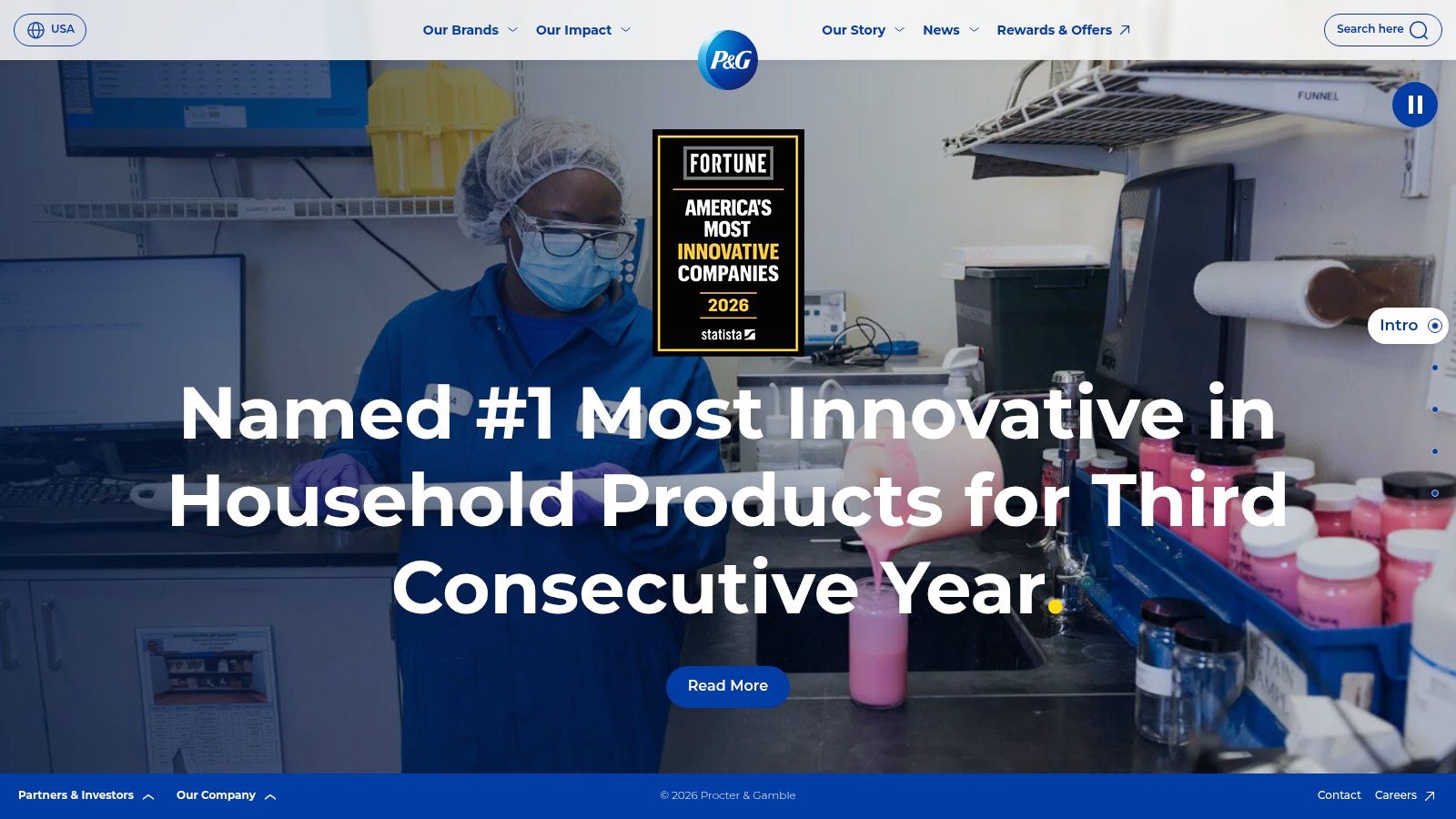
P&G is one of the clearest examples of why top CPG companies now belong on a tech candidate's target list. Its portfolio spans Tide, Pampers, Gillette, Oral-B, and Pantene, which means the company runs across household goods, personal care, grooming, and family care at enormous operational complexity. For technical hires, that usually translates into work tied to forecasting, retail analytics, pricing systems, supply chain visibility, and consumer data platforms.
The appeal is stability with scale. P&G's category leadership and brand equity make it a safer landing spot than smaller challenger brands, and strong cash flow tends to support ongoing R&D and media investment. The trade-off is speed. Large organizations often move more carefully, so experimentation can feel slower than it would at a startup or a digital-native brand.
If you're trying to break in, don't pitch yourself as a generic software engineer. Pitch yourself as someone who can improve a repeatable operating system. P&G rewards people who can make existing processes smarter across planning, merchandising support, digital commerce, and internal tooling.
A few role patterns are worth watching:
Practical rule: In interviews with a company like P&G, talk about business constraints. Mention retailer complexity, stock availability, margin pressure, and demand variability. That lands better than a pure "I built this API" story.
For candidates who want a feel for how startups and consumer brands intersect, Underdog's CPG case studies offer a useful angle on the talent side of the market.
There's also a branding lesson here. Companies with a large family of products care a lot about portfolio logic, naming, and extension strategy, which is why brand architecture work still matters alongside tech hiring. Reddog Group's examples of family branding are useful context if you want to understand how those decisions shape product, packaging, and digital execution.
Visit P&G.
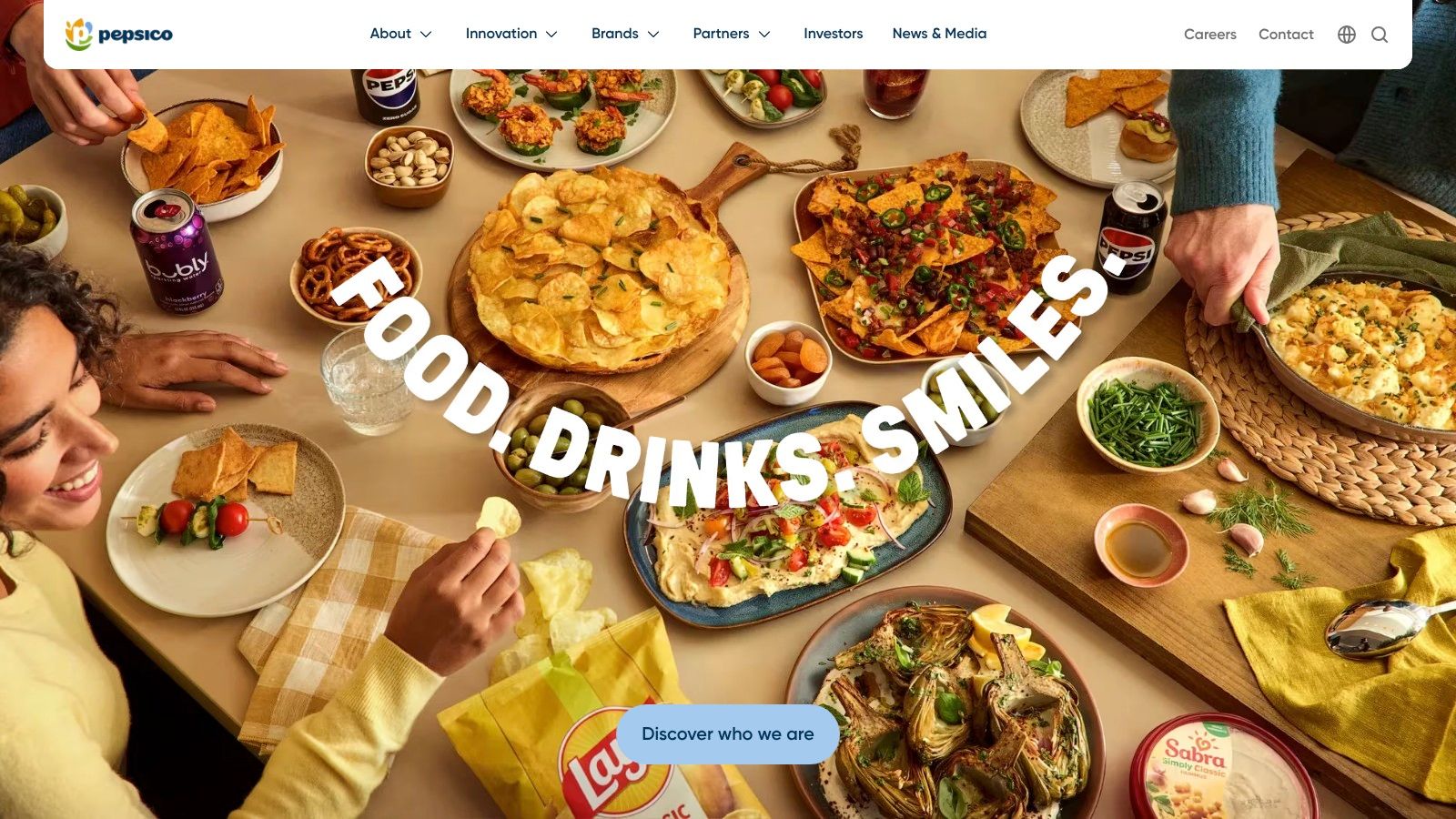
PepsiCo is one of the most attractive entries on this list for technical candidates who want operational complexity without losing consumer brand visibility. The company combines beverages like Pepsi, Mountain Dew, Gatorade, and bubly with snack heavyweights such as Lay's, Doritos, Cheetos, and Quaker. That balanced mix matters because snacks and beverages don't behave identically in distribution, merchandising, or innovation cycles.
What makes PepsiCo especially relevant in 2026 is that top-tier CPG firms such as PepsiCo are increasingly judged by how well they use AI tactics with first- and third-party data analytics to optimize truck loading, warehouse operations, and inventory reduction, as noted in Market Research Future's CPG market outlook. If you've worked on logistics software, operations research, forecasting systems, route optimization, or inventory intelligence, that's your opening.
PepsiCo often makes sense for candidates who enjoy applied technology. This isn't abstract growth hacking. You're dealing with routes, shelf replenishment, direct-store-delivery realities, and high-velocity products that can't sit in a model divorced from field operations.
The pros are strong. PepsiCo has category leadership in salty snacks and sports drinks, along with deep retailer relationships and route-to-market strength. The downside is that core categories also attract health and wellness scrutiny, and commodity exposure can pressure margins. That means teams usually need to justify technology investment with operational impact, not just a nice user experience.
If your résumé shows supply chain, analytics engineering, or ML work, PepsiCo is one of the few brand-name employers where that experience immediately feels native to the business.
A practical move is to watch where PepsiCo posts roles relative to digital manufacturing, enterprise data, revenue management, and field execution. Those tend to be more strategic than generic corporate IT.
For broader tech-market visibility while you search, Underdog's company marketplace is a strong way to compare startup-style roles against opportunities at larger operators.
Visit PepsiCo.
Coca-Cola is a useful reminder that brand scale and technical sophistication often rise together. The portfolio stretches across Coca-Cola, Coke Zero Sugar, Sprite, Fanta, Minute Maid, and Powerade, supported by a franchise bottling system that requires coordination across markets, channels, and local execution. For tech professionals, that usually means opportunities closer to data standardization, demand planning, digital commerce, pricing systems, and customer intelligence.
The company's strengths are obvious. Global brand recognition is unmatched, and the marketing machine is enormous. But candidates should also understand the trade-offs. This is still a beverage company exposed to health-policy shifts and global reporting pressures, so technical work often gets filtered through disciplined business cases.
Coca-Cola becomes especially attractive when you want enterprise-scale problems but don't want to disappear into a back-office function. Technical teams often work close to commercial outcomes because beverage distribution depends on speed, availability, and execution.
Look for roles tied to:
A lot of candidates miss this point. The best signal isn't the title alone. It's whether the role sits near decision-making about sales, merchandising, or fulfillment.
For enterprise candidates comparing larger employers, Underdog's enterprise hiring network is worth tracking alongside direct applications.
Coca-Cola also remains a strong example of how hospitality and retail branding spill into adjacent product ecosystems. For a small but concrete example, Afida's Coke Zero hospitality cups show how far brand systems extend beyond core beverages into operational environments.
Visit The Coca-Cola Company.
Nestlé is one of the broadest bets among top CPG companies because it spans coffee, pet care, nutrition, confectionery, snacks, and water. That diversification matters for tech candidates. A company selling Nescafé, Nespresso, Purina, and products tied to the Starbucks alliance creates more than one path in. You can target consumer platforms, supply chain systems, product data, manufacturing technology, or analytics embedded in category teams.
Nestlé also shows how large-scale food companies are being evaluated differently now. In projections covered by Tastewise's overview of top global CPG food companies, leaders such as Nestlé, PepsiCo, JBS, and Tyson Foods are operating in an environment where innovation, digital capabilities, supply chain resilience, and the use of power brands and local jewels matter more as consumer budgets stabilize. That's useful hiring context. Companies like this want technical people who can support execution, not just experimentation theater.
Nestlé tends to fit candidates who like complexity and can operate within matrixed organizations. The upside is resilience. Coffee, pet care, and nutrition give the company a more defensive category mix than many peers. The downside is exactly what you'd expect from a global operator. Portfolio simplification and reorganization can create internal change, shifting priorities and reporting lines.
Here's where candidates often underplay themselves:
Nestlé is often a better fit for candidates who can handle ambiguity politely. You won't always get startup-speed clarity, but you can get large-scope ownership if you can coordinate across functions.
Visit Nestlé.
Unilever is one of the most interesting companies for tech professionals who want a brand-led environment with broad digital transformation work. Its business groups span Beauty & Wellbeing, Personal Care, Home Care, and Foods, with brands such as Dove, Vaseline, Knorr, and Hellmann's. That category spread creates demand for teams that can support product information, consumer insight, ecommerce execution, retail media, and demand planning.
The strategic context is worth understanding. The U.S. CPG industry supports 10.5% of total U.S. employment and contributes approximately $1.5 trillion to annual U.S. GDP, according to the Consumer Brands Association industry impact overview. In that same view of the sector, major players including Procter & Gamble, Unilever, Coca-Cola, Nestlé, and Colgate-Palmolive dominate global shelf space and brand recognition. If you're moving from tech into CPG, that scale is the argument for taking these employers seriously.
Unilever's current focus on power brands makes it appealing for product and data candidates because resources tend to concentrate around fewer, larger bets. That's usually better than joining a sprawling portfolio where priorities scatter every quarter. The company also benefits from resilient everyday categories and a mix of premium and value offerings.
The downside is transition complexity. Portfolio rotation and structural changes can slow teams down while systems, reporting, and ownership models catch up.
A practical way to read Unilever hiring signals:
"Bridge the gap between insight and execution" is the right mindset for Unilever. Brand-led companies value technical people who understand the consumer, not just the system.
Visit Unilever.
Mondelēz is a strong target if you want CPG exposure with a tighter category story. This company is focused on snacking, with brands like Oreo, Ritz, Cadbury, Milka, and CLIF. That concentration makes the business easier to understand than some sprawling conglomerates, and it often creates cleaner strategic narratives around growth, merchandising, ecommerce, and brand building.
For tech hires, that focus can be an advantage. You're not trying to learn ten unrelated business models at once. Instead, you can go deep on digitally influenced consumer behavior, retail execution, assortment, direct-to-consumer experiences, and promotional analytics.
Mondelēz fits candidates who can connect data work to category growth. Snacking is fast-moving, promotion-heavy, and brand-sensitive. Technical work that supports pricing, campaign measurement, demand forecasting, or channel execution can have visible impact.
A few practical observations:
The pros are strong category leadership and deep merchandising capability. The risk is exposure to input cost swings and slower pockets in some segments, which means initiatives need to prove commercial value. In other words, this isn't a place where "interesting model" beats "useful model."
A focused portfolio can be an underrated advantage for job seekers. It's easier to tell a credible story about impact when the business itself has a clear category identity.
Visit Mondelēz International.
General Mills is often overlooked by tech candidates because it reads as a traditional packaged food company first. That's a mistake. The portfolio includes Cheerios, Betty Crocker, Old El Paso, Nature Valley, and Blue Buffalo, which gives the company exposure to center-store staples, snacks, meals, baking, and pet care. Those categories create plenty of room for technology tied to planning, pricing, demand sensing, ecommerce, and consumer lifecycle work.
General Mills is especially appealing if you want a company where brand familiarity is high and the operating model is easier to parse than in some global giants. Household penetration and brand trust matter in this business, but so does disciplined cost management and targeted innovation. For technical hires, that usually means teams value practicality over novelty.
Candidates who do best here tend to speak clearly about trade-offs. General Mills has to balance legacy categories with newer growth areas such as pet. It also has to manage the reality that center-store products can face private-label pressure when consumers trade down.
That environment rewards a certain type of technical professional:
One more practical point. If you're coming from a startup, don't oversell disruption for its own sake. Companies like General Mills usually respond better to candidates who can modernize mature systems without insulting the existing business.
Visit General Mills.
| Company | Implementation complexity | Resource requirements | Expected outcomes | Ideal use cases | Key advantages |
|---|---|---|---|---|---|
| Procter & Gamble (P&G) | High, enterprise-scale systems and legacy integration | Large R&D, marketing budgets, extensive consumer data platforms | Scalable 1:1 marketing, sustained innovation, category share gains | Large-scale consumer analytics, DTC platform rollouts, supply-chain automation | Deep retail execution, strong cash flow, repeatable productivity playbook |
| PepsiCo | High, complex DSD and logistics integration across channels | Investment in AI/IoT for route planning, fleet tech, e-commerce infrastructure | Improved route efficiency, demand forecasting, inventory optimization | DSD optimization, fleet/IoT projects, e-commerce logistics | Massive DSD network, distribution scale, balanced beverage/snack portfolio |
| The Coca‑Cola Company | Medium–High, coordinating franchise bottlers and cloud consolidation | Cloud platforms, mobile/loyalty tech, franchise data unification | Unified digital ecosystem, stronger direct consumer engagement | Mobile loyalty, bottler-franchise data platforms, global marketing tech | Unmatched brand recognition, flexible bottling system, marketing scale |
| Nestlé | High, diverse business units and device/R&D integration | Large R&D spend, IoT/devices teams, global e-commerce and data ops | Product and service innovation, connected-device revenue, e-commerce growth | IoT/subscription models (Nespresso), R&D data science, petcare e-commerce | Massive R&D, scale in coffee and petcare, global footprint |
| Unilever | Medium, focused Power Brands simplifies scope but requires change programs | Investment in ethical AI, sustainability tech, digital brand ecosystems | Sustainable digital offerings, concentrated brand impact, faster execution | Sustainability tech, DTC brand sites, ethical-AI analytics | Strong sustainability commitment, focused Power Brands, personal care strength |
| Mondelēz International | Medium, innovation hub enables rapid pilots but requires integration | Funding for incubation, digital commerce, personalization data | New snacking experiences, personalized nutrition, DTC acceleration | Incubator-led pilots, personalized snacking platforms, e-commerce innovation | Iconic snacking brands, SnackFutures incubator, strong merchandising capability |
| General Mills | Medium, modernizing legacy systems and integrating acquisitions | Data analytics, cloud modernization, e-commerce and subscription capabilities | Volume-led organic growth, improved digital engagement, DTC expansion | Legacy system modernization, retail & supply-chain analytics, DTC scaling | High household penetration, trusted staples, digital push via Blue Buffalo |
CPG companies are hiring more technical talent than many software candidates realize, and the best openings sit inside large transformation programs, not just corporate IT. P&G, PepsiCo, Coca-Cola, Nestlé, Unilever, Mondelēz, and General Mills are building teams around data platforms, planning systems, ecommerce, retail media, factory tech, and consumer data.
That changes how candidates should present themselves.
Hiring managers in this sector do not screen for tools alone. They screen for operators who can tie technical work to revenue, margin, service levels, and execution. "Python," "SQL," and "A/B testing" help you clear an initial filter. What gets interviews is proof that your work improved forecast accuracy, reduced stockouts, sped up planning, sharpened pricing, or helped commercial teams make better decisions.
Industry context matters more than many candidates expect. Learn how brands sell through retailers, distributors, marketplaces, and DTC channels. Know the basics of trade promotion, sell-in versus sell-through, OTIF, demand sensing, retail media, and direct-store-delivery. You do not need years inside a food or household-products company. You do need to show that you can handle a business built on thin margins, retailer pressure, and constant operational complexity.
Your résumé should read like a business case, not a stack of technologies. Replace generic bullets such as "built analytics platform" with specifics about who used it and what changed. Strong CPG résumés mention inventory allocation, promotion planning, field sales reporting, plant performance, retailer measurement, or ecommerce conversion.
Target the functions where budgets usually hold up. Enterprise data. Supply chain tech. Revenue growth management. Ecommerce platforms. Retail analytics. Manufacturing systems. CRM and first-party data. Innovation labs get attention, but these teams are closer to revenue, cost control, and executive sponsorship.
Watch job descriptions carefully. Roles that mention SAP modernization, cloud migration, MLOps, digital twins, demand planning, personalization, retailer media measurement, or first-party data usually point to active digital transformation work. That is often the cleanest entry point for engineers, analysts, product managers, and data professionals coming from SaaS, logistics, marketplaces, or fintech.
One more practical point. CPG hiring cycles can move slower than startups, but the roles are often broader and the business impact is easier to explain. If you want help finding tech roles at growth-stage companies while you sharpen your CPG positioning, Underdog.io is a useful hiring marketplace to keep in your mix.
The candidates who stand out connect code to shelf-level outcomes. Show how your work helped products get made, moved, sold, or marketed better, and you will look far more credible to a CPG hiring team.