You search "ux design jobs new york" before the coffee is ready, and the first page is a mess. An agency wants a visual designer who can also pitch clients. A remote-only role wears a New York tag so it ranks. An unpaid internship sits beside a Series A product seat. You are a mid-level product designer, and the title is not the problem. The city's market favors people who can tell a real startup opening from a recycled listing, and that skill lives in the source, not the keyword.
A bigger results page does not mean more seats. Hiring is selective, and a lot of what ranks is adjacent work, volunteer work, or a role you would never commute for. I sort boards by how fast they let you drop those listings, not by how many logos they show.
Seven sources cover different stages of the same week. Underdog.io is the one-application startup pass. Built In NYC and Wellfound are for scanning local tech listings. LinkedIn and Indeed are the wide nets. Dribbble is the design-native board. Glassdoor is the pay and review check before you talk to anyone.
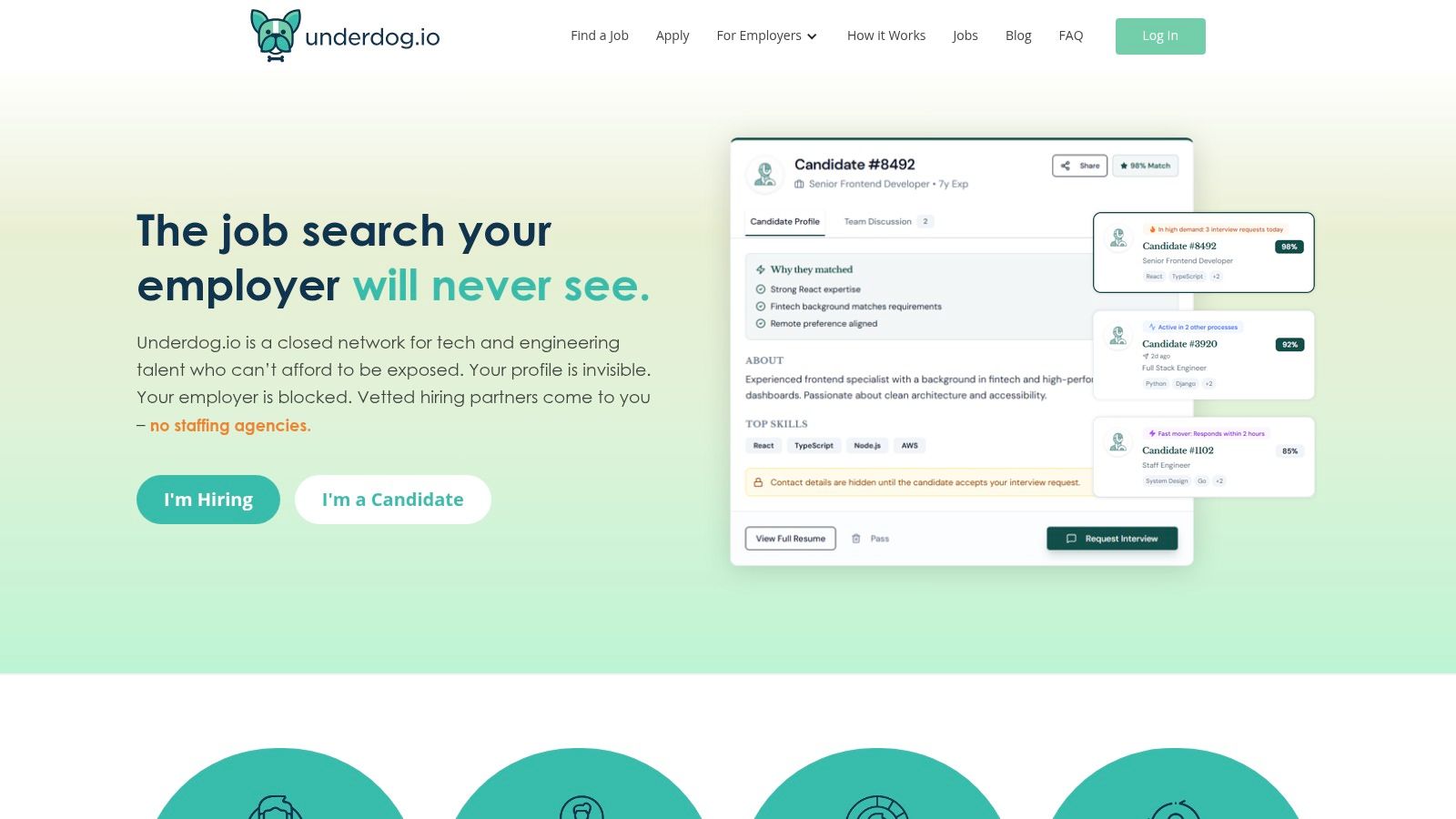
A designer who wants employers to come to them starts with Underdog.io, a curated marketplace connecting tech candidates with high-growth startups in New York City, San Francisco, and across the U.S., including remote roles. One 60-second application puts your profile in front of hundreds of vetted companies, and interested employers reach out to you. The pool runs early-stage through Series B, and large corporations are filtered out. Every startup is screened for funding status, team quality, and product viability before it can contact anyone. It is free for job seekers, since employers pay per hire on a success-based model and public pricing is not listed.
The candidate side is just as selective. Only about 5% of applicants get in. Profiles are reviewed by hand for experience in product, engineering, design, data, or marketing, plus fit with startup culture, so a thin portfolio of pretty screens will not clear review. Profiles stay hidden from your current employer until interest is mutual, which matters if you are still on a team in SoHo and do not want a recruiter emailing your manager. Matches are made by people who weigh fit rather than keywords, and they typically arrive as one to three introductions a month. About 85% of candidates on the platform are already employed and looking discreetly. If you want a large corporation, this is the wrong door. If you want a startup that will talk to a designer, it is the fastest filter I use.
Say you have forty tabs open and twelve of them are "New York" roles that are remote-only or unpaid. Underdog.io does not ask you to triage those tabs. You spend the hour on one case study instead.
Use this order, then stop tinkering:
Practical rule: If the case study cannot name what shipped and what you rejected, do not submit it. Reviewers are matching judgment, not a Figma tour.
Tech:NYC reported 211,800 tech jobs in New York City and 10,595 new tech job postings as of June 2025, with roughly 20% of new postings requiring AI-related skills. No one expects you to train as an ML engineer. Bring one story about error recovery, trust, or how you evaluated a model output alongside engineers. Roles on the platform tend to come with equity transparency and mission-driven teams, so read product designer jobs in NYC after you submit to see how startups title the same work.
One honest profile and a week of interview prep beats refreshing the page for volume. Judge the fit the same way the platform does: company stage, funding, and whether the product is real.
Built In NYC is the board I open when I want tech and startup design roles with the boring details attached. Salary, seniority, skills, company blurbs, and hybrid versus remote often sit on the card. You can scan a lunch hour of ux design jobs new york without decoding a PDF.
A current job index put New York City among the leading global metros for postings that mention UX design, with 44 indexed postings, 4.8% of the tracked total, over a 90-day window, just ahead of San Francisco at 40 postings, or 4.4%. In that same set, "Product Designer" was the most common role tied to UX design, at 35.1% of relevant postings, according to Skillenai's UX design skill data. On Built In, search product designer as well as UX. The work is often the same seat.
Search the title the startup uses, not the title on your resume.
The trade-off shows up fast. Results include adjacent design roles, and sometimes volunteer or low-paid listings. A New York tag can still mean remote. Some account features ask you to sign in. I keep a three-line sort before I click apply. Is there a salary or a seniority band? Is the arrangement hybrid or on-site in the city, not "U.S. remote"? Does the company blurb name a product, not a generic "forward-thinking team"?
Free browsing makes this a good first pass beside a curated marketplace. It is a weak last pass. Freshness varies, and a pretty card is not a vetted startup. Pair it with a short read on design jobs in NYC so your portfolio matches startup ownership, not agency decoration. If forty listings are the afternoon's work, Built In should leave you with five worth a case-study tweak, not forty applications.
Wellfound is where a startup-minded designer goes when equity is part of the decision, not a surprise on the offer call. The New York UI/UX search often shows salary, equity, arrangement, and years expected. You can build a profile, apply, and sometimes message a founder directly.
That direct line is useful and dangerous. A founder reply at 9 p.m. can mean a real seat or a role that is three jobs stapled together. Read stage, team size, and scope before you invest a portfolio rewrite.
Recent labor-market analysis found New York design, creative, and UX employment largely flat year over year even while postings increased 6.6%. Demand was concentrated, with software development about 25% of local demand, technology 20%, financial services 15%, and advertising services 15%, per Callings.ai's design and UX market note. On Wellfound, a software startup wants experimentation proof. A fintech startup wants workflow and compliance awareness. An agency-like studio wants fast client narrative. General UX credentials lose to domain proof.
Wellfound is free to join and apply. Compensation and maturity swing wildly, so the board rewards careful reading and punishes easy-apply habits. I would not use it as your only source. I would use it on the day you are comparing two startup offers and need equity and arrangement on the listing itself.
LinkedIn Jobs is the wide map. Startups, big tech, media, and finance all land in one New York UX search. Filters cover experience, job type, salary, and arrangement. Alerts catch new posts. Company pages and mutual connections tell you who actually works there.
The local advantage shrinks once a role is remote. A recent analysis citing New York Fed research reported that roughly 64% of the recent increase in young-graduate unemployment was associated with changes in remote-work applicant pools rather than AI directly, as covered by Emily Backes on entry-level design jobs. On LinkedIn, a junior in Brooklyn is often stacked against senior applicants nationwide. For a mid-level search, set the arrangement filter to hybrid or on-site before you read a single description. That one click removes most of the false "New York" pile.
Run three title alerts, not one. UX designer, product designer, and interaction designer surface different teams. Then use people search only after a listing survives the filter. A note to a designer on that team beats another easy apply into a pile of hundreds.
Results still include roles that mention UX in a bullet and mean something else. Competition on obvious posts is high. Alerts, some applications, and messaging need a sign-in. What works is alerts plus a location filter plus two thoughtful notes a week. What does not work is treating every "promoted" card as a startup that is really hiring this month.
Indeed is the complement when startup boards feel too narrow. The New York UI/UX search pulls employer posts and reposts across finance, media, healthcare, and public-sector vendors. Some cards show pay and arrangement. Some offer an easy-apply path.

Indeed also surfaces design work inside hospitals, publishers, and finance operations, not only inside startups with a seed round. That breadth is the point of the board. The trade-off is noise. One search mixes UX roles with research posts, loosely related design jobs, and reposts of listings that already ran on the startup boards last week.
Use Indeed to escape a pure startup tunnel, then verify. Listing age and apply flows vary. I open the employer career site before I trust an aggregator card. If the live req is gone, the Indeed post is a ghost.
Say you are choosing between a startup at $130,000 plus equity and a hospital system with a clearer band and hybrid days. Indeed is often where the second offer shows up. It is a poor place to feel the quality of an early team. Keep it as the Wednesday alert sweep, after the startup pass, and cap easy-apply at the roles whose scope you could defend in an interview.
Dribbble Jobs sorts by craft before it sorts by discipline. Product and UX roles sit beside visual, graphic, and marketing design posts, and you can search by company, skill, or tag, with location and remote status usually on the card. A portfolio on the same network can sit beside your application, which helps when the work is visual and hurts when the role is research-heavy.
New York volume runs smaller than on LinkedIn or Indeed. Non-U.S. and remote posts make the location filter required, not optional. Skip it and an afternoon disappears into brand jobs in other countries.
The local density has a real base. The New York–Newark–Jersey City metro held about 13,460 web and digital interface designers in May 2019, at a mean wage of $42.84 an hour (about $89,110 a year), per a career guide summarizing BLS figures. That category is wider than UX alone, and on Dribbble the width is visible: graphic posts and UX posts share one grid, so a fast scan by title is how you separate real product roles from adjacent ones.
A polished shot gets you a click. A case study with constraints gets you a conversation.
Reach for Dribbble when the target team cares about craft and you already have shots worth showing. I skip it when the role is research, accessibility, or design systems with almost no marketing surface. For the broader search beyond the grid, see UI and UX job coverage, then come back to tags like "product design" and "New York" only. Applying to every "designer" tag because the grid looks active is the fastest way to fill a week with roles that were never product work.
Glassdoor is the board I open after a company is real, not before. Listings sit next to reviews, salary reports, and interview notes. Filters cover place and title. Free job-seeker access is the normal path, and some posts bounce you to the employer's own site to finish.
Treat reviews as team gossip with a paper trail, not as a rating you can average into a decision. A one-star from a sales org does not describe the design pod. A salary report may be two years old and missing equity. Still, five interview reports that all mention a whiteboard and a stakeholder critique tell you how to prep.
Glassdoor is strong for comparing two NYC employers you already like. It is weak as a startup sieve. Broad results need the same arrangement filter you used elsewhere, and user-submitted pay will not match a seed-stage equity offer. I would not spend the morning here. I would spend twenty minutes here the night before a screen, with the listing and the review tab side by side.
| Item | Best For | Startup Focus | Salary Info Shown | Free for Candidates |
|---|---|---|---|---|
| Underdog.io | Curated, discreet startup job matching | High-growth startups | Varies by match; not a standard card field | Yes |
| Built In NYC | Browsing NYC tech and design roles | Tech and startups | Some listings show salary ranges | Yes |
| Wellfound | Finding startup roles and contacting hiring teams | Strong startup focus | Often includes salary and equity | Yes |
| LinkedIn Jobs | Broad job search and professional networking | Includes startups and larger employers | Salary filters available; listings vary | Yes |
| Indeed | Searching across industries and employer types | Broad, not startup-specific | Some listings show pay | Yes |
| Dribbble Jobs | Design-focused roles and portfolio-led discovery | Some startup opportunities | Varies by posting; portfolio is the screen | Post-by-post terms |
| Glassdoor | Comparing jobs, companies, and compensation | Broad, not startup-specific | Salary information available | Yes |
Use the table as a speed test, not a ranking by size. A designer with forty tabs open should ask one thing first: does this source surface a NYC startup seat with real scope, or make me filter out remote-only and adjacent work? Underdog.io is the shortest route when you want vetted startups to come to you through one 60-second application. The broader boards still earn a sweep, but they spend your time on arrangement and title checks.
Run one loop each week, not seven hobbies. Monday is the startup pass. Submit or refresh the Underdog.io application, then read only the companies that fit stage and craft. The 60-second form is the point. It gives you the rest of the week for portfolio edits and interview stories instead of another forty listings.
Wednesday is the broad alert sweep. Built In NYC and Wellfound for startup cards with pay or equity. LinkedIn and Indeed with hybrid or on-site filters, three titles, and a hard cap on easy-apply. Dribbble only if the role needs visual proof. Anything remote-only, unpaid, or vaguely "creative" goes in the no pile in under a minute.
Friday is the money check, before you accept a screen. For the New York–Newark–Jersey City metro, May 2025 estimates for web and digital interface designers show about 14,990 workers, a median annual wage of $119,190, a 25th percentile of $96,100, and a 75th percentile of $167,660. The national median for the same category is about $104,000, so the metro median sits about 15% higher, according to Salaries by City's New York UX designer figures. The bucket includes UX, UI, visual, and some front-end digital design, and it excludes equity. An offer under the 25th percentile needs a reason. A senior scope can clear the 75th. Ask what is base, bonus, and equity before you compare two startups as if the titles match.
Use the same evidence in every conversation. One case study, a measurable change, an accessibility decision, and a note on how you worked with engineering. Portfolio planning for digital creators is a useful reset if your case studies still read like a gallery.
This week, file the Underdog.io application, set three filtered alerts, and book two portfolio hours. That is a search. Refreshing one keyword is not.
Underdog.io lets NYC UX and product designers submit one 60-second application and get in front of vetted high-growth startups, so employers reach out instead of leaving you to sort remote-only and adjacent listings all week. It is built for early-stage and Series B teams, and it is free for candidates who want that startup lane. Start the pass at Underdog.io and spend the saved hours on the case study those teams will read.