You're scrolling job boards late at night, saving roles that sound promising and wondering whether anyone's hiring. One listing asks for a generalist who can build the product, another wants production AI experience, and a third gives you no useful picture of the work or the team. The New York startup market is big, but that doesn't make a focused search easy. The way through is to screen for real hiring signals, target roles you can credibly do, and understand the terms before you commit.
A mid-level engineer opens a job board at eleven at night and finds plenty of listings. Several have vague descriptions, some appear to have been open for a long time, and many ask for a broad mix of skills. The candidate's first instinct is to apply widely. That's usually the wrong move.
New York's tech sector is substantial, but a large market doesn't guarantee a straightforward path into a startup. Tech:NYC reported 10,595 new tech job postings and 211,800 tech jobs in New York City as of June 2025, with roughly 20% of new postings requiring AI-related skills. That makes hands-on production experience with AI systems useful evidence, but it doesn't mean every role labeled “AI” involves model development. Some jobs focus on integrating tools into products, building data infrastructure, or evaluating model output. (Tech:NYC's New York tech jobs dashboard)
The hiring playbook from the 2021 boom doesn't translate cleanly to today. Recent market commentary describes funded Series A startups hiring smaller, more senior teams than they did during that period, while junior and generalist candidates face a crowded field. A long list of openings can coexist with limited entry-level access. Don't read demand headlines as proof that every experience level has the same odds.
A company's title might say “software engineer,” but the description could really mean backend infrastructure, applied AI, fintech security, or developer tooling. Treat the title as an initial clue, then inspect the responsibilities, the team, and the expected level of ownership. If the company can't explain what this person will ship or why the role is open, slow down.
Candidates with less experience should look beyond postings explicitly marked junior. Adjacent work in implementation, data operations, product operations, QA, or customer-facing technical roles can build relevant skills, depending on the candidate's background. The key is to show how prior work transfers, not to pretend an adjacent role is identical to the job you want.
A useful search begins with a clear role thesis. Decide which problems you can solve now, what kind of team you want to join, and where you're willing to compromise on company stage or work location. Then apply where the job's core needs overlap with evidence you can show.
Don't spend another six months scrolling through listings that blur together. Pick a specific lane, check whether the company is actively hiring, and make each application answer the hiring manager's actual question: why should this team trust you with this work?
New York offers enough startup variety to support focused searches, but that breadth can become noise if you don't filter it. The Center for an Urban Future counted 25,451 tech-enabled startups in New York City and 8,750 funded technology startups in 2024, more than twice the 3,772 funded tech startups recorded a decade earlier. Those figures describe different things: tech-enabled businesses are a broad pool, while funded technology startups are a narrower group of potential employers. (The Center for an Urban Future's analysis of New York's tech sector)

The size of the ecosystem doesn't tell you which company is a good fit. It does mean you can search by a combination of role, company stage, and specialization, rather than treating every result for “startup jobs New York” as interchangeable. A candidate who wants early product ownership should evaluate seed-stage teams differently from a candidate who wants to join a larger organization with defined functions and processes.
Start with the job you can do well, then identify the kind of employer that needs it. For example, a backend engineer interested in reliability might focus on companies whose products depend on complex integrations or consistent data pipelines. A product manager with fintech experience might prioritize teams serving financial institutions rather than applying to every startup with a product opening.
Stage matters because the company's needs and constraints can differ. Early-stage teams often need people comfortable working across boundaries; more established startups may be hiring for narrower expertise. Ask what the team expects this role to own, how the work connects to current company priorities, and whether the hiring manager can describe success in practical terms.
For an additional way to assess a potential move, use the New York City ReloScore breakdown to consider location context alongside the job itself. It's more useful as one part of a decision than as a substitute for checking the role's actual location policy and your own priorities. For a broader overview of the local technology scene, the guide to tech jobs in New York can help you refine the industries and role types on your list.
A shortlist should be small enough to research properly. For each company, write down the problem it appears to be solving, the role's essential skills, the team stage you're targeting, and the evidence you can bring. If you can't explain why a particular company belongs on the list, it's probably not a priority.
A senior engineer can ignore half the listings and still have options. A junior candidate usually cannot. That is the first reality check: NYC has plenty of startup openings, but the useful ones cluster by level, work model, and whether the posting gives enough information to judge the job before you spend an afternoon on it.
| Channel | Best For | Signal Quality | Cost to Candidate |
|---|---|---|---|
| Broad job boards | Scanning volume and spotting new companies | Mixed; many listings are stale or vague | Usually free to browse |
| Startup-focused boards | Finding younger companies and startup-native roles | Better focus, still verify team and stage | Usually free to browse |
| In-person events | Hearing how teams actually operate | High if the right operators attend | Time plus event cost |
| Curated marketplace | Passive candidates who want relevant introductions | Stronger when profiles and roles are reviewed | Depends on the marketplace |
Read the range before the mission statement. A serious NYC posting should make the salary band and location policy easy to find. If the range is wide enough to be meaningless, or the role says remote while the team is clearly Manhattan-based, ask early whether pay assumes NYC, a remote band, or a different market entirely.
Underdog.io keeps profiles anonymous until interest is mutual, focuses on passive candidates, and is free for job seekers, with companies paying only on a successful hire. Use it if you want relevant inbound while employed. Do not treat a marketplace profile as a substitute for proof: scope, shipped work, and level still decide whether a company takes you seriously.
Broad boards are for discovery, not devotion. Startup boards help you narrow the field. Events matter when founders, hiring managers, or senior operators in your lane are in the room; one specific conversation beats twenty cold applications. If you want a broader menu before choosing, compare these sites for finding startup jobs and keep only the ones that show seniority, salary range, and location clearly.
Set a weekly cadence you can sustain: scan for new postings, refresh your target list, send a small number of direct notes, and follow up with people who gave you real context. The goal is a manageable pipeline of credible opportunities, with a clear next step for each one.
A startup hiring manager doesn't need a résumé that repeats every phrase in the posting. They need evidence that you can handle the work the team needs done. Start by copying the requirements into a working document and labeling each one core, adjacent, or incidental. Core skills are essential to the job; adjacent skills support the work; incidental items are nice-to-haves. Build your application around the core set.
Create a one-page evidence map before editing your résumé. For each core requirement, note a project, your personal contribution, and an outcome you can substantiate. Outcomes might involve latency, reliability, revenue, adoption, or shipped-user scale. If you don't have a defensible number, describe the result clearly without inventing one.
Practical rule: A tool name is a claim about familiarity. A specific project and your contribution show what you can do with it.
Put the most relevant work near the top of the résumé. A backend candidate applying to an infrastructure role should lead with system ownership, production debugging, or reliability work if those are the employer's central needs. A product candidate should show decisions made under uncertainty, user evidence, and what shipped.
Handle AI-related requirements precisely. If you integrated a model API into a product, say that. If you worked on training or deploying machine-learning systems, name the part you owned. If you supported data evaluation or experimentation, describe the task and the result. Don't imply model-building experience when your experience was product integration.
Use a portfolio to give hiring teams enough context to assess your judgment. Include the problem, constraints, your role, the choices you made, and what happened. Remove confidential details, and make clear which work was yours when a project involved a team.
NYC employers covered by the pay-transparency rule must include a good-faith salary range in job advertisements. Use the posted band to ask about level, scope, and compensation components before investing heavily in a process. A New York City Council analysis found that 11% of job listings on Indeed and 44% on Google for Jobs lacked the required range, while more than 80% of postings that did include a range had a maximum no greater than 1.5 times the minimum. (The City Council's salary-transparency analysis)
When a range is relatively narrow, ask which level the company has in mind and what experience would place a candidate toward the upper end. For example, replace “Built scalable systems with Python” with a truthful statement such as “Owned a Python service used by multiple internal teams and improved its reliability through production debugging.” Be specific about the work, but never add an outcome you can't support.
Networking works best when you approach it as a way to learn and establish relevance, not as a sequence of requests for referrals. Identify founders, engineering leaders, or product leads at companies that match your target. Look for a real point of connection: a product launch, a technical challenge, a customer segment, or a shared professional contact.
A concise note should explain why you're contacting that person, what relevant experience you bring, and what you'd like to learn. Ask for a conversation about the work or the team's priorities, not for an immediate job. If someone offers an introduction, make it easy for them to help by sending a short summary they can forward.

Startup interviews often test whether you can make good decisions with incomplete information. For a technical role, prepare to explain a system you built, a production issue you handled, and a trade-off you made. For product or design work, be ready to discuss how you gathered evidence, chose what to prioritize, and responded when the first approach didn't work.
Before a take-home exercise, clarify its intended scope, evaluation criteria, and expected time commitment. For system design, ask questions about users, reliability, data, and constraints before proposing an architecture. Interviewers want to see how you reason, not just the answer you arrived at.
Prepare your own questions, too. Ask about runway and financing dependence, the role's scope, who has decision authority, how the team handles disagreement, and what the company expects you to accomplish. For equity, ask how the grant works and what information the company can share. Clear questions help you assess whether the opportunity fits your risk tolerance.
Since November 1, 2022, NYC employers with at least four employees must include a good-faith minimum and maximum salary in job advertisements. A salary-range discussion is a legal baseline, not a favor. (New York State's pay-transparency information)
Go into every conversation with a short account of the work you want, a few relevant examples, a view of the company's product, and questions geared to the role. Curated introductions can complement direct outreach by connecting candidates with companies whose needs fit their backgrounds. Keep the conversation peer-to-peer: explain the problems you can solve, and ask whether the team's priorities are a match.
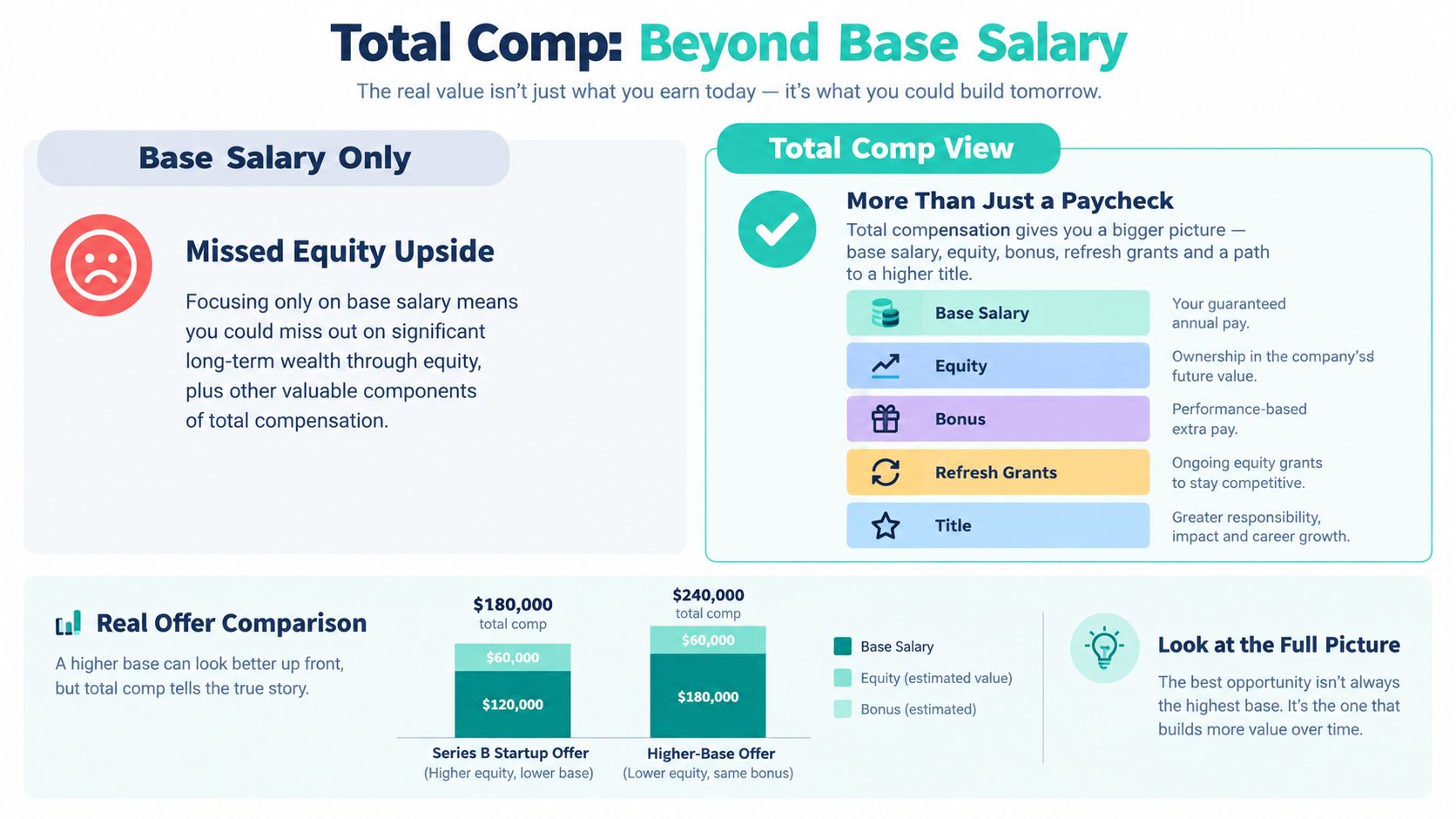
A high base salary can still be a poor offer if the role is unclear, the equity terms are opaque, or the work arrangement doesn't fit your life. Compare the whole package: base pay, bonus, equity, any refresh policy, benefits, title, scope, and the risks attached to the company's stage. Treat equity as uncertain until you understand the instrument and its terms.
Remote work adds another trade-off. A recent industry benchmark describes remote startup roles as sometimes paying less than NYC-market roles, while hybrid arrangements may retain local-market pay in exchange for regular office attendance. Treat those figures as directional, not a rule for every employer. Ask what “remote” means in practice, where the team expects you to work from, and whether the company's compensation policy changes with location.
New York State's pay-transparency requirements took effect September 17, 2023 and apply to jobs performed at least partly in New York, including some remote roles where the worker reports to a New York supervisor, office, or worksite. (New York City's salary-transparency factsheet) Check the stated range and ask how the role's location affects compensation. Don't assume that remote status makes the range irrelevant.
Before accepting, get the material terms in writing. Ask whether equity is an option grant or another form of equity, how vesting works, and what happens if you leave. Clarify bonus conditions, work-location expectations, and the role's scope. If the salary band is the constraint, consider negotiating on responsibilities, title, or other parts of the package rather than pressing for a number the company says it can't offer.
For a structured way to prepare for the conversation, consult Acheloa Wellness, Inc.’s salary negotiation guide. Use it to organize your questions, then compare the actual written terms with the guide to startup compensation and benefits. A calm negotiation is specific: explain what you're asking for, why it fits the role, and what information you need to make a decision.
Landing the job starts a new evaluation, and it runs both ways. The company is watching you, and you should be watching the company. Use the first months to build trust, pin down what you own, and create a record of work that strengthens your next conversation, whether it's a raise discussion inside the company or a move elsewhere.
Keep a running record of decisions and outcomes as you go. If you negotiated on title or responsibilities instead of salary, this record is how you prove the expanded scope and reopen that conversation on your terms.
Underdog.io connects tech candidates with startups through a curated hiring marketplace, with anonymous profiles until interest is mutual and no cost to job seekers. If you want to explore New York startup roles without relying only on public listings, visit Underdog.io.