A vetting process is a structured check that confirms a candidate's identity, work history, qualifications and suitability for a role before an offer is final. Why do so many candidates treat that check as a pass or fail verdict, when a flag is usually just a question that needs an answer?
You can pass every interview and still stall because a date doesn't match, a title reads differently in HR records, or a reference can't be reached. That delay rarely means you're dishonest. It usually means your records need a short, documented explanation, and you can prepare that explanation long before anyone asks.
Say you're buying a house. You don't judge it on a quick walkthrough and a friendly chat with the seller. You pay an inspector to check the foundation and wiring, and you compare the paperwork with the listing. If the inspector finds an old water stain, you don't automatically walk away. You ask when it happened, whether it was repaired, and whether it affects the house now.
Vetting works the same way for a hire. It's a structured review that tests whether a person is suitable, trustworthy and qualified for a specific role. Instead of accepting a résumé at face value, the employer compares each important claim with evidence.
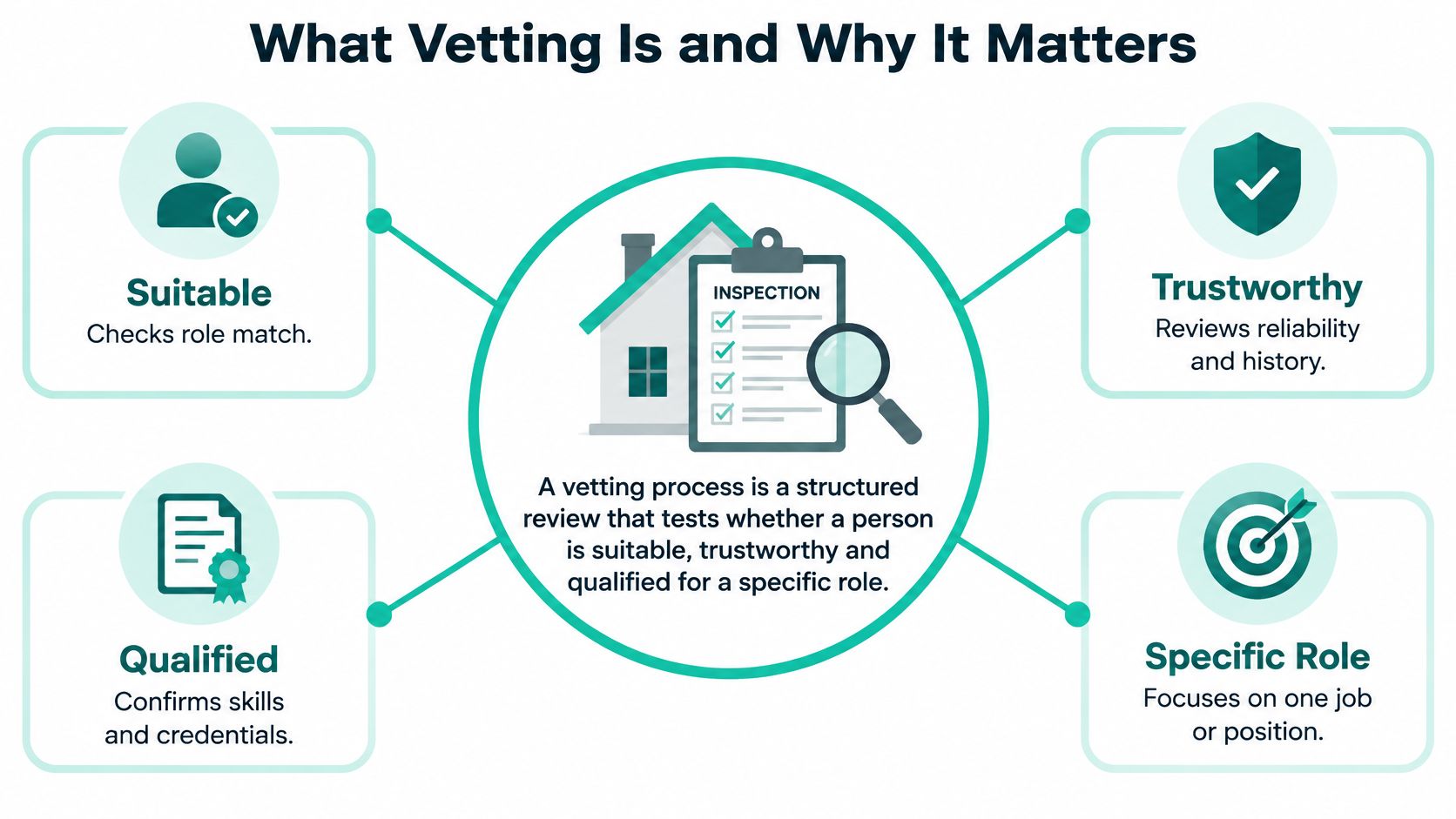
First, is this person who they say they are? An identity check answers that. Second, did they do what they claim? Employment dates, titles, degrees and references answer that. Third, can they do this job? A work sample, portfolio or technical task answers that more directly than a list of past employers.
Those questions sound simple, but they're different from interviewing. An interview tests how you explain your work, solve problems aloud and communicate with a team. Onboarding is different again. It starts after you've accepted an offer and covers accounts, equipment and first assignments.
Vetting checks claims against evidence, while interviews test impressions.
That distinction helps when a process feels repetitive. If a hiring manager asks you to walk through a project and a later check asks your former manager about the same project, they aren't testing the same thing. One is hearing your account. The other is confirming it.
Companies care because a mis-hire can disrupt a small team, expose customer data or send a project back to the start. Startup teams feel that cost quickly because one person may own a whole function. A careful check reduces the chance that a basic mismatch survives until week one.
Candidates benefit too when vetting stays tied to the job. A decision based on verified work is fairer than one based on a polished interview or a famous former employer. It also gives strong candidates with unusual paths a chance to document contract work, portfolio projects or rapid title changes instead of hoping a reviewer guesses correctly.
Even routine records often need clarification. In the 2025 HireRight survey reported by Personnel Today, 64% of 1,000 HR, risk, and talent-acquisition professionals reported discrepancies in candidates' past employment details during pre-employment screening. A discrepancy can be a rounded month or an internal title that differs from the title used externally. It isn't proof of deception on its own.
The same logic applies outside paid employment. If you want a plain-language comparison for unpaid roles, volunteer background checks explained by VolunteerBadge shows how organizations match the depth of a check to the responsibility involved. The role changes, but the principle doesn't. More access and trust call for stronger evidence.
The first failure is treating every flag as an automatic rejection. A four-month gap while you retrained for a career change should prompt a question about dates and activity, not an instant no. The second failure is using weak proxies, such as school prestige or an unexplained preference for uninterrupted employment, as if they measured job performance.
The third failure is inconsistency. If one candidate gets a chance to explain a title mismatch and another doesn't, the process isn't measuring evidence fairly. The fourth is secrecy. When you can't see what was flagged or correct a wrong record, a typo can look like a character judgment.
A useful rule covers the whole process. A flag is a question to resolve, not a verdict. Your job as a candidate is to make that question easy to resolve with dates, documents and people who can confirm your work.
Not every employer runs every check, and the order can shift. Read the table as a map of what a hiring team might verify, the evidence you'd normally supply and when that check usually happens.
| Check | What It Verifies | Typical Evidence | Usual Timing |
|---|---|---|---|
| Identity verification | The applicant is the real person named | Government photo ID or digital ID check | Before or at offer |
| Employment history | Dates, titles and employers match the claims | Employer letters, payslips, dated profile entries | After interview |
| Education and credentials | Degrees, certificates or licences are genuine | Registry lookup or official transcript | After interview |
| Reference checks | Past performance and working style | Named managers or peers who can speak to your work | After interview, before offer |
| Work sample or technical assessment | Ability to do the core task | Portfolio, code test or case exercise | Mid-process |
| Criminal-record screening | Relevant convictions, where legally permitted | Signed consent and third-party report | After conditional offer |
| Right-to-work eligibility | Legal authority to work in the country | Identity and work authorization documents | Before or on first day |
Identity verification confirms that the person applying matches the ID presented. You might upload a government photo ID, complete a digital identity check, or show documents in person for a sensitive role. The question is narrow. It doesn't judge your ability, only whether the record belongs to you.
Employment history compares your dates, titles and employers with HR records, employer letters or payslips. Small differences are common when a company used an internal title or you rounded a start month. Use the title and dates your former employer can confirm, then add a market title in brackets only if it doesn't create confusion.
Education and credential checks confirm that a degree, certificate or licence is genuine and current. A registry lookup or official transcript usually settles it. If your name has changed since graduation, keep the legal document that connects your old and current names with your transcript.
Reference checks ask people who saw your work about scope, results and working style. A former manager can confirm what you owned, while a peer can describe how you handled feedback or deadlines. Our guide to the reference check process and what employers ask explains why specific examples from references carry more weight than general praise.
A work sample tests the core task directly. That might be a code exercise, a product case, a writing sample or a portfolio review. In startup hiring, this often matters more than a formal credential because the team needs to see how you'd handle the actual work with limited direction.
Criminal-record screening should run only where it's lawful, relevant to the role and covered by consent. Right-to-work eligibility confirms you can legally work in that country and usually requires identity and authorization documents. A regulated finance or healthcare role will weight licences and records more heavily. A startup product role will usually lean harder on portfolio work and references.
You can prepare several items now. Keep clear ID copies, dated employer letters, transcripts and contact details for two references who've agreed to speak. That small file turns most routine requests into a same-day reply.
Startup vetting usually gets deeper as you move closer to an offer. Early stages test fit and ability with information you provide. Later stages verify records with outside sources, because those checks take time and may require consent.
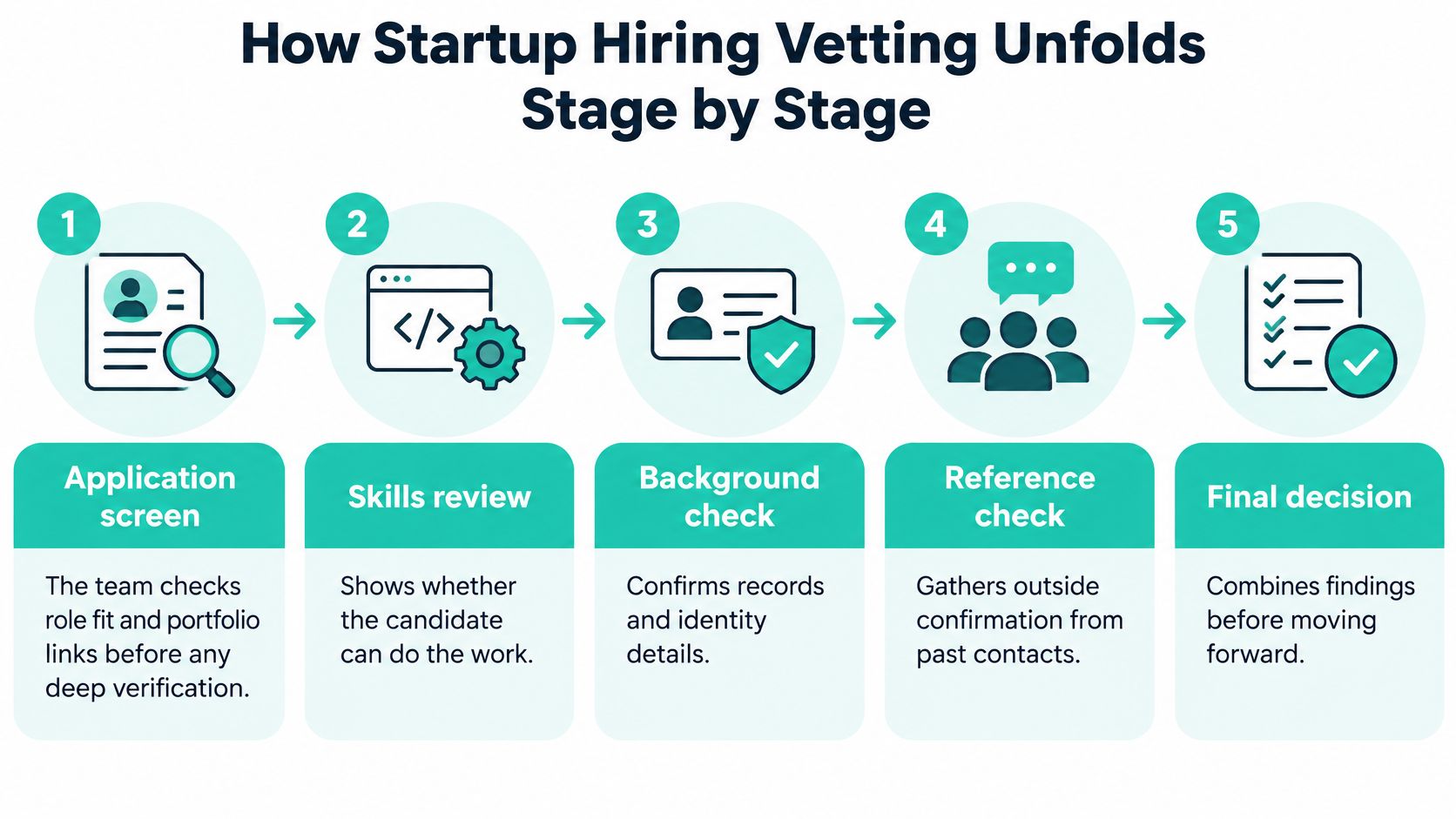
Application screen: The team checks role fit, relevant experience and portfolio links before any deep verification. Your goal here is clarity, not volume. Make dates, titles and links easy to scan.
Skills review: A work sample, case exercise or technical task tests whether you can do the core job. This sits early because there's little value in verifying years of history if the work itself isn't a match.
Interview and reference stage: Conversations explore how you work, and named references confirm scope and results. Brief your references on the role so they can give relevant examples instead of generic praise.
Conditional offer: Formal background screening starts here for many employers, with written consent where required. The offer depends on checks that are relevant and lawful for that role.
Eligibility and onboarding: The employer confirms work authorization and final identity documents, then moves you into accounts, equipment and first tasks. Keep your documents available so a paperwork delay doesn't push your start date.
That order reflects common employer practice. A 2024 national employer survey published by HR.com reported that 86% of organizations conduct background screening after the interview, including 55% that wait until after making a conditional offer. The same source reported that 96% of surveyed employers conduct at least one form of employment background screening.
A small team may ask for references before a final interview because the founder wants outside confirmation early. Another may run a paid work trial before checking credentials. Regulated work creates stricter sequences. Teams that Hire Medical Virtual Assistants through MedicalVirtual, for example, have to think carefully about trust, privacy and access to sensitive information before someone starts.
Compression isn't automatically a warning sign. A missing explanation is. On the first call, ask three direct questions. How many steps remain, which checks happen after an offer, and how long does each step usually take?
Those answers tell you where to spend effort. Before a skills review, polish the sample. Before references, warn your contacts. Before a conditional offer, gather the documents that match your résumé exactly.
Ask for the remaining steps and timing on the first call, not after you've waited in silence for a week.
Responsibility splits across the hiring chain, and confusion starts when you assume one party checked something another party owns. The employer making the hire carries the final responsibility. Companies must conduct their own background checks, reference checks or other due diligence before engaging a candidate, and they must comply with all laws relating to the intended employment or engagement.
That means the employer decides which checks are job related, obtains consent where required and makes the final call on a flag. If a third-party screening firm produces a report, it supplies information. It doesn't hire you, and it shouldn't be the only voice you can appeal to if a record is wrong.
We sit at the candidate discovery stage. Every candidate profile is screened before employers see it, and we review each profile to check fit for startups hiring on Underdog.io. That profile screening isn't a substitute for an employer's own due diligence.
Be precise about the limit. Underdog.io does not inquire into the backgrounds of candidates or verify their statements, but reserves the right to run background checks using available public records. Ask any marketplace which profile details it reviews, when it reviews them and whether it runs public-record screening. Don't infer more from the word vetted than the platform promises.
Staffing partners sit between discovery and employment. When a recruiter such as nexusITgroup.com handles a search, ask which checks that firm runs itself and which checks the employer still owns. The distinction between coordination and decision-making in our explainer on recruiter versus hiring manager responsibilities helps you direct each question to the right person.
Ask each party the same short set of questions, then compare the answers.
Confirm who holds your verified record before you share sensitive documents. Send files through the stated channel, keep copies of everything you submit, and note the date and recipient. If two parties give conflicting answers, ask the employer to confirm in writing because the employer owns the hiring decision.
In the United States, the rules change when an employer buys a background report from a third-party screening company. That report is treated as a consumer report under the Fair Credit Reporting Act, often called the FCRA. The sequence matters because you're entitled to notice and a chance to respond before a report ends your candidacy.
The Federal Trade Commission guide to background checks for employers sets out the required disclosures, permission and adverse action steps. Read your forms against that sequence rather than signing a bundle of documents without separating them.
Stand-alone disclosure: The employer gives you a written, stand-alone disclosure that a consumer report may be used for employment decisions. Look for a separate form, not a sentence buried inside an offer letter.
Written permission: You give written authorization before the employer obtains the report. Keep a copy with the date you signed it.
Certification: The employer certifies to the screening company that you were notified, you consented, and it will comply with the FCRA and applicable equal-opportunity rules.
Pre-adverse-action notice: If the employer may reject you based on the report, it must first give you a copy of the report and a copy of "A Summary of Your Rights Under the Fair Credit Reporting Act."
Opportunity to respond: You get time to dispute errors or explain context. Use it promptly and attach documents, not just a verbal claim that the record is wrong.
Final decision: Only after that process does the employer make and communicate the final adverse decision.
Ask which company will produce the report, what it will include and how you'll receive a copy. Check that your legal name and date details are correct on the authorization, because a small input error can pull the wrong record. If a report contains a mistake, dispute it with the screening company and notify the employer in writing.
Rules differ by state and country, and some roles have extra requirements. Employers that Hire Virtual Legal Assistants in California through HireParalegals still need a process that fits the jurisdiction and the sensitivity of the work. If you're applying from the UK, the EU or another country, check the local consent and privacy rules before you sign.
A fair process can explain itself. You should be able to learn what's checked, why it matters for the role, who sees the result and how you can correct an error. If those answers are vague, more screening doesn't necessarily mean better hiring.
Trust is already thin where software makes the first cut. Gartner reported in 2025 that only 26% of job candidates trusted AI to evaluate them fairly, while 52% believed AI screened their application information and 25% said they trusted employers less when AI was used. That doesn't make every tool unfair. It means employers should expect candidates to ask how the tool is used.
First, ask whether the same standards apply to every applicant for the role. Consistent criteria make results comparable. Our practical guide to strategies that reduce bias in hiring covers structured scoring and other controls employers can use.
Second, ask how each criterion relates to the job. The EEOC guidance on the Uniform Guidelines describes validation as demonstrating that a selection procedure is job-related and measures skills, knowledge, or abilities connected to job performance. If a rule screens out many people but predicts little, it's a weak rule.
Third, ask whether AI scores or ranks your application, what data it uses and whether a person reviews ambiguous cases. Fourth, ask about accommodations and corrections before you need them. A candidate who needs an alternative assessment format shouldn't have to improvise that request after a rejection.
Fraud is a real operational problem, not just a talking point. Reporting on HireRight's 2025 Global Benchmark Report states that one in six organizations worldwide reported experiencing identity fraud during their hiring process in 2025. Separately, Checkr's 2025 survey of 3,000 hiring managers found that 59% suspected a candidate had used AI tools to misrepresent themselves during the hiring process.
Expect identity checks and be ready to complete them. At the same time, you can insist on proportionate, transparent screening. On the first call, ask what is checked, who sees the result, and how you can respond to a flag.
Most candidates don't stall because they lack ability. They stall because their records don't match across a résumé, LinkedIn profile, application form and HR system. Build one verifiable file before you apply, and you'll answer routine questions in hours instead of days.
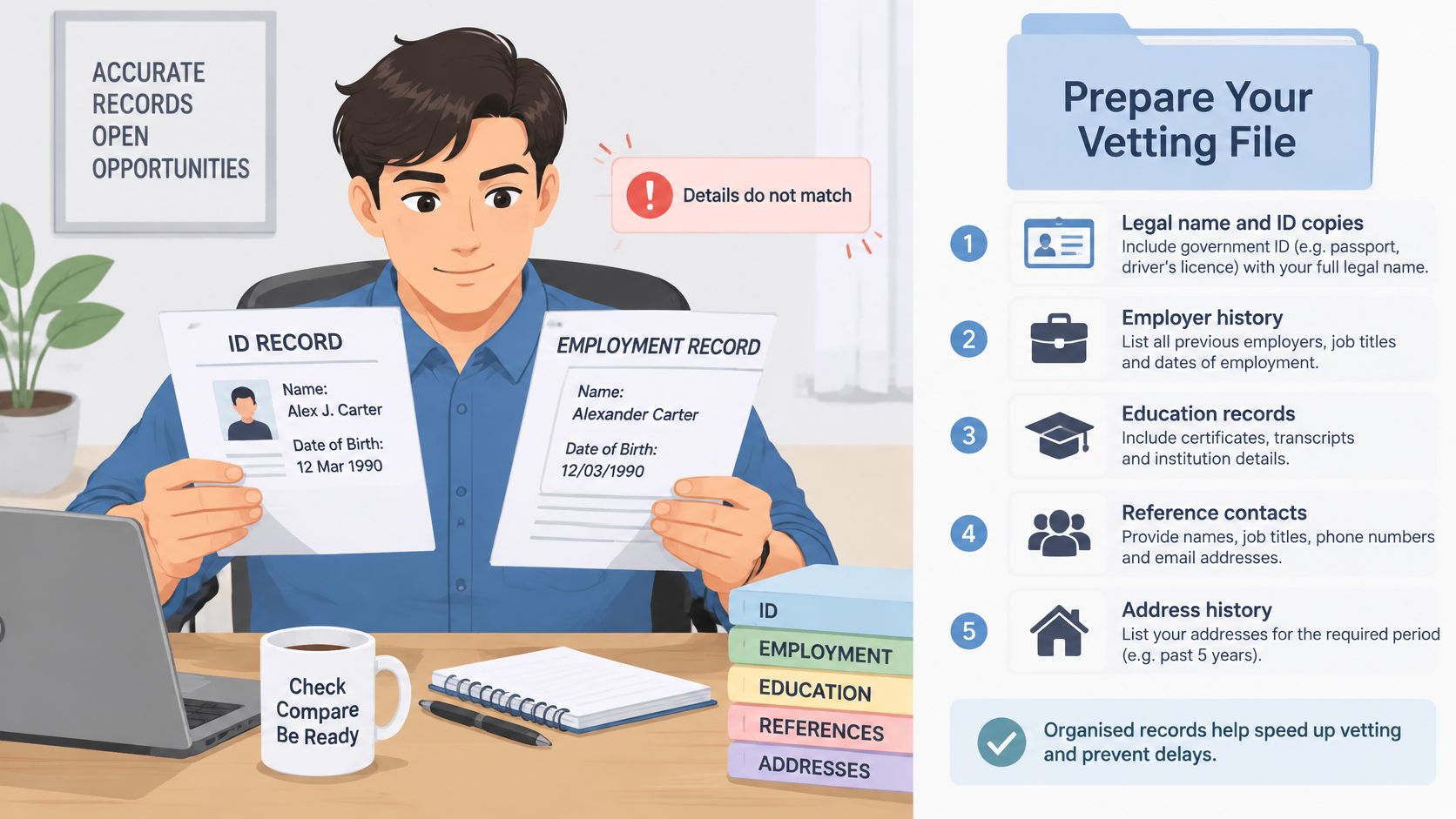
Record the verifiable version: List your legal name, employer names, start and end dates and titles exactly as HR records show them. Add clear ID copies where you're comfortable storing them securely.
Align every public profile: Make your résumé, LinkedIn profile and portfolio use the same dates and titles. If you used a market title publicly, note the internal title beside it in your private file.
Line up references: Choose two or three people who managed or directly saw your work. Ask for permission now, confirm their best contact details and tell them what kinds of roles you're pursuing.
Keep proof of work: Save offer letters, contracts, invoices, portfolio links and repository access details. For freelance work, a signed client letter plus invoices is stronger than a job title with no paper trail.
Prepare right-to-work documents: In the US, Form I-9 from U.S. Citizenship and Immigration Services requires you to complete and sign Section 1 no later than your first day of employment, and your employer must complete Section 2 within three business days after your first paid workday. If you start on Monday, Section 2 generally must be completed by Thursday, so don't leave documents at another address.
Ask for the timeline early: On the first call, ask which checks come after an offer and how long each takes. If we can work with you, you'll typically receive an invitation to finalize your Underdog.io profile within 1-2 business days of signing up, which is a good moment to make sure your profile matches your file.
| Discrepancy | Usual Cause | Best Response |
|---|---|---|
| Start or end date differs from HR record | Month rounded on résumé or a typo | Correct it with a short note and an employer letter |
| Title differs from HR record | Internal title differs from market title | Explain both titles and attach the offer letter |
| Gap in employment history | Career break, study or contract work | State the dates and what you did during them |
| Degree not found in registry | Name changed or registry lookup failed | Provide the transcript and a legal name document |
| Contract work missing from employer records | Freelance or agency placement | Provide invoices or client reference letters |
Answer a discrepancy with three parts. State the correct fact, explain the harmless cause in one sentence, and attach the document that proves it. Don't over-explain, and don't edit a résumé after submitting it without telling the employer what changed.
Do one useful thing this week. Put your documents in a single secure folder, align your dates and titles, and send dated permission requests to your references. When vetting starts, you'll be confirming a record you've already checked yourself.
If you're preparing that file for startup roles, Underdog.io can put your screened profile in front of vetted startups and high-growth tech companies that reach out directly. Create your candidate profile, keep your dates and work samples ready to verify, and let employers come to you with relevant opportunities.