Most advice about reference checks is backwards.
It treats the reference check process like a polite verification lap at the end of hiring. Call a former manager. Ask if the candidate was good to work with. Hear something positive. Mark the box. Move on. That ritual feels responsible, but it usually adds very little to the decision.
That's a problem because reference checks are everywhere. A Virginia Department of Criminal Justice Services handout, summarized in this analysis of why reference checks persist, reports that 96% of HR professionals said their organization conducts some form of background or reference check on applicants. So the question isn't whether companies use them. The useful question is whether your process surfaces signal, or just creates delay.
The teams that get value from references do three things differently. They ask role-specific questions instead of generic ones. They train the person running the call to probe inconsistencies instead of collecting praise. And they treat the conversation like a hypothesis test, not a final rubber stamp.
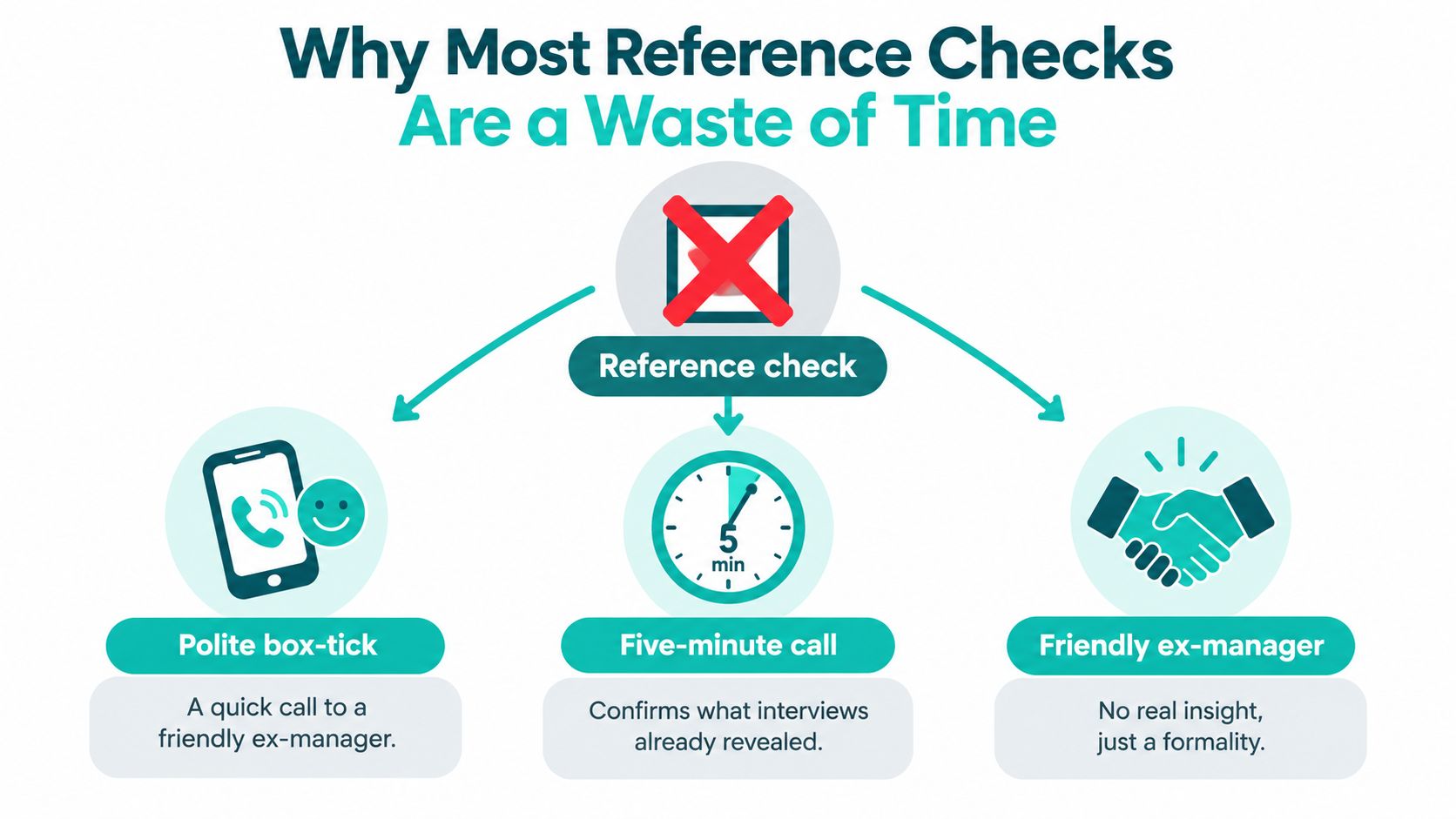
The popular line is that reference checks “confirm the interview.” That's exactly why many of them fail.
If the whole point is confirmation, the process becomes ceremonial. The candidate picks people who like them. The recruiter asks broad questions. The notes say “strong communicator,” “great team player,” and “would recommend.” Nobody learns anything they didn't already think they knew.
A lot of reference checks fail for the same boring reasons:
That's why the process often has weak decision value. A 2026 industry analysis reported that reference checks change a hiring decision roughly 1% of the time, typically consume 45 to 90 minutes of recruiter time per candidate, add 3 to 5 days to time-to-fill, and show a predictive validity of 0.13 for job performance in the cited meta-analytic summary. All of that is captured in the industry analysis published in IJNRD.
Practical rule: If your reference call could be swapped with any other candidate's call and still sound the same, your process isn't measuring anything useful.
The reference check process works better when you design it around uncertainty.
Don't ask, “Is this person good?” Ask, “Which risks are still unresolved after interviews?” For a startup engineer, that might be ownership, judgment, and reliability under ambiguity. For an account executive, it might be pipeline honesty, handoff discipline, and customer trust. For a recruiter at a staffing firm like nexusITgroup.com, it might be candidate calibration, follow-through, and credibility with hiring managers.
The three design choices that improve signal are straightforward:
Here's the version to stop doing:
“Can you tell me about Alex?”
“What were their strengths?”
“Any weaknesses?”
“Would you work with them again?”
That script sounds professional. It also produces mush.
A good reference check process creates comparable evidence. A bad one creates adjectives.
The cleanest time to run references is after the final panel or onsite, but before the offer letter goes out. Earlier than that, you waste time on candidates who won't make the cut. Later than that, you create a new approval bottleneck when everyone already thinks the hire is done.
I like reference checks when the team has already said, “We'd hire this person if the last verification step holds up.” At that point, momentum matters. Candidates read delay as doubt.
A web-based multisource study found that candidates averaged 1.32 business days to complete their portion, references averaged 1.10 business days, and the median overall turnaround was 1.80 days with an overall report turnaround of 2.78 business days. It also identified process KPIs like candidate response time, reference response time, report turnaround time, number of references requested and completed, and response rate in the Wiley study on multisource reference checking. That's useful because it means you can manage references like an SLA, not an improvisation.
The person conducting the call should usually be a trained recruiter or the hiring manager. My bias is toward a recruiter-led call with a second listener taking notes. That setup keeps the conversation structured and gives you a cleaner record.
Don't use the candidate's prospective peer. Peers tend to over-index on vibe, ask uneven questions, and document poorly. Reference checks need consistency more than chemistry.
A simple operating model looks like this:
If your team is trying to streamline recruiting with AI, this is one of the best places to standardize workflow while keeping human judgment in the actual evaluation.
Federal guidance is still a solid backbone here. A practical workflow is laid out in the Virginia DCJS reference check guidance: designate who conducts the check, define standardized questions in advance, obtain candidate permission, briefly describe the role to the referee, contact additional references as needed, and resolve conflicting statements with the candidate before filing and retention.
In a startup hiring system, I'd translate that into five moves:
If you're building hiring operations that need to hold up as headcount grows, this talent engineering view of a scalable recruiting system is a useful companion to the reference stage.
The fastest reference process isn't the one with the fewest steps. It's the one where nobody has to guess what happens next.
Most reference scripts fail because they start broad and stay broad. You want the opposite. Open politely, establish the relationship, then get concrete fast.
Start with a short setup:
“Thanks for taking the time. With the candidate's permission, I'm calling to understand how you worked together and how they operated in situations relevant to this role. I'll ask a few questions about scope, performance, collaboration, and judgment. If there's anything you didn't directly observe, just say so.”
Then ask these in order:
That sequence works because it forces examples. It also gives the reference room to show what they observed versus what they assume.
You're not just collecting content. You're evaluating evidence quality.
Ask for one concrete example every time a reference uses a flattering adjective.
| Competency | Sample Question | Rating (1-5) | Evidence Required |
|---|---|---|---|
| Technical depth | What was the most technically complex problem they solved themselves? | 1-5 | Specific project, constraints, contribution, outcome |
| Ownership | What did they own end-to-end without needing close supervision? | 1-5 | Scope, autonomy, follow-through, escalation pattern |
| Communication | How did they communicate trade-offs to non-engineers? | 1-5 | Example involving product, design, or leadership |
| Integrity | Did their reporting, estimation, or escalation ever create trust concerns? | 1-5 | Direct observation, not hearsay |
A score without written evidence is almost useless. If a recruiter marks “4” for ownership but can't attach an observed example, that score shouldn't count.
A weak answer sounds like this:
“She was great. Very smart. Good with the team. Always dependable.”
Nothing there helps you hire.
A strong answer sounds like this:
“On a messy migration, she pushed back on an unrealistic deadline, proposed a narrower rollout, documented rollback criteria, and kept product updated every day. I didn't need to chase her. Where I coached her was upward communication when leadership changed priorities midstream.”
That answer gives you judgment, communication, ownership, and a development area in a few sentences.
One useful frame from recent industry coverage is that signal quality depends on tying questions to a role-specific scorecard. A 2026 analysis argues that 65% of reference checks add no meaningful signal unless questions are built that way, in the same piece that discusses the operational drag of traditional checks in the Sprad analysis on predictive reference checks.
Fraud rarely shows up as a dramatic confession. It usually arrives as small inconsistencies that don't line up cleanly.
A 2026 source reports that 45% of candidates coached their references on what to say, and another platform says its dataset across more than 100 million reference-check questions in 195 countries found about 21% of candidates were flagged during reference checking, as summarized in this review of reference check fraud trends. That doesn't mean every polished answer is fake. It does mean you should stop treating every provided contact as trustworthy.
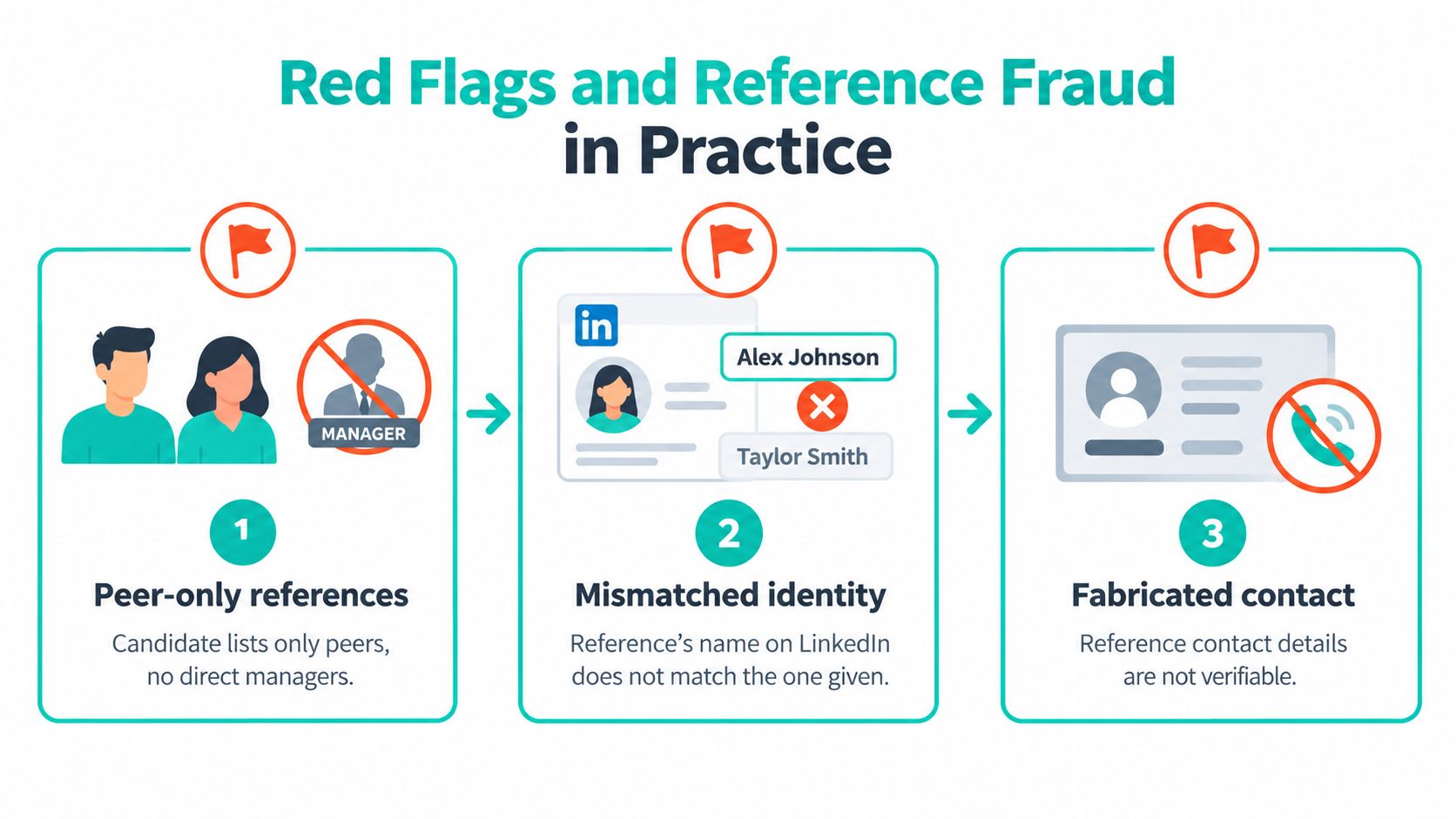
Peer-only references
Candidate sends three references. All were coworkers. None managed them.
Don't accuse. Ask: “Who directly reviewed their work?” Then ask the candidate why no manager is available. Sometimes there's a legitimate answer. Sometimes you learn the candidate is avoiding someone who had a materially different view of performance.
Mismatched identity
The reference name and title don't align with public profiles or company records. The fix is simple. Confirm how the referee knows the candidate, what years they overlapped, and what team they were on. If that stays fuzzy, pause and verify independently before using the call as evidence.
Too polished to trust
You ask about weaknesses and get a perfect, media-trained answer. Every example sounds rehearsed. The language mirrors the candidate's own interview phrasing.
That's when you narrow the aperture. Ask for dates. Ask for project names. Ask what happened when something slipped. Coached references can repeat themes. They struggle with real operating detail.
Use ATS notes that separate observation from conclusion.
That language matters. You're documenting evidence, not making allegations.
If a reference creates confusion, don't decide on the call. Slow down, verify, and triangulate.
Soft red flags don't automatically kill the process:
Hard disqualifiers are different:
A simple triage rule works well:
The legal part of the reference check process is less dramatic than people think, but it's where sloppy teams create avoidable risk.
The two mistakes I see most often are simple. Someone records a call without clear consent. Or someone lets the conversation drift into personal territory that has nothing to do with the job.
For the UK, the rule is straightforward at a high level. An employer usually doesn't have to provide a work reference, but if it does, the reference must be fair and accurate. It can be brief and may include job title, salary, employment dates, and performance details, with stricter obligations in some regulated industries, according to the UK government guidance on work references.
In Canada, privacy guidance grounded in PIPEDA says employers should generally obtain meaningful, voluntary consent before contacting references or sharing information, should inform the candidate about the intended contact, and should ideally use written consent specifying what information will be collected or disclosed, as summarized by the Canadian HR Reporter analysis of privacy rules and legal boundaries.
In the US, reference-sharing protection is common but not identical across states. 41 of the 51 US jurisdictions have a statute protecting employers who give references in good faith, and some states add mechanics like written consent or providing a copy of what was said, as outlined in the Boostpoint summary of US reference check statutes.
For a broader legal read on workplace privacy principles, Nick Norris, P.A. on privacy laws is a useful supplementary resource.
| Jurisdiction | Consent Required | Recording Rules | Retention Limit | Protected Topics |
|---|---|---|---|---|
| US | Varies by employer policy and state mechanics. Written consent is often the safest operating standard. | Don't record unless your process clearly handles consent under the applicable jurisdiction. | Follow company policy and jurisdiction-specific requirements. | Keep questions job-related. Avoid protected characteristics and unrelated personal information. |
| UK | Candidate handling should be transparent, and any provided reference must be fair and accurate. | Don't record without a lawful, clearly disclosed process. | Retain only under documented policy and applicable privacy obligations. | Keep to job-relevant facts and performance. |
| Canada | Meaningful, voluntary consent is the practical baseline. Written consent is the cleanest option. | Don't record without clear consent and a documented need. | Retain according to privacy obligations and internal policy. | Limit collection and disclosure to job-related information. |
Reference checks aren't free just because nobody invoices for them directly. The cost shows up in recruiter time, scheduling friction, and candidate drift.
Manual timing ranges are wider than many teams admit. One hiring guide says reference checks usually take 2 to 5 business days, and can stretch to 1 to 2 weeks for senior or more complex roles, with many guides treating 3 to 10 business days as a normal planning window in the Sapphire Check timeline guide. In a hot market, that's enough time to lose a candidate who thought they were already at the finish line.
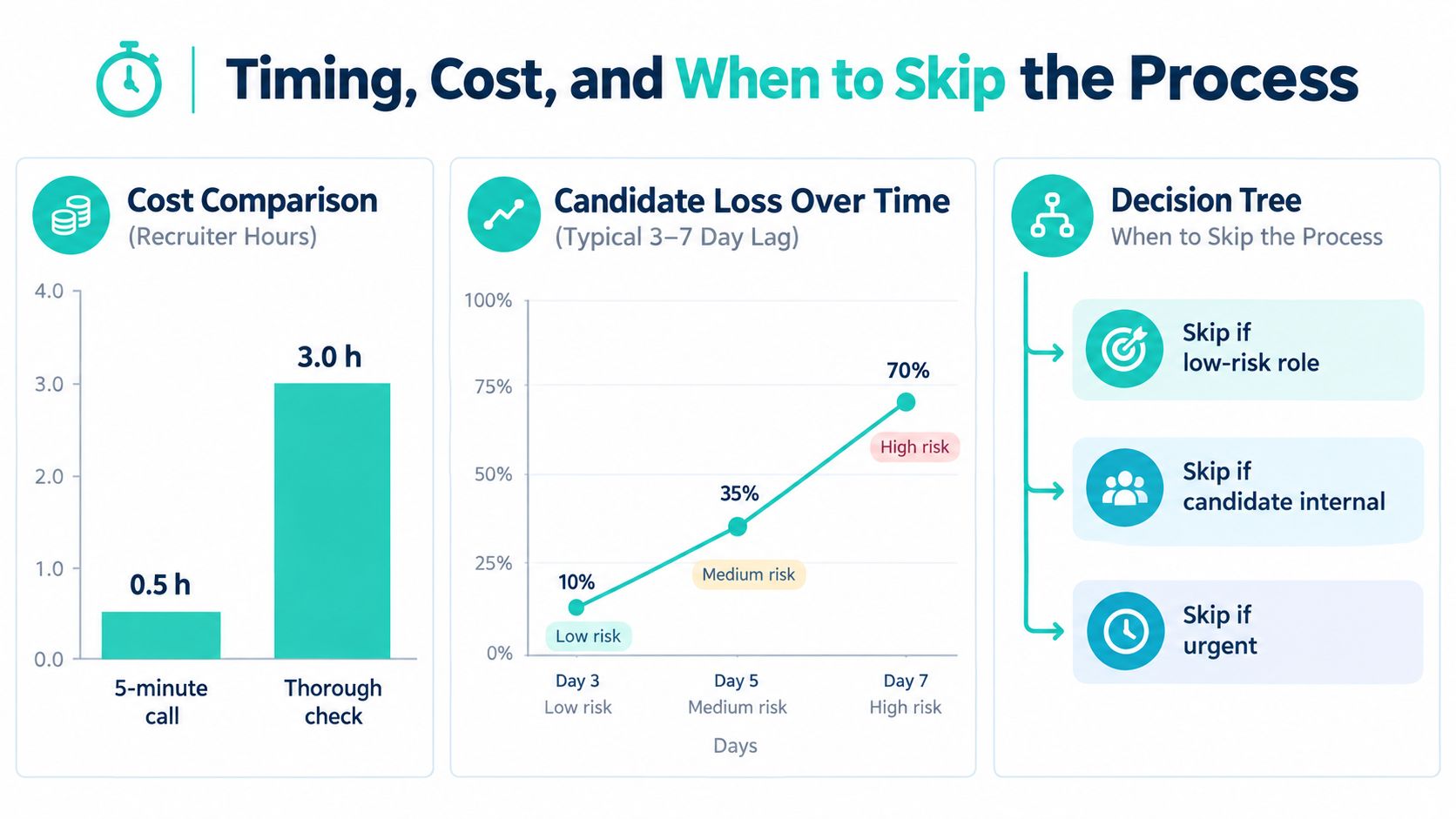
Reference checks are worth more when the downside of a miss is behavioral, reputational, or managerial.
That usually means:
They're worth less when your strongest evidence already comes from direct work observation. Early-career candidates, practical take-home performers, and internal transfers often fit here.
You don't need one policy for every role. Use a decision rule.
A compressed version can be one structured call focused on the unresolved risk. If the issue is execution under pressure, don't ask ten questions. Ask three very pointed ones and document the evidence.
If your hiring team is trying to connect process steps to actual hiring outcomes, these quality of hire metrics are a better management lens than counting completed reference calls.
The best five-minute decision isn't “Should we always do references?” It's “What uncertainty is left, and is a reference the right tool to reduce it?”
Candidates usually get bad advice here too. “Pick people who love you” isn't enough. A better approach is to pick people who can speak credibly to the work you're being hired to do.
The reference check process feels fairer when candidates help references prepare with context, not scripts. The difference matters. Context improves accuracy. Scripts reduce trust.
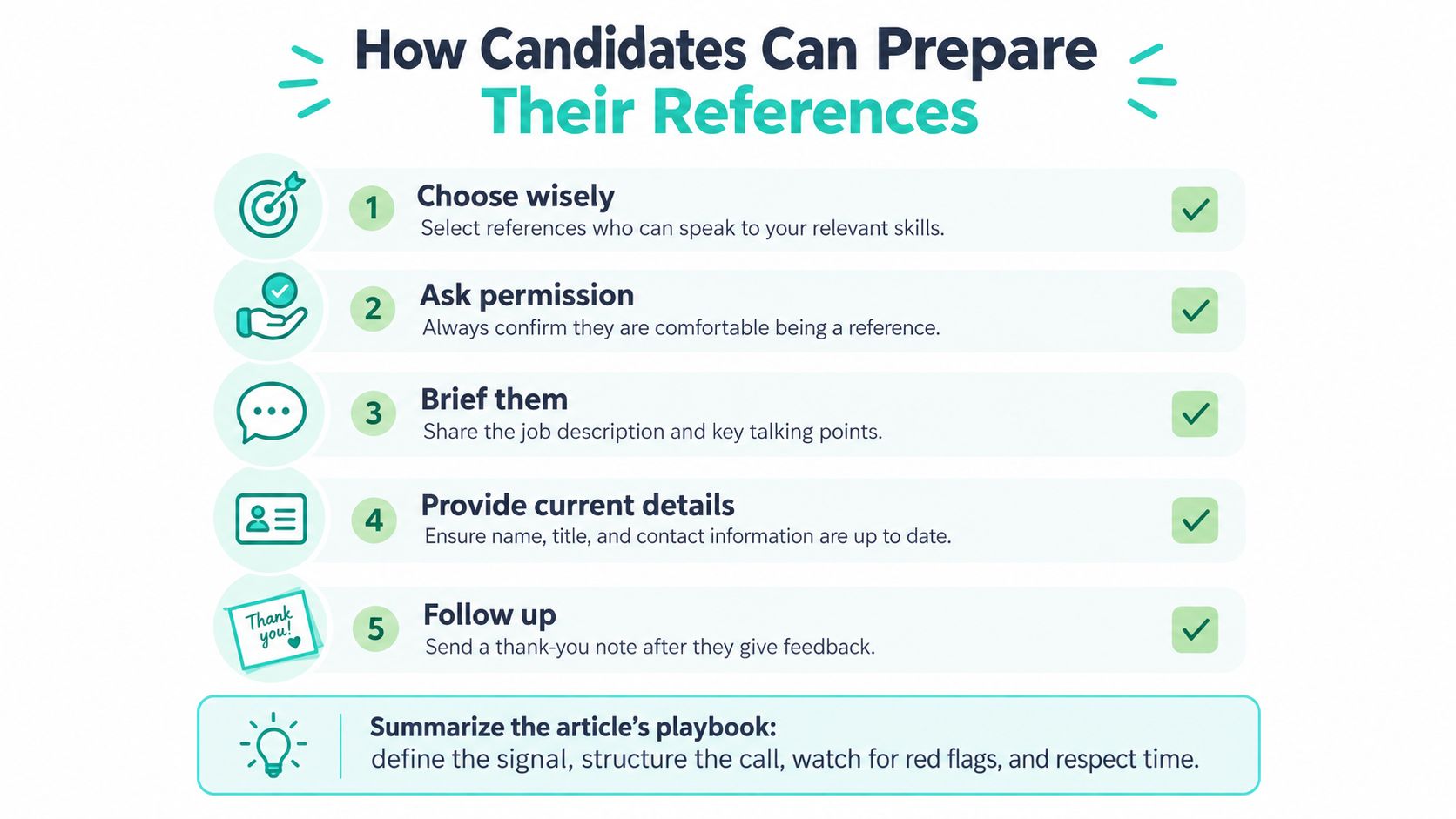
A strong prep routine is simple:
Candidates who care about process quality should also care about candidate experience. This guide to candidate experience best practices lines up well with how references should be handled on the hiring side.
Don't coach references into sounding identical. Don't hand them polished talking points and ask them to memorize phrases. Don't hide the fact that a listed reference only worked with you briefly.
Those tactics usually backfire because they flatten the details that make a real working relationship believable.
Candidates can set reasonable boundaries.
In some cases, they may not want a current manager contacted. In others, they may need to explain why a former supervisor is unavailable. Those aren't automatic red flags. They just need a credible alternative and a clear explanation.
Candidates should also know they can correct factual errors if a reference gets dates, titles, or reporting lines wrong. And where privacy laws apply, they may have rights around access, deletion, or data handling depending on the jurisdiction and the employer's process.
A good closing checklist for candidates looks like this:
Reference checks work best when both sides respect the same idea. Define the signal, structure the conversation, watch for inconsistencies, and don't waste anyone's time.
Underdog.io connects tech candidates with vetted startups and high-growth companies, while leaving due diligence like reference checks to the hiring team where it belongs. If you're building a hiring process that moves fast without getting sloppy, or you're exploring startup roles where signal matters more than noise, take a look at Underdog.io.