Phone interviews are usually 15 to 30 minutes long, and they're screening calls, not full technical evaluations. The test is whether you can give the right amount of signal fast enough to move forward.
You're probably used to the opposite problem. In a longer onsite or video loop, rambling is annoying. On a phone screen, rambling is fatal because the interviewer is deciding in minutes whether you're worth the next round.
That's why people get blindsided by these calls. The format feels casual, but the stakes aren't. A recruiter or hiring manager is listening for role fit, communication clarity, availability, and whether you can stay crisp under pressure. If you know that going in, the whole thing gets easier.
A phone screen is also where a lot of strong candidates lose momentum for dumb reasons. They over-explain, they sound rehearsed, they haven't checked their audio, or they treat the call like a warm-up instead of the first gate. The good news is that this format is predictable once you understand what's being measured, and you can prepare for it without turning your life into a prep bootcamp. If you want a faster path into startup conversations, this guide on how Underdog.io helps candidates get recruited by startups fits the same mindset, focus on signal, not noise.
You're probably between meetings, maybe eating lunch, when your phone lights up with an unknown number. You answer, and within seconds you're talking to someone who wants to know why you're a fit for a role you barely had time to think about. That's the phone interview in its natural habitat, abrupt, short, and more important than people like to admit.
The mistake candidates make is assuming it's a polite prelude. It isn't. Hiring teams use the screen to sort people quickly, and modern hiring data backs that up, initial phone interviews average about 15 minutes, while the broader interview process sits around 40 to 45 minutes according to hiring-statistics roundups from Qureos. That gap tells you exactly what matters here, speed, clarity, and enough substance to justify a second conversation.
Practical rule: treat the screen like a gate, not a performance. Your job is to sound competent, relevant, and easy to work with, fast.
There's another trap hidden in plain sight, over-preparation. People walk into these calls ready to deliver their entire career timeline, when the interviewer usually wants a tight scan of fit, motivation, and logistics. University and recruiter guidance consistently points to short, structured early answers, not long narratives. The best candidates don't sound memorized, they sound organized.
The first format you'll usually see is the recruiter screen. This one is about baseline fit, salary alignment, availability, and whether your background matches the posting closely enough to justify a deeper look. It's not the place to narrate every project you've ever touched.
The second format is the hiring manager screen. That call can feel more substantive because the person across the line knows the team's real needs and wants to hear how you think. Still, it's a screen. They're usually deciding whether you're worth engineering time, not whether you've already won the job.
If you're job searching in startup land, that distinction matters even more. Many early-stage teams move fast and expect you to do the same, which means the call is often less about polish and more about whether you can communicate cleanly, adapt quickly, and sound like someone who gets things done. If you want a deeper look at startup-first interviewing, Underdog.io's startup interview resource is worth reading after this.
A phone interview is a short screening call, and that brevity changes everything. Career guidance from BetterUp frames these calls as quick fit checks, not long evaluations. Interview guidance from UCLA also recommends keeping early answers tight, which matches how recruiters listen. If a team adds a phone screen, the hiring process often stretches a bit longer, because the call exists to filter before anyone spends time on deeper rounds.
That should shape how you prepare. Do not rehearse your full career history. Build a compact version of your background, your motivation, and your logistics, then practice saying it cleanly.
Bottom line: the phone screen is built for comparison. Interviewers are deciding whether your background, communication style, and availability are strong enough to keep spending time on you.
A recruiter screen is about fit and logistics. They want to know whether your experience lines up with the role, whether your compensation expectations sit in the right range, and whether you are available for the next step. If you stay vague on any of those, you slow everything down.
They are also listening for coherence. Can you explain your path without sounding scattered? Can you connect past work to this role in one clean sentence? Can you answer without drifting into unrelated details? That is the test.
A hiring manager screen goes one layer deeper. They want to know whether you understand the work, whether your judgment looks solid, and whether you will fit the way the team operates. In many cases, they are deciding whether you would be useful in the first few months, not just impressive on paper.
The practical takeaway is simple, give short answers with a point first, a brief example second, and a clean exit. If you want to see how sharp interviewers use compact question sets to learn a lot quickly, creative interview questions for hiring is a useful reference point.
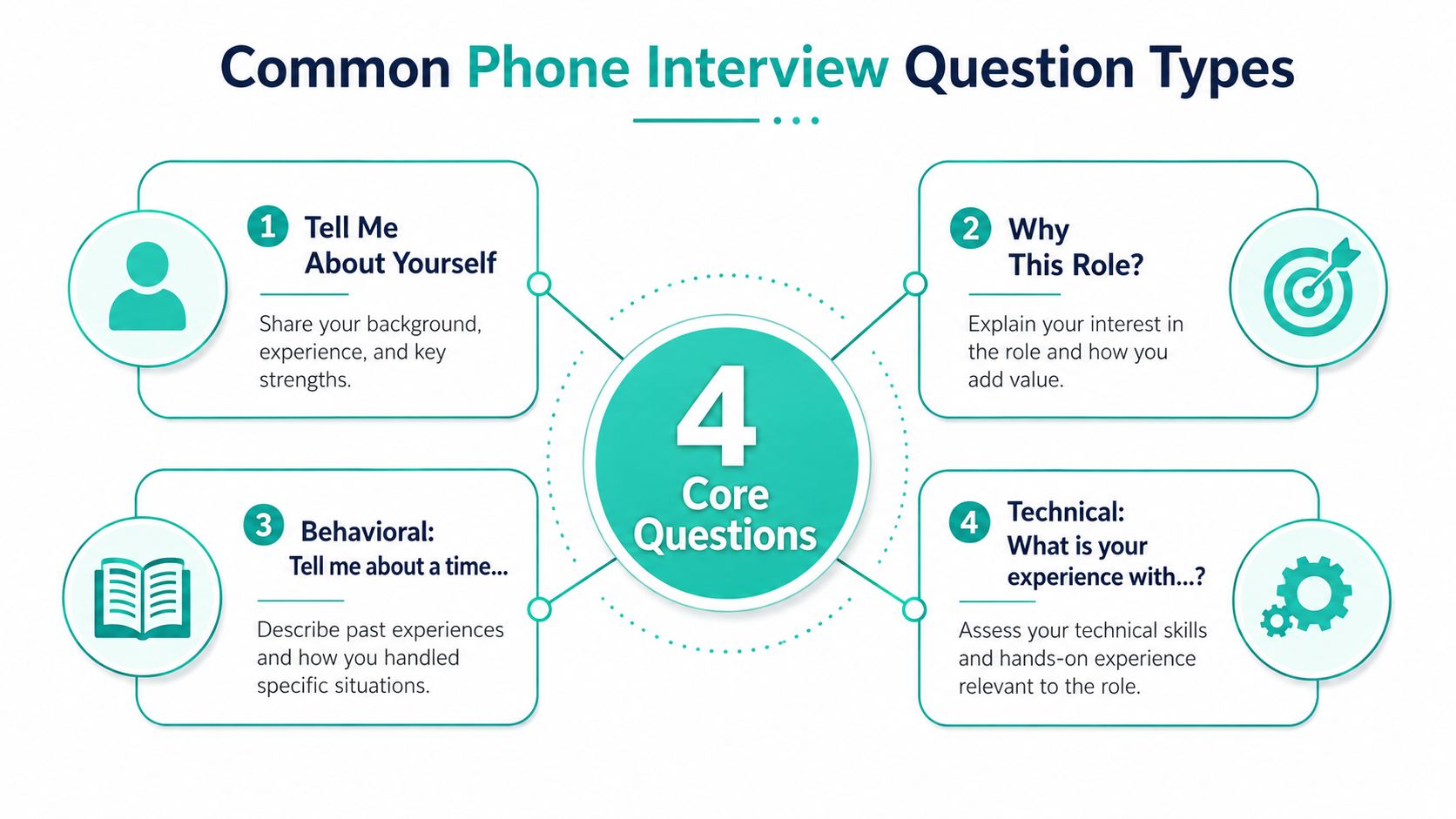
A phone screen usually circles back to a small set of questions. Tech hiring guidance says a concise signal set of about four core questions is often enough to make a decision, and some screening calls contain only 2 to 4 questions total. That is why loose, meandering answers hurt so much. You are not being asked to prove everything. You are being asked to prove enough.
The first question is usually some version of “Tell me about yourself.” Do not treat that as a cue to start in college. Give a clean summary of who you are now, what kind of work you do, and why that connects to the role.
A strong answer sounds like this, in plain terms.
“I'm a product marketer who's spent the last few years working on launch strategy for B2B software. I've mostly supported small teams that needed messaging, positioning, and quick coordination across sales and product. This role stood out because it's a chance to do that work in a faster environment with a tighter feedback loop.”
That answer works because it is specific, short, and easy to follow. It gives the interviewer a frame, not a life story.
When they ask why you want the role or company, they are checking seriousness. Skip generic praise. Say something that shows you understand the work and want it for a reason.
Use a simple structure. State the reason, connect it to your experience, then point to the kind of problems you want next. If you want more question ideas to practice against, the creative interview questions for hiring page is useful for pressure-testing your answers without sounding canned.
Behavioral questions usually sound like “Tell me about a time when...” They are not looking for your whole story, just one example that proves judgment. Keep the setup short, explain what you did, and land on the result or lesson.
Logistics questions are even simpler. Salary range, availability, notice period, location, work setup. Answer them directly. This is not the moment to negotiate with yourself out loud.
For interviewers who keep the conversation tight, body language matters less than the way you pace your response and stop when you have made the point. A quick read on interview body language cues helps if you want to understand how the call feels from the other side.
Phone interviews are conversations, and the other person is giving you signals the whole time. You just can't see them. That means you need to listen harder than you talk, because the pacing, follow-ups, and tone usually tell you more than the words alone.
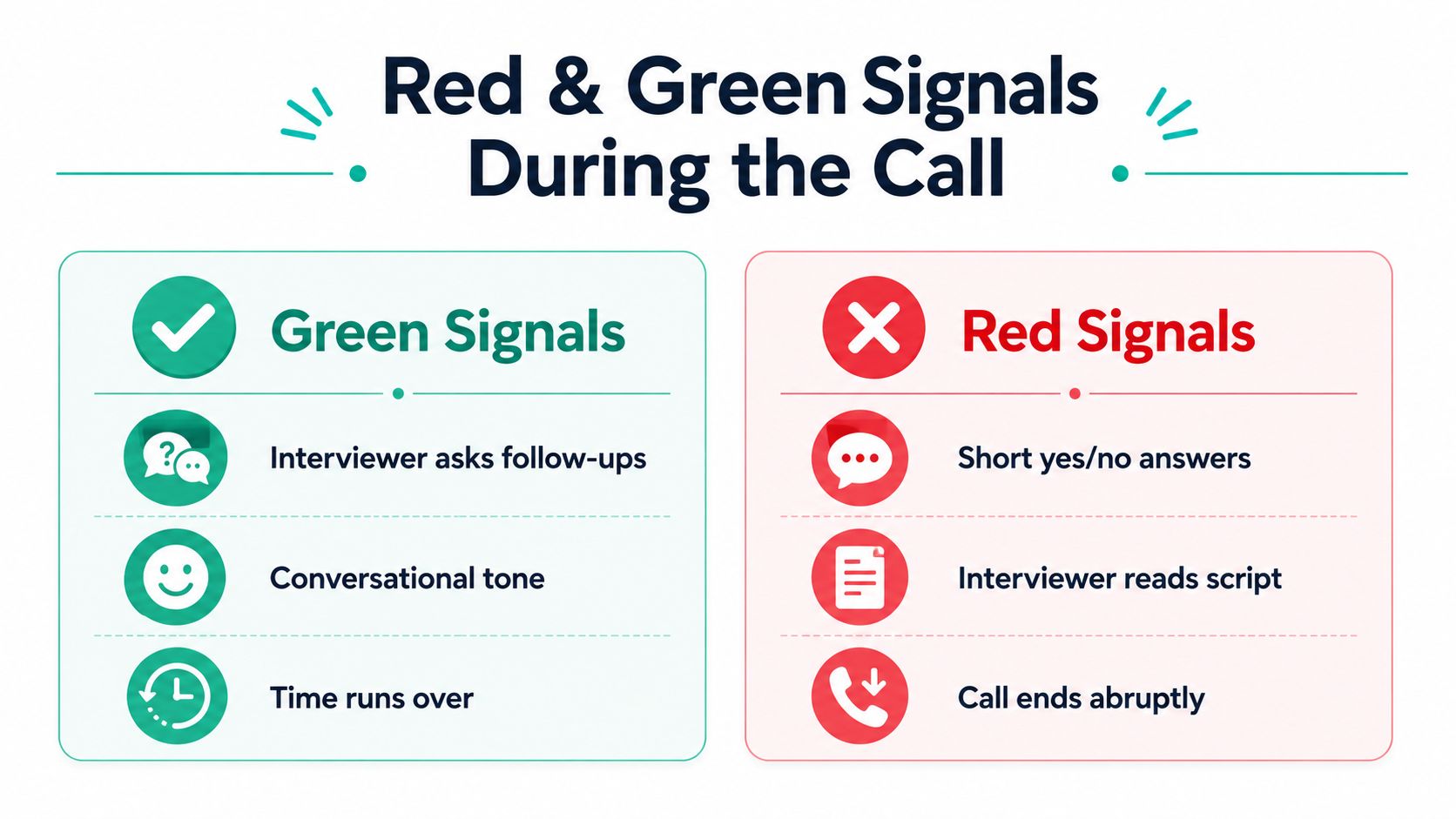
Green signals are obvious once you know what to look for. The interviewer asks follow-up questions. They go deeper into a project you mentioned. They reference team structure, timing, or what success looks like in the role. They sound like they're picturing you inside the team already.
A longer conversation is also a good sign. If time runs over a little, that usually means interest, not disorganization. They're not racing to get off the call.
If the interviewer starts giving you context you didn't ask for, that's usually a good sign. People don't volunteer extra detail when they're not engaged.
Red signals show up as shallow questions, abrupt transitions, and a weirdly mechanical tone. If the interviewer keeps everything at yes or no level, doesn't ask follow-ups, or sounds like they're reading from a checklist without reacting to your answers, they're probably not sold yet. Sometimes the role itself is vague, and that's a problem too.
Don't assume every red signal is about you. Sometimes the team is rushed, undertrained, or just bad at interviewing. That still matters, because you're evaluating them too. If the call feels flat, you should file that away and ask sharper questions later.
Candidates often forget that their behavior is part of the read. If you answer with short, direct responses and then leave awkward silence, the call can stall. If you overshare, you can bury your strongest points before the interviewer has a chance to react.
That's where a calmer baseline helps. If phone conversations spike your anxiety, The Anxiety Checklist's guide to coping with social anxiety in daily life is a sensible place to start. You don't need to be effortlessly smooth. You need to be clear, steady, and readable.
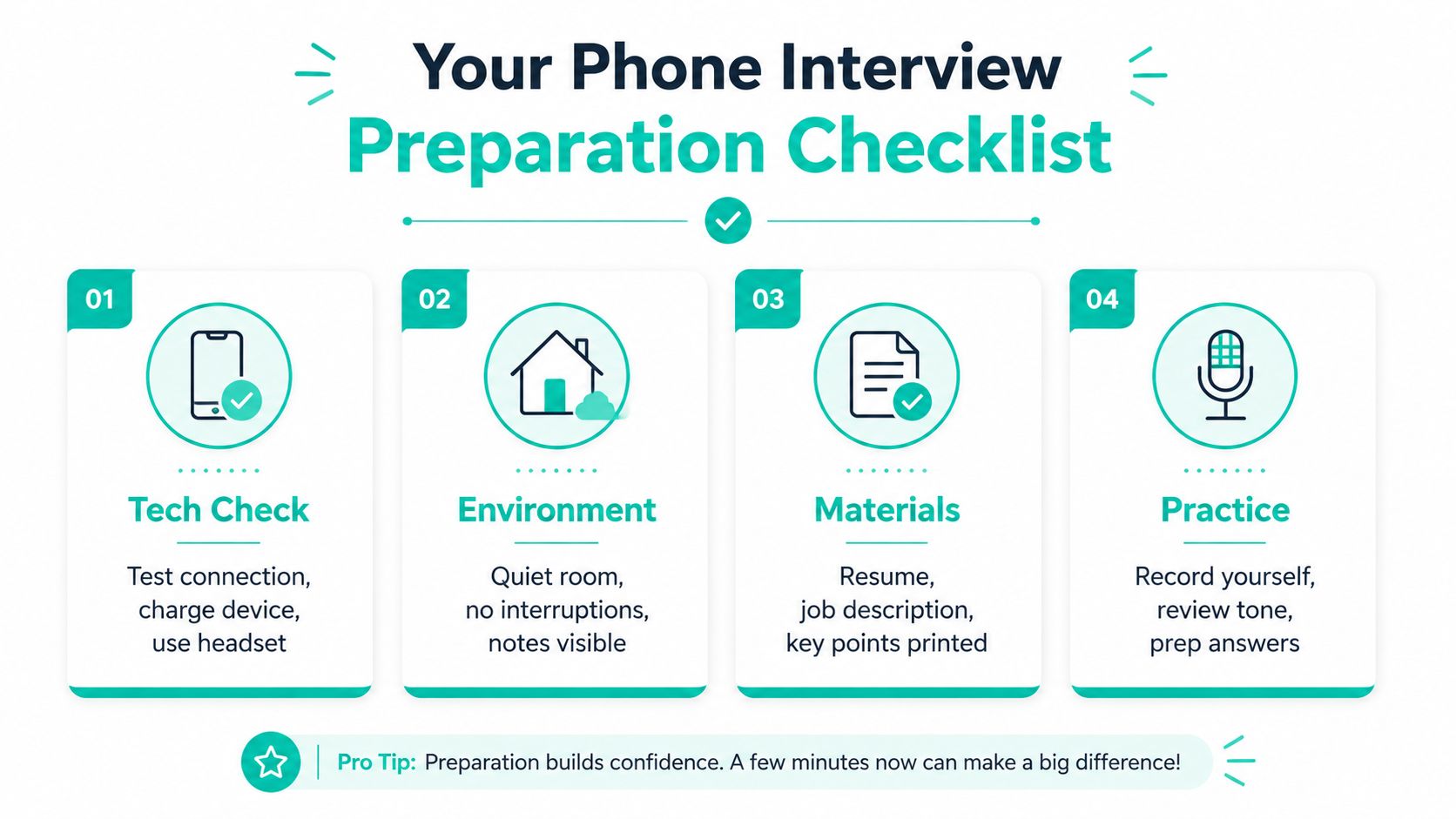
A phone screen goes badly for boring reasons. The battery dies, the room gets noisy, the resume is buried, or you spend half the call hunting for a note you meant to review. Strong candidates lose time to preventable friction, and weak prep makes even decent answers sound scattered. The fix is simple. Remove the distractions before the interviewer calls.
Start with the setup. Use a fully charged phone, check your signal, plug in headphones with a microphone, keep a backup device nearby, and switch on Do Not Disturb. Bad audio and random interruptions can make a strong candidate sound careless, so handle them before the interview starts.
Pick a quiet room where you will not get interrupted, then test everything once. A quick trial call tells you whether the microphone works, whether the connection holds, and whether your voice sounds clear.
Keep your materials within reach. A printed resume, the job description, and three or four bullet points with your strongest examples are enough. The point is to build a memory aid so you can stay present, not to cram like you're sitting for a final exam.
Read your opener aloud a few times. Mental review is too passive because speaking has rhythm, and your mouth needs repetition before the actual call. Then rehearse three short stories, one about impact, one about problem-solving, and one about teamwork or culture fit.
Keep each story tight. The screening call rewards answers that land cleanly in the 2 to 3 minute range, which matches the pacing advice from UCLA's interview guidance. If you feel yourself drifting into extra background, cut it off and get back to the point. A crisp answer beats a polished ramble every time.
Go into the call with your salary range, availability, and work requirements already decided. If you have to invent those live, you are giving away control for no reason. Write down three questions you care about, such as what success looks like, who you would work with, and what the first months would focus on.
Keep your prep practical. If you want a planning aid that trims the fluff from interview prep, Resumatic's interview readiness checklist fits this approach well. Prepare enough to stay calm and responsive, while leaving room to sound natural instead of memorized.
Startup phone interviews move faster and feel more direct. In a bigger company, the screen often sounds formal and process-heavy. At a startup, it can feel like someone is trying to figure out in ten minutes whether you'll help them build something useful.
The interviewer may be a founder, a hiring manager, or the person who will work closest with you. That changes the tone. They're usually listening for impact, adaptability, and whether you can explain yourself without corporate padding. They don't want polished theater. They want someone who can operate in ambiguity.
That also means the same short-answer rule matters even more. If you're long-winded, startup interviewers get impatient faster because they're balancing hiring with everything else. If you're crisp, specific, and honest about what you've done, you'll sound like someone who can keep up with the pace.
Startup screens reward plain language. If you can't explain your value clearly on the phone, you'll probably struggle to do it inside the company too.
There's a second startup advantage worth calling out. In early-stage hiring, the screen is often less about credential checking and more about whether you'd be someone they'd want to work with on a hard week. That means your judgment, curiosity, and ownership mindset matter more than buzzwords. Speak like a person who ships, not like a person who applied to fifty roles and copied the same answer into all of them.
You hang up, and work starts. A strong follow-up within 24 hours keeps you top of mind, especially when an interviewer is comparing several candidates. Keep it tight. Thank them by name, mention one specific part of the conversation, restate your interest, and ask about next steps without sounding needy.
If you're interviewing in startup and tech hiring, pair that follow-up with better matching, not more chasing. a guide to thank-you emails after phone interviews is useful here because the message matters, but so does where you send it. Underdog.io is a curated hiring marketplace that connects tech job seekers with startups and high-growth tech firms across New York City, San Francisco, and throughout the US. With a single 60-second application, candidates can get exposure to vetted companies, so the dynamic shifts and employers come to you instead of making you chase every opening.
That matters because phone interviews are about momentum. One good screen should lead to the next conversation, not disappear into a black hole. Build a one-minute profile that makes your impact obvious, shows the kind of environment you do your best work in, and gives recruiters a clean story to pass along to the right teams.
If you handle the screen well and follow up with intent, you stop treating hiring like a lottery. You start treating it like matching.
If you're serious about getting stronger at phone screens, build a sharper profile and a better pipeline at the same time. Underdog.io connects candidates with vetted startups and high-growth tech companies, so you spend less time guessing and more time in real conversations that fit your background.