You've probably done the hard part already.
You built an agent that routed tasks, called tools, handled memory, maybe even escalated edge cases to a human. Then you opened your resume and wrote something like “Built AI chatbot using Python and LangChain.” That line doesn't describe what you shipped, and it doesn't tell a hiring manager whether you understand production-grade agentic systems.
That gap matters more now than it did a year ago. Hiring teams aren't just scanning for “AI” anymore. They're sorting candidates based on whether they can build systems that act, recover, integrate with business workflows, and stay governable once they leave a demo environment.
A lot of candidates still treat agentic AI like a trendy label they can drop into a skills section. That's the fastest way to look junior.
By 2026, 62% of organizations are already testing or scaling agentic AI agents across business functions, according to the cited McKinsey-based reporting in MetaIntro's hiring analysis. That changes how resumes get screened. You're no longer writing only for a recruiter who vaguely knows AI. You're writing for hiring managers, technical interviewers, and screening systems that want evidence you can connect models to work.
When I see “worked on AI agents,” I have immediate follow-up questions:
If your resume doesn't answer those questions, I assume the project was narrow, academic, or heavily assisted.
That's why “agentic AI development on your resume” has become a framing problem, not just a wording problem. The strongest candidates show they understand how autonomous systems fit inside larger workflows. They don't just list LangGraph, n8n, AutoGen, or OpenAI APIs.
The market has already moved past simple novelty. IBM notes that by 2025, “agentic AI” had become the dominant industry buzzword, with major players developing agentic platforms and deployments spreading across sectors including healthcare and supply chains. IBM also states that the market is projected to grow from $7.6 billion in 2026 to $236 billion by 2034, a 31x expansion at a 38.5% compound annual growth rate, and projects that at least 50% of companies will launch some form of agentic AI by 2027 in its overview of the evolution of AI agents.
That doesn't mean every candidate should stuff “agentic” into every bullet. It means employers now expect specificity.
Practical rule: If your resume could describe a weekend prototype and a production workflow equally well, it's too vague.
For candidates trying to sharpen that distinction, it helps to think in terms of AI for workflow automation, because that's how employers increasingly evaluate these systems. They want proof that your work changed how a team operated, not proof that you can call an API.
Recruiters and hiring managers don't review your project the way you do. You remember the prompts, the debugging, the orchestration headaches, and the ugly tool failures. They see a few lines on a page and need to decide whether you understand applied autonomy.
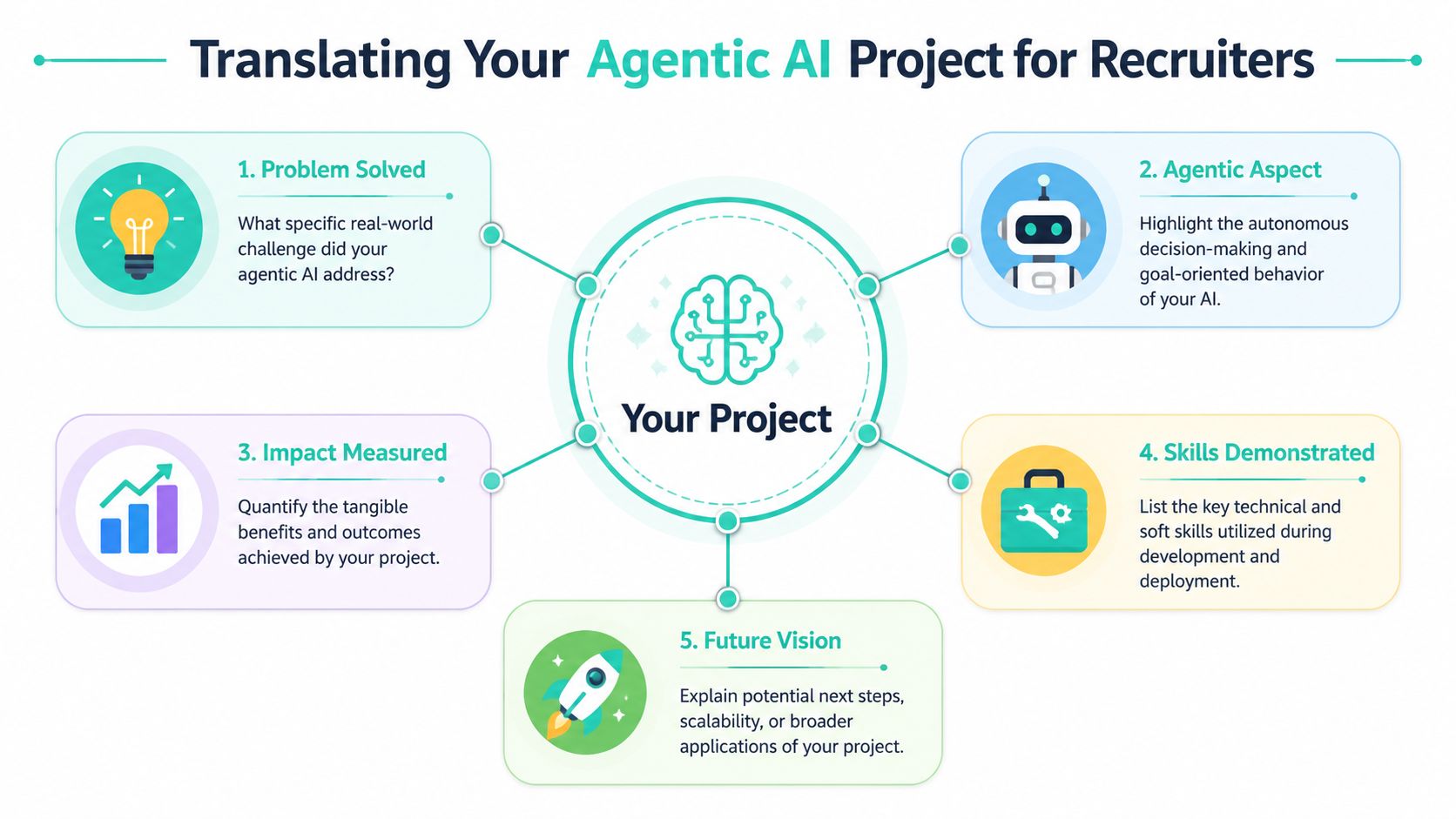
The best way to translate agentic AI development on your resume is to deconstruct one project through three filters.
What business problem did it solve?
“Built a customer support agent” is weak. “Built an agent that triaged inbound support requests, selected the right internal knowledge source, and escalated exceptions to a human queue” is stronger because it names the operational job.
How autonomous was it?
There's a big difference between a copilot and a system that owns a defined slice of a workflow. Kore.ai describes a six-stage adoption path for enterprise agentic AI, where Stage 5 is the point where agents manage a defined portion of a workflow and handle routine decisions, requiring human input only when patterns fall outside predictable ranges, in its overview of AI agent evolution. That's useful language because it gives you a realistic way to describe autonomy without overselling it.
What complexity did it handle?
Did the agent work with ambiguous input, multiple tools, changing context, compliance constraints, or long-running memory? Those details separate toy projects from systems people would trust in a company.
A lot of resumes still over-index on tool names. That's not where senior signal lives anymore.
Job seekers should prioritize showcasing context engineering and guardrail implementation over basic Python or API work, and cited reporting tied to McKinsey's “Superagency” piece frames these as the layers employers increasingly value for senior roles, with compensation for specialized MLOps and agentic roles exceeding $300,000–$350,000 in major markets, as referenced in McKinsey's superagency workplace analysis.
That means recruiter-speak should include details like:
If the most impressive thing in your bullet is the framework name, the bullet is underperforming.
Use this simple rewrite pattern when reviewing your own project notes:
For example, if you built an agent to identify accounts likely to leave, don't stop at “built churn model.” Show whether it monitored behavior, selected interventions, or triggered downstream workflows. If you want a practical example of how retention work gets framed in business terms, this piece on how teams prevent customer churn is a useful mental model for turning technical output into operational value.
Candidates who answer those questions write resumes that sound like they've shipped systems. Candidates who don't usually sound like they assembled demos.
At this point, most resumes fall apart. The candidate clearly built something real, but the only evidence offered is “improved efficiency” or “reduced manual work.” That language doesn't survive technical review.
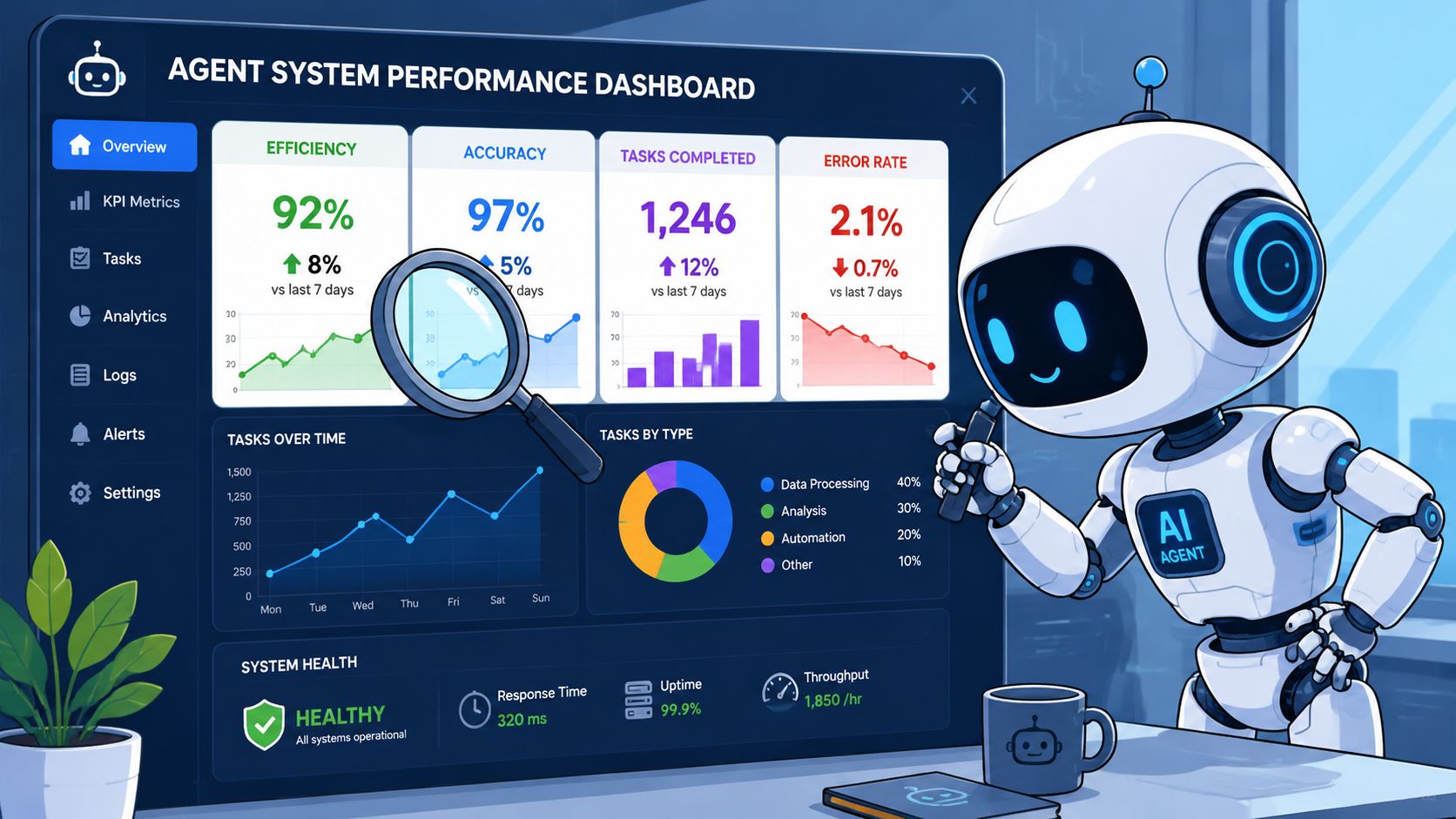
A credible resume bullet starts with instrumentation. Auxiliobits recommends a step-by-step framework that logs every agent step with timestamp, action, and tool used, captures LLM inputs and outputs for auditability, and defines five core evaluation dimensions: Effectiveness, Efficiency, Autonomy, Accuracy, and Reliability. It also calls out advanced metrics including LLM Cost per Task, Hallucination Rate, and Latency Per Agent Loop in its guide to evaluating agentic AI in the enterprise.
If you didn't log those things, start now on your next project. If you did, your resume can move from “I built an agent” to “I built an agent and can defend how it behaves.”
Not every metric belongs in a bullet point. These do.
Task Success Rate
This answers the hiring manager's first question. Does the system complete the intended job under real conditions?
Human Override Rate
This is one of the most underused metrics. A system that hands work back to humans too often isn't very autonomous, even if the demo looked great.
Hallucination Rate
Especially important if the agent generates decisions, summaries, or tool arguments. It shows whether outputs can be trusted.
Latency Per Agent Loop
Critical when the agent works in customer-facing or operational contexts where slow loops break the user experience.
LLM Cost per Task
Good candidates know that a workflow can “work” and still be commercially wrong.
Context Utilization Score
Strong for systems using retrieval or memory. It proves the agent used available evidence instead of ignoring it.
Auxiliobits also recommends synthetic task benchmarks using 50–100 simulated prompts across workflows such as “Download sales data, clean it, and upload to SharePoint,” and suggests evaluating Task Success %, Token Cost, Latency, Memory Usage, and Action Accuracy. The same piece notes that well-instrumented agents in real-task replay can show 70–85% task completion in finance and support domains when context utilization exceeds 60% and hallucination rates stay below 5% in that evaluation context.
Akka's framework write-up adds a different but useful lens. It states that agentic AI deployments face a 40% failure rate due to poor generalization and weak tool selection, that production systems should target Task Success Rate of at least 90% across 5+ test cases, and that top models in AgentBench and WebArena reach only 60–75% success in multi-turn tool use and 30–40% in lateral thinking puzzles, highlighting a 40% generalization gap in its discussion of agentic AI frameworks.
Don't put benchmark numbers on your resume unless they came from your own instrumentation or a clearly defined evaluation setup.
Use this when preparing a project for resume-worthy documentation:
That level of evidence does two things. It makes your bullet stronger, and it gives you better interview material than most candidates have.
Most bad AI resumes fail for a simple reason. They describe activity, not value.
Modern ATS 2.0 systems filter for semantic meaning, measurable impact, and technological application methods, which means your bullets need numerical data where you have it and they need to explain how tools fit into a complete workflow, as described in this breakdown of how agentic AI screens resumes.
A strong bullet usually includes four elements:
That's just the STAR method adapted for agentic systems. You don't need to spell out Situation, Task, Action, Result. You need to compress them.
Hiring test: If I remove the model and framework names from your bullet, does it still sound impressive? If not, the bullet relied on jargon instead of impact.
For candidates who want a broader refresh on formatting and structure, this guide on how to write a tech resume is useful. The AI-specific layer only works if the underlying resume is already clean.
| Before (Generic & Weak) | After (Specific & Strong) |
|---|---|
| Built an AI chatbot for customer support. | Built a customer support agent that retrieved policy context, selected response actions, and escalated exceptions to human reviewers; instrumented task success, hallucination rate, and override frequency to validate production readiness. |
| Used LangChain and Python to automate workflows. | Developed a multi-step agent workflow in Python that called external tools, maintained context across tasks, and enforced structured outputs with guardrails for downstream system compatibility. |
| Improved operations with AI automation. | Automated a defined portion of an internal operations workflow using an agent that handled routine decisions within predictable ranges and passed out-of-pattern cases to a human-in-loop queue. |
| Worked on LLM evaluation. | Designed agent evaluation around effectiveness, efficiency, autonomy, accuracy, and robustness; logged step-level traces, tool choices, and latency per loop for auditability and tuning. |
| Created an AI project for the company. | Deployed an agentic workflow tied to a business process, documented tool orchestration, governance constraints, and measurable outcomes so recruiters and interviewers could assess production impact rather than prototype scope. |
One warning. Don't force fake precision into bullets just because “data looks good.” Hiring managers can spot invented numbers faster than candidates think. A clean, specific qualitative bullet beats a suspiciously polished metric every time.
A resume gets you into consideration. Your portfolio and interview decide whether your claims survive scrutiny.

Most AI portfolios are still galleries of apps. Hiring managers want operating evidence.
A good project page or README should include:
Covalense's trend analysis makes this framing more relevant because it argues resumes must highlight business impact and multi-agent orchestration, with agentic systems now embedded across supply chains and departments beyond IT. It also notes that candidates should emphasize deployment governance such as RBAC and privacy in its 2025 agentic AI trends overview.
That same logic applies to your portfolio. If the project page doesn't show governance, it looks unfinished.
Interviewers don't want a replay of your README. They want your judgment.
Use talking points like these:
Why this workflow deserved agentic design
Explain why a deterministic script wasn't enough. Maybe the input was ambiguous, the tool choices varied, or the system needed long-lived context.
Where you constrained the agent
Strong candidates talk about what they refused to automate, not just what they automated.
How you handled human collaboration
Mention handoff logic, approval gates, or exception routing. That's how real systems earn trust.
What broke first
Good stories often come from failures in retrieval quality, tool selection, or prompt routing. Those details sound real because they are.
In interviews, the strongest answer usually isn't “the model got smarter.” It's “we changed the workflow, the controls, or the context so the model stopped making the same class of mistake.”
If you need a lightweight site to package case studies, architecture notes, and screenshots, Solo's guide to portfolio builders is a practical starting point.
Then make sure the portfolio supports the same narrative as your resume. If your bullet says “multi-agent orchestration,” your portfolio should show the agents, the handoffs, and the governance model. If your target roles are startup roles, reviewing live AI engineer jobs can also help calibrate the level of system ownership companies expect to see.
A lot of engineers still think their value is “I build AI features.” That framing is getting too small.
The better framing is that you design strategic automation for messy workflows. That includes model behavior, yes, but also context, guardrails, evaluation, interfaces, handoffs, and business constraints. The people who grow fastest in this market won't be the ones with the longest framework list. They'll be the ones who can decide when an agent should act, when it should stop, and how its work gets measured.
Think less like a prompt engineer and more like a systems owner.
That means you should keep building across these layers:
For engineers trying to stay sharp on where the role is heading, this perspective on the evolving AI engineer role is worth reading.
The fastest way to stand out with agentic AI development on your resume is simple. Stop presenting yourself as someone who used AI tools. Present yourself as someone who made autonomous systems useful, measurable, and safe inside real business operations.
If you're exploring startup roles where that kind of work matters, Underdog.io is a strong place to look. It connects experienced tech candidates with vetted startups and high-growth companies, and it's built for people who want thoughtful opportunities instead of throwing resumes into a black hole.