You're probably staring at two tabs right now, one with a remote job board, the other with your resume, and wondering why the roles all blur together. They don't. Remote tech jobs split into different markets, and if you apply like they're all the same, you waste time, miss better fits, and pitch yourself wrong.
The people who land these roles fastest don't chase “remote” as a lifestyle perk. They pick a lane, build proof for that lane, and stop pretending every listing is open to everyone. That's the difference between spraying applications and getting hired.
A mid-level engineer reading a remote offer in 2026 is not choosing between office and home. They are choosing a lane. The split is fully remote versus hybrid, location-agnostic versus region-locked, generalist versus specialized, and startup speed versus enterprise process. Those differences shape who gets hired, what gets paid, and how much flexibility the role really offers.
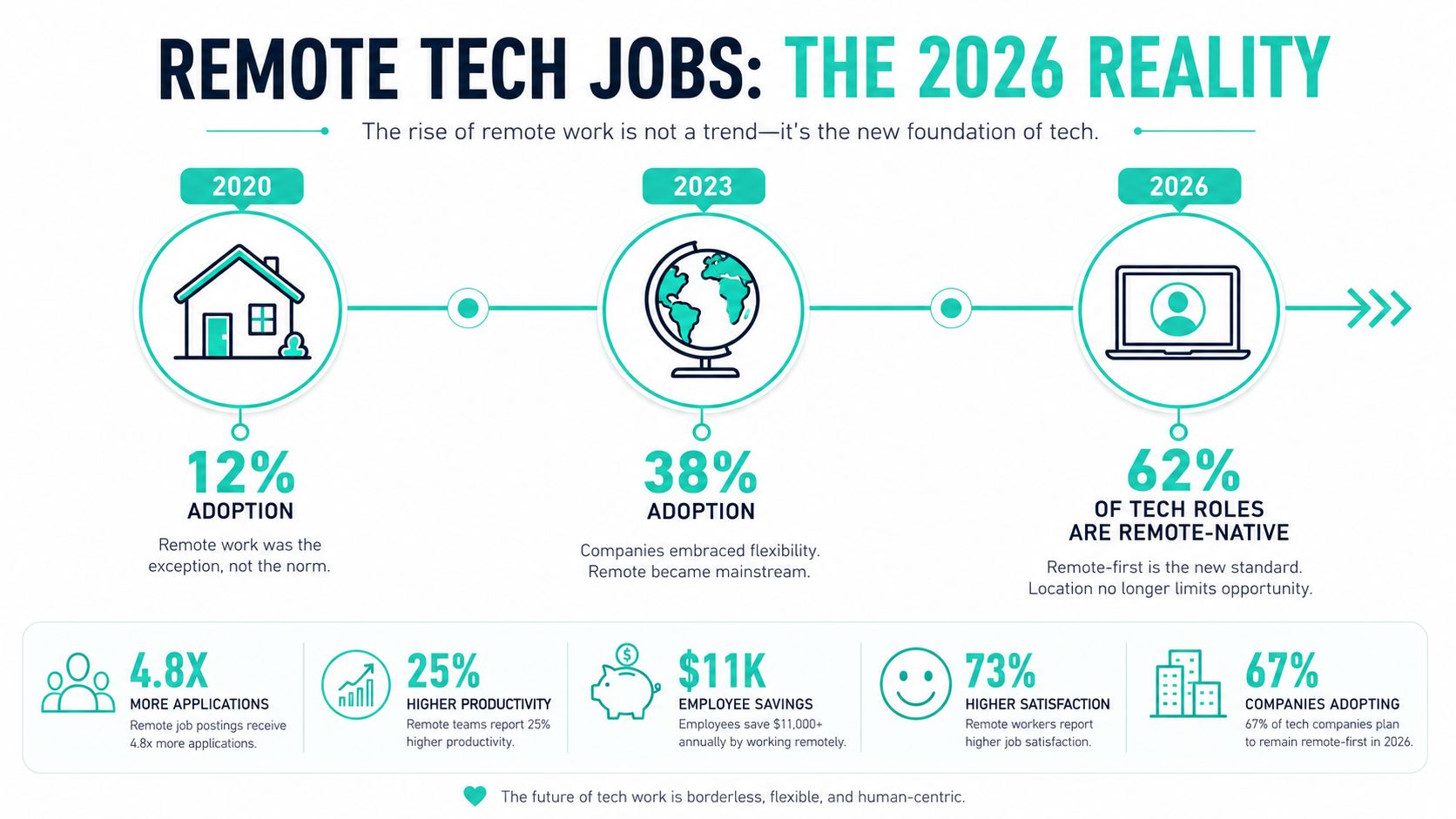
Remote hiring did expand sharply after the pandemic. StrongDM shows that remote-work opportunities moved from roughly 4% of total available jobs to more than 15% of U.S. job opportunities, and that technology stayed the strongest remote-hiring sector, with information technology services producing about 250,000 remote jobs in six months and tech-related roles making up roughly 32%–35% of remote job postings (StrongDM).
That matters because the market is real, but it is tighter than the word “remote” suggests. Fully remote roles have been declining from their 2022 peak even while remote hiring remains significant (StrongDM). So the opportunity is there, but the easy openings are gone.
A candidate should ask one blunt question before applying: is this role remote, or is it just less office-bound? The answer changes your odds, your compensation, and the kind of work you will do.
If you are mapping your background to the right lane, the UK computer science vs software engineering guide is a useful reference point for deciding whether your profile fits a broader engineering role or a more specialized path.
Using “remote” as if it describes one job market is inaccurate. It doesn't. The better way to read listings is to sort them into four sub-markets, because each one rewards a different profile and punishes a different mistake.

Fully remote means the company expects no office presence as part of the role. Remote-first usually means remote is the default, but office access still exists. Hybrid means scheduled in-office days. Remote-friendly is the loosest category, and it often means you can work away from the office sometimes, not that the role is location independent.
The mistake candidates make is applying to a “remote” role without checking the location rules. Many listings still restrict applicants by country, state, time zone, or payroll constraints, even when the ad says remote. For a practical reality check, read a comp-sci versus software-engineering comparison like the UK computer science vs software engineering guide, then map your background to the lane that fits the employer's expectations.
The second split is skill depth. Generalist roles, like broad support or junior product work, can be easier to enter but usually pay less and receive more applicants. Specialized roles, especially in AI, cloud, cybersecurity, and systems-heavy engineering, are where employers struggle more to hire.
That doesn't mean every candidate should chase specialization immediately. It means you should be honest about whether your current proof supports a specialist lane. If your strongest evidence is shipping features, fixing production issues, or owning infrastructure, don't market yourself like a pure product generalist.
Startup remote hiring is usually faster, rougher, and more proof-driven. Enterprise remote hiring is usually more structured, slower, and more compliance-heavy. Both can be good, but they reward different temperaments.
If you want speed and ambiguity, target startups. If you want process and stability, target enterprises. If you want the highest chance of a clean fit, don't mix the two in the same application sprint.
A quick self-test helps. If you need full geographic flexibility, focus on fully remote, location-agnostic roles. If you can commute sometimes, hybrid may widen your options. If you have certifications, portfolio proof, or a strong technical niche, specialize. If you're still building confidence, start where proof matters more than pedigree.
The candidates who get hired for remote tech roles do not spray applications at every opening. They pick a lane and make their resume, portfolio, and interview stories match that lane. That matters because fully remote, hybrid, location-locked, and specialization-heavy roles all reward different proof.
A remote engineer, for example, is often judged on code quality, written communication, and whether they can keep moving without being watched. A remote support or operations hire is judged on responsiveness, troubleshooting, and how clearly they document fixes. AI-heavy and systems-heavy roles raise the bar again, because employers want people who can work through ambiguity and still produce clean output.
Software engineering remote work still centers on shipping features, debugging systems, and collaborating through code review. In high-growth teams, employers care less about where you sit and more about whether you can write clean code, explain tradeoffs, and work without constant supervision. For machine learning and data engineering, the day-to-day shifts toward pipelines, model support, data quality, experimentation, and making data usable for everyone else.
DevOps and site reliability roles are different again. These candidates spend time on deployment workflows, incident response, infrastructure automation, and reliability work. Cloud and security roles bring a heavier focus on access control, risk reduction, compliance, and systems design. If your background includes Terraform, Kubernetes, AWS, identity tooling, or production hardening, put that near the top of your resume and portfolio.
The lane matters as much as the title. A broad software generalist, a region-locked infrastructure hire, and an AI specialist all signal very different value to a hiring manager.
Remote product management candidates need to show sharp prioritization, async decision-making, and a track record of aligning engineering, design, and business goals. Product design hires are judged on how well they reason through user problems, systems thinking, and clean handoffs, not just visual polish. Technical program management demands planning discipline, stakeholder management, and the ability to keep cross-functional work moving without face-to-face pressure.
These roles get screened differently from engineering. A strong product manager can be rejected for vague writing. A strong designer can be rejected for weak systems thinking. A strong TPM can be rejected for looking too tactical and not enough like an operator.
Proof beats title in every lane. Employers want portfolios, specific project writeups, and evidence that you can work independently. That is why remote IT hiring guidance pushes candidates toward certifications like CompTIA A+ or Google IT Support, mock-ticket portfolios, and volunteer remote work to show real troubleshooting and communication skills. For compensation framing and the way hiring managers weigh proof against pay, see Underdog.io's compensation and benefits guidance.
Short version, if your resume only lists titles and tools, you look generic. If it shows what you fixed, shipped, or improved, you look hireable.
The warning signs are easy to spot. If you cannot show distributed collaboration, written communication, and role-specific evidence, you will lose to someone who can. That is true even when your technical ability is solid.
A recruiter looks at two remote candidates with the same years on paper. One has general support and admin experience. The other ships cloud, security, or AI work that is hard to replace. The second candidate gets the stronger offer. That is how pay works in remote tech.
Pay in remote tech is wide because the market breaks into separate lanes. A remote technical job averages $156,348 a year on ZipRecruiter, with a typical band of $116,000–$205,000, while an adjacent role like technical support specialist sits much lower at a national average of $54,916 on Indeed (ZipRecruiter, Indeed). That gap is not about working from home. It is about specialization depth and how hard the skill set is to replace.
Pay follows scarcity. If the work is hard to source and expensive to replace, the range jumps.
Remote pay can also run above local-market equivalents in the right lane. One guide says remote tech workers earn 10-15% more than local-market equivalents because remote hiring expands access to higher-paying companies (Hakia). I would apply that idea only to candidates with rare skills, strong portfolio proof, and enough seniority to work without heavy oversight. It does not rescue weak applicants, and it usually does not show up in low-skill support roles.
CBRE's tech-talent data points in the same direction, and it also shows where the market is concentrating. U.S. tech talent employment grew by 1.1% in 2024, adding 64,140 jobs, while the high-tech industry itself shrank by 3.1%, or 76,230 jobs. Analysts at CBRE also found that AI-related postings doubled to 20% of available U.S. tech-talent jobs by June 2025. That is the premium lane right now.
| Role Lane | Typical Annual Pay (USD) | Seniority | Remote Premium? |
|---|---|---|---|
| Software engineering | Higher end of the remote range | Mid to senior | Sometimes, if skills are scarce |
| AI, cloud, security | Upper range or above it | Mid to senior | More likely |
| Product management | Broad spread | Mid to senior | Sometimes |
| Product design | Broad spread | Mid to senior | Sometimes |
| Technical support | Lower range | Entry to mid | Usually not |
| Junior support-style tech roles | Lower range | Entry level | Rarely |
Use this compensation guide as a framework when you compare offers, but do not obsess over one number. Compare lane, seniority, and flexibility together. That is how you avoid underpricing yourself or chasing roles that were never meant for your level. A simple check is to ask whether your experience maps to a scarce lane, a crowded lane, or an entry-level lane, then price yourself accordingly. If you are still debating how much weight to give proof versus pay, a good email tester workflow will not help, but a clean portfolio, tight writing, and role-specific evidence will.
The wrong place to job hunt is any board that dumps thousands of “remote” listings in your lap and calls that a strategy. You want channels that match your profile. Open boards are useful for breadth, but curated marketplaces are better when you want signal, especially if you're already employed and don't want to spray applications everywhere.
We Work Remotely says it has been the #1 site for remote jobs for over a decade and gets 6 million monthly visitors (We Work Remotely). That scale matters, because it shows the market is deep enough to support specialized discovery channels. Open boards like LinkedIn, Indeed, and We Work Remotely are good for volume and for understanding what's broadly available.
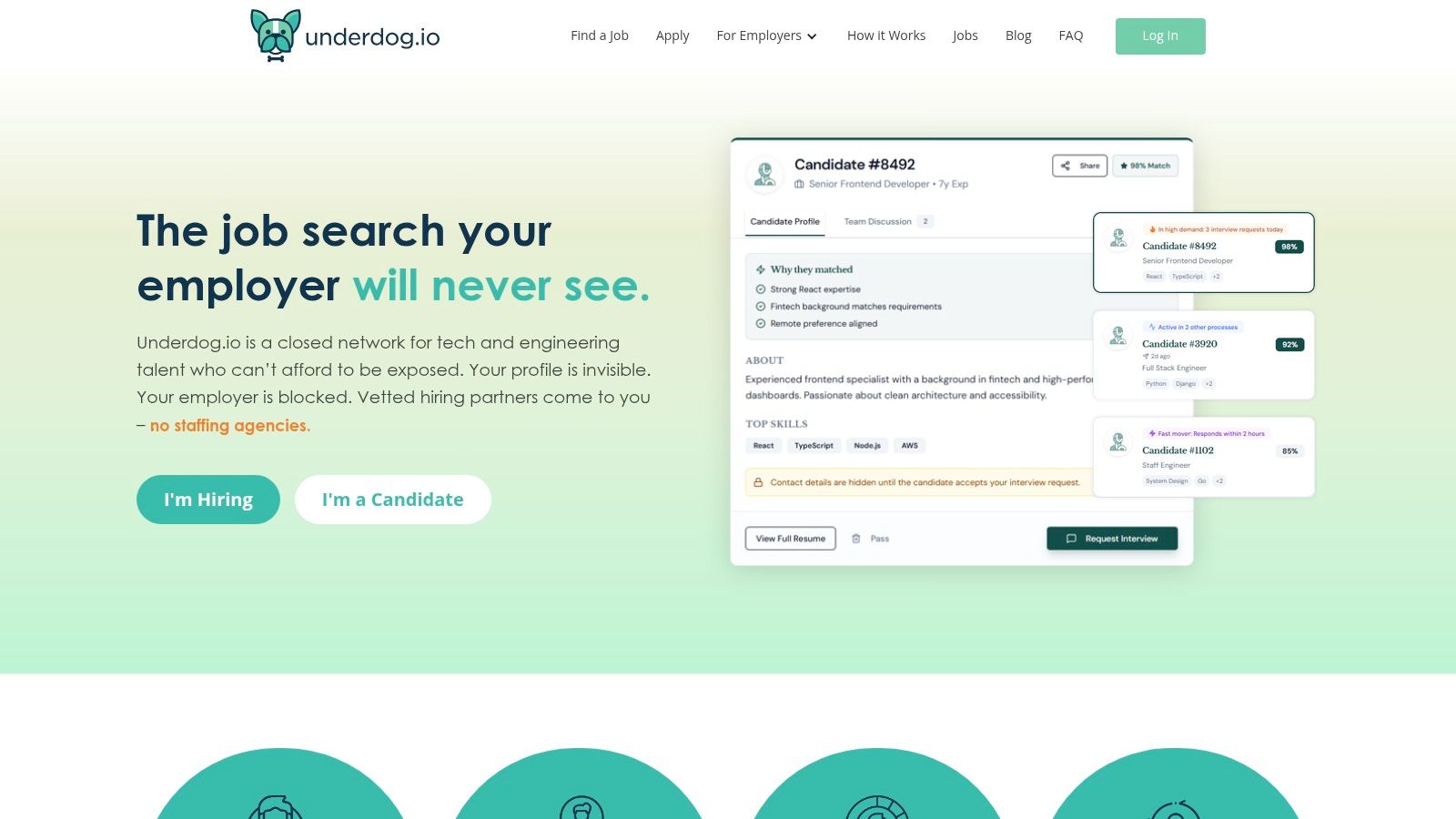
Curated marketplaces are different. They screen for fit, reduce noise, and often save candidates from the worst parts of the search. One example is Underdog.io, which connects candidates with vetted tech startups and high-growth firms. I'd use a platform like that as one option among others, not as your entire strategy. It's useful when you want selective introductions instead of endless form submissions.
For broader search discipline, the companies that hire remotely guide helps you think about where remote demand lives.
Before you spend time on any platform, check three things. First, whether the listings are filtered for role quality. Second, whether location rules are clear. Third, whether the platform respects candidate time.
If you're sending applications or outreach from your inbox, a tool like email tester helps you catch deliverability issues before they hurt replies. That matters more than people admit, because even a strong pitch fails if it never reaches the inbox.
A remote interview loop is usually structured, and smart candidates treat it like a sales process with gates, not a mystery box. Most companies move through a recruiter screen, a hiring manager conversation, a technical screen, then a full loop of back-to-back interviews. Jobbi's guide to remote tech jobs lays out that pattern clearly, and the flowchart infographic detailing the five stages of a remote tech job interview process. makes the sequence easy to remember.
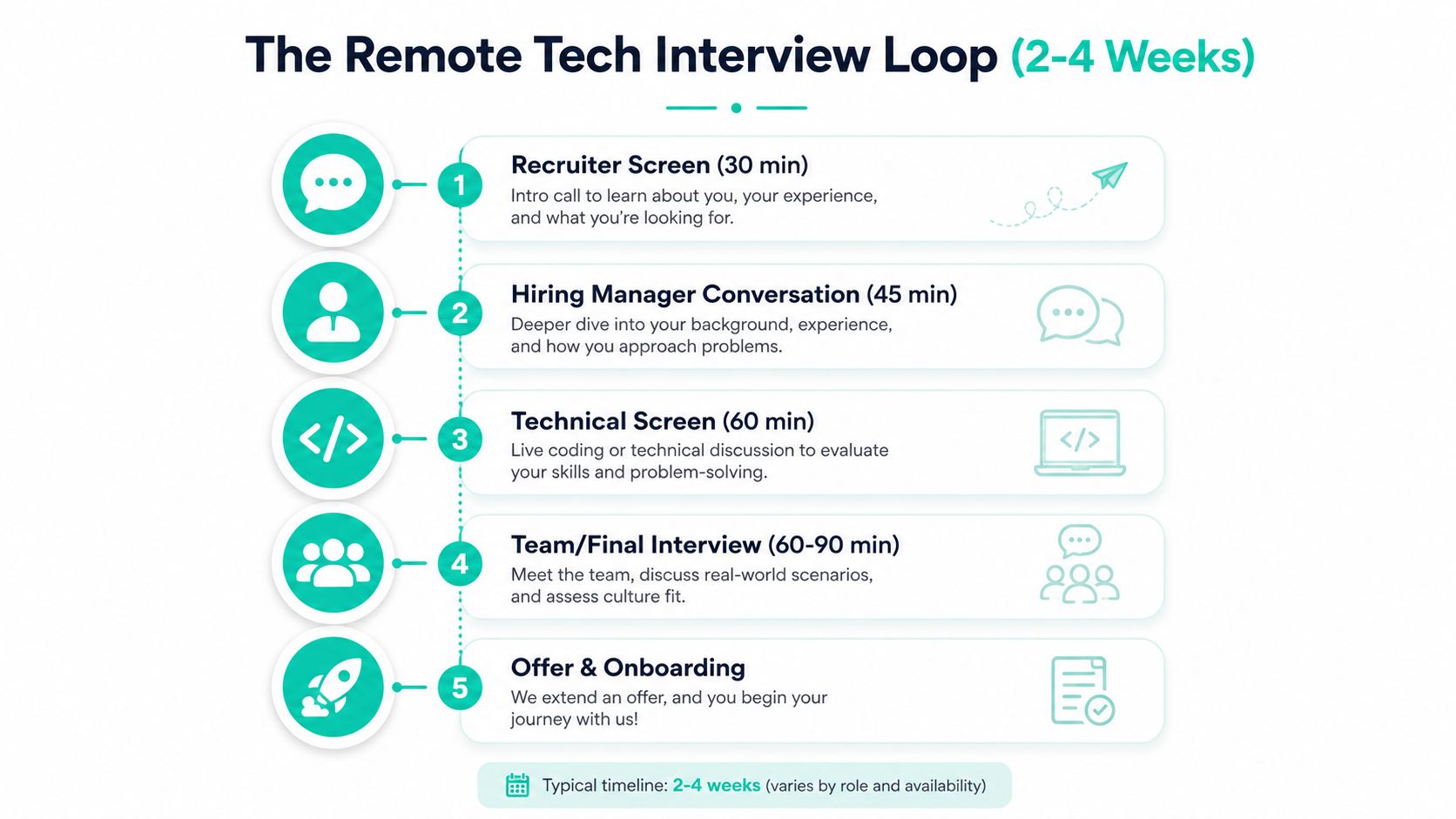
The recruiter screen is about fast fit. Keep your story tight, tie it to the lane you are targeting, and make it obvious why you want this kind of remote role instead of a generic job. The hiring manager conversation is where judgment matters, so speak plainly about tradeoffs, ownership, and how you work with little supervision.
The technical screen is signal time, not theater. Engineers need to make their thinking visible, step by step. Product and program candidates need to show how they break down ambiguity and keep work moving without constant follow-up. If you want a clean prep plan, use the software engineer interview preparation guide before you walk into the loop.
Remote hiring teams are asking one question, can this person do the job without being managed by proximity? They are screening for async communication, self-management, and proof that you have already worked across distributed teams. Companies also want evidence they can verify quickly, so a portfolio, certifications, and specific remote project examples matter more than polished confidence.
That is why your interview prep should sound like proof, not aspiration. If you have shipped remotely, say how. If you have led async projects, describe the handoff, the communication pattern, and the result.
A practical way to sharpen your answers is to rehearse with an AI Notetaker like Weeve. Review the recording, find where your answers ramble, where you dodge specifics, and where your examples are too thin. That feedback is useful because remote interviewers reward clarity, not a script.
Keep your answers direct. Remote interviewers want evidence, not a transcript of your thought process.
Before each round, check three things. Your portfolio should match the role. Your resume should mirror the language in the job description. Your examples should prove you can work across time zones and still deliver on deadline.
The first 90 days decide whether you become a multiplier or a drag. Remote managers can't watch your desk, so they judge you by the quality of your written updates, how reliably you deliver, and whether other people trust your handoffs. If you go silent, you don't look “busy.” You look risky.
Start with explicit onboarding notes. Write down decisions, blockers, access problems, and the names of the people who can unblock you. Keep your manager updated before they have to ask, and do it in writing when the topic matters.
Your communication should be written-first by default. That means concise Slack updates, clean docs, and meeting notes that other people can use later. If a meeting doesn't need a decision, kill it or shorten it.
Remote teams live and die on overlap windows. Use yours for questions, reviews, and decisions that need live discussion. Save deep work for the hours when you won't be interrupted.
The other habit that separates strong remote hires is proactive documentation. When you solve a problem, write the fix down. When you learn a process, capture it. That makes your value visible even when you're offline.
A simple 90-day rhythm works well:
Spend 90 minutes this week mapping your last three projects to the four sub-markets above. Decide whether you're targeting fully remote, hybrid, location-agnostic, or region-locked roles, and don't mix all four in one search. Then pick two or three platforms max, one open board, one curated marketplace, and one network channel.
Prep your materials around the lane you chose. If you're technical, strengthen your portfolio and certification proof. If you're product or program focused, sharpen your written case studies and cross-functional examples. Then rehearse the interview loop until the timing feels normal.
After you land the role, spend the first 90 days making your work legible. That means updates, docs, and visible ownership. Remote careers reward people who make their value easy to see.
A CTA for Underdog.io. If you're ready to stop guessing and start targeting the right remote tech lane, use a curated marketplace that puts your profile in front of vetted startups and high-growth tech companies instead of sending another round of cold applications.