A tech recruitment agency is a specialist recruiting firm focused on technology roles — but the label covers very different models, from high-volume contingent search to boutique retained firms to curated candidate marketplaces. For startups, the right hiring partner can reduce time-to-hire for hard-to-fill roles by up to 40 percent and filter out the majority of unqualified candidates early. The wrong one wastes budget and floods your team with noise. This guide covers how agencies work, what they cost, when each model makes sense, how to vet a partner, and how candidates can work the system from their side.
You raised money, the roadmap is packed, and one role is blocking everything. Maybe it’s a founding engineer. Maybe it’s a product lead who can translate customer pain into a build plan. Maybe it’s the first data hire and nobody on the team can tell a solid machine learning profile from a keyword-stuffed resume.
That’s when most founders realize hiring is not an admin task. It’s product strategy, execution risk, and fundraising narrative all tied together.
The hard part is that startup hiring breaks in two directions at once. You get too many applicants for some roles, and almost none of the right ones for the roles that matter most. You also compete in a labor market where the U.S. tech workforce is projected to grow twice as fast as the overall workforce over the next decade, requiring about 352,000 new workers each year, while the employment and recruiting agencies industry is projected to rebound to $34.4 billion by 2030 according to CompTIA’s State of the Tech Workforce 2025.
That pressure is why the term tech recruitment agency keeps coming up in board meetings, founder chats, and candidate conversations. But that label covers very different models. Some agencies run high-volume contingent search. Some act like embedded recruiting partners. Some know startup dynamics cold. Others sell speed and deliver noise.
There’s also a newer category in the mix. Curated marketplaces try to solve a problem traditional agencies often create: too much outreach, too little trust, and weak candidate experience.
Founders need a clear view of what each option does. Engineers and product people need the same clarity from the other side. A good hiring partner can save months of drift. A bad one can waste them.
A tech recruitment agency is a recruiting firm that specializes in technology roles and the companies that hire them. Unlike generalist staffing firms that cover operations, finance, and marketing under one umbrella, a specialist tech agency focuses narrowly on roles like software engineers, product managers, data scientists, DevOps engineers, and engineering leaders — and on the companies competing to hire them.
At its best, a tech recruitment agency provides three things an internal team often lacks. First, access to passive talent networks — the 85 percent of qualified candidates who are employed but open to the right opportunity and will never apply through a job board. Second, technical pattern recognition — enough fluency in engineering, product, and data roles to distinguish credible profiles from keyword-stuffed resumes. Third, process control — owning intake, sourcing, screening, scheduling, and offer management under a single accountable owner, so founders and hiring managers don't lose momentum when a search stalls.
The key distinction is between agencies that compete on volume and those that compete on fit. Volume-driven agencies send as many plausible candidates as possible across as many clients as possible. Fit-driven agencies — or curated marketplace models like Underdog.io — filter aggressively so that every candidate introduction represents a genuine match, not a pipeline-flush. For startups especially, this distinction determines whether outside recruiting help accelerates hiring or adds another distraction to manage.
A startup usually starts hiring seriously at the exact moment it has the least room for a mistake. The team is lean. Managers are stretched. Every open seat changes product velocity.

The founder’s problem isn’t just “find talent.” It’s narrower and tougher.
A typical startup hiring loop breaks down in a few places:
Startups rarely lose hiring momentum because nobody cares. They lose it because nobody owns the process tightly enough.
The challenge is bigger because the market itself is tight. As noted earlier, projected workforce growth and replacement demand keep pressure on every company trying to hire technical talent, especially in startup-heavy markets.
When one open role slows launch plans or customer delivery, founders start seeking solutions. That usually means some version of outside recruiting help.
What they find is confusing fast:
All of them promise access and speed. Not all of them understand startup trade-offs.
That is the dilemma. You don’t just need candidates. You need a hiring channel that fits your stage, your budget, and your company's evolving nature.
A tech recruitment agency is a recruiting firm that focuses on technology roles and the companies that hire them. That sounds simple, but the difference between specialist and generalist recruiting is usually the difference between signal and noise.
A good tech recruiter works like a real estate agent who only covers one high-demand neighborhood.
They know what inventory is real. They know which listings are stale. They know which buyers can close. And they can tell the difference between a polished listing and a property with structural problems.
A generalist recruiter can still help. But when the role is a backend engineer, ML engineer, product manager, or engineering leader, surface familiarity isn’t enough. The recruiter has to understand the market, the role, and the candidate’s market position.
At their best, these firms provide three things internal teams often lack:
For technical niches, that specialization matters. According to People in AI’s overview of specialist data and analytics recruitment agencies, specialized tech recruitment agencies can achieve up to a 40% reduction in time-to-hire for roles such as data science and AI, filter out 70-80% of unqualified resumes early, and boost hire quality by an estimated 25-30%.
That doesn’t mean every agency performs that well. It means the ceiling is much higher when the recruiter understands the work.
A general staffing firm might cover operations, finance, marketing, and tech under one umbrella. A strong tech agency narrows the lane.
That usually shows up in how they talk about roles. A weak recruiter treats software hiring like title matching. A strong one understands why a startup may want a product-minded full-stack engineer instead of a narrowly scoped platform specialist.
For a deeper look at how specialist firms differ by role focus and hiring model, this guide on software engineer recruitment agencies is useful.
Practical rule: If the recruiter can’t discuss what success looks like in the role beyond years of experience and a stack list, they’re probably forwarding resumes, not recruiting.
Most founders see the output of an agency. Candidate intros, interview coordination, fee terms. They don’t always see the machinery behind it.
A strong agency process is usually easy to recognize because it feels structured without becoming bureaucratic.
The work starts before the first search string.
A real agency kickoff should define more than title, salary, and remote policy. It should cover who this person reports to, what they need to ship in the first months, what kind of ambiguity comes with the role, and what type of background tends to fail in your environment.
After intake, the agency usually moves through a sequence like this:
The pricing model changes behavior. Founders should understand that before signing anything.
You pay only if you hire a candidate from the agency.
This is attractive because it lowers upfront risk. It also creates mixed incentives. Some firms work hard on contingency. Others hedge by sending volume to many clients at once.
Best fit: mid-level roles, straightforward searches, teams that can evaluate quickly.
You pay part of the fee upfront for dedicated work.
This makes more sense for executive hires, very niche roles, or searches where confidentiality matters. The upside is focus. The downside is committing budget before you know whether the partnership works.
Best fit: leadership roles, hard-to-fill searches, confidential replacements.
Some firms blend a smaller upfront commitment with success-based payment. That can work well for startups that want agency attention without going fully retained.
Best fit: startups with urgency but limited tolerance for open-ended search spend.
What separates a serious agency from a resume pipeline is candidate vetting quality.
Look for signs like these:
Some specialist firms have built reputations around a focused process and technical recruiting depth. Nexus IT Group at nexusitgroup.com is one example founders may come across when evaluating tech-focused recruiting partners.
If an agency sends three candidates and all three look different in useful ways, that’s usually a sign they understand the brief. If all three look the same, they’re matching keywords.
Startup hiring and enterprise hiring may use the same job titles, but they don’t evaluate the same risk.
Big companies usually hire into established systems.
They can lean on brand recognition, stronger cash comp, clearer leveling, and more defined processes. A candidate can join a known machine and perform inside a narrower lane.
That changes how recruiters pitch the job. Stability is the sell. Scope is bounded. Interview loops often optimize for consistency across many hires.
Startups hire for slope, not just credentials.
The candidate might write code, shape process, talk to customers, and patch gaps nobody predicted when the role opened. That means the startup has to evaluate different traits:
A recruiter who mostly staffs larger companies can miss this. They may over-index on logos, pedigree, or exact title history and underweight startup behavior.
A large company can absorb a hire who needs structure. A startup often can’t.
That’s why startup founders get frustrated when agencies send candidates who are technically qualified but culturally wrong for an early-stage environment. The issue isn’t “culture fit” in the vague sense. It’s whether the person can function without the support systems they’re used to.
This is also where startup-specific pitfalls show up. Some analyses note that early-stage companies can run into long placement droughts when an agency misunderstands the company’s risk profile or equity-heavy offers.
Early-stage hiring breaks when everyone talks about the role and nobody talks honestly about the company.
The right recruiting partner for a startup doesn’t just source talent. They translate the company’s uncertainty into a story the right candidate can buy.
Founders usually ask the wrong first question. It’s not “Should we use a tech recruitment agency?” It’s “Which hiring model fits this search?”
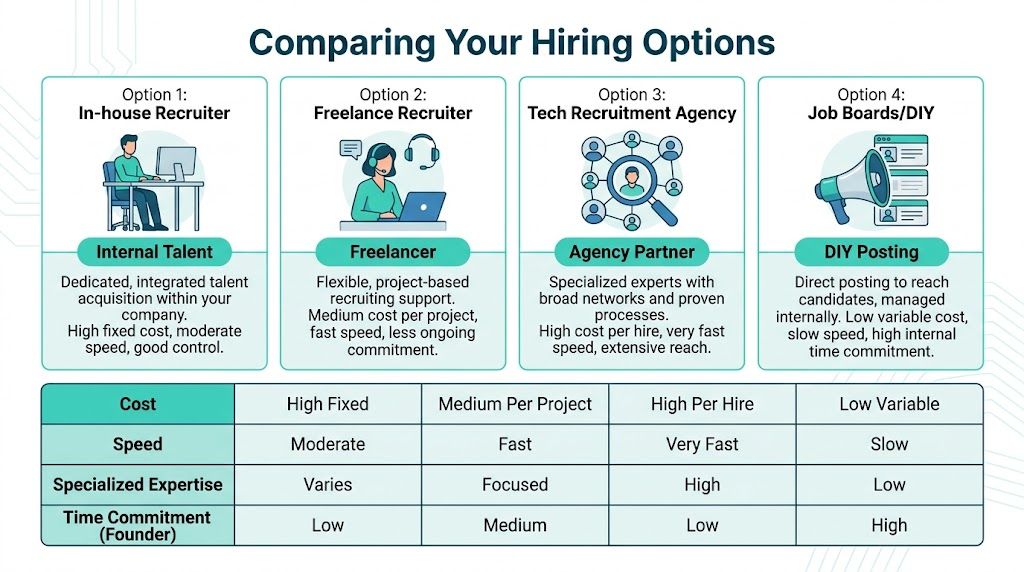
A startup hiring one engineer has a different need than a startup building a team across engineering, product, and design.
Volume is the enemy if your team can’t process it. Tech employers receive an average of 110 applications per hire, which is 51% more than other industries, according to SmartRecruiters’ technology benchmark recruiting metrics. That’s why hiring models that filter aggressively can outperform cheaper channels that flood the team.
This works when hiring is constant and predictable. If you’re opening several roles and can keep one recruiter fully occupied, the fixed cost starts making sense.
The downside is obvious. One internal recruiter can’t instantly become an expert in every niche, and founders still need to help sell the opportunity.
This is often underrated. A strong freelance recruiter can behave like a practical extension of the team.
But there’s less process infrastructure. You’re betting on one person’s network, discipline, and communication habits.
This is the best fit when speed matters and the role is painful enough to justify external fees.
The danger is misalignment. Some agencies optimize for activity rather than fit. You need to know which type you’re buying.
For startup hiring, this model can solve a different problem than classic agency search. Instead of blasting outreach, it pre-qualifies talent and makes the process more mutual. One example is Underdog.io, a curated hiring marketplace where candidates apply once and vetted startups can reach out when there’s mutual fit.
If you’re building your process from scratch, this practical guide on How to Hire Developers: Expert Tips & Strategies is also worth reviewing because it forces good decisions before sourcing even starts.
A polished sales pitch tells you almost nothing. Founders should treat agency selection like vendor diligence with hiring consequences.

Don’t ask whether they have a network. Every recruiter says yes.
Ask these instead:
Who will run the search?**
Salespeople often disappear after signature.
For founders hiring around company-building milestones, it can also help to understand the funding environment around recruiting and talent infrastructure. This list of top recruiting investors in the United States gives useful context on who’s backing the ecosystem.
A bad agency usually reveals itself fast.
As noted earlier, startups can hit long hiring droughts when agencies misunderstand early-stage constraints and candidate risk perception. That’s why process fit matters as much as network.
You don’t need a legal novel. You need clear working rules.
Define:
This resource on recruiters for startups is a useful reference if you want to compare partner types before committing.
A founder should never wonder what the agency is doing this week. If you don’t have that visibility, the search is already drifting.
From the candidate side, the best recruiter relationship feels selective and calm. The worst one feels like spam with calendar links.
That difference matters because 85% of tech talent is passive, meaning employed but open to hearing about the right move, and confidentiality matters in those conversations, as noted in this discussion of when tech companies should turn to a recruiting agency.
A strong recruiter can help if you treat the relationship like a professional channel, not a blind handoff.
A tech recruitment agency sources, screens, and presents qualified candidates for technology roles on behalf of companies that hire them. The process typically begins with a thorough role intake — understanding not just the title and stack but who the candidate reports to, what they need to accomplish in the first months, and what failure looks like in the environment. From there the agency sources through its networks, databases, and direct outreach, screens candidates for technical credibility, motivation, compensation alignment, and startup readiness where relevant, and submits candidates with a narrative that explains the fit rather than just repeating the resume. Strong agencies also manage interview coordination, help candidates prepare, gather feedback quickly, and actively support the offer and close stage.
Most contingency-based tech recruitment agencies charge between 15 and 25 percent of the placed candidate's first-year base salary, paid only when a hire is made. For a candidate with a $150,000 base salary, that represents a fee in the range of $22,500 to $37,500. Retained search — where the company pays a portion upfront for dedicated focus — is typically structured as three payments of roughly one-third of the estimated total fee across the search timeline. Some firms offer hybrid or container models that combine a smaller upfront commitment with a success payment at placement. For startups evaluating cost, the comparison is not "agency fee versus nothing" but "agency fee versus the opportunity cost of months without a critical hire" or "the cost of a bad hire made from unvetted candidates."
A staffing agency typically provides contract, temporary, or permanent workers across many functions — administration, light industrial, finance, and technology all under one roof. A tech recruitment agency specializes in permanent or long-term technology roles and develops sourcing networks, screening capability, and market knowledge specific to engineering, product, and data roles. The practical difference is depth of technical pattern recognition. A generalist staffing firm may be able to fill a junior developer seat from a large database. A specialist tech agency is better positioned to evaluate a senior machine learning engineer, a technical product manager, or a founding engineer role where the candidate profile is narrow and the stakes are high.
The clearest trigger is when one open role is visibly blocking product velocity or revenue and internal bandwidth cannot sustain a quality search. Other good signals include: the role requires passive candidate access because the right person is employed and not job-searching; the role is technically niche enough that the internal team can not accurately screen resumes; previous DIY search attempts produced poor yield; or the search requires confidentiality that internal posting cannot protect. A startup should not default to an agency for every hire — the cost per placement is substantial and the value only justifies itself when the search is genuinely hard and the quality of match matters significantly.
The most useful signals come from asking specific questions rather than reviewing polished pitch decks. Ask which startups at a similar stage and sector they have placed for recently. Ask how they qualify candidates before submission — you want to hear specifics about motivation, compensation alignment, startup appetite, and technical screening, not vague claims about their network. Ask what would make them push back on your role brief, because good partners challenge bad assumptions early. Ask how many candidates they expect to send before you see real traction, which reveals whether they believe in curation or volume. Ask who specifically will run the search after the contract is signed, because salespeople often hand searches to junior operators. If the recruiter cannot answer these questions concretely, treat that as a meaningful signal.
A traditional tech recruitment agency typically operates on an outreach and submission model — recruiters actively source and present candidates, the company reviews submissions, and fees are paid on successful placements. A curated hiring marketplace inverts the dynamic: candidates apply once, are screened and accepted into the platform, and companies that are also vetted can reach out when there is genuine mutual interest. This model is particularly well suited for passive candidates who want confidentiality and high signal rather than blanket recruiter outreach. Marketplaces also tend to be lower cost for companies than traditional contingency fees. The trade-off is less proactive sourcing on specific role briefs and more reliance on the quality and volume of the existing candidate pool.
For candidates, working with a specialist tech recruiter can surface opportunities that don't appear publicly — particularly at startups that don't post jobs broadly or that want to hire before a role is finalized. The best agency relationships feel selective: the recruiter asks detailed questions about what you want, protects your confidentiality, and presents you only to roles that are genuinely relevant. The worst feel like spam with calendar links. The practical test is whether the recruiter can explain specifically why a given role could be a fit for you — not just that it matches your title. If the recruiter sends you three roles in different functions with boilerplate language, they are managing volume, not your career.
Large enterprises typically use agencies for volume hiring across well-defined roles, often on a preferred-vendor basis with negotiated fee rates. The hiring process at large companies is more structured, which makes it easier for agencies to place candidates at scale. Startups use agencies differently — and should vet for different things. A startup needs a recruiting partner who understands equity compensation, can pitch ambiguity as opportunity, can evaluate candidates for operating without process, and can move fast when both sides are aligned. An agency that specializes in enterprise hiring may underperform for a startup because they will screen for the wrong traits and pitch the opportunity with the wrong story.
Several patterns consistently signal weak agency quality. Resume-first behavior is one: if the recruiter starts sending profiles before thoroughly understanding the role, they are treating search as a matching exercise rather than a strategic problem. Thin candidate writeups are another: submissions that just repeat the resume without adding judgment about motivation, fit, or risk indicate the recruiter has not done real screening. Lack of startup fluency shows up in conversations about equity — if the recruiter is vague or uncomfortable discussing option grants, vesting schedules, or startup risk, they will struggle to close candidates who need those conversations handled well. And pressure tactics, including artificial urgency on timelines and exclusivity demands before trust is established, are a reliable sign of a volume-driven operation rather than a quality-focused partner.
Good recruiters do a few things consistently.
They know the company well enough to answer practical questions. They don’t pressure you into every process. They remember your preferences. They close the loop even when the answer is no.
If you’re evaluating the candidate side of hiring systems more broadly, this guide to candidate experience best practices is a strong reference point.
If a recruiter can’t explain why a role may be a fit for you specifically, they probably sent the same message to fifty people.
For engineers, PMs, and designers, the right recruiter isn’t a gatekeeper. They’re a filter. They should reduce noise, preserve confidentiality, and help you see roles that don’t show up cleanly on job boards.
If you want a quieter way to explore startup roles, Underdog.io offers a curated marketplace where tech candidates can apply once, stay confidential until there’s mutual interest, and hear from vetted startups directly.