You're eighteen months into a startup job, staring at a service nobody fully understands. The deadline is Friday. Your pull request touches three modules nobody has refactored, and the engineer who designed them has left.
You don't need another reading list that treats every programming classic as mandatory homework. You need the book that helps on your worst day at work, when you're deciding whether to extract a function, add a test, or leave a dangerous abstraction alone.
The right book can save a week of guesswork by giving you a concrete way to approach the problem. It won't remove the deadline or replace a teammate's review. And if you're already exhausted, after-work recovery strategies for busy professionals belong alongside technical learning, not beneath another evening of compulsory study.
Choose a book for the decision you're struggling to make, not the engineer you think you're supposed to become.
These seven picks are the best books on software engineering for different startup problems, from inheriting fragile code to hiring an engineer who needs your guidance. Each recommendation names the stage it fits, what to read first, an experiment to run during a working week, and where the advice needs restraint.
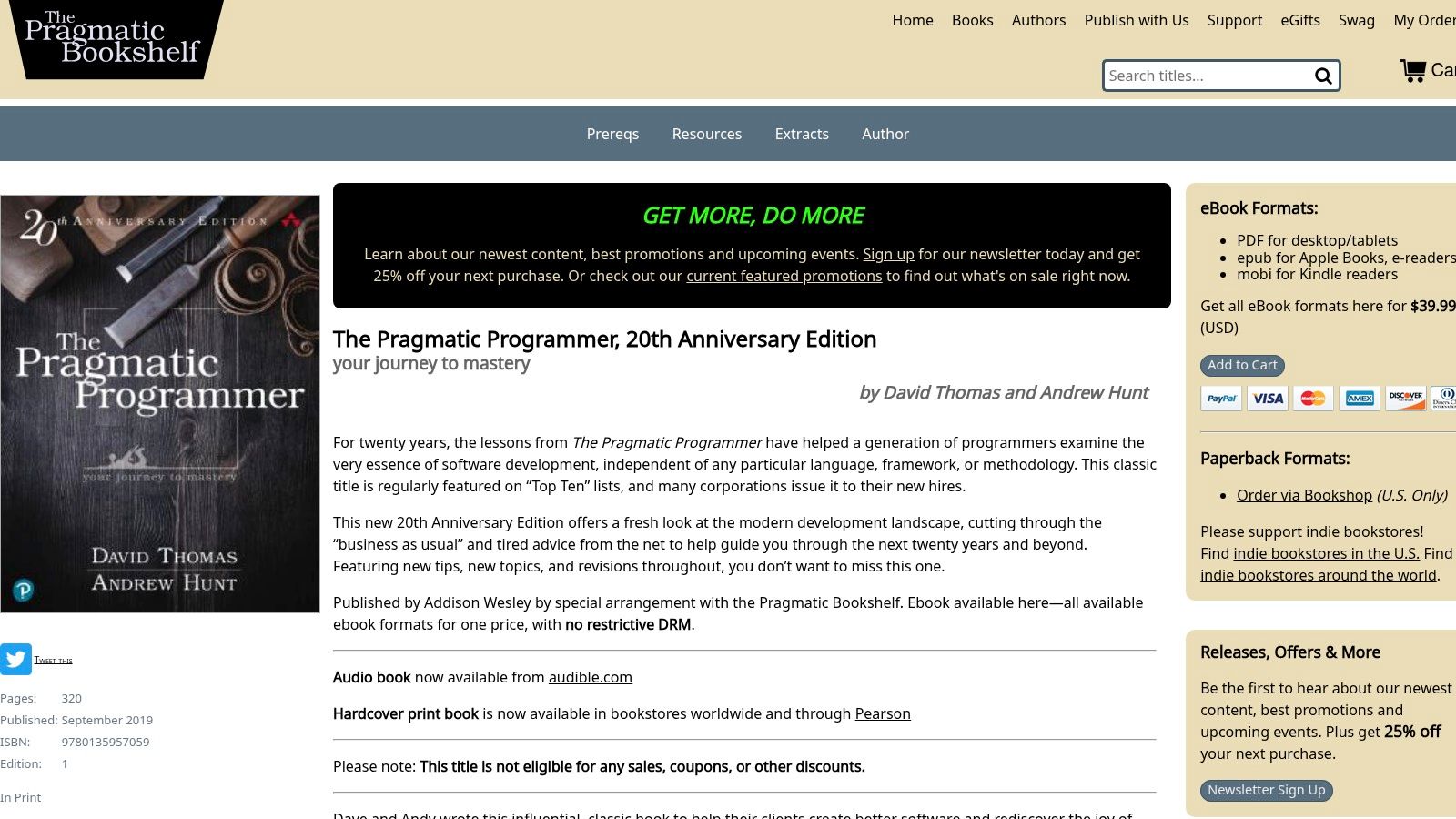
Best startup moment: You've become the default owner of several services, but your working habits haven't caught up with your responsibilities.
The Pragmatic Programmer connects everyday coding with professional judgment. Design, debugging, version control, estimation, communication, and continuous learning belong together when the same engineer must implement a feature and explain why it's late.
Its durability comes from that breadth. Pearson describes the anniversary edition as an update to the original 1999 book, published in 2019, with lessons independent of a particular language or framework.
Start with the topics closest to your current friction: debugging when failures are mysterious, communication when requirements keep shifting, or design when every change spreads. Read a short chapter, attempt its exercise, and apply the idea before opening another.
The advantage is flexibility. A developer working in Python can discuss the same principle with a teammate writing Go without translating an entire framework tutorial.
I'd choose this first when your problem spans code and responsibility. It's also useful when considering the difference between staff and senior engineers, because technical ownership extends beyond implementing your own changes.
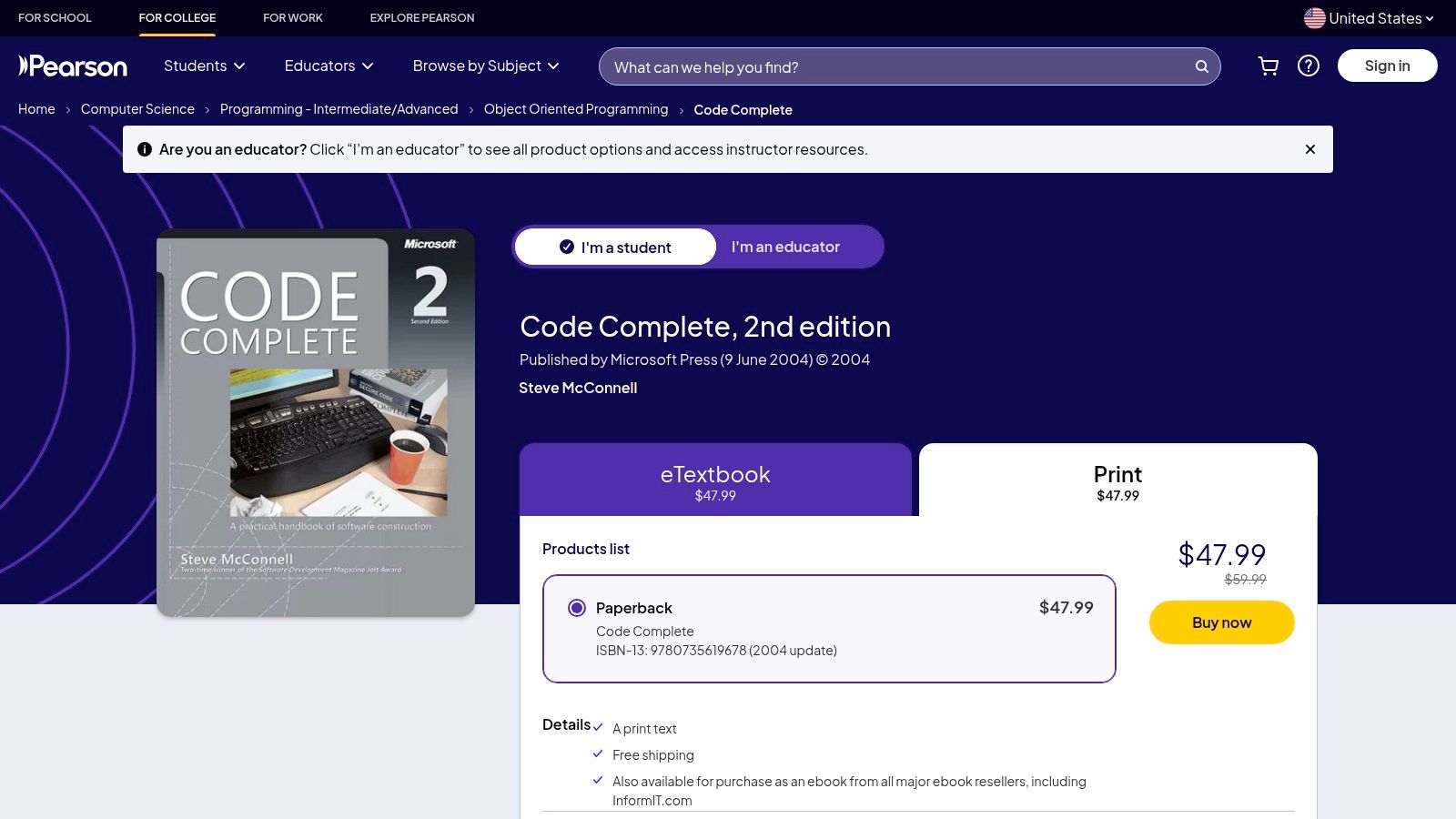
Your team agrees that a feature works, but nobody agrees that the implementation is ready. Review comments alternate between naming preferences, missing edge cases, and demands to restructure everything.
Best startup moment: You need a shared standard for construction quality before inconsistent implementation becomes the team's default.
Code Complete is a substantial handbook covering design, coding, construction planning, testing, debugging, and quality. Its strength is depth: you can examine a routine's responsibilities, control flow, and error handling instead of debating whether the code merely looks clean.
Don't start by committing to a cover-to-cover read. Pick the material on routines, defensive programming, and debugging, then keep your current pull request open beside it.
For a payment webhook handler, that means examining malformed payloads, duplicate events, unexpected states, and failure reporting. Those are concrete review subjects, unlike a general instruction to improve readability.
A useful construction standard lets reviewers explain the risk, not just express a preference.
Your one-week experiment: Select a frequently changed function. Write down its valid inputs, expected outputs, error behavior, and assumptions before modifying it.
Add tests around those boundaries, then simplify the implementation without expanding the feature's scope. Ask your reviewer which assumptions remain hidden and whether the revised function is easier to reason about.
The trade-off is size. This is an encyclopedic reference, available in print and digital formats, rather than a quick sequence of tips. Some examples and tool references are dated, so take the construction reasoning and verify implementation details against your current stack.
Choose it over The Pragmatic Programmer when the immediate problem is implementation discipline rather than broader professional habits.
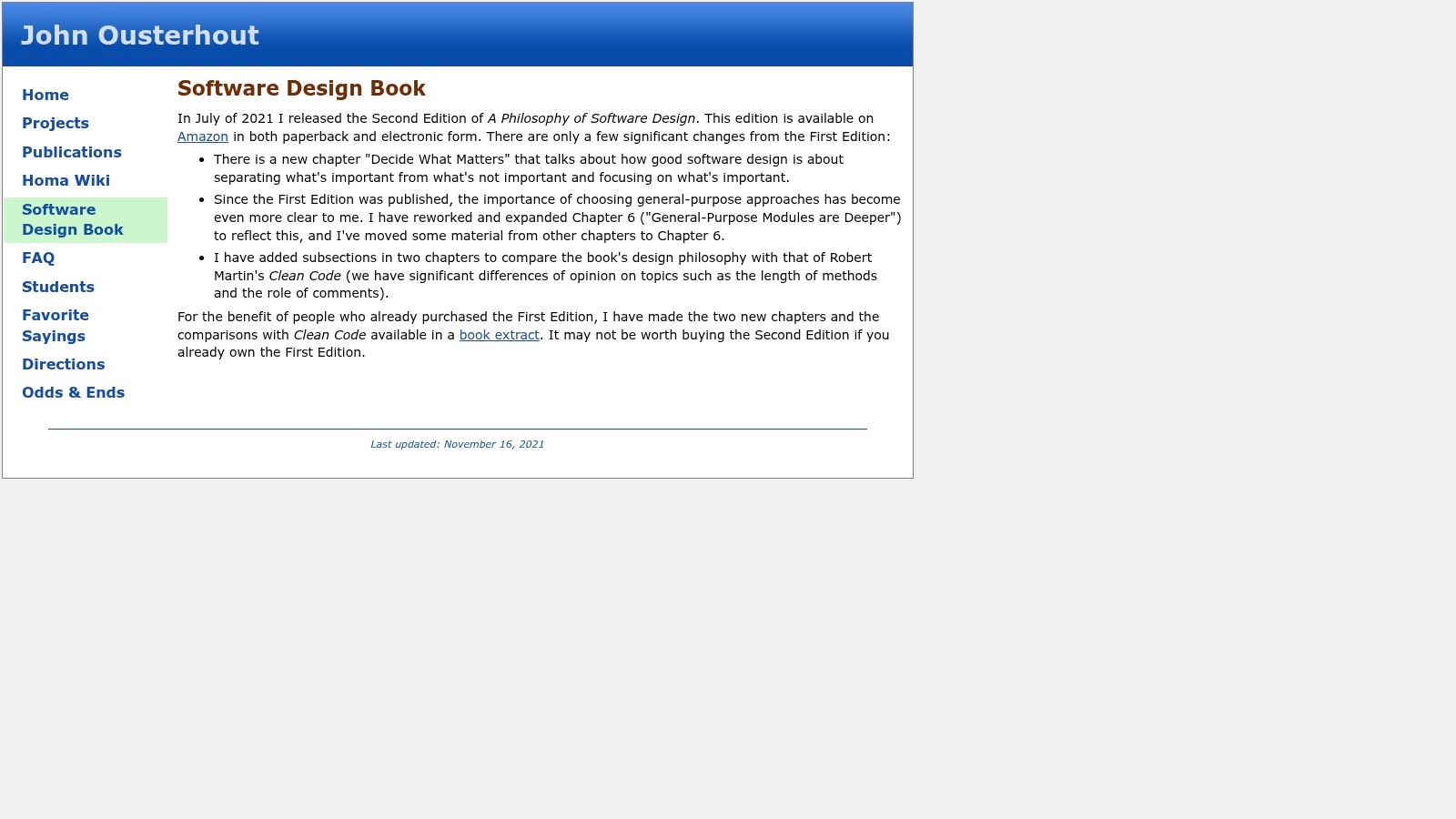
Best startup moment: A small product change requires understanding an unreasonable amount of unrelated code.
A Philosophy of Software Design focuses on managing complexity through module boundaries and interfaces. Its discussion of deeper modules is particularly useful when your team has extracted many small classes but still makes callers coordinate the difficult work.
Consider an upload flow where every caller must validate filenames, select storage, translate exceptions, and assemble metadata. Splitting those steps into separate helpers doesn't necessarily make the interface easier to use.
Read the discussions of complexity, deep modules, general-purpose design, and comments. Then trace a real feature from its entry point through the dependencies it requires.
Ask what each caller must know. Does it understand storage internals? Must it invoke methods in an undocumented order? Does a comment explain an important constraint, or merely narrate the next line?
The book provides a coherent design philosophy, not a universal scoring system. Compare its advice with Clean Code rather than treating either author's preferences as laws.
It's more focused than Code Complete, which makes it easier to use during an interface debate. It offers less help with delivery processes, mentoring, or operational ownership. Choose it when the difficulty lies in understanding and changing code, not coordinating the people shipping it.
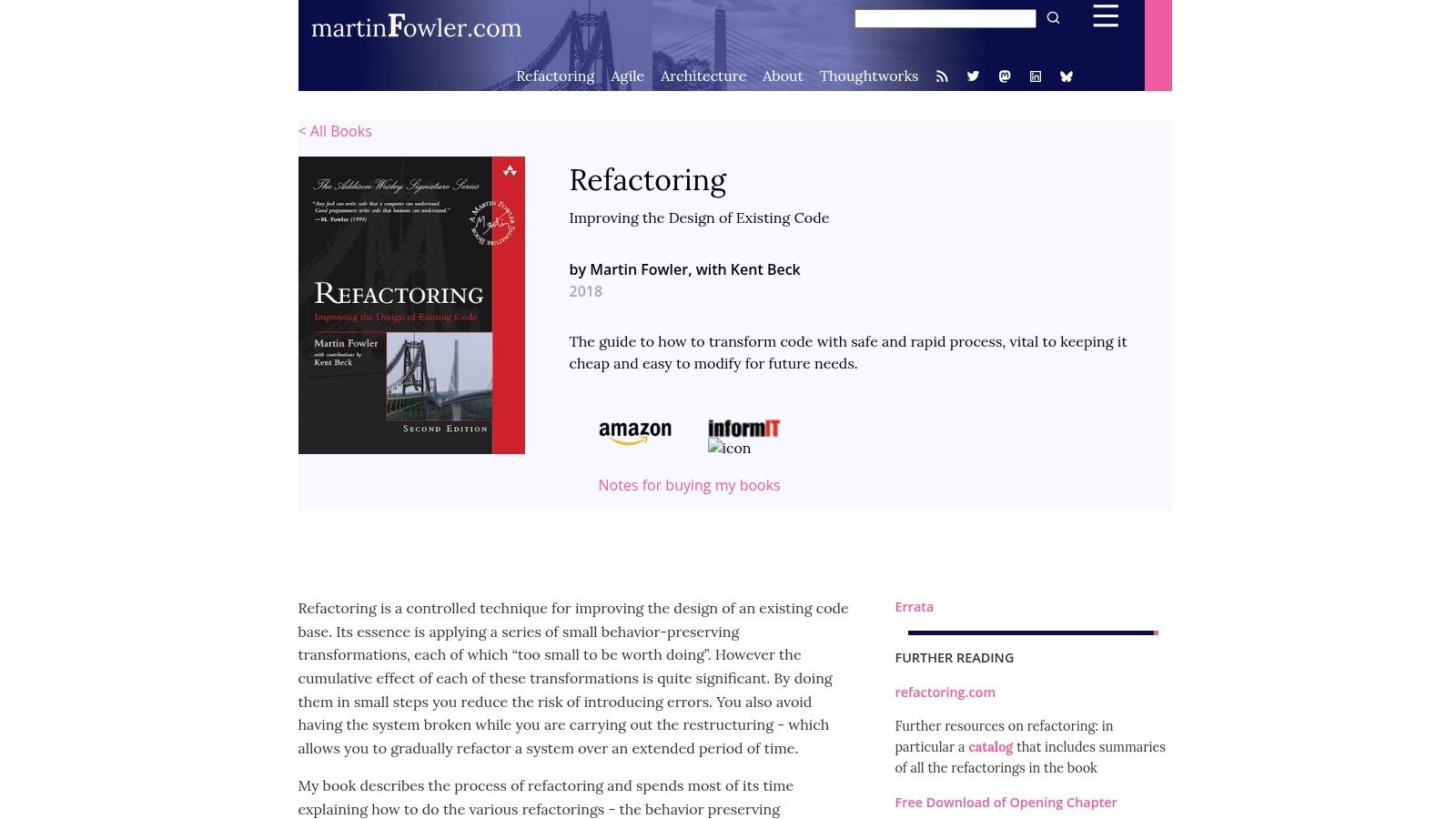
The engineer who wrote your billing service has departed. You've inherited a feature request, tangled conditionals, and a strong temptation to replace the whole service.
Refactoring is the better starting point when you need to improve existing code without deliberately changing its behavior. Fowler provides a catalog of transformations, their motivations, and the mechanics for making changes incrementally.
Best startup moment: You must ship inside an inherited codebase, and a rewrite would introduce more uncertainty than the deadline allows.
Read the introductory worked example and the guidance on recognizing code that may benefit from refactoring. Then select a transformation that matches the code in front of you, such as extracting a function or moving behavior closer to its data.
The second-edition examples use JavaScript. If that isn't your language, translate the mechanics carefully, especially where your type system or runtime behaves differently.
Practical rule: Keep structural changes separate from behavior changes whenever a reviewer would otherwise struggle to distinguish them.
For your one-week experiment, find a function on the path of an upcoming feature. Add characterization tests that capture its current behavior, including awkward edge cases.
Extract a coherent responsibility in a separate pull request. Run the tests after each small transformation, then implement the feature against the clearer structure.
Use explicit code review standards so the reviewer knows which change preserves behavior and which introduces new behavior. Include the relevant tests and explain anything they don't cover.
The limitation matters: tests can preserve an existing bug, and incomplete tests leave gaps. The book makes incremental improvement concrete; it doesn't make an untested system risk-free.
Best startup moment: Your first serious outage involves missing, duplicated, delayed, or inconsistent data, and changing database settings no longer feels like an adequate response.
Designing Data-Intensive Applications explains the trade-offs behind storing, processing, and moving data. It covers databases, distributed systems, cloud services, reliability, scalability, and maintainability without reducing architecture to a product-selection exercise.
This is the strongest fit for backend engineers who need to explain why a design behaves badly under failure. It's less useful when your immediate blocker is a confusing function or an inconsistent review process.
Start with the material relevant to your incident: transactions for partial updates, replication for stale reads, or stream processing for delayed events. Draw your current data flow before proposing a replacement architecture.
Say your application stores an order and then publishes an event. Ask what happens if the process exits between those operations, or if a consumer handles the same event again.
Don't run destructive failure experiments against production customer data. Keep the test reproducible and retain evidence of the resulting state.
The trade-off is depth. This is an intermediate-to-advanced systems book, not a quick operational runbook or a guide to the entire development lifecycle. Read the relevant concepts alongside your database and queue documentation, not instead of them.
Your first direct report opens a pull request and waits for you. They also need you to explain the build, identify the service owner, and tell them which tests matter.
Best startup moment: You've hired an engineer under you, and your undocumented knowledge has become a delivery bottleneck.
Software Engineering at Google examines software that changes over time, with attention to culture, collaboration, knowledge sharing, testing, review, version control, and build systems. It addresses work that code-focused books can leave out: helping other engineers make safe changes without depending on your memory.
Read the material on knowledge sharing and code review first. Then examine testing and build practices where they intersect with your newcomer's actual work.
You don't need Google's infrastructure to name a reviewer, document a build command, or explain a test's purpose. You do need to distinguish a useful safeguard from a process your small team can't maintain.
Adapt the practice to the failure you need to prevent. Don't copy the surrounding bureaucracy.
Your one-week experiment: Give the new engineer a bounded change in an existing service. Write down the build command, test command, owner, deployment path, and expected review route before they start.
Have them record every missing instruction while completing the change. Update the repository documentation and clarify ownership using that evidence, rather than adding a broad onboarding manual nobody has tested.
The book is useful when you're reconsidering your startup engineering team structure, especially where mentoring and review responsibilities are unclear. Its limitation is context: examples from a large engineering organization can exceed a small startup's needs.
Keep practices that remove dependence on particular people. Simplify anything that introduces approval work without addressing a clear risk.
Best startup moment: Everyone is busy, releases still feel risky, and the team's proposed solution is another planning meeting.
Modern Software Engineering treats engineering as a discipline of learning, experimentation, feedback, and managing complexity. It's useful when programmers, technical leads, and managers need a shared way to evaluate how work moves from an idea to running software.
Unlike Refactoring, it isn't a catalog of code transformations. Unlike Code Complete, it isn't the desk reference to reach for when examining a complicated routine.
Start with the discussions of feedback, incremental progress, and experimentation. Apply them to a delivery frustration your team can describe precisely, such as discovering integration failures only when a release candidate is assembled.
Write down the proposed change, the expected result, and the evidence that would persuade you to keep or reject it. Use a short decision record to keep software project decisions clear, including constraints and reasons for stopping the trial.
A brief trial won't prove that a practice works everywhere. It can expose a bad fit before you turn it into team policy.
Choose this book when the obstacle sits between coding and delivery. Pair it with a more focused title when the experiment reveals a specific design, testing, or construction problem.
| Book | Primary Focus | Best For | Main Limitation |
|---|---|---|---|
| The Pragmatic Programmer: Your Journey to Mastery, David Thomas and Andrew Hunt | Everyday coding habits and professional practice | Developers seeking practical, language-agnostic guidance | Offers principles, not a step-by-step technology course |
| Code Complete, 2nd Edition, Steve McConnell | Software construction, testing, debugging, and quality | Readers wanting a comprehensive implementation reference | Long, and some examples and references are dated |
| A Philosophy of Software Design, 2nd Edition, John Ousterhout | Managing complexity through module and interface design | Readers seeking a focused framework for design decisions | Gives limited attention to team processes and delivery |
| Refactoring: Improving the Design of Existing Code, 2nd Edition, Martin Fowler | Improving existing code through behavior-preserving changes | Engineers maintaining or extending established codebases | JavaScript examples may be unfamiliar; safe refactoring benefits from good tests |
| Designing Data-Intensive Applications, 2nd Edition, Martin Kleppmann and Chris Riccomini | Data systems, distributed systems, and architecture trade-offs | Backend engineers and people building data-heavy products | Advanced and substantial; focuses on data systems, not the full development lifecycle |
| Software Engineering at Google, Titus Winters, Tom Manshreck, and Hyrum Wright | Team practices and maintaining software at scale | Engineers moving toward technical leadership or mentoring | Practices may need adapting for smaller organizations |
| Modern Software Engineering: Doing What Works to Build Better Software Faster, David Farley | Feedback, experimentation, and managing complexity in software delivery | Programmers, technical leads, and managers evaluating how teams work | Less focused on specific coding techniques and technical reference material |
Return to that Friday deadline. You're still responsible for an unfamiliar service, and the pull request still crosses modules that nobody wants to touch. Finishing a book won't make those constraints disappear.
Opening Refactoring to the relevant transformation gives you a narrower move. Capture the current behavior, extract the calculation you need to change, and keep the structural pull request separate from the feature. Your reviewer can examine a bounded decision instead of trying to approve a rescue operation.
Start by choosing a book matched to the pain you can name. If you can't explain why you're reading it in terms of current work, postpone it.
Treat reading as part of engineering work, not a separate achievement. The useful output might be a clearer interface, a reproducible failure test, or documentation that lets a new hire deploy without waiting for you.
Be careful with conclusions. A smooth pull request doesn't establish that every future change should follow the same pattern, just as a difficult migration doesn't automatically disprove the underlying idea.
Revisit the list as your startup grows from a few engineers into a larger team. Personal habits may be the immediate constraint today; shared ownership, knowledge transfer, and delivery coordination may matter more after your next hires.
The best book is the one that changes how your next change gets made. Pick the title that addresses the problem on your screen, read the relevant material, and bring a small, reviewable improvement back to your team.
Underdog.io is a curated hiring marketplace connecting tech professionals with startups and high-growth companies across the US. If you're looking for a role where you can apply stronger engineering judgment, visit Underdog.io to explore opportunities with teams building and growing their products.